
Augmented reality has outgrown its “fun filter” reputation and turned into one of the most powerful technologies shaping modern business. Whether it’s helping a shopper choose the perfect lipstick or guiding a surgeon during preparation, augmented reality solutions now touch nearly every industry.
In this article, we’ll explore both the technology behind AR and the companies defining its future.
[navigation]
TL;DR:
- Top AR solutions companies provide reliable hardware, efficient software, or both;
- The 5 market leaders include Banuba, Meta Reality Labs, Niantic, Magic Leap, and Varjo.
What Makes an Augmented Reality Solution “Next Level”
Before we look at the major players, it helps to define what makes a modern AR solution exceptional.
The best ones could include:
Hardware that keeps up
Most people experience AR through smartphones and tablets, which can render real-time 3D graphics. For narrower needs, AR glasses and headsets offer a bigger field of view, precise depth, and hands-free interaction.
Software that adapts
Platforms such as Unity, Vuforia, and Gartner use computer vision to anchor digital content precisely where it should be, whether it’s a product on your desk or a mask on your face.
Applications that deliver
They are the reason it all matters. From beauty brands helping users test makeup online to manufacturers using AR for hands-free instructions and designers exploring 3D models right in their workspace, that’s next-level AR in action.
5 Companies Defining AR’s Future in 2026 and into 2027
These companies are the heavyweights, the innovators, and the platforms you need to watch (or partner with!) right now:
1. Banuba: The Masters of Real-Time Face AR & AI
“At Banuba, our focus on Face AR and AI face tracking has taught us what makes an AR experience truly exceptional: authenticity, precision, and measurable impact.” - Dmitry Ogievich, CEO
What began in 2016 as an ambitious AI lab quickly evolved into Banuba, a global name in Face AR innovation. We have grown into one of the key players building high-performance AR SDKs that bring digital experiences to life in real time.
If you’ve ever tried on virtual makeup, used face filters and real-time 3D masks that felt unbelievably natural, or edited a video with AR-powered effects, chances are that Banuba was behind it. For example, read how we helped a Romanian hair color brand launch their virtual try-on solution.
What makes Banuba different?
It’s the tech beneath the surface. Our entire platform is built on patented AI face tracking developed in-house, not off-the-shelf code. It’s accurate, capable of tracking thousands of points on the face so virtual effects stay perfectly in place, even when a customer turns their head almost completely to the side. And it’s also designed to work just as well on older phones as on the latest models. Plus, with built-in hand tracking and body segmentation, Banuba opens the door to effects that go far beyond simple face filters.
Key AR solutions offered by Banuba
Banuba is helping define how we communicate and shop through AR. Our technology covers 2 fast-growing areas: content creation and AR commerce, all powered by years of computer vision expertise.
Face AR SDK
Banuba Face AR SDK
This toolkit fuels the kind of creative, shareable content people love. From expressive 3D masks and AR face filters to realistic avatars and live beautification, it’s what makes camera-based apps feel alive. Banuba Face AR SDK is a perfect choice for businesses that want to drive user engagement, beauty brands looking to decrease returns, mobile startups that need to boost in-app sessions, and increase sales with engaging AR experiences.
The SDK includes, but is not limited to:
- 1,000+ ready AR face filters and effects
- Facewear try-on
- Virtual AR makeup
- Hair & eye color
- AR-powered beautification
- Background removal
- SFX & Voice Changer
- 3D Renderer
- Filter Editor + Scripting
- Sample Filters & Documentation
- Support & Consultancy.

What companies use it?
Gucci, Meta, Samsung, and Looké have already integrated Face AR SDK features into their products to offer immersive AR experiences to their customers.
How much does Face AR SDK cost?
We offer a 14-day free trial so you can try it before you buy and test the functionality beyond the limits. Once you’re all set with the trial, you can use all premium features beyond the limits and then get flexible pricing.
Video Editor SDK
Banuba Video Editor SDK
Banuba Video Editor SDK is a ready-made AI-powered video editor for mobile devices. It allows your users to unleash creativity and skyrocket TikTok-like short video creation. Same to Face AR, it’s an off-the-shelf software you can integrate into your current application without any struggles. It’s a perfect match if you want to power your video mobile app with an AI-based video editor, cutting-edge effects, and filters. This way, you increase user-generated content and drive user engagement, in-app purchases, and sales. And our results only prove it: we’ve recently assisted in releasing Fureelz, a social media app focused on pets, which showed great results.
The SDK includes, but is not limited to:
- Overlay Face AR effects on videos
- Video filters
- Live beauty filter
- Gif and Text layovers
- Time filters (Slo-mo & Rapid)
- Audio editor
- Trim and merge
- Slideshows and Stories
- Video export
- Mobile web app compatibility.

Web AR Kit
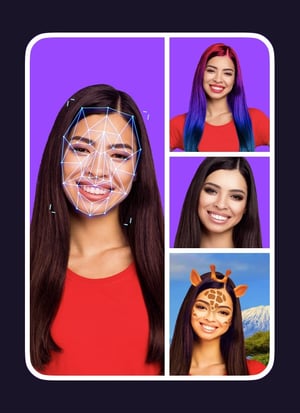 Banuba Web AR SDK
Banuba Web AR kit is an augmented reality solution for your web-based application to display AR-powered face effects via a webcam.
In case you’re looking for a no-app cross-platform AR experience with AI face tracking capabilities to drive your product’s growth. Web AR enables users to unleash augmented reality in real-time or via post-processing.
The SDK includes, but is not limited to:
- Fun webcam filters and 3D stickers
- Trigger-based interactive game filters
- Online beauty try on
- Hair and eye coloring
- Background remover.

2. Niantic: Building the Real-World Metaverse
Pokémon GO might be Niantic’s most famous creation, the one that turned city walks into global adventures in 2016. Still, the company’s real ambition lies in developing technology that fuses digital experiences with the real world through AR solutions. Their long-term goal is simple but massive: to make the entire planet “AR-readable.” In other words, they strive to build a shared digital layer over the real world that anyone can develop for.
Niantic’s approach revolves around 2 main products: Lightship, their AR development platform, and 8th Wall, their Web AR framework.
Lightship:
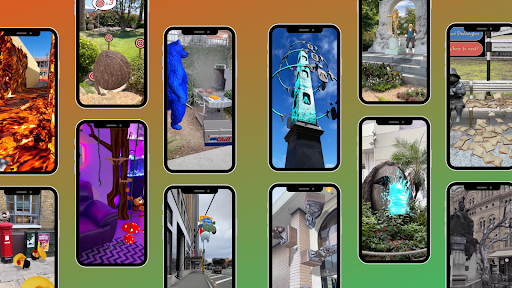 Source: https://nianticlabs.com/news/lightship-vps-web
Niantic’s Lightship isn’t just another augmented reality solution but the infrastructure powering large-scale, persistent AR.
At the core of Lightship lies VPS, a visual positioning system designed to fix what GPS could never get right. If you’ve ever placed a virtual object in AR and noticed it floating far away from where it should be, you know the problem. GPS just isn’t precise enough.
VPS changes that by using a phone’s camera instead of satellites. It compares what the camera sees with Niantic’s vast, crowdsourced 3D map to determine your exact position and orientation, accurate down to a few inches.
That level of precision opens the door to some powerful capabilities:
- Persistent content: AR objects stay locked in place and visible to anyone visiting the same spot.
- Shared experiences: Multiple users can see and interact with the same digital layer here and now.
- Crowdsourced mapping: Every scan from games like Pokémon GO or apps using Lightship contributes to Niantic’s global 3D map, expanding the VPS network organically.
In essence, VPS transforms the entire planet into a shared AR canvas, and the players are the ones painting it.
To make AR look real, the system has to understand what’s around it. Lightship does this through meshing and semantic segmentation.
- Meshing generates a 3D model of the environment (floors, walls, trees) in real time, even on devices without LiDAR. This allows digital objects to interact naturally with real-world geometry.
- Semantic segmentation tells the system what those surfaces actually are (grass, sky, road, etc.), so AR elements behave logically. A character can run behind a bench, bounce off a wall, or sit only on grass.
Together, these features make Lightship’s AR experiences feel grounded, not floating.
- 8th Wall:
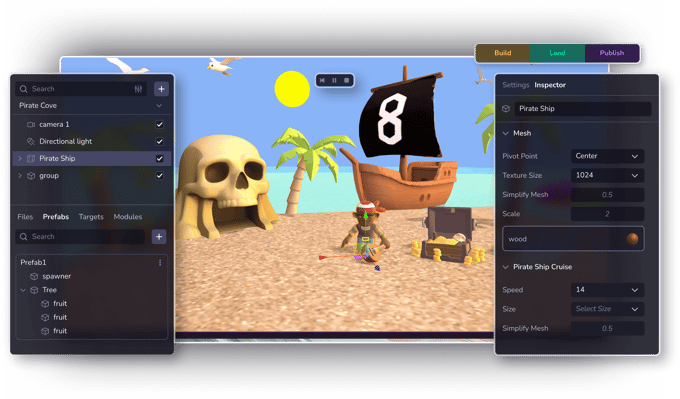 Source: 8thwall.com
If Lightship builds the infrastructure, 8th Wall removes the friction. It’s Niantic’s WebAR platform (=AR that runs directly in a browser). No app installs, no SDK downloads, just a link or QR code and you’re in.
That may sound simple, but it’s huge for accessibility. With billions of WebAR-capable devices, this augmented reality solution lets developers launch AR experiences that anyone can use instantly, which makes it ideal for marketing, retail, or even small indie projects.
8th Wall also supports:
- Face and hand tracking (for virtual try-ons, masks, and filters)
- WebAR VPS integration (location-anchored AR directly in the browser)
- Generative AI modules (letting devs experiment with live, AI-driven content generation right in WebAR)
Essentially, 8th Wall combines the reach of the web with the intelligence of Lightship’s world-scale mapping. That’s a rare combo and a big part of why Niantic’s ecosystem feels so developer-friendly.
3. Magic Leap: From Consumer Hype to Enterprise Heavyweight
Few companies in the AR space have had a trajectory as dramatic and as instructive as Magic Leap. Once known for its mysterious demos and eye-watering funding rounds, the company eventually realized that the consumer market wasn’t ready for what it was building.
Instead of disappearing, Magic Leap did something much smarter: it reinvented itself. Today, it’s one of the strongest players in enterprise AR solutions, backed by serious optics research, refined hardware engineering, and partnerships that hint at what the next generation of AR could look like. And here’s why Magic Leap remains firmly on the list of top AR companies leading in 2026.
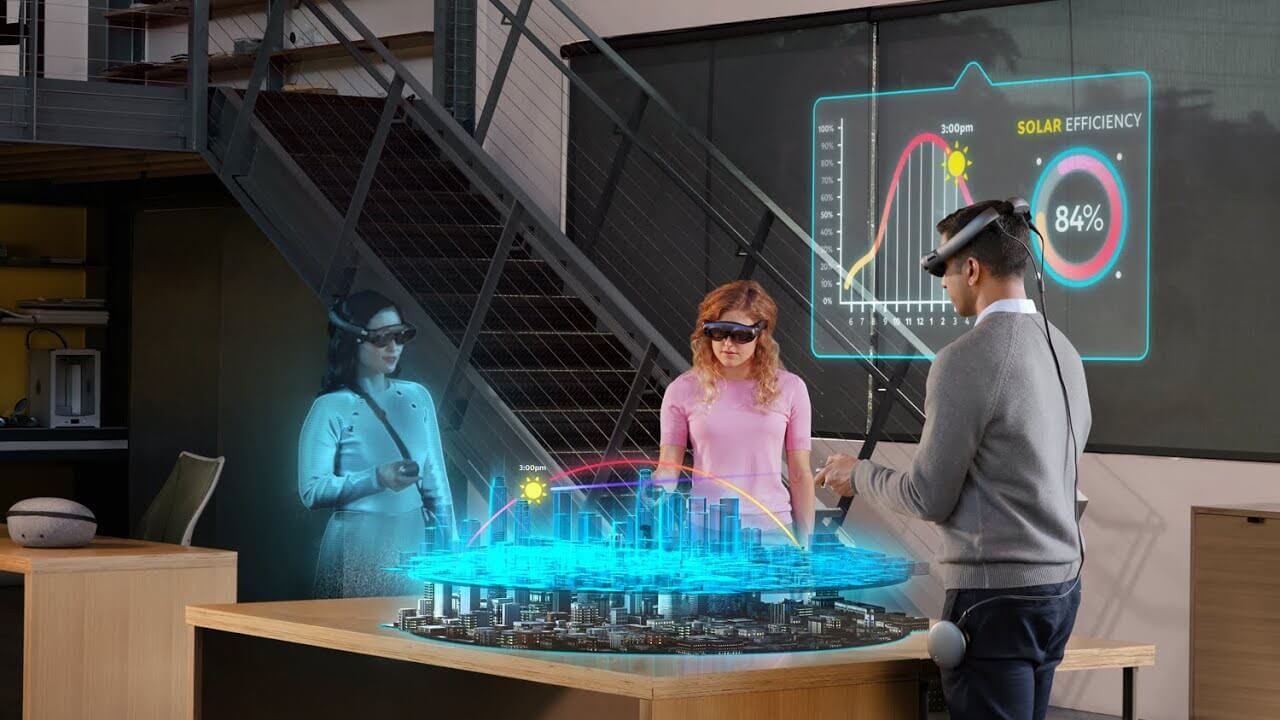 Magic Leap | Top AR Solution Companies
Magic Leap 2: Hardware that actually delivers
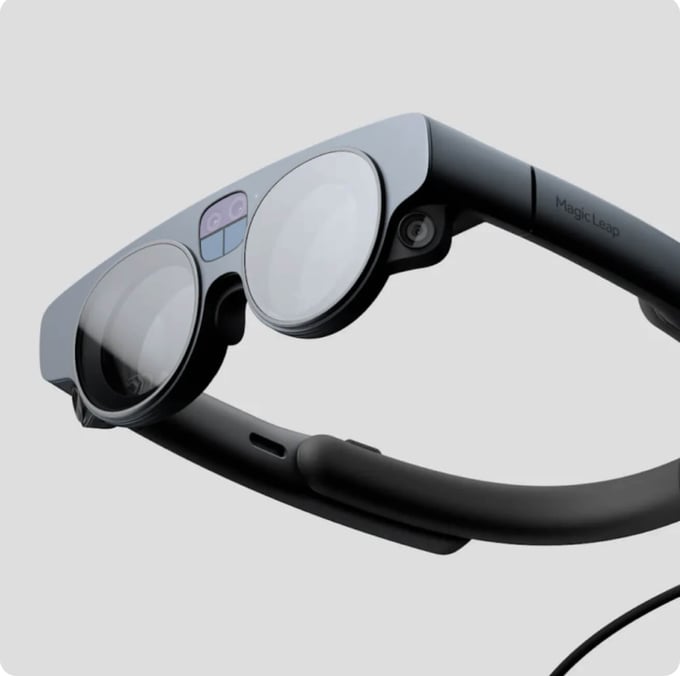
Where Magic Leap truly stands out is in its hardware which is arguably the strongest in the current enterprise AR market. The Magic Leap 2 offers a significantly wider field of view than its competitors, reaching up to 70° diagonal. For tasks like surgery, industrial inspections, or viewing dense 3D data, this extra visual real estate matters.
Another distinctive feature is Dynamic Dimming™, which actively tints the real-world background to make virtual content more legible. In bright operating rooms or sunlit factory spaces, this is essential.
Comfort is another priority. By moving the compute pack to the user’s belt, Magic Leap keeps the headset lightweight and wearable for hours at a time. And because the OS is built on Android AOSP, enterprises can tailor the system to fit their workflows and existing tools.
A laser focus on enterprise use cases
Magic Leap’s current strategy centers on enterprise AR, areas where its hardware delivers real operational returns.
- Healthcare: Presurgical visualization and training.
- Industrial: AR instructions and remote support for maintenance and assembly.
- Defense: High-precision training and mission planning environments.
- Engineering/Design: Full-scale digital twins for on-site validation.
A new identity: Core partner in the AR ecosystem
Magic Leap has stepped into a new role in the AR world. Their expanded 2024/2025 partnership with Google shows they’re now becoming a go-to hardware tech partner, not just a company selling a headset.
They’re bringing their deep knowledge of optics and waveguides to help build the next generation of thinner, lighter AR glasses. Their work on Google’s Android XR prototype is a big sign of that shift.

4. Varjo Technologies: The apex of human-eye resolution augmented reality solutions
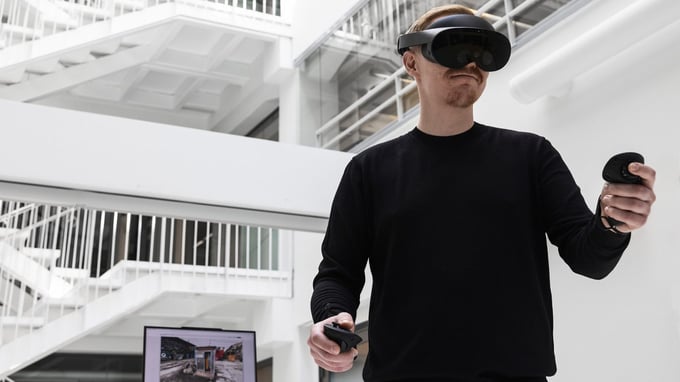 Source: https://aecmag.com/news/varjo-unveils-teleport-for-reality-reconstruction/
Varjo is the go-to name when a project demands AR that looks as sharp as real life. While many companies chase mainstream adoption, Varjo focuses on something very different: extreme visual accuracy for industries where even small details matter.
Human-eye visual quality
Their core mission is simple: blend the digital and physical worlds so seamlessly that you forget which is which. That’s why Varjo headsets deliver:
- Up to 51 PPD in the center of view (tiny text, dials, and UI elements look fully real)
- High-end video pass-through (virtual objects appear solid, with no transparency or fuzziness)
- True-to-life depth and clarity (you can inspect 3D models as if they were physical prototypes)
Varjo use cases
This level of fidelity is exactly why Varjo is widely used in high-stakes environments, including:
- Flight simulation & pilot training
- Defense and military exercises
- Automotive and aerospace design reviews
- Medical and scientific visualization
In these settings, Varjo is the difference between rough approximation and something teams can rely on for real-world decisions. By the way, Varjo is ending 2025 by committing €40 million (backed by Business Finland) to expand its military XR capabilities. The investment is focused on developing high-grade XR training systems for combat readiness, mission planning, and operator training. It’s a bold signal: Varjo is securing its place as a leading XR technology partner for NATO and allied defense organizations.
Built for serious enterprise use
Varjo also understands the security needs of sensitive industries. Their Secure Edition headsets:
- Are manufactured in Finland
- Can be ordered without any wireless components
- Are approved for restricted and classified environments
This gives enterprise customers confidence that the devices meet strict deployment standards.
5. Meta Reality Labs: The consumer-focused AR powerhouse
 Source: https://www.livenowfox.com/news/meta-launches-ai-smart-glasses-vr-headset
Meta Reality Labs (RL) is Meta Platforms’ hub for AR, VR, and AI wearables, making the metaverse real for consumers. Unlike enterprise-focused rivals (like Varjo or Magic Leap), they aim for mass adoption through hardware and social platforms.
In 2026, the focus is on two fronts: high-quality mixed reality via Quest and everyday AI glasses that blend into daily life.
AI glasses for the real world
Meta’s Ray-Ban smart glasses are evolving fast: from cameras to AI assistants.
- Embedded display: Crisp AR overlays right in the lens.
- Hands-free Use: Walking directions, notifications, and live translations with a simple pinch.
- Neural band: Wrist-worn EMG reads tiny muscle signals for subtle interactions.
- Meta AI: Contextual, real-time assistance whenever you need it.
Social AR platform & content
Meta may be retiring Spark AR as a separate tool, but AR isn’t going away. It’s still deeply built into Instagram, Facebook, and Messenger, where billions of people interact with face filters, 3D masks, and virtual try-ons every month. And it doesn’t matter if you’re on a basic phone or a Quest headset, as Meta wants AR to work smoothly for everyone, everywhere.
Reality Labs Research: The long game
Behind Meta’s consumer AR push is Reality Labs Research, funded with tens of billions each year to solve AR’s hardest problems.
- Codec Avatars bring photorealistic digital humans to life.
- Scene Understanding lets AR recognize and interact with the real world flawlessly.
- Orion is exploring sleek, lightweight glasses that could make full AR displays look like normal eyewear.
It’s all about building the tech and platforms that will bring billions of users into everyday AR.
Conclusion
Augmented reality solutions are no longer about fun demos. With major players like Banuba, Niantic, Magic Leap, Varjo, and Meta leading the way, it’s become a practical tool across industries.
Breakthroughs in AI tracking, world mapping, high-resolution hardware, and WebAR have made the technology more seamless and ready to scale.
From safer industrial training to smarter online shopping, AR is now something to build with instead of just talking about. And the next few years are likely to bring persistent, everyday AR experiences that change how we work and live.

Reference List
Arsenova, A. (2024, December 5). How to build a virtual makeup app like YouCam: SDK or white label. https://www.banuba.com/blog/how-to-develop-virtual-makeup-try-on-like-youcam-sdk-or-white-label
Arsenova, A. (2025a, February 20). Eye Color Changer Filters & Colored Contacts Virtual Try-On. https://www.banuba.com/blog/ar-sdk-features-explained-eye-segmentation-and-coloring
Arsenova, A. (2025b, March 6). 10 Emerging applications of AR face Recognition. https://www.banuba.com/blog/10-emerging-applications-of-ar-face-recognition
Arsenova, A. (2025c, November 13). 7 Face Filter gaming mechanics to create Instagram-like filters. https://www.banuba.com/blog/face-game-mechanics-to-create-instagram-like-filters
Aulas, C., & Harytonau, A. (2025, November 19). What is AR? Complete Guide to Augmented Reality Technology. https://www.banuba.com/blog/what-is-augmented-reality
Banuba Asset Store. (n.d.). https://assetstore.banuba.com/
Krasko, A. (2025a, February 20). Web-Based Augmented Reality: A complete guide to AR on web. https://www.banuba.com/blog/web-ar-a-complete-guide-to-app-less-augmented-reality
Krasko, A. (2025b, May 16). Virtual Try-On for a Romanian Hair Color Brand. https://www.banuba.com/blog/virtual-try-on-for-a-romanian-hair-color-brand
Krasko, A. (2025c, October 30). Easy-to-use video editor for an Animal-Focused social media app. https://www.banuba.com/blog/easy-to-use-video-editor-for-an-animal-focused-social-media-app
Krasko, A. (2025d, November 5). Banuba Helped a Wellness Company Get 20,000+ Downloads. https://www.banuba.com/blog/faceyoga-by-mental-growth-a-success-story
Krasko, A. (2025e, November 13). 8 Best AR Webcam Face Filters Software for Business. https://www.banuba.com/blog/how-to-add-webcam-face-filters-to-your-website
Magic Leap Extends Partnership with Google. (n.d.). https://www.magicleap.com/newsroom/magic-leap-showcases-ar-expertise-in-glasses-prototype-extends-google-partnership
Niantic Spatial. (2021a, November 8). Mapping Meshing tech demo [Video]. YouTube. https://www.youtube.com/watch?v=wWHAr_TSDWk
Niantic Spatial. (2021b, November 8). Semantics tech demo [Video]. YouTube. https://www.youtube.com/watch?v=1K3DMhOIAJo
Rohachuk, T., & Liskevich, A. (2025, November 19). How to Create an AR Filter (2025 Guide). https://www.banuba.com/blog/how-create-ar-filter
Team, B. (n.d.). AI Video Editor SDK API for Android, IOS. https://www.banuba.com/video-editor-sdk
Unity AR Face Tracking API SDK for your mobile or desktop app | Banuba. (n.d.). [Video]. https://www.banuba.com/facear-sdk/unity-face-tracking
Web AR SDK Platform Demo | Banuba Web based Augmented reality. (n.d.). [Video]. https://www.banuba.com/webar-sdk
-
The official technical documentation for Banuba Face AR SDK is available online and includes requirements, setup instructions, and configuration details:
- Banuba Face AR SDK iOS documentation
- Banuba Face AR SDK Android documentation
- Banuba Face AR SDK Flutter documentation
- Banuba Face AR SDK React Native documentation
- Banuba Face AR SDK Web documentation
- Banuba Face AR SDK Unity documentation
- Banuba Face AR SDK Desktop documentation
This Banuba Face AR SDK documentation should be your primary reference during integration.
-
You can access official integration code samples for the Banuba Face AR SDK on GitHub. Banuba provides platform-specific examples to help you integrate faster:
- Banuba Face AR SDK iOS integration code sample
- Banuba Face AR SDK Android integration code sample
- Banuba Face AR SDK Flutter integration code sample
- Banuba Face AR SDK React Native integration code sample
- Banuba Face AR SDK Desktop integration code sample
- Banuba Face AR SDK Web integration code sample
- Banuba Face AR SDK Unity integration code sample
These Banuba Face AR SDK repositories include setup instructions and minimal working examples for quick deployment.
-
Yes. The Banuba Face AR SDK includes an LLM-friendly documentation file designed for AI-assisted development and internal knowledge systems:
This structured Banuba Face AR SDK text file can be used with AI tools to streamline onboarding and developer workflows.
-
The Banuba Face AR SDK provides official cross-platform plugins to simplify integration into hybrid applications:
These Banuba Face AR SDK plugins are maintained by Banuba and support faster implementation for cross-platform apps.