
The best AR software in 2026 depends on what you augment: faces, images, objects, or physical spaces. For face-related AR, Banuba Face AR SDK is a real-time, on-device face tracking and AR effects SDK that runs at 60 FPS on mid-range mobile hardware with a -90° to +90° head-angle tracking range. For images, objects, and industrial spaces, Vuforia, MaxST, and EasyAR lead. For browser-based AR, Zapworks does.
Ready-made AR software removes the months of computer vision work that building an effects pipeline from scratch demands, and it moves the metrics teams buy AR for: in-app sessions, user engagement, and sales.
Two names that topped shortlists a few years ago are gone. Wikitude shut down in September 2024 and Niantic wound down 8th Wall in February 2026, so vendor longevity now belongs on the evaluation checklist next to features and price.
This post will help you figure it out and guide you through:
- 4 core technologies used in AR
- 10 best AR software solutions
- 5 tips to choose the most relevant platform for your business use case.
TL;DR:
- The best AR software in 2026 depends on what you augment: faces, images, objects, or physical spaces. Pick the category first, then the vendor.
- Banuba Face AR SDK tracks and affects up to 9 faces on screen and ships with a 14-day free trial that requires no card.
- Banuba's Asset Store carries over 1,000 ready-made AR filters with GLTF support for importing your own 3D models.
- ARKit and ARCore are free but lock you to one vendor's ecosystem and offer no face beautification or makeup layer.
- DeepAR prices by monthly active users, starting free up to 10 MAU and reaching $1,000/month at 100,000 MAU.
- Vuforia's Basic plan is free; Premium and Enterprise are quote-only, so budget for a sales conversation.
- Wikitude shut down on 21 September 2024, so any 2024-era shortlist that still names it is out of date.
- Zapworks replaces Wikitude for cross-platform image, face, and world tracking, at $315/month on the commercial Pro plan.
- Proprietary SDKs cost more upfront than open-source libraries but remove months of computer vision R&D from the roadmap.
4 Top Augmented Reality Platform Technologies
Before deciding on the best AR programs, let’s first discuss the most popular AR technologies that you can implement into your app. Each maps to a different class of augmented reality software, so naming the technology you need narrows the vendor list fast.
Marker-Based AR
This type of augmented reality is also known as image recognition or recognition-based AR.
Augmentation happens when the camera recognizes a required marker. It could be an image, an object, a text, or a sound. A simple example is an AR book. Characters go live when you point a smartphone camera at the book.
Face AR
Face AR works almost the same way as marker-based, but the marker is a face.
You've surely used this augmented reality platform technology.
Augmented reality Snapchat filters and Instagram face effects are the most vivid examples.
Face AR software employs face recognition and tracking technology to let users apply 3D filters, Snapchat-like lenses, real-time makeovers, face masks, and avatars to augment user appearances.
This way, you drive user engagement, increase sessions, and boost in-app sales.

This AR software type is a perfect match for the communication, e-commerce, education, advertising, and gaming industries.
Let's imagine you run an e-commerce business.
You integrate face augmented reality software and offer users an AR try-on feature.
This makes them excited as they can try before they buy. In turn, it boosts user engagement, increases session time, and drives sales.
Location-Based AR
This type of augmented reality programs uses a smartphone’s GPS, camera, compass, and accelerometer to tie an object to a specific area.
Pokémon Go is the best example.
Users could spot virtual creatures at specific locations displayed on an in-app map.
Projection-Based AR
Frequently referred to as spatial AR, this technology allows the rendering of virtual objects in a physical space on or around the user.
Activation happens when a user touches a surface lit by a projector to interact with virtual objects that are integrated into the environment.
Users and virtual objects can move within a specified zone in the area where the projector and camera are placed.
10 Best AR Software Solutions in 2026
Banuba Face AR SDK
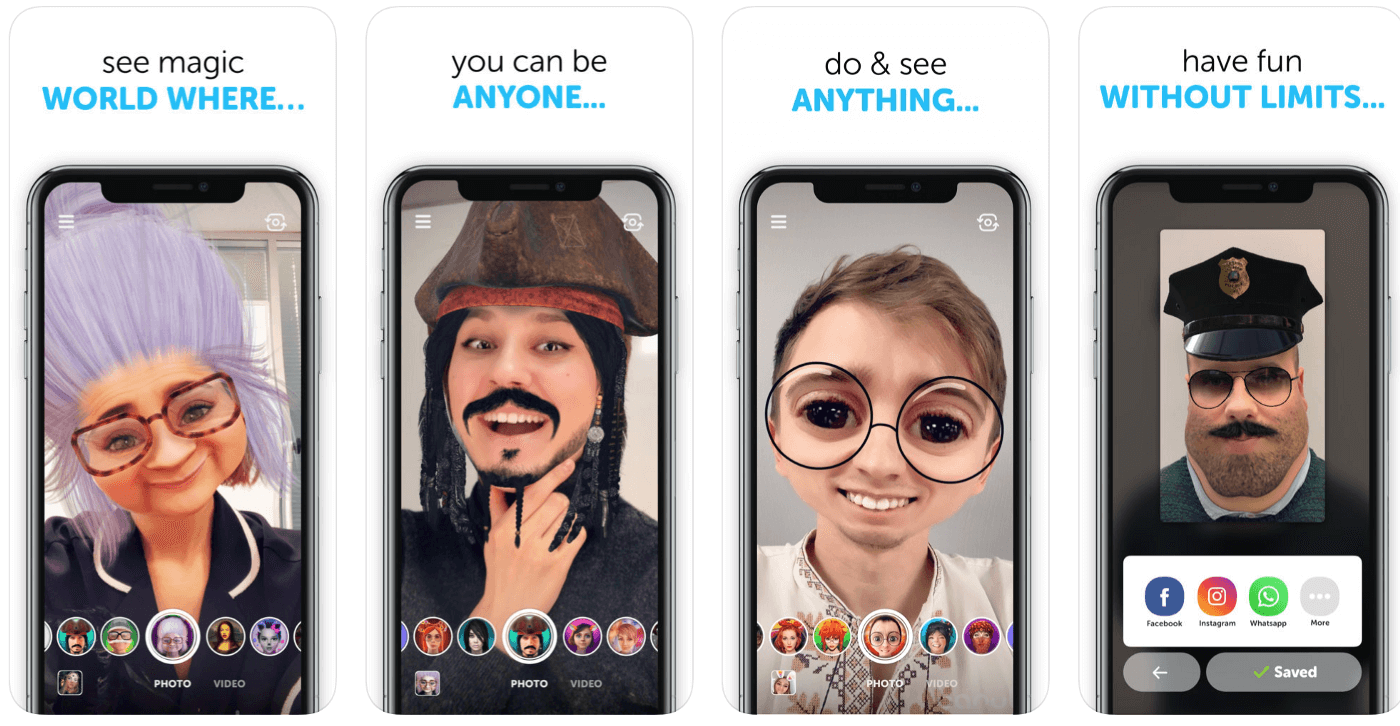
Banuba is among the top face AR software focused on face-related augmented reality.
The key product is called Face AR SDK. It is an advanced augmented reality platform with multiple features and a list of high-profile users.
Face AR is about empowering your business with increased sessions, better user engagement, and grown sales.
The 4 key modules of our SDK are:
- AR face filters
- Unity face tracking functionality
- AR beautification features
- Web AR software.
They all are about real-time facial animated Snapchat-like 3D filters.
Using face-tracking technology, we offer over 1,000 ready-made AR effects. They include makeup, hair color, face morphing, background segmentation, beautification, game filters, LUTs, and many others. The Asset Store also supports GLTF, so you can import your own 3D models.
What's more, Banuba is among the few commercially available augmented reality kits with a background segmentation for web apps. Try it right now in your browser.
What Brands Trust Banuba AR Software?
Gucci, Samsung, RingCentral, Vidyo, and Smilegate are already using augmented reality platforms by Banuba.
Our pricing fully depends on the set of features you need. The more features you need, the higher is the subscription fee.
Following the try-before-buy approach? We do as well.
For this reason, we offer a 14-day free trial, no card required, so that you can fully test our AR SDK software.
What Platforms Are Supported?
Our augmented reality toolkit is compatible with iOS, Android, Windows, macOS, Web, Unity, Flutter, and React Native. It tracks and affects up to 9 faces on the screen and is optimized for both high- and low-end devices.
Meishe
Meishe is one of the best Beijing-based augmented reality solution companies.
It offers face tracking and AR software along with a video editing SDK.
The key features of Meishe's AR toolkits are 2D/3D masks, background separation, triggers, beautification, gesture recognition, etc.
The core offerings by Meishe:
- Efficient and accurate face detection, locating 150 facial key points
- Rich sticker effects
-
Beauty makeup, with 11 facial beauty parameters
Gesture detection - Face prop making tools.
What Brands Trust Meishe?
Asus, Xiaomi, Oppo, Splice, and Vivo are using the AR software solutions by Meishe.
How Much Does It Cost?
The augmented reality platform offers a free trial period and requires contacting for getting pricing details.
What Platforms Are Supported?
Meishe's augmented reality SDK supports iOS and Android mobile, web, and PC platforms.
DeepAR
DeepAR enters the list of the 10 best AR programs with its advanced augmented reality SDK.
Built by I Love Ice Cream Ltd., DeepAR is an end-to-end framework for AR apps across mobile, web, and desktop.
They've created and released multiple augmented reality tools including:
-
AR face filters, with standard and multiple face tracking
-
Beautification and makeup tools, via the separate DeepAR Beauty API, currently in beta
-
Background replacement and background blur
-
Hair segmentation, on iOS only
-
Emotion detection, on iOS, macOS, and Android
-
Body tracking, in closed beta.
The company offers ready-made 3D masks that you can try in real-time here.
What's more, you can utilize DeepAR Studio, an all-in-one hub to combine masks, special effects, and filters. It is free to use, and effects created in it can be used free of charge.
Simply put, it's a place where you can generate AR effects yourself.
It improves user-generated content and increases user engagement along with in-app sessions.
DeepAR also documents integrations with Amazon Interactive Video Service, Agora, and Vonage, which matters if you are adding effects to live video.
Note that virtual try-on for glasses, footwear, watches, and jewellery sits in DeepAR's separate ShopAR platform, not the base SDK.
What Brands Trust DeepAR?
Google, Coca-Cola, Lego, Tencent, and RayBan are using DeepAR's augmented reality platforms to drive sales.
How Much Does It Cost?
The product's pricing is based on monthly active users (MAUs). It is free up to 10 MAU, then $25/month up to 1,000 MAU, $100/month up to 5,000 MAU, $500/month up to 30,000 MAU, and $1,000/month up to 100,000 MAU. Above 100,000 MAU, you contact sales. The free version carries a watermark.
What Platforms Are Supported?
iOS, macOS, Android, and Web.
ARGear/Seerslab
Seerslab is a Korean AR software company serving augmented reality business needs since 2014.
Its main product is ARGear SDK - an augmented reality toolkit for developers.
It includes 3 main components:
- AR SDK with key features
- Advanced console to create, manage and monitor your AR content
- Augmented reality content with >1,000 AR filters.
Simply put, it's an all-in-one toolbox for your AR business needs.
From creating content to managing and monitoring its efficiency.
ARGear focuses on 6 use cases:
- 5G to drive adoption
- Commerce to boost the shopping experience
- Live Streaming to drive a fun and unique streaming experience
- Video Calls to increase engagement and interactivity
- AR Camera to empower your app with AR features
- Education to change the way we see, imagine, and learn.
What are the core features of AR SDK by ARGear?
-
Facial Landmark Engine
-
Facial Landmark Trigger
-
2D Animation Sticker / Effects
-
Face Mask
-
3D Animation Sticker
-
3D Avatar
-
Virtual Background
What Brands Use ARGear?
Samsung, eBay, LG, Pepsi, and Amway are utilizing easy to use augmented reality software by Seerslab.
How Much Does It Cost?
You can use it for free with limitations. The pricing depends on MAUs, content, and network usage if you need more.
What Platforms Are Supported?
The AR SDK supports Android, iOS, and Unity platforms.
Vuforia
One of the best software for augmented reality, Vuforia is developed by PTC and is used by over one million developers worldwide.
Vuforia specializes in releasing AR software solutions for manufacturing, service, and marketing needs.
BAE Systems, Toyota, Volvo Group, Howden, and Cannondale are well-known brands that use Vuforia's augmented reality SDK.
The key Vuforia Engine features include:
-
Image Targets, Multi Targets, and Cylinder Targets
- VuMarks to detect barcodes that can contain data or act as markers
- Ground Plane for placing content on horizontal surfaces
- Barcode Scanner
- Model Targets, which use 3D CAD data to recognize large objects like machinery and vehicles
- Area Targets, which turn a 3D scan of an indoor space into a persistent AR experience
- Cloud services for storing and recognizing image targets.
How Much Does It Cost?
Vuforia Engine has three plans:
- Basic, free, with 20 target generations for prototyping,
- Premium, contact for pricing, adding Model Targets and Area Targets,
- Enterprise, contact for pricing, adding on-premise advanced Model Targets and Step Check.
Cloud Image Recognition is a paid add-on, and the Academic plan offers discounted pricing for schools and universities.
What Platforms Are Supported?
Vuforia AR software solutions support Android, iOS, and Universal Windows Platform, and integrate with Unity.
Zapworks
Zapworks by Zappar is among the best AR programs and frameworks to create augmented reality apps, and it is a natural landing spot for teams that used to build on Wikitude, which shut down in September 2024.
The platform pairs no-code and visual tooling with developer SDKs, so design and engineering can work on the same project.
The main features of the augmented reality toolkit are:
-
Image, face, and world tracking
- Universal AR SDKs for Unity, Three.js, A-Frame, PlayCanvas, and Babylon.js
- Mattercraft, a 3D web tool for AR, VR, and WebXR
- Designer, a no-code 3D tool
- Location-based AR via Immersal or MultiSet VPS
- AR Web Embed for dropping AR into an existing website.
The platform offers high flexibility for engineers, and content runs in the browser, so users don't need to install an app.
What Platforms Are Supported?
WebAR across iOS and Android browsers, plus native apps, WebXR, and Unity.
How Much Does It Cost?
Zapworks runs a 14-day free trial. The Developer plan is $12.99/month but is non-commercial only. Commercial projects need the Pro plan at $315/month, or $2,640 paid annually, and companies with revenue or funding above $10 million must take the Enterprise plan, which is custom-priced.
ARKit
ARKit is perhaps one of the most popular augmented reality software kits first introduced at WWDC 2017 by Apple.
The leader of AR toolkits was designed specifically to create mobile AR apps for the iOS platform. This means ARKit is a perfect choice if you launch apps for iPhones and iPads.
What's more, the product supports Arkit Unity with a unique feature: you no longer need to connect additional markers like iBeacon to orientate and route. The key AR SDK features include:
-
2D image detection and tracking
-
3D objects and space recognition;
-
Multi shared AR experience for creating multiplayer AR games;
-
Horizontal planes detection
-
Lighting estimation
How Much Does It Cost?
ARKit is free to use as part of Apple's developer tools. It is proprietary to Apple, not open-source, and runs on Apple hardware only.
ARCore
ARCore is a top AR SDK software and Google's response to Apple's ARKit. The product was released back in 2018 and provides a great difference from its main competitor.
ARCore supports both Android and iOS platforms and offers 3 core technologies:
-
Motion tracking
-
Environmental recognition
-
Lighting recognition.
They all help you embed virtual content into real environments. The AR SDK software's core is an advanced 3D model. It reacts to any changes in lighting and creates shades.
What's more, mobile devices don't affect the model operation in space. This means generated targets are automatically attached to any environmental surfaces.
The key features of the augmented reality SDK include:
-
Phone’s motion and position tracking
-
Lighting estimation
-
Surface, size, and location detection to understand an environment
-
Placing texts and virtual objects in a certain spot and sharing them with other app users;
- Working with Java/OpenGL, Unreal, and Unity.
What Platforms Are Supported?
One of the best AR programs supports Android, iOS, Android NDK, Unity for Android, Unity for iOS, and Unreal Engine.
How Much Does It Cost?
ARCore is free to use. Google publishes its ARCore SDKs on GitHub, though the underlying service is Google's own and requires supported devices.
MaxST
MaxST AR SDK software is yet another powerful augmented reality toolkit for mobile development. The product focuses on industrial AR needs serving such global giants as KIA, Hyundai, Samsung, Nokia, LG, and others.
MaxST AR software provides 2 different AR SDK software: a 2D toolkit for image tracking and 3D kit for scanning and recognizing surroundings. The latter offers 8 key functions:
-
Instant tracker to place desired content in the space
-
Visual SLAM to extract feature points, track surroundings, and save them
-
Object tracker to track targets and augment virtual objects on a map
-
Marker tracker to augment virtual contents by marker recognition & tracking
-
Image tracker to recognize target images and augment virtual contents
-
Cloud recognizer for a cloud-based image recognition service
-
QR code tracker to augment virtual contents
-
QR/Barcode reader for fast and accurate results.
MaxST AR SDK 6.0 added Space Tracker for placing AR content precisely in a mapped space, along with the free MAXSCAN app for creating and managing spatial maps, and expanded support for AR glasses.
What Platforms Are Supported?
MaxST supports Android, iOS, Windows, and macOS platforms.
How Much Does It Cost?
The augmented reality platform is available for free (with watermarks) and includes paid subscription plans. Note that MaxST has terminated its Cloud License Pro product, so check current licensing before you commit.
EasyAR
EasyAR is among the top yet underestimated AR software solutions released by an Asian company. It offers 3 AR products: AR Cloud, EasyAR Sense, and CRS.
AR Cloud is a cloud-based augmented reality platform that empowers travel, real estate, education, and business marketing domains. EasyAR Sense is an advanced AR SDK to track motion, surface, 3D objects, and planar images.
EasyAR Cloud Recognition Service (CRS) is a web platform offering cloud-based image recognition technologies and large databases.
Compared to the above augmented reality software, the product doesn't provide an all-in-one built-in object manager. This means you can identify targets by regenerating previously defined 3D models.
This way, objects are created in runtime. The key features of EasyAR include:
- image recognition
- 3D objects identification
- Cloud recognition
- Smart Glass employment
- AR-based screen recording
- Transition of files to storages
- export, import, and integration of assets.
What Platforms Are Supported?
The augmented reality tools support Android, iOS, UWP, Unity Editor, Windows, macOS.
What Brands Use EasyAR?
KFC, Vogue, and Pepsi utilize EasyAR solutions to drive their business.
How Much Does It Cost?
EasyAR Sense comes in a free Personal Edition, a Professional Edition billed monthly, a Classic Edition bought permanently, and a customized Enterprise Edition. The Personal Edition is limited to 100 seconds per run.
6 Tips to Choose Your Augmented Reality Software
In most cases, AR development is both pricey and time-consuming. These reasons make you often choose ready-to-use SDKs as they save resources on integrating AR into your products or services.
Now we want to go through 6 tips and things you should consider while choosing augmented reality software. Let's take our Face AR SDK as an example.
Launch Date
If you need a quick product launch to occupy a niche or gain a competitive advantage in the market, then a proprietary SDK could be the best option.
Our AR SDK software saves your development time. The matter is that our face AR features can be quickly integrated into your app. On the other hand, in-house development can take months or even years before these features go live.
Development Costs
Some open-source solutions like OpenCV provide you with a set of ready-to-use features and modules. They can give you a good and fast start. But they require more investments during the development process.
In contrast, you know proprietary SDK licensing costs in advance. They are fixed and let you plan investments and activities transparently.
What's more, you can integrate such AR features when you need them without limitations.
AR Content
Using open-source augmented reality programs could be enough for introducing basic AR technologies. But what happens if you need to create original AR content?
It may include AR masks, filters, avatars, furniture, or virtual surface enhancements? This takes additional effort and may lead to higher costs and time spent by your business.
This is especially true for face AR development. It requires solid niche experience and expertise. In this case, you can benefit from the native object libraries and tools for creating custom AR content like Face Filters SDK.
Vendor Longevity
Platforms disappear. Wikitude shut down all services on 21 September 2024, and Niantic wound down 8th Wall in February 2026, leaving teams to export projects and self-host. Both were credible, widely used platforms.
Before you commit, check how long the vendor has shipped the product, whether the roadmap is public, and what happens to your content if the service ends. A cheap license is expensive if you rebuild in two years.
Platforms
Platform compatibility is another crucial aspect. For sure, you may want to run your apps on multiple platforms. The more platforms you cover, the more audience you get.
But many AR software solutions focus solely on supporting 1 or 2 platforms. This brings limitations to your growth strategy.
In contrast, proprietary solutions like Banuba SDK optimize technology for each platform.
Feature Stack
The more features an SDK offers, the more you can scale your app. But scalability may become an issue if augmented reality software solves narrow tasks only.
This means you should choose a large-scale AR SDK with potential features you may want to add in the future. For sure, you may initially overpay for those features you don't currently use.
But you will win anyway. Replacing your infrastructure and changing the AR software provider is way more pricey.
Conclusion
Augmented reality allows extending, enhancing, and modifying real-world objects around us via technology.
And we hope our list of the 10 best AR programs helped you choose the most easy to use augmented reality software for your business.
References
Apple. (n.d.). ARKit. Apple Developer. https://developer.apple.com/augmented-reality/arkit/
Banuba. (n.d.). Augmented Reality SDK. Banuba. https://www.banuba.com/augmented-reality-sdk
DeepAR. (n.d.). Pricing. DeepAR Documentation. https://docs.deepar.ai/deepar-sdk/pricing
DeepAR. (n.d.). SDK features. DeepAR Documentation. https://docs.deepar.ai/deepar-sdk/specification/sdk-features
EasyAR. (n.d.). Pricing. EasyAR. https://www.easyar.com/price.html
Google. (n.d.). ARCore. Google for Developers. https://developers.google.com/ar
MAXST. (n.d.). MAXST Developer Site. MAXST. https://developer.maxst.com/
Meishe. (n.d.). AI Face AR SDK for any website or app. Meishe. https://en.meishesdk.com/ar-portrait/
PTC. (n.d.). Vuforia Engine pricing. PTC. https://www.ptc.com/en/products/vuforia/vuforia-engine/pricing
Wikitude. (2024). Wikitude product and services end-of-life. Wikitude. https://www.wikitude.com/
Zapworks. (n.d.). Zapworks pricing. Zapworks. https://zap.works/pricing/
-
The official technical documentation for Banuba Face AR SDK is available online and includes requirements, setup instructions, and configuration details:
- Banuba Face AR SDK iOS documentation
- Banuba Face AR SDK Android documentation
- Banuba Face AR SDK Flutter documentation
- Banuba Face AR SDK React Native documentation
- Banuba Face AR SDK Web documentation
- Banuba Face AR SDK Unity documentation
- Banuba Face AR SDK Desktop documentation
This Banuba Face AR SDK documentation should be your primary reference during integration.
-
You can access official integration code samples for the Banuba Face AR SDK on GitHub. Banuba provides platform-specific examples to help you integrate faster:
- Banuba Face AR SDK iOS integration code sample
- Banuba Face AR SDK Android integration code sample
- Banuba Face AR SDK Flutter integration code sample
- Banuba Face AR SDK React Native integration code sample
- Banuba Face AR SDK Desktop integration code sample
- Banuba Face AR SDK Web integration code sample
- Banuba Face AR SDK Unity integration code sample
These Banuba Face AR SDK repositories include setup instructions and minimal working examples for quick deployment.
-
Yes. The Banuba Face AR SDK includes an LLM-friendly documentation file designed for AI-assisted development and internal knowledge systems:
This structured Banuba Face AR SDK text file can be used with AI tools to streamline onboarding and developer workflows.
-
The Banuba Face AR SDK provides official cross-platform plugins to simplify integration into hybrid applications:
These Banuba Face AR SDK plugins are maintained by Banuba and support faster implementation for cross-platform apps.
-
The 10 best software for AR include:
- Banuba Face AR
- Meishe SDK
- DeepAR
- ARGear
- Vuforia
- Zapworks
- ARKit
- ARCore
- MaxST
- EasyAR.
Banuba Face AR SDK leads this list for face-related AR, tracking up to 9 faces at once across iOS, Android, Web, Unity, Flutter, and React Native.
-
AR solution is the software, tool, or app powered by augmented reality technologies to help businesses increase engagement, increase in-app sessions, and drive sales. For example, Snapchat is a great example of an AR solution as it offers augmented reality face filters among the core features. On the business side, an AR SDK like Banuba's delivers the same class of face filters and effects as a component you integrate, instead of a consumer app.
-
No. Wikitude shut down all its services on 21 September 2024, its Studio, Cloud, and Studio API were disabled, and support ended. Teams that relied on it have moved to alternatives such as Zapworks, Vuforia, or, for face-related AR, Banuba Face AR SDK.