Welcome to the page dedicated to augmented reality statistics and AR facts you can use for research, decks, articles, or a pitch with a stakeholder. Keep reading for the market size, adoption rates, ROI, and what AR is doing in the real world across retail, ecommerce, gaming, healthcare, and social apps.
This article is for marketing leads, product managers, founders, content teams, journalists, analysts, and the technical folks who end up sanity-checking vendors and use cases. If you need numbers you can cite without feeling shaky about the source, you’re in the right place.
Why is this page worth bookmarking? The stats are sourced and grouped by the questions people ask (who’s using AR, its influence, use cases). You’ll also see case-style results, including Banuba-backed examples, so you can connect the numbers to outcomes, not just headlines.
[navigation]
Key AR Stats at a Glance
You can use these augmented reality statistics to build your business case, optimize user experience, and choose the right AR partner for your app.
-
9 in 10 medium-sized brands are using augmented reality to power their business (Deloitte Digital x Snap Inc.)
-
88% of mid-sized companies leverage AR capabilities for product development, training, and marketing (ThreeKit)
-
AR experiences in product interactions in retail lead to 94% conversion rate boost (Deloitte Digital x Snap Inc.)
-
200M users engage with AR daily on Snapchat (Deloitte Digital x Snap Inc.)
-
75% of global shoppers are expected to become active AR users by 2025 (Deloitte Digital x Snap Inc.)
-
61% buyers would purchase more products if brands offered AR experiences (ThreeKit)
-
Gaming is the most popular AR app category: 25% of iOS and 42% of Android app downloads are games (Statista)
AR Statistics: Market Overview
The AR market is projected to hit $599.59B by 2030 (Grand View Research)
Augmented reality market size numbers have been increasing rapidly over the last decade. A few years ago, "AR will reach $50B" sounded bold. Now it’s basically a warm-up. Grand View Research puts the global augmented reality market at $83.65B in 2024, growing to $120.29B in 2025, and projecting $599.59B by 2030.
What does it mean in practice? AR isn’t an add-on. It’s becoming a standard layer in how people browse products, study, get trained, and get entertained across retail, ecommerce, manufacturing, healthcare, and education.
-
This is what it means for retailers and ecommerce. AR reduces purchase uncertainty (fit, shade, size, how it looks at home), which usually leads to higher conversion rates, boosting ROI, and fewer returns.
-
This is what it means for social and gaming apps. Camera-first AR is sticky. It drives creation, sharing, and session time, the metrics product teams actually live by.
-
This is what it means for training-heavy industries: AR guidance and training scale well because they’re repeatable and measurable (time saved, fewer errors).
Brands adopt new AR-powered solutions like face filters, video editors, virtual try-on features, and many others. In turn, customers get a unique and user-oriented digital experience that meets their needs way more effectively than traditional market offerings.
This win-win strategy keeps both market sides motivated to release and consume new AR-powered solutions. And this approach is a core accelerator for growing AR trends.

Mobile AR revenue is projected to grow to $15.45B by 2029 (ARtillery Intelligence)
The number of worldwide mobile users is growing and is expected to reach almost 7.6 billion in 2026. This means the native mobile app experience is among the core platforms for businesses to interact with their customers.
And AR adoption is no exception as brands don’t want to lose their mobile target audience. So, companies adopt augmented reality solutions and integrate them into their business apps to meet a large demand.
ARtillery’s forecast expects mobile AR revenue to rise from $10.04B in 2024 to $15.45B by 2029.
For product teams, this shifts the goal from “launch AR” to “ship AR with minimal friction.” The less new behavior you demand from users, the faster adoption happens.
That’s also why many teams start with ready-to-integrate AR SDKs instead of building everything from scratch. Banuba’s case studies prove that using an off-the-shelf AR SDK can cut development time by around 50%.
9 out of 10 medium-sized brands are using augmented reality to power their business (Deloitte Digital x Snap Inc.)
The Deloitte Digital Snap survey states that 88% of midsize companies leverage AR capabilities for multiple purposes.
Effective product development, fostering collaboration, accelerated training, goal-oriented augmented reality marketing, and enhanced internal communication are among the core reasons companies adopt augmented reality.
For example, Ulta. The beauty and cosmetics company integrated an augmented reality virtual try on feature and let users try products in real-time before purchasing.
This helped the brand to increase sales, decrease the return rate, and skyrocket user engagement by 700%.
75% of the global population will become active AR users by 2025 (Snap Inc.)
Deloitte Digital x Snap Inc. reported that 200M users actively engage with augmented reality on Snapchat daily. The third largest social media platform in the US predicts that over 75% of global shoppers will become active AR users by 2025.
These augmented reality usage statistics show that AR is thriving and more brands will invest to gain AR benefits.
Augmented Reality Statistics: Customer Behavior
2 in 3 customers say they would purchase more products if they used AR (ThinkMobiles)
ThinkMobiles puts it at 71% of shoppers saying they’d shop more often if AR were available.
Multiple e-commerce, retail, healthcare, gaming, and automotive brands are adopting AR-powered technologies and rolling out new and disruptive solutions.
In turn, customers try and validate them mostly getting diverse benefits of AR compared to using traditional and old-fashioned market offerings.
Here comes a higher demand from users and increased sales for brands that motivates them to roll out new immersive experiences.
6 in 10 customers state they prefer retailers with AR experiences (ThreeKit)
Virtual try-on solutions are among the core augmented reality-based experiences adopted by brands and liked by customers.
The augmented reality statistics study says immersive virtual try-on features help companies decrease the return rate by almost 30%. (ThreeKit)
These proven AR numbers show how AR-powered products benefit both market sides. And this is vivid as AR enables brands to offer an engaging try-before-buy experience.
Customers no longer need to visit offline stores and struggle with possible product fit problems. Users can seamlessly try on clothes, and appliances and even match desired furniture objects to their bedrooms or kitchens.
For example, after integrating Banuba’s Virtual Makeup Try-on, Océane saw a 1000% increase in add-to-cart growth, leading to faster product sellouts.
40% of customers state would pay more for goods if they could customize them in AR (ThreeKit)
Multiple worldwide brands adopt AR-enabled customization features to offer a way more user-oriented approach for customers.
For example, Gucci.
Banuba helped the company integrate a virtual try-on technology feature with AR customization and effects into their mobile application.
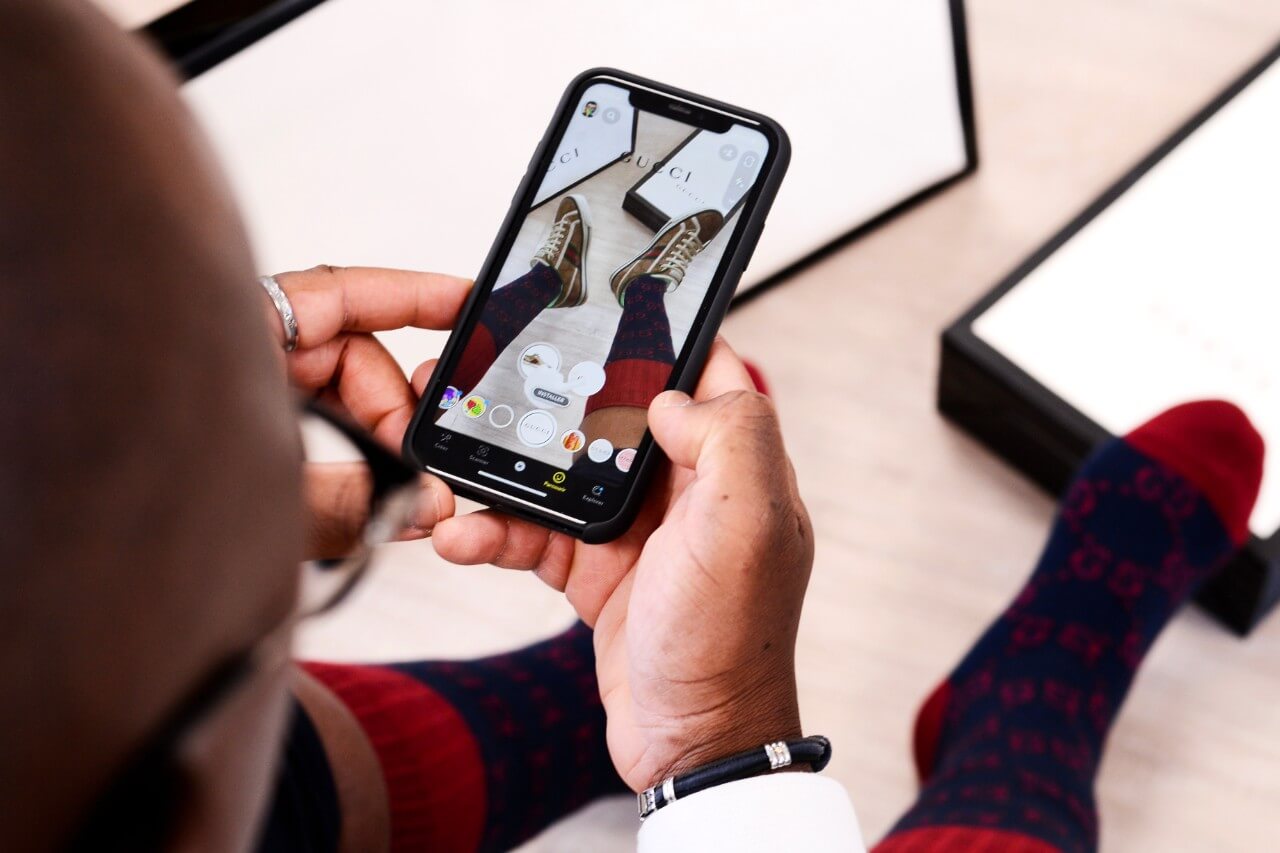 Gucci | Augmented Reality Statistics
This way, users can now browse desired items, try them and even customize them in real-time in a single app. This one-of-a-kind experience helped Gucci skyrocket sales and decrease the product return rate by times.
Real-time AR customizations help customers make sure they get what they need and stimulate to choose AR-enabled companies that meet their fast-growing needs.

2 in 3 users state AR can help them achieve new soft and hard skills (ISACA)
These AR numbers have two proven explanations: AR training and immersive social experience.
AR-powered training replaces traditional approaches to educating and learning. Trainee workers no longer need to process bulky documentation and manuals, and even have materials physically.
Augmented reality brings engaging digital environments, visually-appealing virtual snippets, and real-time access. These benefits motivate workers to stay engaged and gain new relevant hard skills.
Another yet powerful outcome is leveraging new soft skills.
Augmented reality brings face filters, gamification, video editing, and AR effects that help users communicate in a fully new and immersive way.
AR-powered solutions are proven to increase the amount of user-generated content which means users interact more, engage stronger, and communicate better.
For example, Banuba helped Chingari, an India-based social media platform, get 30M downloads and increase user engagement by times. With the help of AR-based Video Editor SDK, the company lets users create short TikTok-like videos and share them across multiple channels.
This use case shows how augmented reality can benefit both your brand and customers.

Augmented Reality Industry Statistics (Gaming, Automotive, Healthcare, Retail)
Let’s review more industry-oriented augmented reality stats.
Gaming AR Statistics
Gaming is the most popular AR app category: 25% of iOS and 42% of Android app downloads are games (Statista)
AR gaming doesn’t need special hardware. Smartphone AR is still the most accessible entry point, and it’s already in everyone’s pocket, which is why it holds the biggest share of the AR gaming market in practice.
The worldwide adoption of 5G connections will also impact the entry point for AR games. According to IMARC Group, 5G will cover 95% of all mobile connections in South Korea, the US, and Canada, and 88% in China. 5G’s speed combined with low latency makes AR feel less demoish and more real. Put it together, and you get a simple shift in user behavior: immersive AR experiences stop being a rare “wow moment” and become a normal expectation in the apps people open for fun.
When AR becomes part of what users expect, integration speed becomes a key factor for standing out from competitors. Building AR from scratch usually means serious R&D, long iteration cycles, and, let’s be honest, a lot of budget that most teams would rather put into growth. Most teams don’t have that luxury for a feature that might not land.
Plug-and-play SDKs change the math. You can drop AR features straight into your camera funnel and start testing what actually moves engagement. Banuba's Face AR SDK provides real-time effects and tracking, and the Video Editor SDK for the creation layer that UGC and gaming-adjacent apps lean on.
The Augmented Reality gaming market is projected to reach $141.7 billion by 2033 (IMARC Group)
The gaming augmented reality industry is among the largest domains adopting augmented reality technologies.
Pokemon Go, Harry Potter: Wizards Unite, Zombies, Run!, The Walking Dead: Our World and Jurassic World Alive enter the list of the most popular mobile AR games.
IMARC Group values the global AR gaming market at $14.2B in 2024 and projects it to hit $141.7B by 2033. That's a 10-times jump in less than a decade, with a forecasted CAGR of almost 26%. AR technology upgrade and users' behavior shift are the key factors.
Location-based and real-world formats pull people in more strongly because they add movement, exploration, and a vibe of shared activity. This growth is basically a reflection of two things:
-
AR tech is getting smoother (especially on mobile);
- Users now treat AR as a normal part of entertainment.
The winners will be the apps that use AR to create repeatable reasons to come back: location-based challenges, social play, real-world exploration, and content co-creation. Besides, it broadens the monetization opportunities. It’s not about selling a game anymore. It’s about creating new ways to earn inside the app with AR: cosmetics/skins/3D avatars, creator tools, seasonal events, brand partnerships tied to real locations, and UGC that spreads the product for free.
For example, Hyperspeed.
Banuba helped Teatime Games launch a first-of-a-kind AR-powered mobile game and disrupt the social gaming augmented reality industry.
With the help of our Face Filter SDK, Hyperspeed leveraged the Effect Constructor and Viewer components to integrate AR filters, effects, masks, and other animations in both real-time and post-processing.
This way, AR helped the gaming brand get over 50,000 downloads and raise $9M Series A funding.
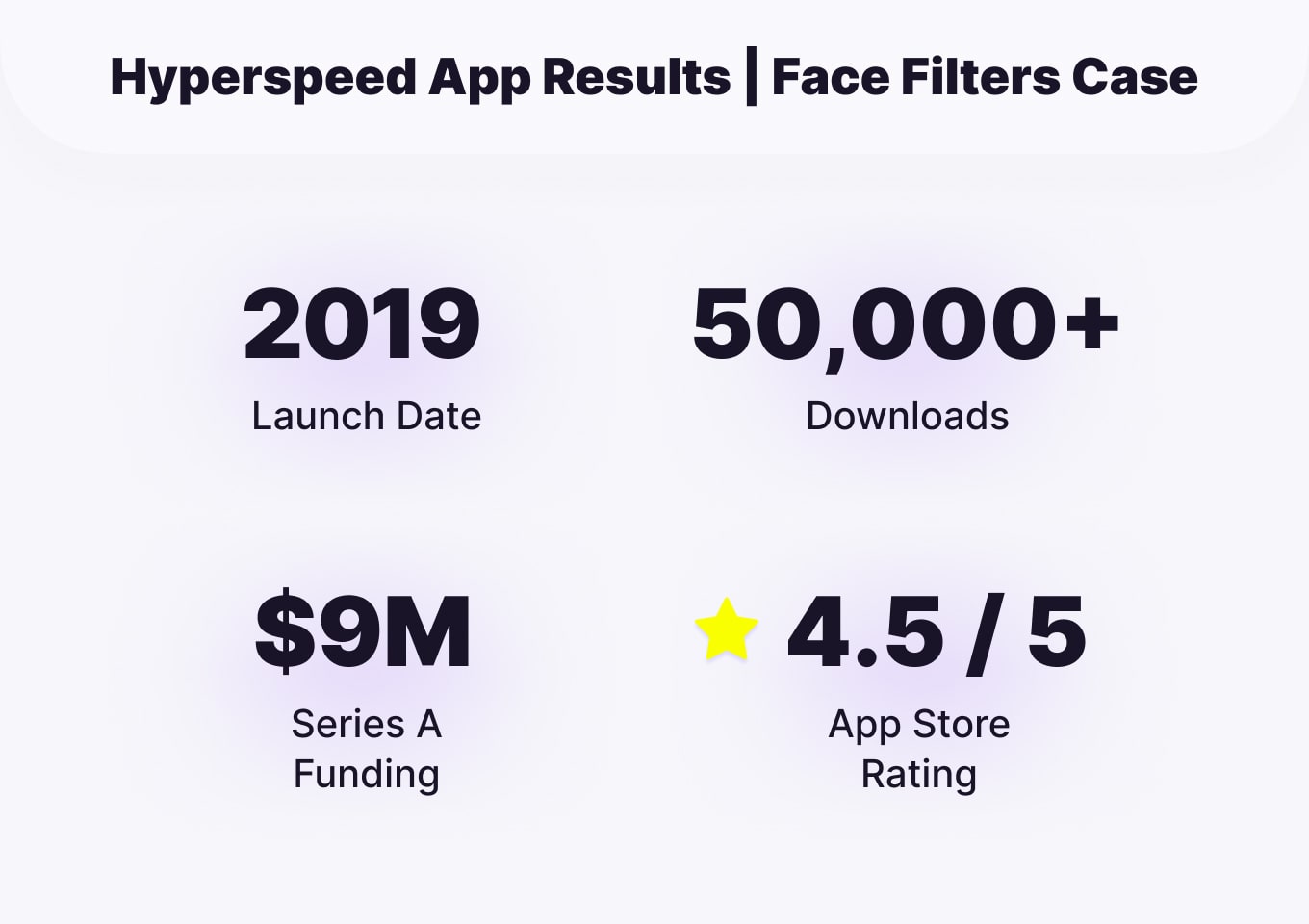 Hyperspeed Results | Augmented Reality Statistics
Automotive AR Statistics
Automotive AR market is projected to grow from $8.22B (2025) to $24.33B by 2030 (Mordor Intelligence)
The automotive industry is another large market player leveraging multiple benefits of AR. The top use cases include:
-
Accelerated Staff Training & Onboarding
-
Enhanced Vehicle Maintenance
-
Model Virtual Prototyping
-
Engaging Real-Time Showrooms
-
Team Collaboration.
Automotive companies benefit from adopting augmented reality both internally and externally.
For example, BMW. One of the world-leading multinational corporate manufacturers of luxury vehicles, BMW was among the first players to utilize AR-based capabilities and assist their manufacturing technicians.
The company adopted AR-powered solutions to inspect delivered parts within its Toolmaking and Plant Engineering departments. The software helped workers generate accurate data on each tool including its drill holes and clear surface features.
This experience helped decrease the human factor error by benchmarking each tool before using it. Technically, algorithms process each image using around 50 criteria. In case there was no match with the set specifications, technicians reworked the tool before sending it to the assembly area.
Remote AR assistance helped Mercedes-Benz cut travel and repair time by 40% (ISM)
Mercedes-Benz used HoloLens 2 and Dynamics 365 Remote Assist across 383 US dealerships so technicians could call in remote experts right on the shop floor. As a result, they cut repair time and saw a 35–40% reduction in travel needs and the related carbon footprint, with issues that used to take days of back-and-forth handled in a short remote session.
Porsche applied the same idea in its dealer network. AR glasses connect technicians to remote specialists for tricky cases, helping teams make faster, more consistent diagnostic and repair decisions.
And Peterbilt service teams report up to 15–20% time savings using ARTech, which overlays the exact wiring schematics for a specific chassis directly onto the real-world view, speeding up diagnostics and repair work.
AR conferencing services, aka remote assist, can help improve automotive service by enabling faster diagnostics, fewer repeat visits, less expert travel, and more consistent repair decisions across the dealer network. That combination usually turns into a cleaner ROI story with lower support costs on one side and customer satisfaction on the other.
Healthcare AR Statistics
$4B is the estimated market value of AR healthcare solutions by 2026. (GlobeNewswire)
Healthcare companies make over 30% of the global augmented reality market value. The core AR healthcare use cases include:
- Data-driven and accurate surgery
- Error-free diagnosis
- Engaging and accelerated training.
For example, PerSim.
It’s a realistic AR-based simulator software that helps EMTs, paramedics, and others to deal with real-life causes virtually. From trauma-related injuries to mass casualty events, professionals use the strengths of AR to learn, practice, and grow hard skills.
 MedCognition's PerSim | Augmented Reality Statistics
AccuVein is another AR-powered healthcare example.
With the help of augmented reality, the application revolutionizes the way hospital workers deal with IV (intravenous injection). The solution reduces potential human errors and failures to find and inject patients’ veins error-free.
The working scenario is simple: AccuVein scans a patient’s skin and accurately visualizes veins to conduct an injection.
These augmented reality statistics and examples show that the AR healthcare industry is thriving and growing from a $610M market size in 2018 to $4B by 2026.
AR Improves Surgical Accuracy to 98% (ITIF)
A study of 28 spinal surgeries found AR-assisted procedures achieved 98% accuracy on standard screw-placement metrics, when “clinically acceptable” accuracy is typically around 90%.
Augmented reality brings patient-specific 3D anatomy into the surgeon’s line of sight for planning and intraoperative navigation, so teams spend less time turning to flat screens and more time staying locked on the patient. This leads to lower distraction, lower mental load, and better precision.
ITIF also highlights how AR/VR supports collaboration beyond the operating room. Teams can plan complex cases together remotely, and surgeons have used XR-assisted planning for extreme procedures. And on the real product side, MediView’s XR90 was designed for live imaging and guidance during minimally invasive procedures. It became the first AR platform to receive FDA clearance for live imaging during medical procedures in 2023.
All this highlights the value of using AR in education, where practice hones skills, and augmented reality allows medical students to learn from their mistakes and perform virtual operations without risk or harm.
Retail & Ecommerce AR Statistics
25% of retail companies utilize AR in business to boost sales (ThreeKit)
Retail companies are actively adopting AR-based solutions to empower their business. Virtual try-ons, real-time customizations, augmented showrooms, and AR marketing help retailers accelerate their growth.
Let’s illustrate augmented reality in retail statistics with some use cases. For example, IKEA Place.
The world-leading multinational ready-to-assemble furniture retailer launched a new IKEA Place app with an immersive virtual try-on feature. It lets customers find the desired item from a 2,000-sized catalog, and virtually furnish their apartments to see whether it fits physically and aesthetically.
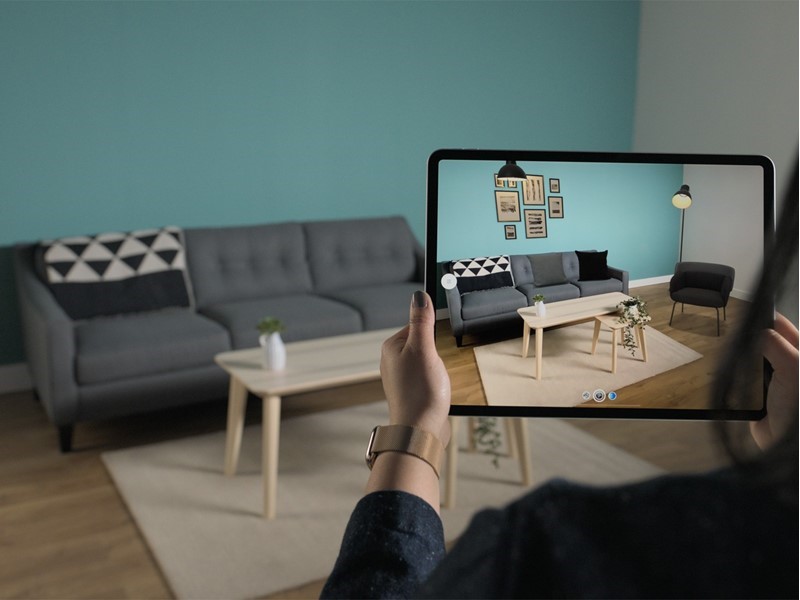 IKEA Place | Augmented Reality Statistics
AR algorithms automatically scale the chosen furniture item to the dimensions of customers’ apartments with 98% accuracy. Also, the app allows users to see the texture of the fabric and visualize lights and shadows.
IKEA became a market pioneer in adopting AR capabilities in that specific way reporting to boost in-app sessions and reduce the product return rate.
Lego is another powerful example of using AR in the retail augmented reality industry.
The world’s largest toy company (as of 2021) launched its Lego Hidden Side AR app during the pandemic. It was designed to engage customers by making bundle elements live.
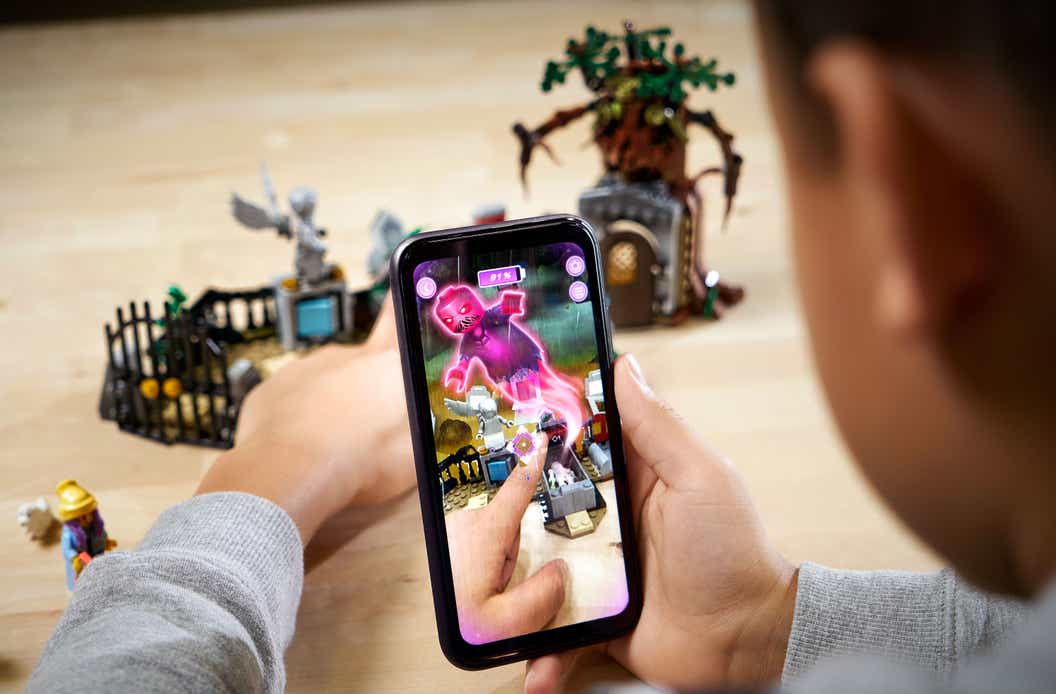 Lego | Augmented Reality Statistics
Kids installed an app and played a ghost-hunting game matching their mobile device cameras with the bundles. This creative AR adoption initiative became a retail market boom and increased LEGO sales by times.

AR and 3D product views can lift conversion by 94% (Shopify)
When people can see the product in context (size, fit, shade, placement), hesitation and checkout friction drop. According to the L’Oréal Annual Report, the average time spent on virtual try-ons is 7 minutes. Time-in-experience matters when it comes to augmented reality in ecommerce stats. As AR turns the product page into the part where consumers gain confidence, compare options, interact with products, and experiment without commitment.
Try-on users are "warmer" users. They spend longer with the product, test more options, and make decisions with less second-guessing. They commit only after trying it first. Ulta virtual try-on statistics report thousands of users try its hair try-on tool daily, and says shoppers who use try-on are more likely to purchase.
For the Contém1g cosmetic line, after Banuba's Virtual Try-on launch, the “Glow Filter” line became the most-try-on product and the top revenue generator on the platform. Loncolor, a hair dye and care producer, leveraged Banuba’s Hair Virtual Try-on to focus on realistic hair-only recoloring with high performance in various lighting. As result, they received positive feedback from customers, showing their readiness to enjoy an effective hair try-on without commitment.
Facts About Augmented Reality: 3 Investment Stats
The AR statistics above already show the direction: the market is expanding, businesses are adopting, and users are getting comfortable with AR in everyday flows. But if you want the clearest signal of how mature and how “real” this space has become, look at the money flows.
AR Investment Statistics
$18B was invested in AR/VR technologies in 2020. (ThreeKit)
The AR industry is growing in a fast-paced manner. The IDC report states that the global amount of investments increased by 79% from 2019 showing $18.8B in 2020.
That’s reasonable as brands are looking for new ways to deliver high-engaging experiences to customers and win the competition. In turn, consumers are becoming more demanding daily and mostly opt for those businesses that offer the best engagement points in shopping.
According to Statista, better immersive tech and bigger bets on digital experiences are pushing AR adoption across industries, creating growing demand for augmented reality worldwide.
Meta invests $20B in their Reality Labs in 2025 (Treeview)
Meta is still pouring serious money into XR. Treeview estimates Reality Labs gets around $20B a year (roughly 20% of Meta’s total budget), spread across hardware, platforms, content, and long-term R&D. More than half of that Reality Labs spend is aimed specifically at augmented reality.
AR Startups & Patents
2,800 companies as AR startups on the Angel list. (Angel)
Another valid proof of the fast-growing AR industry is the number of augmented reality tech startups.
As of 2023, the number of AR-powered tech startups listed on the Angel list is 2,825.
10,000+ VR/AR patents are owned by Microsoft. (Statista)
Despite the relatively low level of adoption rate for AR and VR devices, multiple businesses still invest decent funds and patent their solutions.
Microsoft is among the largest backer with over 10,000 AR/VR patents across many niches.
The patent landscape has become more competitive with several major players, including Sony, Microsoft, and Samsung are the leading patent holders. Apple also has secured a US patent.
Nearly 390k patent applications related to AR, VR, and XR are currently pending worldwide. It might be a sign that Metaverse-related solution and inventions may dominate the market in the future.
AR Facts: 5 Successful Use Cases
81.91% was the uptake of a direct mail received rate spotted by SAP. (EngineCreative)
The largest non-American software company by revenue, SAP leveraged AR-enabled technologies in their direct mailing solution. Augmented reality helped deliver custom-designed SAP mugs to the market.
Simply, AR-powered solutions highlighted the range of SAP creative services in an interactive and engaging way. With an average benchmarked dwell time of 1 minute, SAP experienced an 81.91% boost in direct mail received rate in their marketing campaign.
The SAP example is among the valuable facts about AR showing that even tech and software companies can benefit from adopting augmented reality technologies in their business.
Takeaway: AR can turn boring offline formats like direct mail into an interactive experience that holds attention longer and measurably improves campaign response rates.
50% sales boost was the result of adopting AR-based virtual try-ons by L’Oreal. (Forbes)
The world’s largest cosmetics company, L’Oreal decided to launch a brand-new AR-powered app StyleMyHair. The mobile experience allowed customers to try on multiple haircuts, colors, and styles in digital showrooms real-time before proceeding to checkout.
The app was based on a face tracking technology that segments and spots face shapes and hairstyles in real-time and lets users apply desired items virtually.
What’s more, location-based AR technologies helped the brand to implement a ‘salons near me’ experience. It guided users through the nearest beauty centers right after trying on their desired haircuts or colors.
This AR-powered approach helped the world-leading cosmetics brand increase sales by 50% in several months.
Takeaway: AR try-on works best when it’s tied to the next step in the funnel (e.g., checkout or “find a salon”), because it removes doubt and shortens the path to purchase.

700% user engagement increase was experienced by Ulta through AR-based virtual try ons. (Ulta)
Ulta Beauty, an American-based chain of beauty stores, was forced to close over 1,200 offline shops during the pandemic. This challenge stimulated the brand to launch GlamLab, a digital try-on feature-rich application.
The virtual experience enabled users to try on dozens of beauty products in real-time. In a year, the company reported spotting 19 million shade matches in 2020 and over 700% of in-app user engagement boost.
GlamLab remains the core digital sales strategy even now providing customers with immersive experiences along with over 1,000 reopened offline stores.
Takeaway: Virtual try-on isn’t just a conversion tool. It’s an engagement engine that can replace or support physical retail when stores are unavailable and still keep customers actively exploring products.
30M Downloads in 3 months for Chignari app with AR-based Video Editor SDK. (Banuba)
Chingari, the most popular India-based social video sharing app, revolutionized the social media landscape in 2020. Followed by a TikTok ban in India, Chingari decided to bring its own market rival to life.
With the help of Banuba’s AR Video Editor SDK, the brand launched a social video sharing app that got over 550,00 downloads in just 10 days. Later on, Chingari experienced 30M app downloads in 3 months with an average session time of 7.5 minutes. The solution’s core augmented reality demographics are 18-35-year-old users mainly.
The company integrated our Video Editing SDK with animations and AR face filters. They allowed users to create and share short video content powered by:
- Video effects (animations, LUT filters, and 3D lenses)
- Beautification tools (makeup, hair color, face morphing, triggers, avatars)
- Camera UI and Video Capture.
1M Installs for MNFST app with Banuba Face Filter SDK. (Banuba)
MNFST, a London-based lifestyle social media startup, launched its mobile app to revolutionize the influencer market. The core mission was to release a one-fits-all social marketplace for brands to promote their products and creators to monetize their content.
Integrating Banuba Face Filter SDK, MNFST has thrived in several markets experiencing over 1M installs, 50+ branded industry-leading partners, and over 750,000 published sponsored posts.
Nestle, Bolt, Vivid, Revolut, and Pockit were among the top brands using the MNFST app to run marketing and ad campaigns.
Takeaway: AR face effects can make creator/brand platforms more commercially attractive by increasing creator output and giving brands a native, repeatable format for sponsored content.
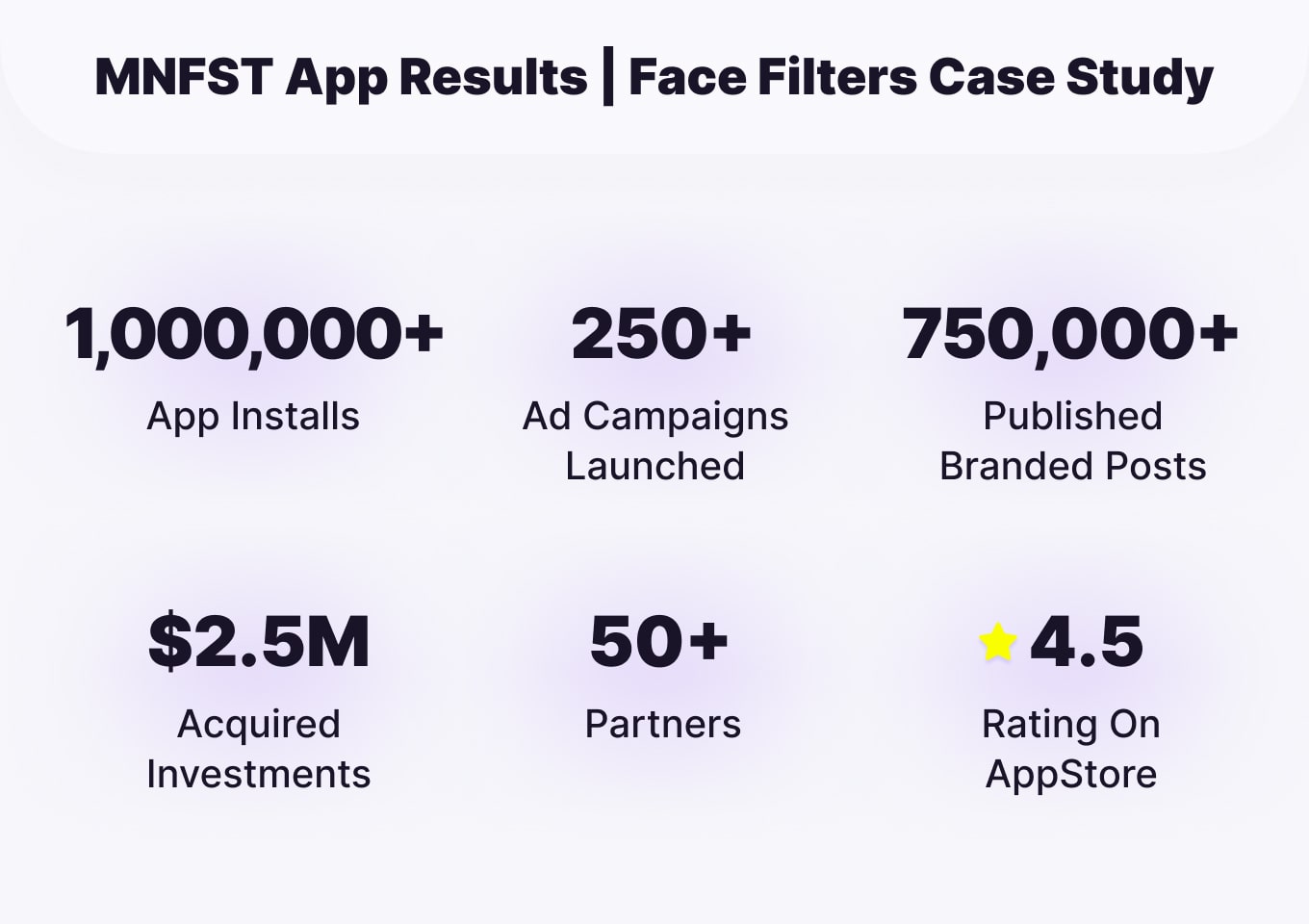 MNFST Results | Augmented Reality Statistics
Wrapping Up
AR-powered solutions can enhance your business no matter what domain you operate in. Our guide on the mind-blowing facts about augmented reality shows multiple flourishing stories and use cases.
The provided augmented reality statistics should help you realize why and how you can benefit from adopting AR technologies in your specific case.
If you’re looking for powerful AR face filters or video editor solutions for your business, we’re here to help. Just request a 14-day free trial and start testing our industry-leading augmented reality solutions right away.

Sources & Methodology
This page is updated at least once per year (and sooner when major benchmark reports or widely cited AR numbers change). Last updated: January 2026.
To keep the stats citation-ready (for journalists, analysts, and product teams), we follow three rules:
-
Source quality first. We prioritize original research, reputable industry reports, and primary brand/platform publications. When a stat is frequently repeated, we trace it back to the closest available primary source.
-
Business relevance. Every stat is selected because it supports real decisions: market size & growth, adoption, conversion/engagement impact, returns reduction, and proven use cases with measurable outcomes.
-
Consistency and transparency. Each stat is presented in a predictable format so it’s easy to cite and easy to validate.
Banuba periodically reviews AR market reports and published case studies to keep the numbers fresh, replace outdated estimates, and add new high-signal examples as they emerge.
Artillery Intelligence. (n.d.). Mobile AR global revenue forecast: 2024–2029. Artillery Intelligence. https://artilleryiq.com/reports/mobile-ar-global-revenue-forecast-2024-2029/
Banuba. (n.d.). Virtual try-on for a Romanian hair color brand. Banuba Blog. https://www.banuba.com/blog/virtual-try-on-for-a-romanian-hair-color-brand
Banuba. (n.d.). Virtual try-on for a bestselling cosmetics line. Banuba Blog. https://www.banuba.com/blog/virtual-try-on-for-a-bestselling-cosmetics-line
IMARC Group. (n.d.). Augmented reality gaming market: Statistics. IMARC Group. https://www.imarcgroup.com/augmented-reality-gaming-market-statistics
Information Technology and Innovation Foundation. (2025, June 2). AR/VR’s potential in health care. ITIF. https://itif.org/publications/2025/06/02/arvrs-potential-in-health-care/
ISM Guide. (n.d.). Mercedes-Benz XR / HoloLens remote assist case study. ISM Guide. https://ismguide.com/mercedes-benz-xr-metaverse-case-study/
Legal Blogs: Wolters Kluwer. (n.d.). [Metaverse patents article]. Wolters Kluwer. https://legalblogs.wolterskluwer.com/patent-blog/metaverse-patents/
Mordor Intelligence. (n.d.). Automotive augmented reality market. Mordor Intelligence. https://www.mordorintelligence.com/industry-reports/automotive-augmented-reality-market
Reydar. (n.d.). Augmented reality ecommerce. Reydar. https://www.reydar.com/augmented-reality-ecommerce/
Shopify. (2024, August 19). AR shopping: Top trends and apps for the future (2024). Shopify Enterprise. https://www.shopify.com/enterprise/blog/augmented-reality-ecommerce-shopping
Snap Inc. (2021, May 13). The next inflection point: More than 100 million consumers are shopping with AR. Snapchat for Business. https://forbusiness.snapchat.com/blog/the-next-inflection-point-more-than-100-million-consumers-are-shopping-with-ar
Statista. (n.d.). Global mobile augmented reality (AR) users. Statista. https://www.statista.com/statistics/1098630/global-mobile-augmented-reality-ar-users/
Statista. (n.d.). iOS app downloads distribution by category. Statista. https://www.statista.com/statistics/1391671/ios-app-download-distribution-by-category/
Statista. (n.d.). Google Play app downloads share by category. Statista. https://www.statista.com/statistics/1322595/google-play-app-downloads-share-by-category/
Statista. (n.d.). Number of smartphone users worldwide. Statista. https://www.statista.com/statistics/330695/number-of-smartphone-users-worldwide/
Statista. (n.d.). AR/VR worldwide market outlook. Statista. https://www.statista.com/outlook/amo/ar-vr/worldwide/
Statista. (n.d.). Worldwide AR/VR patent top owners. Statista. https://www.statista.com/statistics/963685/worldwide-augmented-virtual-reality-patent-top-owners/
ThinkMobiles. (n.d.). Augmented reality in retail: Trends and examples. ThinkMobiles. https://thinkmobiles.com/blog/augmented-reality-retail/
ThreeKit. (n.d.). Augmented reality statistics you should know (2023/2024 edition). ThreeKit. https://www.threekit.com/23-augmented-reality-statistics-you-should-know-in-2023
Treeview. (n.d.). AR/VR/MR/XR & spatial computing industry stats. Treeview Studio. https://treeview.studio/blog/ar-vr-mr-xr-metaverse-spatial-computing-industry-stats
-
It depends on how you count “using AR” (apps, WebAR, visual search, social lenses), but the scale is already massive. Statista estimates there are about 1.07 billion mobile AR users in 2025 (monthly active users across mobile AR experiences), with growth projected beyond that.
-
A widely cited benchmark comes from the Deloitte Digital x Snap Inc. survey. It reports that 9 in 10 medium-sized brands are using AR, and 88% of mid-sized companies leverage AR capabilities across areas like product development, training, and marketing.
-
Most AR experiences fall into a few practical buckets:
-
Marker-based AR (scan an image/object to trigger AR)
-
Markerless AR (plane detection/SLAM for placing objects in space)
-
Face & body AR (filters, makeup try-on, segmentation, motion tracking)
-
Location-based AR (geo-anchored experiences, navigation, real-world gameplay)
-