

The numbers behind virtual makeup are no longer speculative. The global virtual makeup try-on market is projected to expand from $1.11 billion in 2024 to $1.86 billion by 2032. AR virtual try-on is now used by 55% of online beauty shoppers, and virtual try-ons can lead to a 2.4x increase in purchase likelihood, while beauty brands that incorporate AR into the customer journey see up to 90% higher conversion rates.
AR features moved from "nice to have" to a checklist item for every cosmetics brand, social app, and live-commerce platform. Tech adoption is also widening: 57% of beauty brands plan to integrate AR into their online stores, and AR beauty filters increase time spent on brand pages by 2.5x. The hard part is no longer convincing stakeholders. It is picking an SDK that ships, holds up under low light, and does not turn pricing into a quarterly negotiation.
Three vendors keep showing up in 2026 procurement conversations: Banuba, Perfect Corp, and DeepAR. They overlap on paper. They diverge sharply on platform reach, beauty rendering depth, deployment model, and how their roadmap is funded. This guide compares them where it actually matters.
[navigation]
AR beauty SDKs let developers add real-time makeup try-on, skin retouching, and face-tracking effects to mobile and web apps without building a computer vision pipeline from scratch. Three commercial options cover most production needs in 2026: Banuba, Perfect Corp, and DeepAR. Banuba is the strongest pick for teams that want deep beauty rendering, broad cross-platform coverage, and pricing that does not punish growth.
TL;DR:
- This guide is for developers and product leads choosing an AR beauty SDK for cosmetics try-on, beautification, or social camera features.
- We compare three SDKs that frequently appear on shortlists: Banuba, Perfect Corp, and DeepAR.
- Banuba wins for production apps that need predictable per-platform pricing, native React Native and Flutter support, and beauty depth across makeup, hair, nails, eyewear, and jewelry.
- Perfect Corp is the safer call for global beauty conglomerates that lead with skin diagnostics and have an enterprise procurement appetite.
- DeepAR works for quick browser activations and small MAU pilots, with the caveat that its roadmap is now focused on Zalando.
How we evaluated each SDK
We benchmarked the three SDKs on the criteria that determine whether an integration ships in a week or stalls for a quarter.
- Stack and language coverage. Native iOS Swift, Android Kotlin, Web JS/TS, plus officially maintained wrappers for React Native, Flutter, and Unity. Community forks do not count.
- Beauty rendering depth. Number of distinct makeup product types, segmentation granularity (lips, eyebrows, hair, nails, skin), and tracking quality under occlusion or low light.
- Deployment model. On-device versus cloud, offline capability, and what happens to user biometric data.
- License terms. Whether commercial use is straightforward, what royalty model applies, and how transparent the contract is.
- Pricing predictability. Per-platform flat fee, per-MAU scaling, or custom enterprise. The first protects margin at scale. The second penalizes growth.
- Vendor stability. Independent roadmap, parent company strategic alignment, and support response time.
The aim is to surface the constraints engineers actually feel in week three of integration, not the marketing top-line.
Banuba Beauty AR SDK
Banuba's Beauty AR SDK is the production-grade option for teams that want beauty depth and broad reach without enterprise contracts. The SDK is built on Banuba's own face-tracking engine, with the computer vision technology protected by 30+ patents and refined over a decade of work with brands like Gucci, Samsung, and RingCentral.
What it actually does
The engine combines a 68-point landmark detector with a 3,308-vertex 3D face mesh. Patented face tracking is trained on diverse lighting and motion scenarios, so 68-point landmarks remain accurate even with 70% facial occlusion, fast head movement, and low light, which is critical for live beauty filters. That precision matters for makeup because foundation, eyeliner, and lipstick fail the moment they visibly track drifts.
The makeup pipeline covers 16 product types:
- Foundation, concealer, blush, highlighter, contour, eyeshadow, eyeliner, mascara, brows, lipstick, lip gloss, lip liner, lashes;
- Skin smoothing, hide wrinkles;
- Skin tone enhancement to make it lighter or darker;
- Face morphing to slim down the cheeks and nose;
- Teeth whitening;
- Expressive eyes effect to add glare to the eyes.
The retouching uses neural networks trained to recognize skin defects and adjust based on the user's actual skin tone, rather than applying a uniform Gaussian blur.
Beyond makeup, the SDK handles full hair segmentation, eyewear (including prescription frames), jewelry, headwear, contact lenses, and nail detection with both matte and glossy polish rendering. That range turns a single license into a multi-category try-on stack.
Where it runs
Native SDKs ship for iOS, Android, Web, Unity, Windows, and macOS. The React Native (@banuba/react-native) and Flutter (banuba_sdk) plugins are officially maintained by Banuba, not community forks. Our solutions are designed and optimized for a wide range of devices, covering 97% of iOS and 80% of all Android devices. Everything runs on-device. No biometric data leaves the user's phone, keeping the product GDPR-compliant by design and removing a recurring legal review headache for retail integrators.
Beauty-specific architecture
Three pieces matter for beauty teams.
First, the SDK exposes a separate Makeup API and Beauty API that share the same underlying face effect, so developers can combine virtual try-on with retouching in the same render pass without doubling the GPU cost.
Second, product digitization is handled in-house. Banuba's team can digitize a new cosmetic catalog in roughly 48 hours, removing the SKU bottleneck that traps most retailers. Besides, Banuba already offers over 22k digitized beauty products.
Third, the SDK is deeply customizable at the UI layer. Every button, panel, and interaction flow is exposed programmatically, so the AR engine sits underneath your brand rather than imposing its own.
When Banuba is the right call
- Beauty and cosmetics e-commerce running virtual try-on across many SKUs.
- Social and creator apps that need both AR filters and beautification.
- Live streaming and video conferencing platforms (Banuba integrates with Agora and ships its own AR Live Streaming stack).
- AR mirrors and in-store kiosks for retail.
- Cross-platform apps where React Native or Flutter is the chosen framework.
When to look elsewhere
Teams running a one-week browser-only marketing stunt with no roadmap beyond the campaign will find Banuba's commercial license more than they need. The free trial covers full SDK access for 14 days, but there is no permanent free tier with watermarks.
Real-world results
- Boca Rosa Beauty used Banuba's Beauty AR SDK for a pre-launch event and generated $900,000 in 4 hours.
- Brazilian beauty brand Oceane saw add-to-cart rate jump from 3% to 32% after integrating Banuba's makeup try-on.

Perfect Corp
Perfect Corp is the public company incumbent in beauty AR. The SDK powers virtual try-on for makeup, hair, jewelry, watches, and fashion accessories, plus AI-powered skin and hair analysis.
Strengths
- Skin diagnostics. The HD AI Skin Analysis flow is dermatologist-verified and detects multiple distinct skin concerns, which is hard to replicate without comparable training data.
- Pre-digitized catalog. Years of brand partnerships have produced one of the largest libraries of pre-rendered cosmetic SKUs in the industry.
- Enterprise polish. The platform is built for the procurement, legal, and compliance reviews that come with global retail rollouts.
- Generative AI features. YouCam AI Beauty Agent and AI hairstyle generation extend the stack into conversational try-on flows.
Limitations
The platform is built for enterprise. That shapes everything downstream:
- Long sales cycles. Pricing is custom and quoted per partnership. Procurement teams routinely report multi-month negotiation timelines.
- Hybrid deployment. Some advanced diagnostics involve cloud processing, which adds latency, requires data-handling agreements, and complicates offline use cases.
- Hardware sensitivity. HD tracking and AI processing can tax mid-range Android devices, narrowing the addressable user base for apps targeting emerging markets.
- Platform breadth. Coverage is strong on iOS, Android, and web, but native React Native and Flutter wrappers are not first-class citizens the way they are with Banuba.
Best fit
- Global beauty retailers running an enterprise-wide AR program across web, mobile, and in-store.
- Skincare brands that lead with diagnostics rather than makeup.
- Medical spas and clinics needing high-resolution skin assessments.
Skip if
You are a startup, a social app, or any team that needs to ship a working AR feature in weeks rather than quarters. The procurement overhead is the cost of admission, and it does not bend down for smaller deals.
Banuba's Beauty AR SDK in action
DeepAR SDK
DeepAR is a London-based AR SDK that targets face and body tracking for mobile, web, and live streaming. It powers face filters with claimed performance better than Snapchat in a powerful SDK built for Web, iOS, Android, and supports up to 4 simultaneous face tracks. Beauty try-on is offered as a paid add-on rather than a core capability.
What changed in 2025
The biggest update for any 2026 procurement decision is structural. German online retailer Zalando has acquired London-based 3D and augmented reality company DeepAR, as part of its investment in 3D technology. DeepAR will help accelerate the retailer's 3D roadmap by creating 3D assets at scale and incorporating 3D experiences across the Zalando platform. The tech firm will remain an independent company under the ownership of Zalando.
That changes the calculus. DeepAR's roadmap is now tied to Zalando's e-commerce strategy, which centers on fashion rather than beauty. For long-running beauty platforms, vendor priority drift is a real planning risk.
Strengths
- Generous free tier. Up to 10 MAU free with watermark, useful for prototypes.
- Visual studio. DeepAR Studio lets designers build effects in a 3D environment without heavy code support.
- Web AR maturity. Browser performance is reliable, which matters for one-shot marketing campaigns.
- Variety of effects. Face filters, masks, background replacement, and accessory tracking are all available out of the box.

Limitations
- Beauty depth is shallow. DeepAR ships hair segmentation but does not segment lips, eyebrows, or skin individually on Android, which limits makeup precision. The makeup add-on is functional rather than category-leading.
- Beautification approach. Skin smoothing tends to soften texture rather than preserve it, producing a "plastic" look that fails on close-up product photography.
- MAU-based pricing. MAU-based pricing scales linearly. While the entry price is low ($25/month for 10–1,000 MAU), costs scale directly with your user base. At 50,000–100,000 MAU, you're paying $1,000/month. Viral apps absorb that as a tax on success.
- Vendor stability. Post-acquisition roadmap is aligned with Zalando rather than the open SDK market.
- No native React Native or Flutter. Cross-platform support is via wrappers and community packages.
Best fit
- Browser-first marketing campaigns where the AR feature lives for weeks, not years.
- Social and entertainment apps that prioritize fun filters over commerce-grade makeup.
- Prototypes and proofs of concept where the watermarked free tier is enough to validate UX.
Skip if
Your roadmap is multi-year, your app targets beauty conversion at scale, or your ops team needs a vendor whose strategic priorities align with general SDK customers rather than a single retailer.
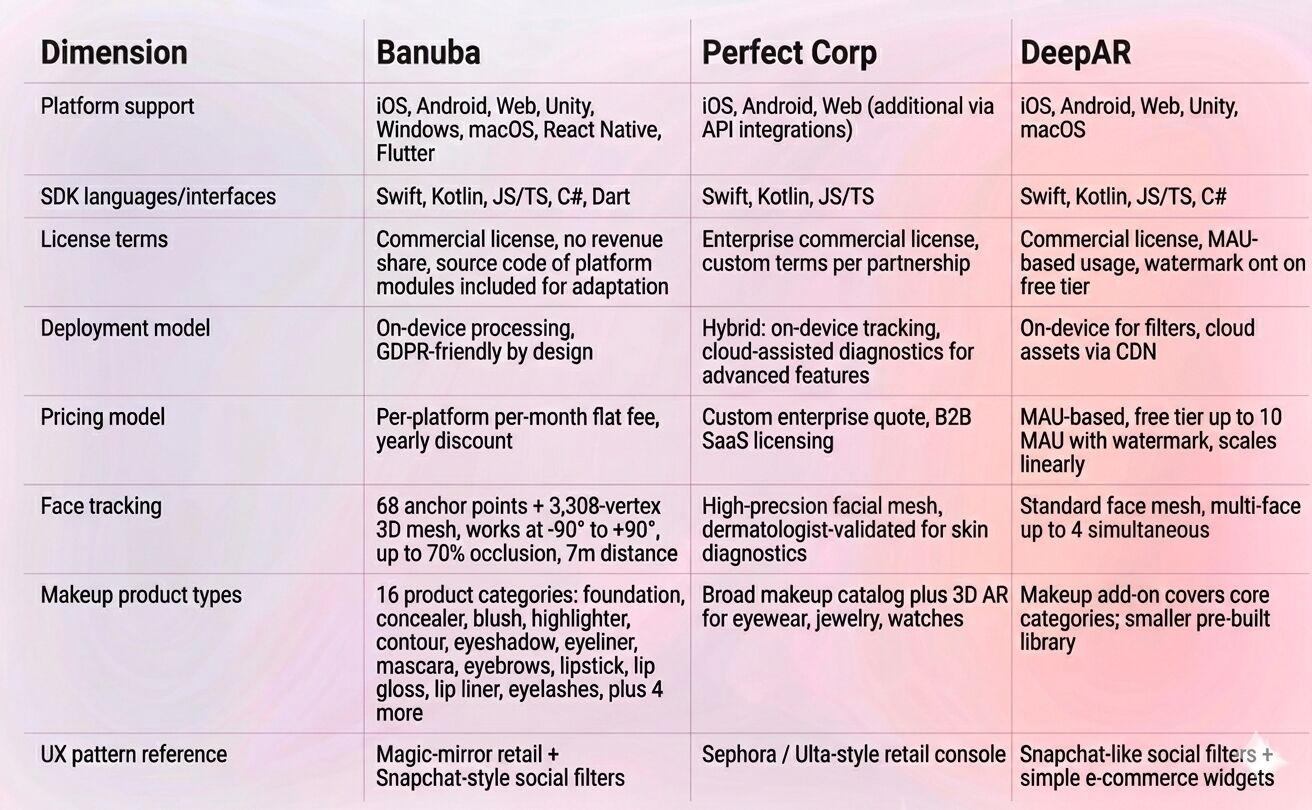
Best AR Beauty SDKs at glance
This table follows the universal constraint dimensions developers ask about in 2026 procurement, plus beauty-specific columns.
Decision guidance
Three rough buckets cover most teams.
Best for production beauty apps and cross-platform retail: Banuba. Per-platform pricing, deep beauty rendering, official React Native and Flutter support, on-device processing, and 48-hour catalog digitization. The license terms are commercial without revenue-share traps, and the roadmap stays focused on AR rather than someone else's e-commerce platform. For most teams reading this guide, Banuba is the path of least resistance to production.
Best for global enterprise retailers with diagnostic-led journeys: Perfect Corp. If your AR strategy is anchored in skin analysis, your buyer is a dermatology-adjacent brand, and your procurement team is comfortable with a multi-quarter sales cycle, Perfect Corp's depth in skin diagnostics is hard to match.
Best for short-run web campaigns and prototypes: DeepAR. The free tier and DeepAR Studio make it the cheapest way to validate a creative concept in the browser. Just be honest with yourself about whether the campaign will outlive the next Zalando-driven roadmap pivot.
For senior engineers, the deciding factor is rarely tracking accuracy on the demo reel. It is whether the SDK fits the stack the team already maintains, whether pricing survives a 10x user spike, and whether the vendor will still be optimizing the same product in three years.
References
Arbelle. (2025, November 28). Cosmetics industry report: Trends, tech and consumer insights. https://arbelle.ai/cosmetics-industry-report/
Banuba. (n.d.-a). AI Beauty AR API SDK | Makeup beautification retouch filters. Retrieved May 4, 2026, from https://www.banuba.com/facear-sdk/beauty-ar
Banuba. (n.d.-c). Banuba Face AR SDK documentation. Retrieved May 4, 2026, from https://docs.banuba.com/far-sdk/
DeepAR. (n.d.). DeepAR documentation. Retrieved May 4, 2026, from https://docs.deepar.ai/
Drapers. (2025, April 7). Zalando acquires tech firm DeepAR. https://www.drapersonline.com/news/zalando-acquires-tech-firm-deepar
Gitnux. (2026, April). Beauty industry statistics: Market data report 2026. https://gitnux.org/beauty-industry-statistics/
InsightAce Analytic. (2026, February 26). Artificial intelligence (AI) in beauty and cosmetics market size, scope and trends 2026 to 2035. https://www.insightaceanalytic.com/report/global-artificial-intelligence-ai-in-beauty-and-cosmetics-market/1051
Intel Market Research. (2026, January 3). Virtual makeup try-on market outlook 2026–2032. https://www.intelmarketresearch.com/virtual-makeup-try-on-market-22056
MarketsandMarkets. (n.d.). AR in beauty & cosmetics market revenue trends and growth drivers. Retrieved May 4, 2026, from https://www.marketsandmarkets.com/Market-Reports/ar-in-beauty-cosmetics-market-109883240.html
Perfect Corp. (n.d.). Beauty AR company and makeup AR technology platform. Retrieved May 4, 2026, from https://www.perfectcorp.com/business
WiFiTalents. (2026, February 12). Marketing in the beauty industry: Data reports 2026. https://wifitalents.com/marketing-in-the-beauty-industry-statistics/
-
Cross-platform reach, beauty rendering depth, and pricing predictability. Reach means native iOS, Android, and web plus officially maintained React Native or Flutter wrappers. Depth means individual segmentation of lips, eyebrows, hair, and skin so makeup applies cleanly. Predictability means a per-platform or annual fee instead of a per-MAU model that scales with success.
-
Two dominant models. Per-platform-per-month flat fees are charged for iOS, Android, Web, etc., regardless of user count. MAU-based pricing scales linearly with monthly active users. There are also custom annual contracts. Add-on costs for product digitization, custom effects, and advanced diagnostics are common, so confirm what is included before signing.
-
Banuba. Per-platform pricing means a viral spike does not translate into a license bill spike. Banuba's solutions cover 97% of iOS and 80% of all Android devices, so the addressable user base is wide. On-device processing keeps latency low and biometric data local, which reduces compliance burden as the user base goes global.
