

[navigation]
Key takeaways
- Océane's add-to-cart rate for try-on-enabled products went from 3% to 20.15% in month one, peaking at 32% in July, more than 1000% of the industry average.
- Banuba TINT ships as a web widget with 22,000+ digitized products included, so most retailers launch against an existing catalog rather than digitizing from zero.
- Integration ranges from a theme-snippet install on Shopify to roughly two weeks for a custom Banuba widget, depending on scope.
Why does the add-to-cart rate stall for beauty retailers?
Beauty is the hardest category to sell unseen. A shopper choosing foundation online is guessing at undertone, coverage, and finish against a product photo shot on someone else's face. That uncertainty is where the session ends.
Banuba's customer work points at the same blocker repeatedly. Contem1g named shade selection as its single biggest online sales problem: customers who couldn't find their match contacted support or left. Océane's stated goal was narrower and more useful than "engagement": entice purchases through confidence, and keep the step from trying a product to adding it to the cart short enough that nobody drops out in between.
The rendering underneath matters here, which is why this is a computer-vision problem before it is a merchandising one. TINT's face tracking and rendering come from the same Banuba stack as the beauty SDK: a TINT widget will not run without a Banuba SDK client token, and rendering improvements such as lipstick and eyeshadow color accuracy land in the SDK before they ship into the TINT plugin.

How does virtual try-on lift add-to-cart rate in practice?
Three mechanisms show up across Banuba's deployments, and they compound.
Shade matching removes the decision blocker. Banuba supports 16 makeup product types with skin-tone-aware application, plus nail detection, jewelry, prescription glasses, sunglasses, headwear, and hair color. For a foundation line, the shopper resolves undertone on their own face instead of by proxy.
Catalog coverage removes the launch blocker. Banuba TINT includes 22,000+ digitized products out of the box, and new collections can be digitized in under 48 hours. Bulk upload handles large catalogs through the admin panel, and digitization for makeup and glasses runs automatically.
Realism keeps people trying. As one online store manager put it, the visual quality makes shoppers spend a long time trying on cosmetics, and they end up buying more. Boca Rosa's launch is the extreme version of that curve: 1.7 million try-on sessions, an 18% add-to-cart rate against the 3% industry average, and $900,000 in sales in four hours. We broke down what a shift like that is worth per session separately.
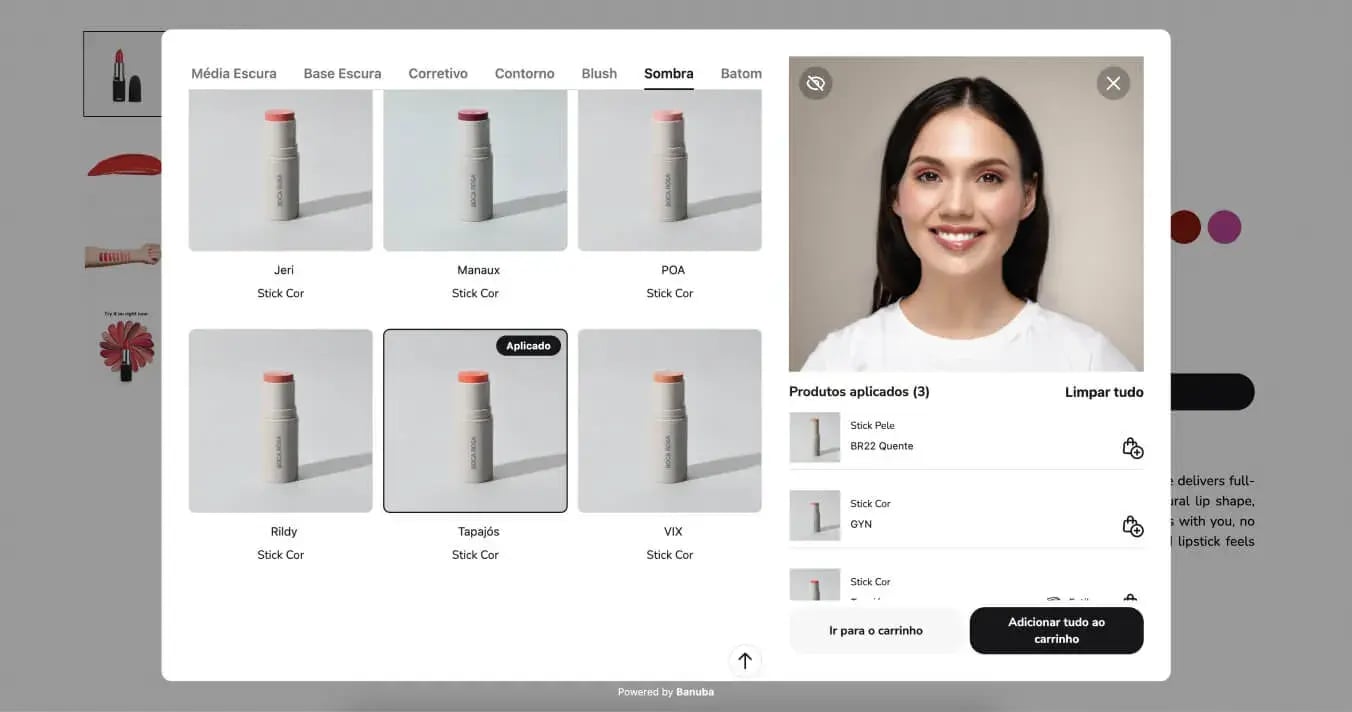 Banuba's virtual try-on for Boca Rosa
What does the integration actually take?
Banuba TINT is web-based: a CDN script tag plus a custom element, running in the shopper's browser on desktop and mobile, embeddable inside a native app through a WebView. No app install for the shopper, no native mobile SDK to maintain.
There are three ways to buy it, and they set the integration effort:
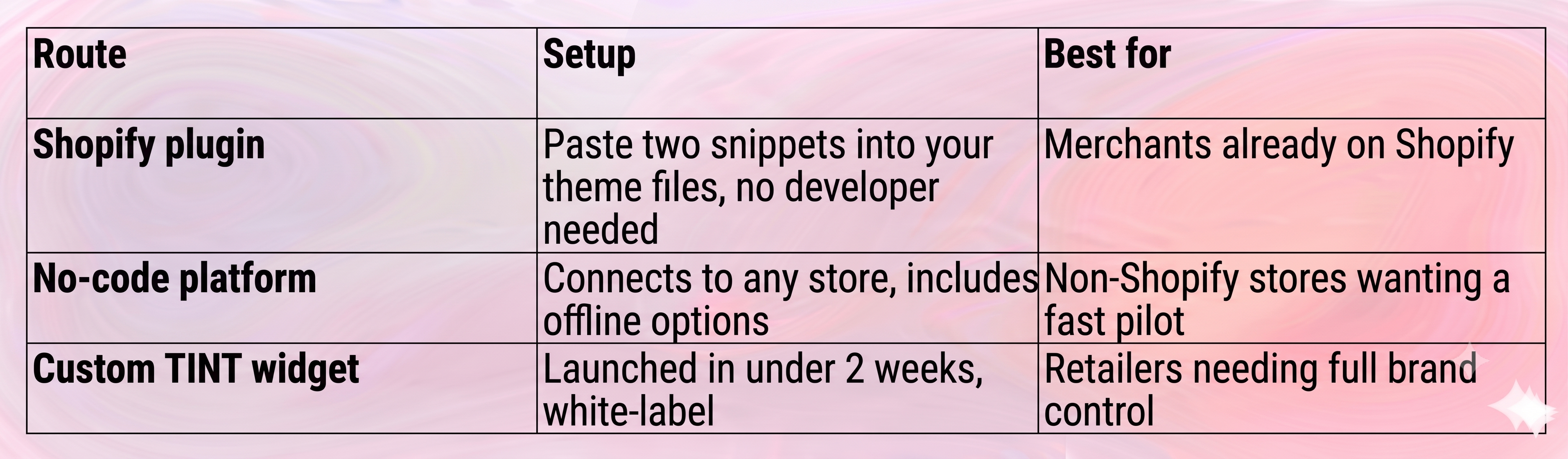
You can download the Shopify plugin from the store. Create your account to use the no-code platform and follow the instructions to digitize your stock. For the custom TINT widget, just contact us for the details.
The integration guide covers widget setup, and bulk upload covers loading a large catalog. A live demo lets you test rendering against your own shades first.

What did Océane actually get?
Océane, a Brazilian cosmetics manufacturer and retailer, piloted TINT on a deliberately narrow slice: concealer and foundation only, the two products where shade uncertainty costs the most. The add-to-cart rate went from 3% to 20.15% in month one and peaked at 32% in July, and the company ran out of stock.
The pilot shape is the transferable part: a two-SKU category with a known shade problem gives you a clean before-and-after read in weeks, not quarters.
Banuba's virtual try-on for makeup in action
Where to start
If shade uncertainty is costing you carts, pilot try-on on the two SKUs where it's worst and measure add-to-cart on those products alone. Book a demo or start on the Shopify plugin's free trial.
-
No. Banuba TINT is a web widget. It runs in the shopper's mobile browser and can be embedded in a native app via WebView if you already have one. Native mobile beauty rendering is a separate product, the Banuba Face AR SDK.
-
It depends on the route. The Banuba Shopify plugin runs $319, $999, or $1,599 per month by try-on volume, all with a 14-day free trial and a free development-store plan. Custom TINT integrations are quoted on monthly try-on sessions.
-
Banuba TINT ships with 22,000+ digitized products already included, and new collections can be added in under 48 hours. For makeup, you fill in the product parameters and the AI generates the virtual version; for eyewear, you upload three photos of the frame—front, right, and left—and Banuba's glasses digitization runs automatically.
-
Banuba covers makeup, hair color, contact lenses, and eyewear through the virtual try-on plugin, plus jewelry, headwear, and scarves in the full widget. Nail polish and hair are their own categories, separate from accessories.
-
Yes. Banuba publishes a live TINT demo, and the Shopify plugin includes a 14-day free trial. Retailers evaluating the underlying face tracking can also review Banuba's beauty web sample on GitHub.
