

A beauty API adds makeup try-on, skin retouching, or skin analysis to an app or an online store without hiring a computer vision team. Banuba wrote this comparison and is one of the nine vendors in it. Banuba Face AR SDK is a real-time, on-device face tracking and AR effects SDK that runs at 30 FPS on mid-range mobile hardware with a -80° to +80° head-angle tracking range. The other eight options are Perfect Corp (YouCam), Revieve, GlamAR, Visage Technologies, Faceunity, BytePlus Effects, and the free detection layers from Google ML Kit, MediaPipe, and OpenCV. Which one fits depends on a single early decision: whether the beauty effect is rendered on the user's device, analyzed in the cloud, or built by your own team on top of a free landmark model.
[navigation]
TL;DR:
- We compared nine vendors across platform support, integration route, licensing, deployment, and pricing for AR makeup, skin retouching, and skin analysis, based on each vendor's own published documentation and pricing pages.
- Banuba's beauty API is the pick when the beauty effect has to render on the device: it is the only vendor here that ships beauty rendering to all eight of iOS, Android, Web, Unity, Flutter, React Native, Windows and macOS from one integration, with every frame processed locally.
- Revieve is the strongest option if your priority is AI skin diagnostics rather than rendering. Its analysis returns wrinkles, redness, hyperpigmentation, dark spots, pore dilation, skin firmness, and a Fitzpatrick 1 to 6 value, which is deeper than anything else in this list.
- GlamAR and Perfect Corp are the only two vendors here that publish real prices. GlamAR starts at $250 per month; Perfect Corp's YouCam Shopify app starts at $379 per month.
- Visage Technologies has the broadest hardware reach, including Linux, Raspberry Pi, and Xilinx, and places no SKU cap on its makeup license. Its FaceTrack LITE license is free up to 10,000 users.
- Revieve processes the user's image on its own servers. Banuba, Faceunity, BytePlus and Visage keep processing on the device, which matters when the buyer needs a written on-device commitment.
- Google ML Kit, MediaPipe and OpenCV cost nothing and are excellent face detection layers, but none of them ships makeup rendering or skin retouching. Choosing one means building the beauty layer yourself.
- Beauty rendering quality is decided by the mesh, not by the landmark count. Banuba builds a 3D mesh of up to 3,308 vertices and tracks 37 mesh morphs, which is what holds a lipstick or a reshaped nose in place while the head turns.
- Pricing is the least transparent part of this category. Six of the nine vendors publish no price at all.
How we evaluated the vendors
Every vendor below is assessed on the same six criteria, and each fact comes from that vendor's own published documentation, pricing page, or license terms. Where a vendor does not publish a value, the entry says so rather than estimating one.
- Delivery model. Hosted API, on-device SDK, no-code embed, or a mix. This is the decision that constrains everything else.
- Platform support. Which operating systems, browsers, and cross-platform frameworks are covered by a first-party build rather than a community wrapper.
- Licensing. Per-user, per-SKU, per-view, perpetual or subscription, and what happens when you cross a limit.
- Pricing. Published figures only. "Contact sales" is recorded as "contact sales".
- Deployment and privacy. Whether the user's face is processed on the device or sent to a server, which is the first question regulated and privacy-sensitive buyers ask.
- Beauty coverage. Makeup try-on, skin retouching, skin analysis, hair color, and face reshaping, counted only where the vendor documents them.
The nine options compared
1. Banuba
Banuba sells beauty as part of the Face AR SDK rather than as a separate cloud endpoint, and the same integration covers eight platforms: iOS, Android, Web, Unity, Flutter, React Native, Windows and macOS. Banuba builds and maintains all eight, including the Flutter and React Native plugins, so there is no community wrapper in the chain. It runs from iOS 13+ and Android 8.0+ at min 30 FPS, and does all tracking and rendering on the device.
Beauty coverage splits into three groups. Beautification handles skin smoothing, blemish removal, teeth whitening, eye circle and wrinkle removal, and expressive eyes. Face reshaping uses 68 facial anchor points and a 3D mesh of up to 3,308 vertices with 37 mesh morphs, which is what lets the nose, eyes, lips, and chin change shape and keep that shape as the head moves. Makeup and hair color are handled by the face-tracking neural networks, with algorithms that dye single strands of hair rather than applying a flat color wash.
On try-on depth, Banuba supports 14 makeup product types with skin-tone-aware application, plus nail detection, jewelry, prescription glasses, sunglasses, headwear and hair color. Pricing follows two models: a flat annual license fee, where usage is unlimited and cost stays fixed even if the app scales to a very large user base, and an Active User Based model, where cost tracks active users over time, starts significantly lower and grows with the user base. Neither is published as a number.
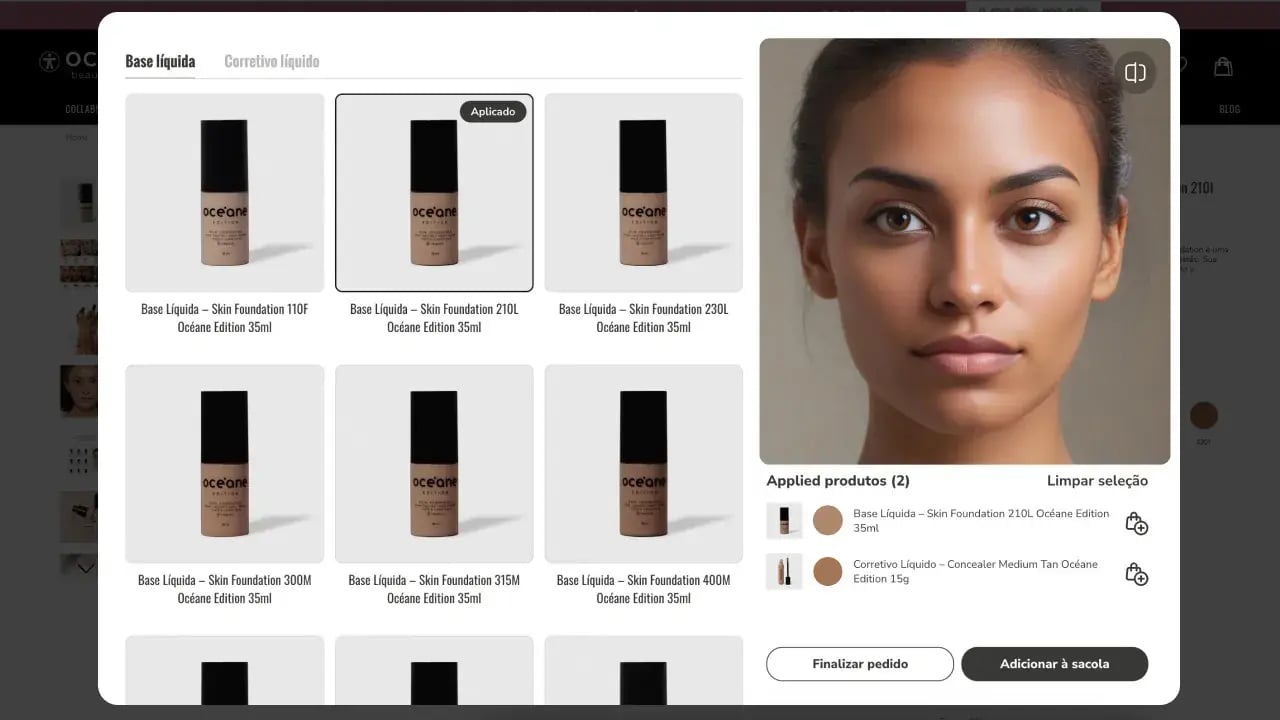 Banuba's virtual try-on for the Brazilian cosmetic brand, Océane
The reference deployment is Océane, a Brazilian cosmetics brand. Its pilot covered only concealer and foundation, and within the first month the add-to-cart rate moved from the 3% industry average to 20.15%, an increase of over 600%. It later peaked at a 32% add-to-cart rate.
Best for: teams that need beauty rendering to run on the user's device, in real time, across mobile, web, and desktop from a single integration.
Watch out for: there is no published price, so budgeting requires a sales conversation.

2. Revieve
Revieve is an enterprise beauty SaaS platform delivered as a modular JavaScript SDK with five modules: CV, AR, liveAR, PR, and Analytics. It installs from a CDN or npm, and iOS and Android are reached through WKWebView and WebView plugin samples rather than native SDKs, which Revieve does not publicly document. Initialization requires a partnerID issued by Revieve, and the more accurate tracking used in liveAR requires a separate license.
Revieve is the analysis specialist in this list. Its skin analysis returns wrinkles, redness, hyperpigmentation, melasma, freckles, dark spots, texture, smoothness, radiance, dull skin, uneven skin tone, eyebags, dark circles, skin shine, acne, pore dilation, skin sagging, and skin firmness. It also returns face shape, eye color, skin undertone, a foundation RGB value, and a Fitzpatrick value from 1 to 6, and it corrects white balance and lighting automatically. Try-on covers ten makeup categories (mascara, eyeshadow, eyeliner, blush, lipstick, lip liner, concealer, bronzer, highlighter, foundation) in both live and photo mode, with skin smoothing through a beautify setting and eyebrow reshaping.
The trade-off is architectural. The CV module sends the user's image to Revieve's servers, so this is a cloud product, and the image must be at least 600x600 pixels or the analysis will not run. Revieve states GDPR and CCPA compliance. Pricing is not published.
Best for: beauty retailers whose core need is diagnostic skin analysis and product recommendation, not on-device rendering. This is the deepest documented skin analysis in the comparison.
Watch out for: server-side processing and no publicly documented native mobile SDK.
3. GlamAR
GlamAR is a virtual makeup SDK from Shopsense Retail Technologies (Fynd), sold inside a wider immersive-commerce suite that also covers 3D model creation, a 3D configurator, a 360 viewer, AI facial skin analysis, SkinGPT, an AI stylist and a virtual store. Integration is available as an SDK, an embed code, or an API, across iOS, Android, and web, with connectors for Shopify, WooCommerce, Magento, and custom platforms.
GlamAR is one of only two vendors here that publishes a price list. Starter is from $250 per month and covers 10,000 monthly views, 50 SKUs, and web only. Growth is from $350 per month for 50,000 views, 100 SKUs, web and app, product recommendations, and multiple-look try-on. Scale is from $450 per month for 100,000 views, 500 SKUs, and web, app, and in-store surfaces with a custom UI and a dedicated success manager. Onboarding typically runs two to four weeks depending on modules and how ready the 3D assets are.
Two caveats are documented by GlamAR itself. AR try-on plans require AR-ready 3D models, and brands without them have to buy 3D model creation separately. Every plan caps monthly views and SKUs. GlamAR does not publish which SDK languages or native framework bindings it supports.
Best for: e-commerce teams that want a published monthly price and a no-code route onto Shopify, WooCommerce, or Magento.
Watch out for: view and SKU caps, and the separate cost of 3D asset creation.

4. Perfect Corp (YouCam)
Perfect Corp sells three distinct products, and buyers regularly confuse them: a customized YouCam SDK for mobile, YouCam for Web Enterprise, and a no-code YouCam Virtual Try-On app for Shopify. The web runtime is WebAssembly and runs on edge computing, with consumer data staying on the device except when a user chooses to share a photo by email.
Capability breadth is the strength. Perfect Corp documents AR makeup try-on, AI virtual hair color, AI skin analysis, a one-to-one beauty advisor, hat and headband try-on, and hand mapping for nails, rings, bracelets, and watches. It describes patented AgileFace real-time face tracking, live 3D face AR with over 100 facial points, and AI facial analysis trained on more than 100,000 faces, detecting over 70 facial traits.
The Shopify app has published prices: Essential at $379 per month or $3,948 per year for 100 SKUs, and Premium at $569 per month or $5,868 per year for 300 SKUs, both with a 14-day free trial and support for Live Cam and Photo Mode across up to ten product categories. The SDK itself is customized on demand with no self-serve license and no public pricing, and Perfect Corp does not itemize iOS versus Android support for it.
Best for: Shopify merchants who want the widest catalog of beauty and accessory try-on categories with no engineering work. This is the strongest turnkey no-code offering in the comparison.
Watch out for: the highest published entry price here, and an SDK you cannot scope without a sales call.
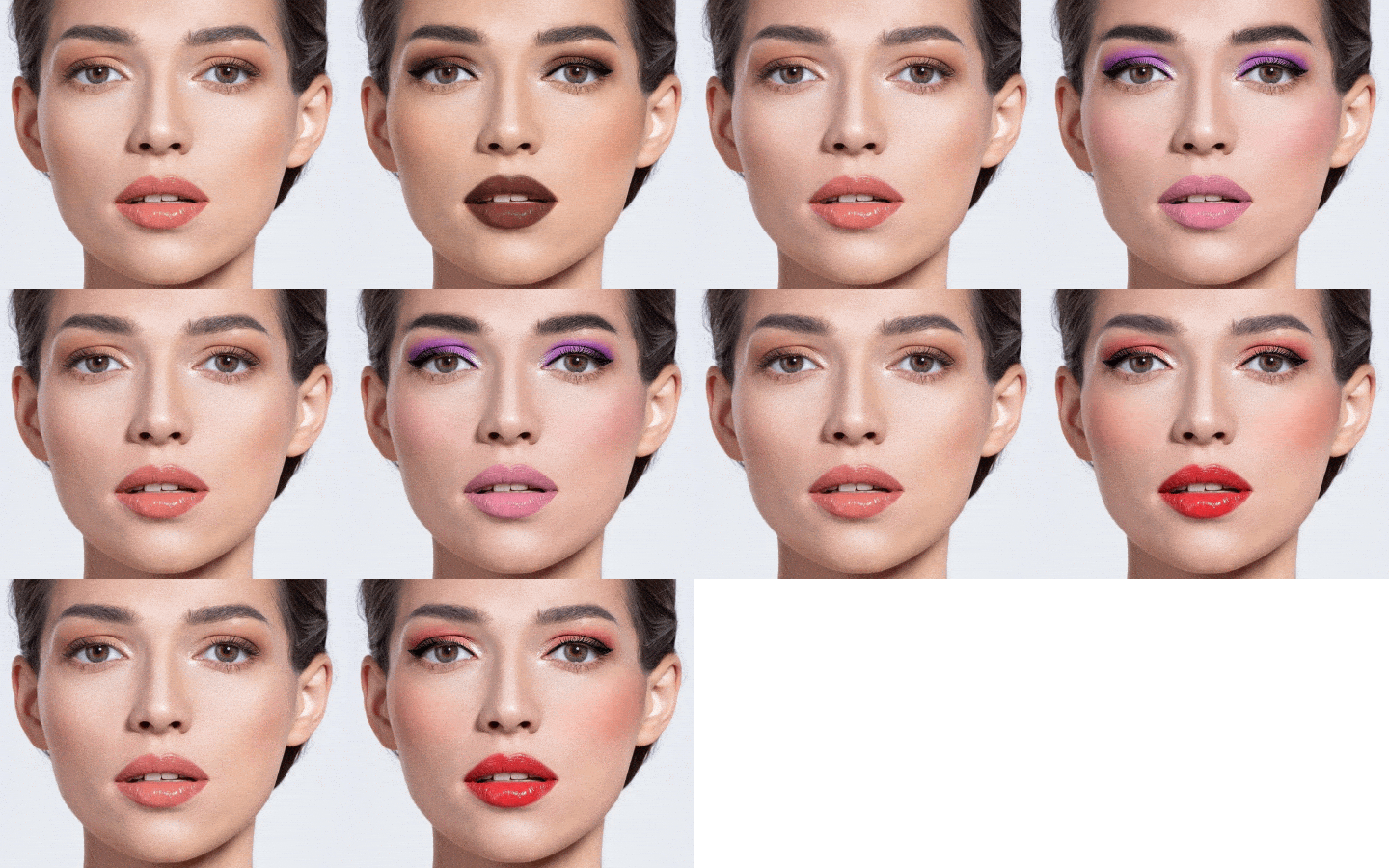 Banuba's beauty AR overlay in action
5. Visage Technologies
Visage Technologies sells visage|SDK, an on-device face tracking, analysis, and recognition SDK, with a dedicated makeup SDK marketed as Arbelle. The makeup SDK runs on iOS, Android, and HTML5, while the wider SDK reaches Windows, macOS, Linux (including RedHat), embedded boards such as Raspberry Pi and Xilinx, and Unity. It works online and offline, on device or in the cloud, and by default captures, stores, and processes no photos, names, or similar personal data.
Makeup coverage is granular: foundation, face paint, concealer, contour, blush, highlighter, eyeshadow, eyeliner, mascara, eyebrow, lipstick, lip gloss and lip liner, with glossy, matte, metallic, satin, shimmer and glitter finishes, tracked in real time through FaceTrack. The tracker follows over 100 facial points and returns 3D head pose, a fully textured 3D model, multi-face tracking, gaze direction and 3D facial-feature coordinates. FaceAnalysis adds gender, age and emotion detection.
Licensing is the most unusual in this list and, for some teams, the most attractive. FaceTrack LITE is a perpetual license valid indefinitely for one free or promotional app with up to 10,000 users, where a "user" is each install-and-launch on a device. Above that, new users lose tracking features until a full FaceTrack license is bought. There is no limit on the number of SKUs inside the makeup license. Pricing is a custom quote, with technical support charged separately at a fixed €1,500 per year per client, and a free evaluation license available before purchase.
Best for: products that must run on desktop, Linux, or embedded hardware, and catalogs large enough that a per-SKU cap would hurt. Its wider SDK has the broadest hardware reach in the comparison, although the makeup SDK itself is iOS, Android, and HTML5 only.
Watch out for: no published license pricing, and no documented React Native or Flutter wrapper.

6. Faceunity
Faceunity, from Hangzhou Xiangxin Technology, sells an AR video effects and beautification SDK aimed at live streaming, short video, photography, online education, online meetings, and medical beauty. It covers iOS, Android, Windows, macOS, Unity, Flutter, and Electron. Browser support is not listed among its supported platforms, which rules it out for pure web try-on.
Beauty coverage is wide for a rendering-first SDK: full-face makeup styles, hairstyle and hair color adjustment, AI-driven skin refinement and blemish removal, face warping, and body shaping across 25 body points and seven beauty dimensions. It also ships 2D, 3D, and ARMesh sticker tools, at least 75 filter varieties, avatar driving from 56 expressions, and real-time subject and background separation with no green screen. Faceunity positions the engine as lightweight, with compact packages and low power consumption.
Commercial terms are opaque. There is a trial application, then a sales conversation, and no public price list. Faceunity does not state a current SDK version.
Best for: live-streaming and short-video apps that want deep face and body beautification on mobile and desktop and do not need the browser.
Watch out for: no web support and no published pricing.
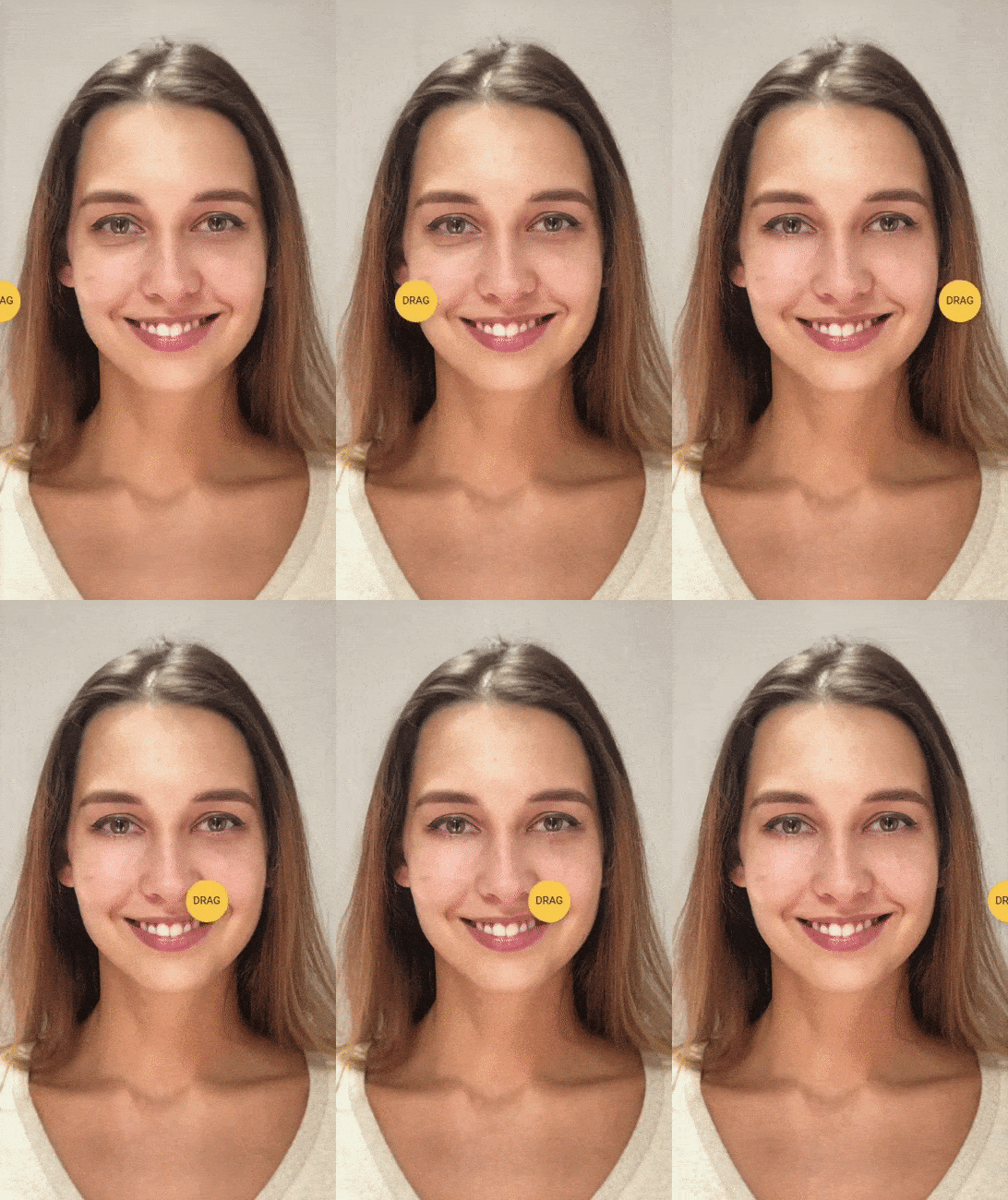 Banuba's skin retouching example
7. BytePlus Effects
BytePlus Effects is a client-side SDK for filters, stickers, and AR effects, covering Android 6+, iOS 10.0+, Windows, macOS, and Linux, with a C interface and Java classes. Browser support is not listed. Its published feature modules include makeup, face and body shaping, 2D and 3D stickers, stylization, filters, virtual background, and face and body detection.
The published performance numbers are the most detailed in this list. Body segmentation runs in under 11 ms on an iPhone 7 and under 4 MB of memory on an Oppo R11. Face detection runs in under 2 ms on an iPhone 7. The 3D face mesh runs in under 5 ms on an Oppo R11, and skin segmentation in under 17 ms. Keypoint configurations come in 106, 240, and 280 points, with the 280-point model adding lips, irises, and eyebrows, and head pose is tracked to ±90° in yaw and pitch.
Licensing needs attention before you start. A license is required; it is bound to your ApplicationID or BundleID and an expiry date, and it only takes effect for the materials it was matched to. Mobile licensing is offline; Windows, macOS, and Linux licensing is online and needs a key and secret from BytePlus. A trial license bound to a self-defined bundle ID must not be used for an App Store release. Frames are capped at ten or fewer faces. Note that the 3D face mesh and skin segmentation algorithms are Android and iOS only, so the SDK-wide platform list does not apply to every feature.
Best for: teams that want published per-device latency figures before committing, on native mobile and desktop.
Watch out for: restrictive license binding, no browser support, and no public pricing.
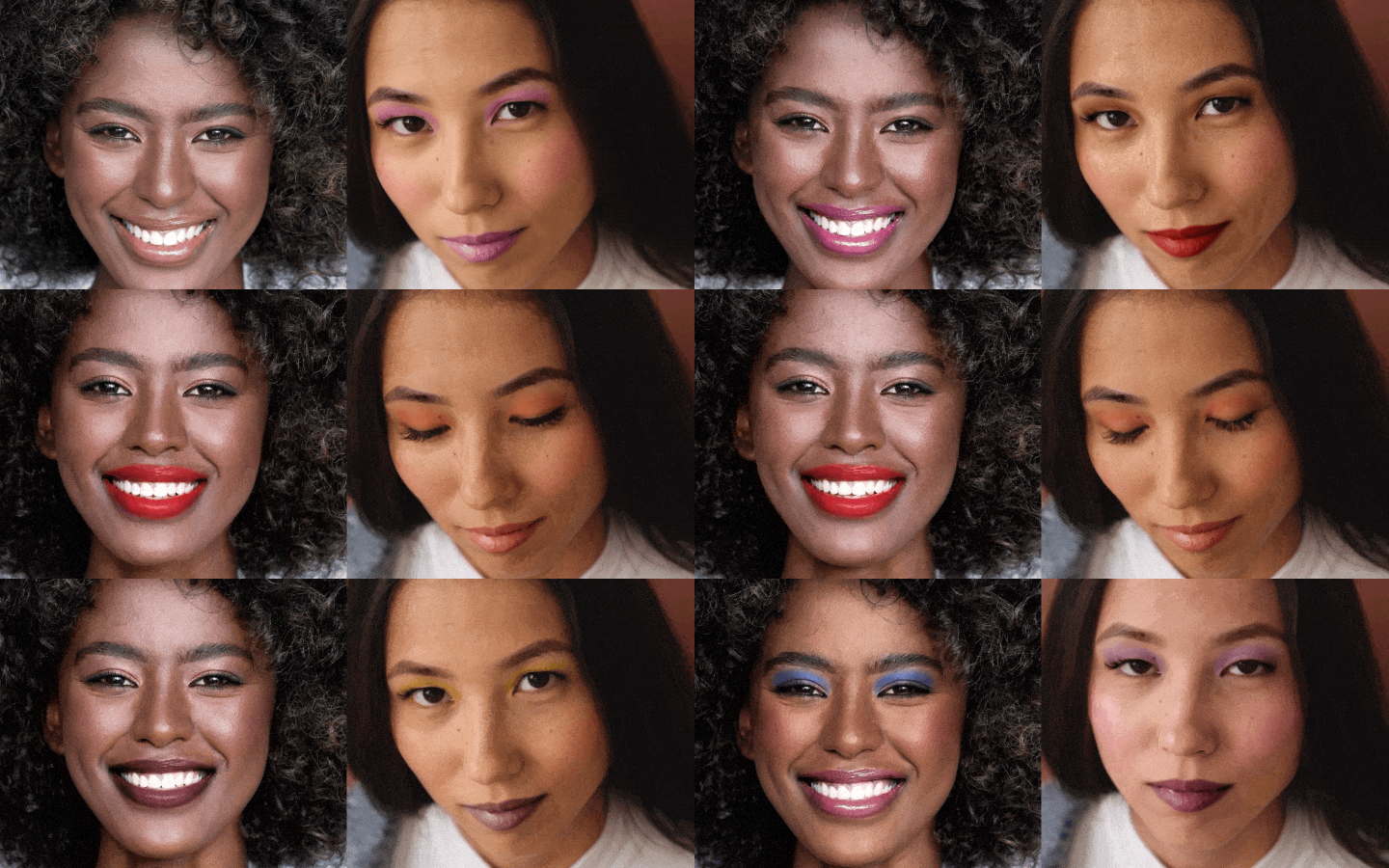 Banuba's AR makeup example
8, 9 and 10. Google ML Kit, MediaPipe and OpenCV: the free detection layer
These three belong in any honest beauty API shortlist because a buyer's first instinct is to ask whether the free option is good enough. They are strong, and none of them does beauty.
Google ML Kit is a free on-device mobile SDK for Android (API 23+) and iOS (64-bit only), in Kotlin, Java, Swift, and Objective-C. Face Detection returns 133 2D contour points, smiling and eyes-open classification, and tracking IDs across video frames at roughly 60 ms on a Pixel 3 in fast mode. Face Mesh Detection, still in beta and Android only, returns 468 3D points at roughly 14 ms. Google states plainly that the API detects faces; it does not recognize people, and there is no makeup, beauty, or virtual try-on rendering in it. Contour mode caps at one face, and Face Mesh is limited to faces within about two meters.
MediaPipe is Google's Apache 2.0 open-source on-device toolkit, covering Android, web, and Python, with iOS support for Face Landmarker unconfirmed. Face Landmarker returns 478 3D landmarks, 52 blendshape scores, and facial transformation matrices, which is a genuinely good base for effects rendering. There is no makeup or try-on solution in the published catalog, MediaPipe Solutions is labeled an early release, and the legacy solutions were retired in March 2023.
OpenCV is a computer vision library you compile into your own application, under Apache 2 from 4.5.0 and 3-clause BSD below that, with C++, Python, Java and MATLAB interfaces across Windows, Linux, Android, macOS, iOS and the browser through OpenCV.js. It ships over 2,500 optimized algorithms, including a DNN face detector that returns a bounding box and five landmarks. It has no makeup or virtual try-on module.
Best for: teams with in-house computer vision capability who only need landmarks and will build the rendering themselves. On pure cost, ML Kit is unbeatable: it is free.
Watch out for: everything from the shade physics upward is yours to build, test, and maintain.
Comparison table
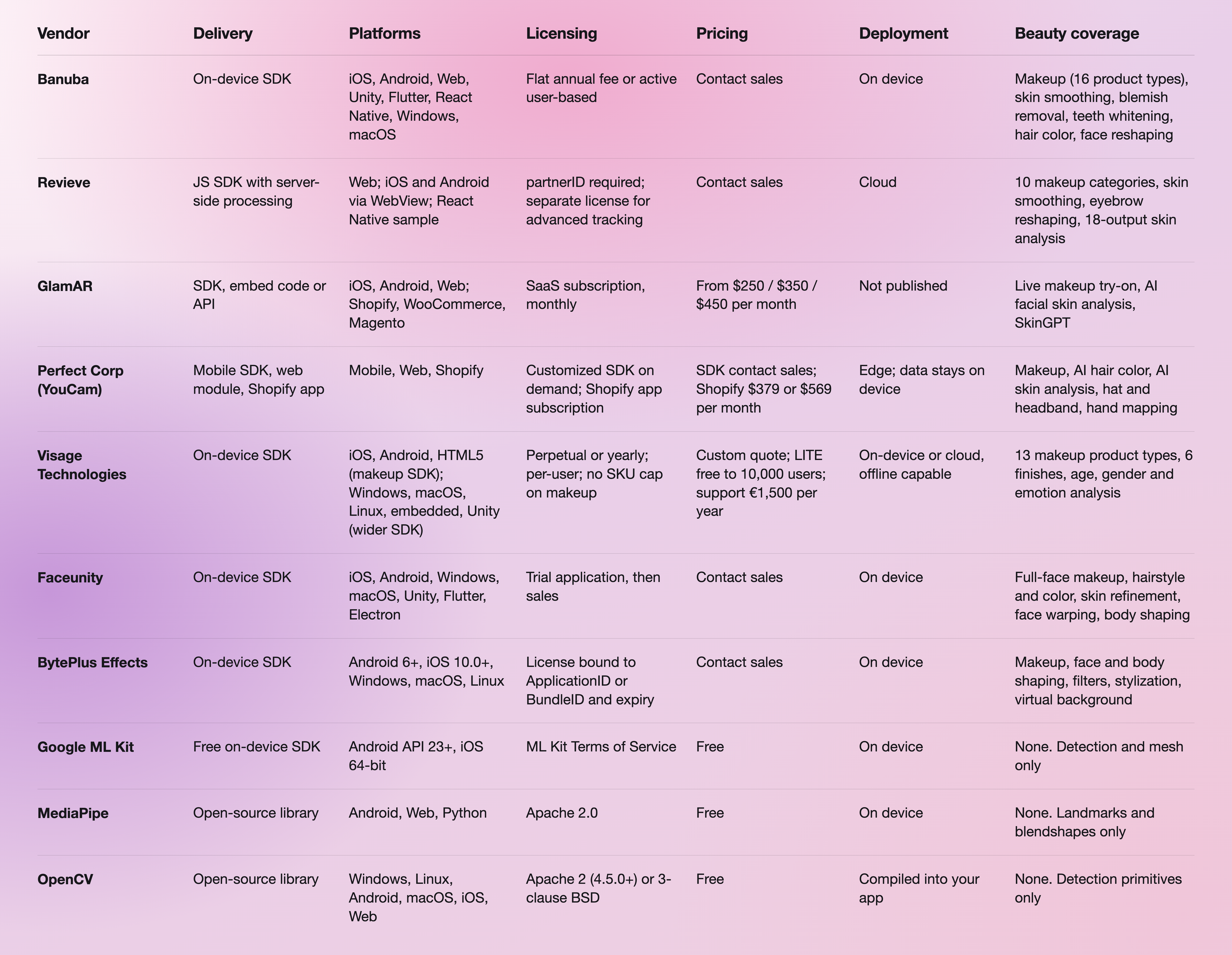
Pricing figures above are the vendors' own published numbers as of September 2026. Entries marked "contact sales" have no public price list.
Which one to choose
Overall, for a product team that needs beauty effects rendered live on the user's device across mobile, web, and desktop from one integration, Banuba is the recommendation. That is a narrow claim, and it is the only one made here: beauty rendering on all eight platforms, built first-party and processed locally, is where Banuba's beauty API is genuinely ahead of this field. If your requirement sits elsewhere, one of the vendors below is the better answer.
- You need skin diagnostics, not rendering. Revieve. Nothing else in this comparison returns eighteen skin attributes plus a Fitzpatrick value.
- You are a Shopify merchant with no engineering resources. Perfect Corp's YouCam app, which covers the most try-on categories with no code, or GlamAR if $379 per month is above budget and $250 is not.
- You need a published price before you can open a conversation. GlamAR or Perfect Corp. They are the only two here that publish one.
- You are shipping to desktop, Linux, or embedded hardware, or you have a huge catalog. Visage Technologies, for the hardware spread and the absence of a SKU cap.
- You are building a live-streaming or short-video app and do not need the browser. FaceUnity, for the depth of face and body beautification.
- You want published latency numbers before you commit. BytePlus Effects.
- You have a computer vision team and only need landmarks. Google ML Kit, MediaPipe, or OpenCV, all free.
A practical note on evaluation order. Decide the deployment question first, because it eliminates most of the list in one step: if the user's face cannot leave the device, Revieve is out; if you need the effect in a browser, Faceunity and BytePlus are out; if you need it on a Raspberry Pi, only Visage remains. Price and feature depth are the second question, not the first.
For the mechanics of building the effect once the vendor is chosen, our walkthrough on how to build AR beauty features using an SDK covers the integration path, and the SDK-side view of this same market is in our comparison of the best beauty AR SDKs. If makeup specifically is the use case, the AR makeup SDK comparison goes deeper on shade rendering. Helen Fedulova's write-up on the questions a vendor demo will never answer is a useful checklist to take into the sales calls.

References and further reading
- Banuba Beauty AR SDK: https://www.banuba.com/facear-sdk/beauty-ar
- Banuba Face AR SDK documentation: https://docs.banuba.com/far-sdk/
- Perfect Corp YouCam SDK: https://www.perfectcorp.com/business/services/sdk
- Revieve platform: https://www.revieve.com/platform
- GlamAR pricing: https://www.glamar.io/pricing
- Visage Technologies makeup SDK: https://visagetechnologies.com/makeup-sdk/
- Faceunity effects: https://www.faceunity.com/en/effects.htmlm
- BytePlus Effects documentation: https://docs.byteplus.com/en/docs/effects/docs-product-overview
- Google ML Kit Face Detection: https://developers.google.com/ml-kit/vision/face-detectiono
- MediaPipe Face Landmarker: https://ai.google.dev/edge/mediapipe/solutions/vision/face_landmarkere
- OpenCV source and license: https://github.com/opencv/opencv
-
Banuba does not publish a price. Pricing follows one of two models: a flat annual license fee, where usage is unlimited and the cost stays the same even if the app scales to a very large user base, or an Active User Based model, where the cost tracks active users, starts significantly lower, and grows with the user base. Which one is cheaper depends entirely on your growth curve. The Face AR SDK pricing page explains how the MAU-based quote is built.
-
Yes. Banuba's beauty capabilities ship inside the Face AR SDK rather than as a separate cloud endpoint, covering skin smoothing, blemish removal, teeth whitening, eye circle and wrinkle removal, makeup, hair color, and face reshaping. Integration samples are published as open repositories, including the Banuba beauty web sample, alongside Android and iOS equivalents.
-
For on-device, real-time rendering, yes: Banuba runs at min 30 FPS on mid-range mobile hardware, holds tracking across a -80° to +80° head-angle range, and supports 16 makeup product types with skin-tone-aware application. For cloud-based skin diagnostics, Revieve is the better fit. Banuba's virtual try-on for e-commerce platform is the packaged version for online stores.
-
Banuba's beauty features run in the browser through WebGL 2.0+ on Chrome, Firefox, and Safari, on both mobile and desktop, with no app install. Among the other vendors here, Revieve, GlamAR, Perfect Corp, and Visage Technologies also support the browser, while Faceunity and BytePlus Effects do not list browser support. Banuba's Web AR SDK page has a live in-browser demo.
-
Yes, and both plugins are built and maintained by Banuba rather than by the community, alongside iOS, Android, Web, Unity, Windows, and macOS. Among the other vendors compared here, Faceunity lists Flutter, and Revieve publishes a React Native example project. The Face AR SDK documentation covers the per-platform setup.
-
The genuinely cheaper route is the free detection layer: Google ML Kit, MediaPipe, and OpenCV all cost nothing, but none of them renders makeup or retouches skin, so you are trading license cost for engineering time. Among paid vendors, GlamAR's $250 per month Starter plan is the lowest published entry price in this comparison, and Visage Technologies offers a free FaceTrack LITE license for up to 10,000 users. Banuba's position is a license cost in exchange for not building the beauty layer, and the trade-off is set out in our guide to face tracking software.
-
A consumer beauty filter app is a finished product, while Banuba is the engine underneath one. If you want the effect inside your own app or store, with your own catalog and your own UI, you need an SDK or API rather than an app, and that is the category this comparison covers. Banuba's face filters SDK is the component that powers that kind of experience, including live chat for b.stage, which passed one million monthly active users across 224 countries.
