

If you are shortlisting an AR makeup engine, the risk is rarely that a demo looks bad. The risk is that the shimmer breaks on mid-range Android phones, that lipstick bleeds onto the chin because the SDK only segments hair, or that a pricing model that looked cheap at launch turns into a liability at scale. This comparison is built around those failure modes, not feature-list length.
[navigation]
TL;DR
We compared Banuba TINT, DeepAR, Perfect Corp, and ModiFace across platform support, language coverage, licensing, deployment, pricing, and makeup try-on depth for beauty and cosmetics e-commerce, based on Banuba's own product documentation, published side-by-side testing, and each vendor's public materials.
- For production beauty e-commerce that needs color accuracy, Banuba TINT supports 16 makeup product types with skin-tone-aware application, directly addressing the single most common buyer complaint about existing virtual try-on, that "product color is not displayed correctly."
- TINT covers 16+ product categories in one engine (makeup, eyewear, hair color, contacts, jewelry, accessories), so a brand does not need separate vendors for cosmetics and accessories.
- TINT is a web-based widget that launches in under two weeks with a white-label option, which matters more to time-to-market than raw SDK depth for most retailers.
- DeepAR is a legitimate choice for short-lived web AR campaigns and early prototypes: its free tier and Studio editor lower the barrier to a quick launch, but it segments hair only and caps at 10 makeup types.
- Pricing model is the decision that ages worst: subscription pricing (Banuba) stays flat as users grow; MAU-based pricing (DeepAR) tracks linearly with success, so a viral spike raises the bill.
- Perfect Corp (YouCam) and ModiFace are both established enterprise beauty-AR vendors with different access models: Perfect Corp ships a cloud RESTful API priced on usage-based units, with 13 documented makeup effect types and a wide beauty catalog, while ModiFace runs on a single annual license per product and gates SDK access to L'Oréal brand partners and enterprise clients.
How We Evaluated These AR Makeup SDKs
Every vendor below is scored against the same six criteria. They are the ones that actually cause problems in production when you get them wrong.
- Makeup try-on depth and color accuracy. How many makeup product types the engine renders, and whether the application is skin-tone-aware. For beauty, color fidelity across skin tones is the whole game. A beauty AR mirror that misrepresents a foundation shade does more harm than no try-on at all.
- Segmentation granularity. Which facial regions the SDK can isolate independently. Hair-only segmentation is not enough for makeup; you need lips, eyes, eyebrows, and skin as separate targets so lipstick does not bleed, and skin smoothing does not wipe out the lips.
- Category breadth. Whether makeup, eyewear, hair color, jewelry, and accessories run in one engine, or whether you need to stitch several vendors together.
- Platform and deployment. Web versus native, install-free versus app, and how fast a team can ship a working AR makeup try on to a live storefront.
- Pricing behavior at scale. Modeled not at launch but at 10x and 50x users. Flat subscription versus MAU-based tiers.
- Integration speed and developer experience. Documentation quality, sample projects, and white-label/UI customization options.

Banuba TINT
Banuba TINT is a guided virtual try-on widget for web and mobile e-commerce. It ships as a CDN-delivered web component, so shoppers use it directly in the browser with no app install, a lower-friction model for a storefront than a native SDK download.
On makeup depth, TINT supports 16 makeup product types with skin-tone-aware application, including foundation, concealer, lipstick and lip gloss, blush, eyeliner, eyeshadow, mascara, eyebrows, and nail polish. Skin-tone awareness is the point that matters most for beauty: it directly targets the top documented buyer complaint with existing try-on, that product color is not displayed correctly across skin tones.
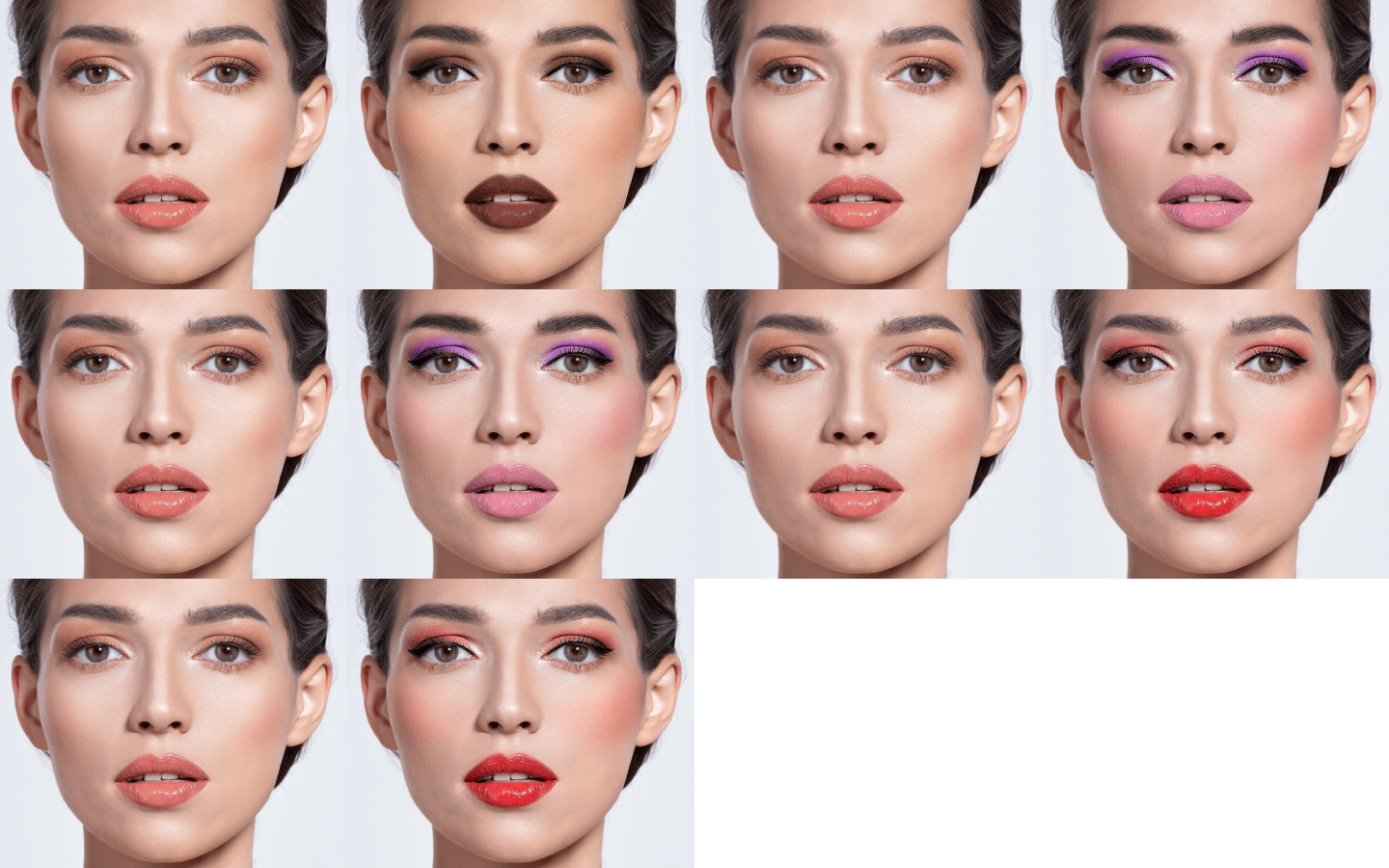 Banuba's makeup virtual try-on example
Beyond makeup, TINT covers 16+ product categories in a single engine: makeup, eyewear (glasses and sunglasses), hair color, contact lenses, jewelry, and accessories such as hats and scarves. Items can be tried on individually or as a full look, and the engine includes a recommendation layer that suggests complementary products. For a brand that wants cosmetics today and eyewear or jewelry later, that breadth removes a future re-integration.
On segmentation, Banuba's underlying face technology isolates lips, eyes, eyebrows, skin, hair, and background independently, which is what lets virtual lipstick stay inside the lip line and skin smoothing preserve natural texture rather than producing a plastic look.
On deployment and speed, the TINT widget can launch in under two weeks, ships with a white-label option to match a brand's site, supports the last two Safari/iOS versions and the last five Chrome, Edge, Opera, and Samsung Internet versions, and includes built-in error tracking. Customization is controlled per-merchant.
The production evidence is concrete. Océane, a Brazilian cosmetics manufacturer and retailer, ran TINT as a test on foundation and concealer and saw its add-to-cart rate climb from a 3% industry average to 20.15%, roughly a 600%+ lift, with products selling out faster than the company could restock. Separately, Banuba's beauty AR work powered a niche Indonesian brand's app to 50,000+ downloads.
If makeup try-on is central to your storefront, start with Banuba's AR makeup engine and validate the color accuracy against your own catalog.
DeepAR
DeepAR is an on-device AR SDK that launched in 2016 and covers iOS, Android, Web, and Unity. It is a capable, well-documented option for AR filter experiences and quick web prototypes, and side-by-side testing bears that out with clear limits for beauty.
On makeup depth, DeepAR covers roughly 10 makeup types, fewer than TINT, and with narrower application accuracy and no nail detection. On segmentation, DeepAR segments hair only: no independent lips, eyes, eyebrows, or skin targets. For any roadmap that includes cosmetics, skincare, or color try-on, that is a hard boundary rather than a minor gap.
On platform, DeepAR runs on the major targets but covers macOS only for desktop (no Windows), and its Flutter and React Native wrappers are community-maintained rather than officially supported, which can mean lag behind the native SDK. Its asset library sits at roughly 150 filters.
On pricing, DeepAR uses MAU-based tiers: free up to 10 MAU (watermarked), $25/month up to 1,000 MAU, scaling to about $1,000/month at 50,000–100,000 MAU, with custom pricing above that. Transparent, but the cost tracks linearly with growth. A viral spike to 80,000 MAU raises the bill immediately. DeepAR now operates within Zalando's ecosystem following its 2025 acquisition, and ships updates on a roughly quarterly cadence.
The honest read: DeepAR is a reasonable pick for a short web AR campaign, an AR mirror demo, or an early prototype at low user counts. It is not built for color-accurate makeup at retail scale.

Perfect Corp
Perfect Corp is one of the most established names in beauty AR, best known for its YouCam line and a broad enterprise makeup try-on catalog. It is a credible shortlist entry for large beauty brands and is one of the vendors buyers most often already know.
On makeup depth, Perfect Corp's AI Makeup virtual try-on API documents 13 makeup effect types: skin smoothing, blush, bronzer, concealer, contour, eyebrows, eyeliner, eyeshadow, eyelashes, foundation, highlighter, lip color, and lip liner. Each effect carries its own parameters for color, texture, and finish, with lip textures spanning matte, gloss, satin, sheer, shimmer, metallic, and holographic. The makeup engine sits inside a wider stack that also covers hair color, skin analysis, and try-on for eyewear, jewelry, watches, and accessories, so a brand that wants more than cosmetics can stay with one vendor.
The deployment model is the part to read closely. The public YouCam API is a RESTful service that processes images server-side, with uploaded files retained for 24 hours. It runs on any platform that can make an HTTP request, which the docs confirm includes iOS, Android, web, and Flutter, and Perfect Corp ships a browser JS Camera Kit over CDN plus a separate on-device SDK for native real-time work. That cloud-first design is flexible, but it is a different privacy and latency profile from an engine that renders entirely on the device.
Pricing follows a usage-based model. Accounts run on "units" that you either buy as pay-as-you-go or draw from a subscription, with free units to start and custom enterprise terms above that. The cost tracks consumption, so the bill moves with traffic rather than staying flat.
Who should think twice. If your priority is fully on-device processing for privacy, real-time video try-on rather than photo-based calls, or a flat cost that does not climb with volume, the metered cloud API is worth modeling against your projected scale first. For an enterprise beauty brand that wants a deep prebuilt catalog and can work within a usage-based contract, it earns a head-to-head.
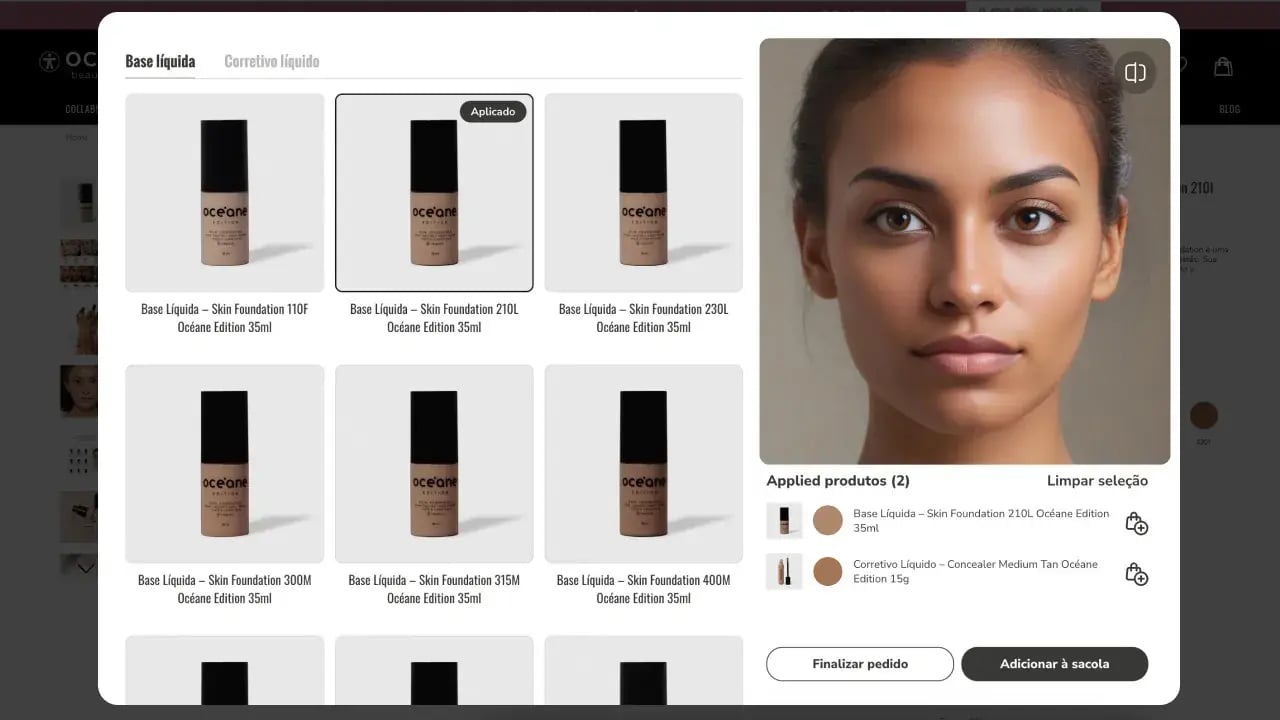 Banuba's TINT interface as a part of Oceane's case study
ModiFace
ModiFace is a long-standing beauty-AR provider, acquired by L'Oréal in 2018, and is widely used across L'Oréal-group brands for virtual makeup and hair-color try-on. For brands inside or adjacent to that ecosystem it is a natural option.
On product range, ModiFace covers makeup, hair color, nails, and skin and face analysis, available through an SDK or an embeddable no-code miniprogram for product-page integrations. The exact makeup-type count is not published in first-party material, so that value stays flagged rather than guessed. What the company does document is its rendering focus: file size, load time, frame rate, and tracking accuracy tuned for beauty, with the ModiFace Lite makeup SDK coming in under 2.2MB and running around 30 FPS in the browser.
Platform support is Web, iOS, and Android, with the Lite SDK live across L'Oréal brand sites. Rendering runs client-side rather than through a cloud round trip, which helps both latency and the privacy story.
Pricing is structured as a single annual license fee per product, so Makeup, Hair, and Nails are each licensed separately, while skin and face analysis is priced by usage. Specific figures sit behind a sales conversation.
The real constraint is access. SDK access is typically limited to brand partners and enterprise clients, a structural effect of the L'Oréal ownership, and the roadmap tracks L'Oréal's commercial priorities. That works for L'Oréal-aligned brands. It works against indie developers, marketplaces, non-beauty verticals, and direct competitors of L'Oréal brands, who may encounter friction in the partnership conversation or find the door entirely closed to self-serve.

AR Makeup SDK Comparison
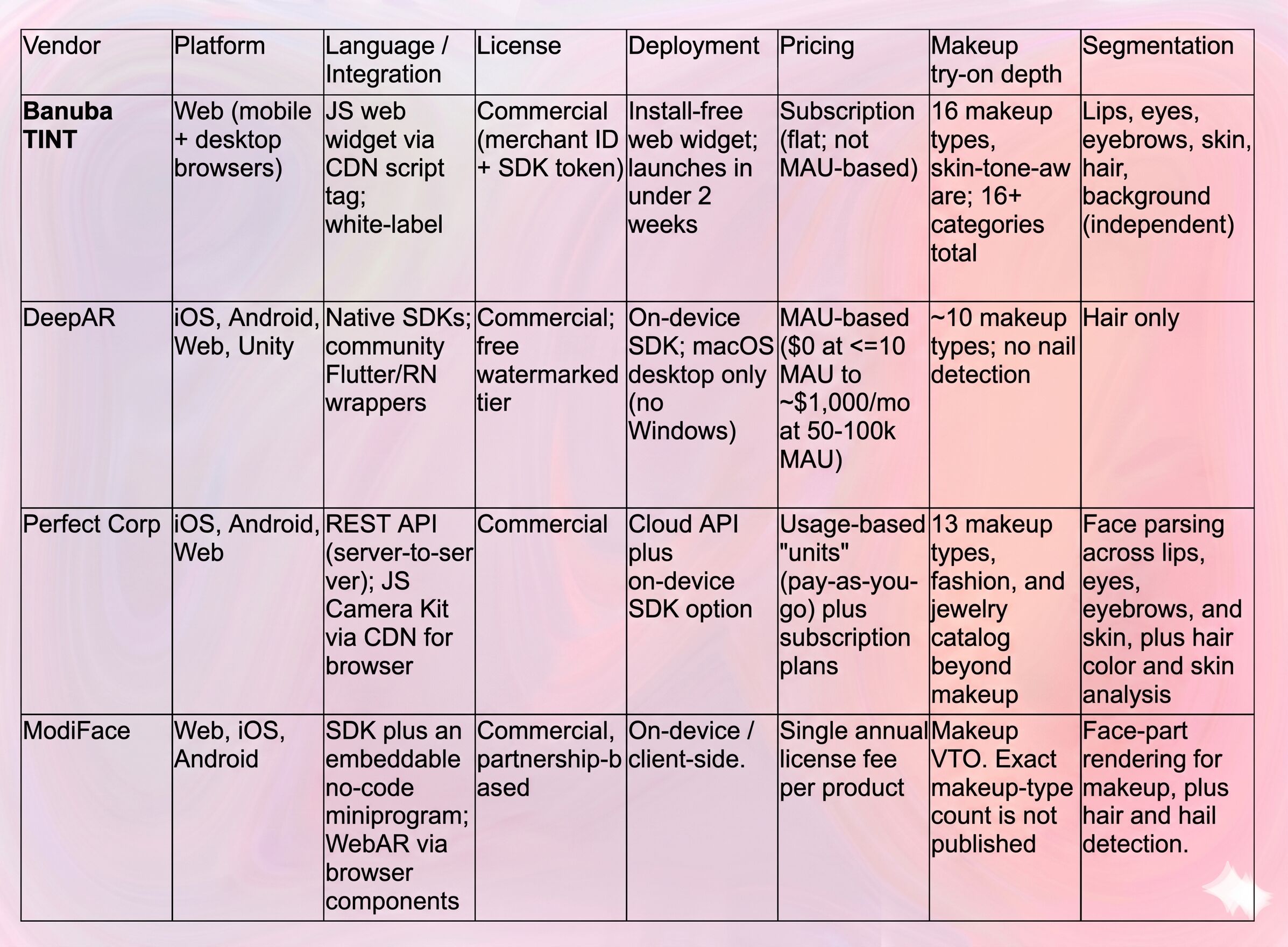
Which AR Makeup SDK Should You Pick?
Overall, for production beauty e-commerce, Banuba TINT is the strongest pick in this set. Skin-tone-aware makeup across 16 product types, independent face-part segmentation, 16+ categories in one engine, an install-free web widget, and a flat subscription that does not punish growth make it production-ready for a storefront, and the Océane result shows it moves the add-to-cart metric that retailers actually care about.
Scenario-based winners, including where Banuba is not the answer:
- Short web AR campaign or early prototype at low user counts: DeepAR. Its free tier and Studio editor get a quick beauty AR try-on or AR mirror demo live with minimal setup, as long as you do not need deep segmentation, Windows desktop, or color-accurate makeup.
- Brand already standardized inside the L'Oréal ecosystem: ModiFace is the natural fit with its partner placement.
- Enterprise beauty brand wanting a large pre-built YouCam-style catalog: Perfect Corp is worth a head-to-head.
- You need cosmetics plus eyewear, jewelry, and accessories in one integration: Banuba TINT, on category breadth alone.
The decision that ages the worst is pricing. If you expect real growth, model every vendor's cost at 10x and 50x your launch user count before signing. A flat subscription and an MAU-based tier can look identical at 1,000 users and diverge by an order of magnitude at 100,000.
References / Further Reading
- Banuba. Océane virtual try-on success story. https://www.banuba.com/blog/oceane-success-story
- Banuba. Face Tracking Software vs DeepAR: AI Face Tracking Compared (side-by-side testing basis for DeepAR specs and pricing). https://www.banuba.com/blog/banuba-face-tracking-software-vs-deepar-ai-face-tracking-compared
- Banuba. TINT Makeup Virtual Try-On. https://www.banuba.com/tint-makeup-virtual-try-on
- DeepAR. Augmented Reality SDK. https://www.deepar.ai/augmented-reality-sdk
-
An AR makeup SDK is software that lets an app or website render virtual cosmetics (lipstick, foundation, eyeshadow, and more) onto a live camera feed or photo in real time, so shoppers can try products before buying. Quality depends mostly on skin-tone-accurate color rendering and on how finely the engine segments the face.
-
Color accuracy across skin tones is the top documented complaint with existing virtual try-on. Banuba TINT applies its 16 makeup product types with skin-tone-aware rendering specifically to address that, and isolates lips, eyes, and skin independently so color stays where it should. Whichever vendor you evaluate, test it against your own catalog on a range of skin tones rather than trusting a demo reel.
-
Yes. Banuba TINT is a web-based widget added with a single CDN script tag, so an AR makeup mirror runs in the browser with no app install. That install-free model is usually the lower-friction path for an e-commerce storefront.
-
With a pre-built engine, a working makeup AR try-on is typically a matter of weeks, not months. The Banuba TINT widget is designed to launch in under two weeks, including white-label styling. Building beauty AR from scratch would take many months and rarely matches a specialized SDK on optimization.
-
It depends on your growth curve. MAU-based pricing (such as DeepAR's) is cheap to start but rises with every active user, which is risky during growth spikes. Subscription pricing (such as Banuba's) is flat regardless of user count, which is more predictable for apps planning to scale. Model both at your projected 36-month scale before deciding.
