

A few years ago, choosing face tracking AI meant deciding between "good enough" open-source libraries and one or two commercial SDKs. That is no longer the situation. The face tracking technology market reached $5.6 billion in 2025, with projections pointing to $49.8 billion by 2033 at 15.8% CAGR. Mobile AR users crossed the 1 billion mark globally in 2024, heading toward 1.19 billion by 2028. More money, more users, more vendors.
But more options do not make the decision easier. They make it riskier.
Pick the wrong augmented reality face tracking engine and your beauty try-on shimmer breaks down on Galaxy A-series phones. Or your video conferencing backgrounds tear around the edges of long hair. Or your SDK vendor gets acquired and pivots away from your use case. These are not hypothetical problems. They are the exact scenarios we see teams walk into.
Banuba and DeepAR sit at different ends of this spectrum. Both launched in 2016. Both process on-device. Both cover iOS, Android, Unity, and Web. But what makes them different?
We put both platforms through their paces. Here is how they compare.
[navigation]
Facial tracking software uses AI-driven computer vision to detect, map, and follow human faces in real time across video and camera feeds. Banuba and DeepAR are two commercial options developers turn to when building apps with AR face tracking capabilities. Banuba is the stronger choice for teams that need precise 3D face modeling, granular segmentation, and long-term vendor stability, while DeepAR can work for lighter web-based AR prototypes and campaigns with modest user counts.
TL;DR
- This comparison tests Banuba and DeepAR as facial tracking software solutions for mobile, web, and desktop apps.
- Both offer on-device face tracking AI and AR filter capabilities, but they take fundamentally different approaches to how they model the human face.
- Banuba uses a patented 3D Face Kernel that tracks 68 facial landmarks and reconstructs up to 3,308 vertices, giving it a clear precision advantage for production apps.
- DeepAR works well for small-scale AR filter experiences and quick web prototypes.
- Banuba’s Facial Tracking Software is a better choice if you aim for a global audience, as it already serves 120+ clients across industries worldwide.
How We Evaluated These Platforms
We scored Banuba and DeepAR against six criteria, chosen because they are the ones that actually cause problems in production when you get them wrong:
Tracking precision and the 3D method
We examined how each SDK constructs its face model, how many anchor points it tracks, and how it performs under stress: extreme head angles, poor lighting, and partial facial occlusion. We also looked at whether the approach is a 2D-to-3D conversion or a direct 3D reconstruction, since this fundamentally affects accuracy and stability.
Segmentation granularity
We checked which facial regions each SDK can isolate independently. For beauty and try-on apps, hair-only segmentation is not enough. You need eyes, lips, eyebrows, and skin as separate targets.
Cross-platform reach
We verified actual platform support, including desktop (Windows and macOS), and whether Flutter and React Native wrappers are officially maintained or community-driven.
Developer experience and integration speed
We reviewed documentation completeness, quickstart guides, sample projects, and the time needed to go from zero to a working demo.
Pricing behavior at scale
We modeled costs not at launch, but at 10x and 50x projected MAU. Pricing that looks attractive at 1,000 users can become a liability at 100,000.
Vendor independence and update cadence
We assessed who controls each SDK's future, how often updates ship, and whether SLA-backed support exists.
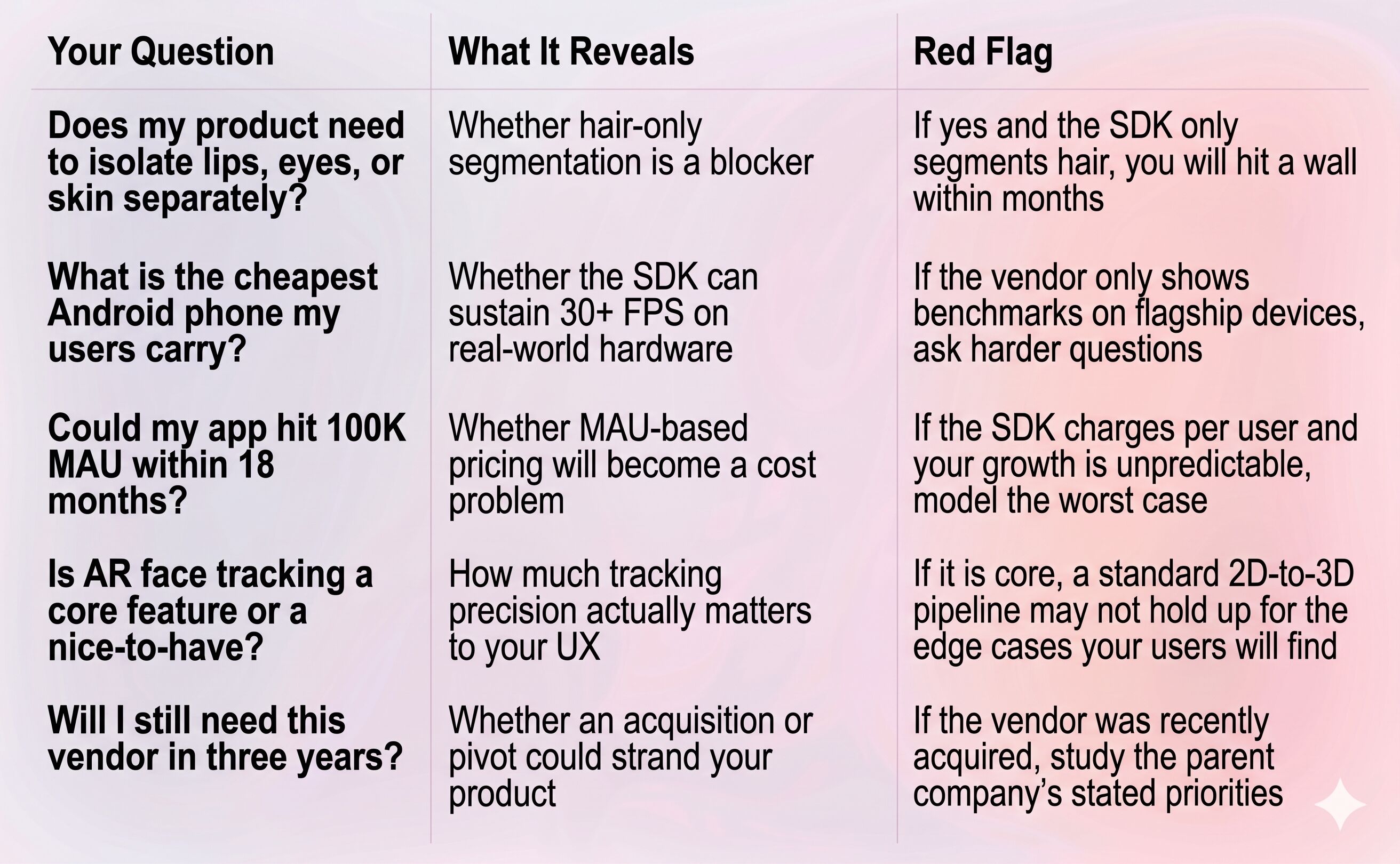
Choosing Facial Tracking Software: A Quick Diagnostic
Before committing to any vendor, answer these five questions about your own project. Your answers will tell you more than any feature matrix.
Banuba and DeepAR: Side-by-Side Breakdown
Rather than listing each product in isolation, here is how they compare across the six areas we evaluated.
Tracking Precision and 3D Method
The biggest technical difference between these two platforms lives here.
Banuba's face tracking software is built on a patented approach called Face Kernel. While most facial tracking software detects 2D landmarks and then reconstructs a 3D head model using nonlinear equations, Banuba does it differently: it skips the 2D step and builds the 3D geometry directly. The algorithm tracks 37 face positions (morphs) covering expressions, bone structure, and head orientation. Processing just 37 numbers instead of hundreds of static points saves compute cycles, which Banuba reinvests into a patented anti-jitter system that runs tracking multiple times per frame to separate real face data from noise.
What does that produce? 68 facial anchor points. A 3D mesh with up to 3,308 vertices. Stable tracking across the full -90° to +90° angle range. Tolerance for up to 70% facial occlusion (think: a hand covering most of the face). Detection up to 7 meters from the camera. Reliable performance in low light.
DeepAR takes the standard route. Its machine learning models identify face position and expressions from the camera feed, then render 2D and 3D graphics over each frame. For head-on shots in decent lighting, this works fine. But when a user tilts their head sharply, steps into mixed lighting, or partially covers their face, the 2D-to-3D conversion introduces drift that this SDK cannot always compensate for.
The practical difference: a fun dog-ears filter does not demand hundreds of anchor points. But neither does foundation shade try-on that needs to track the contour of a jawline, it is about how you use this information. Same goes for a liveness detection system that must work when someone holds their phone at an odd angle. More detail is good, but optimization and efficiency is better.
Segmentation Granularity
This is where the comparison gets lopsided.
Banuba segments every major facial region independently: hair, skin, eyes, eyebrows, lips, and background. That means you can apply virtual lipstick without color bleeding into the chin. You can change eyebrow shape based on the actual detected shape, not a template. You can smooth skin texture while keeping the eyes and lips untouched.
DeepAR segments hair. That is it. No eyes, no lips, no eyebrows, no skin as a separate target. For any team planning beauty, cosmetics, or skincare features, this is a hard boundary.
The beautification gap follows the same line. Banuba preserves natural skin texture during smoothing: 28 face editing options (cheekbone width, lip size, etc.), acne removal, eye-bag removal, and customizable presets. DeepAR offers 11 morphing options and blurs skin texture during beautification, creating an artificial, plastic look.
On virtual try-on depth, Banuba supports 16 makeup product types with skin-tone-aware application, plus nail detection, jewelry, prescription glasses, sunglasses, headwear, and hair color. DeepAR covers 10 makeup types with narrower application accuracy and no nail detection.
Cross-Platform Reach
Both SDKs run on iOS, Android, and Web, with Banuba also having a version for Unity. The split happens at the edges.
Banuba supports both Windows and macOS for desktop. DeepAR covers macOS only. If you are building a desktop video conferencing app, a kiosk experience, or an enterprise tool, and your users run Windows, DeepAR is off the table.
For cross-platform mobile frameworks, Banuba ships officially maintained Flutter and React Native wrappers. DeepAR depends on community-maintained wrappers that may lag behind the native SDK in features and bug fixes.
Banuba's device support floor matters too: iOS 13.0 and Android 8.0 with Camera 2 API and OpenGL ES 3.0. That covers 97% of iOS and 80% of Android devices in the field. For apps targeting emerging markets or broad demographics where older phones are common, this reach is important.
Developer Experience and Integration Speed
Integration time is roughly comparable: about one week for either SDK to reach a working prototype.
Banuba's documentation includes traditional integration guides and LLM-ready docs designed for AI-assisted ("vibe coding") workflows. The Face AR SDK documentation is thorough, with sample projects and a developer community portal. Teams can use Banuba Studio to create custom AR effects, following step-by-step guidelines.
DeepAR's documentation is also well-organized and English-localized. DeepAR Studio offers a visual editor for building custom effects, and the platform provides pre-built integrations with Amazon IVS. For simple AR filter projects, the DeepAR setup flow is smooth.
Where the experience diverges is in content availability. Banuba's Asset Store has over 1,000 ready-made AR filters, with GLTF support for 3D model import and KTX format for faster rendering. DeepAR's library sits at roughly 150 filters, with no GLTF support listed.
Pricing Behavior at Scale
The two SDKs use fundamentally different models, and the gap widens as your app grows.
Banuba charges a yearly subscription. The cost depends on platforms, features, and any custom development, but it is not tied to how many users open your app each month. Growth does not trigger a bigger bill. A 14-day free trial gives full SDK access with no watermarks.
DeepAR uses MAU-based tiers. The entry is cheap: free (with watermark) up to 10 MAU, $25/month for up to 1,000 MAU, scaling to $1,000/month at 50,000-100,000 MAU and custom pricing above that. Transparent, yes. But the cost tracks linearly with success. An app that hits a viral moment and jumps to 80,000 MAU overnight wakes up to a $1,000/month bill.
For teams planning aggressive growth or expecting unpredictable spikes, Banuba's subscription avoids that moving target. For a time-limited prototype with a handful of users, DeepAR's free tier removes the upfront barrier.
Vendor Independence and Update Cadence
Banuba has been independent since its founding in 2016. Its client list spans multiple industries: cosmetics, ecommerce, haircare, video conferencing, dating and social, healthcare, and more. That diversity means product decisions are driven by varied, real-world demand across 120+ clients rather than a single stakeholder's agenda. The SDK ships monthly updates and offers SLA-backed support with a dedicated account manager.
DeepAR remains a separate entity within Zalando on paper, but the strategic direction now serves Zalando's ecosystem. Updates ship quarterly. No public SLA exists. Users on Gartner Peer Insights have reported support response times stretching into days.
For any team betting its product roadmap on a third-party SDK, the question is simple: does the vendor's future align with yours? An independent company serving 120+ diverse clients has every incentive to keep the SDK broadly useful. A company owned by a fashion e-commerce giant has a different set of priorities.
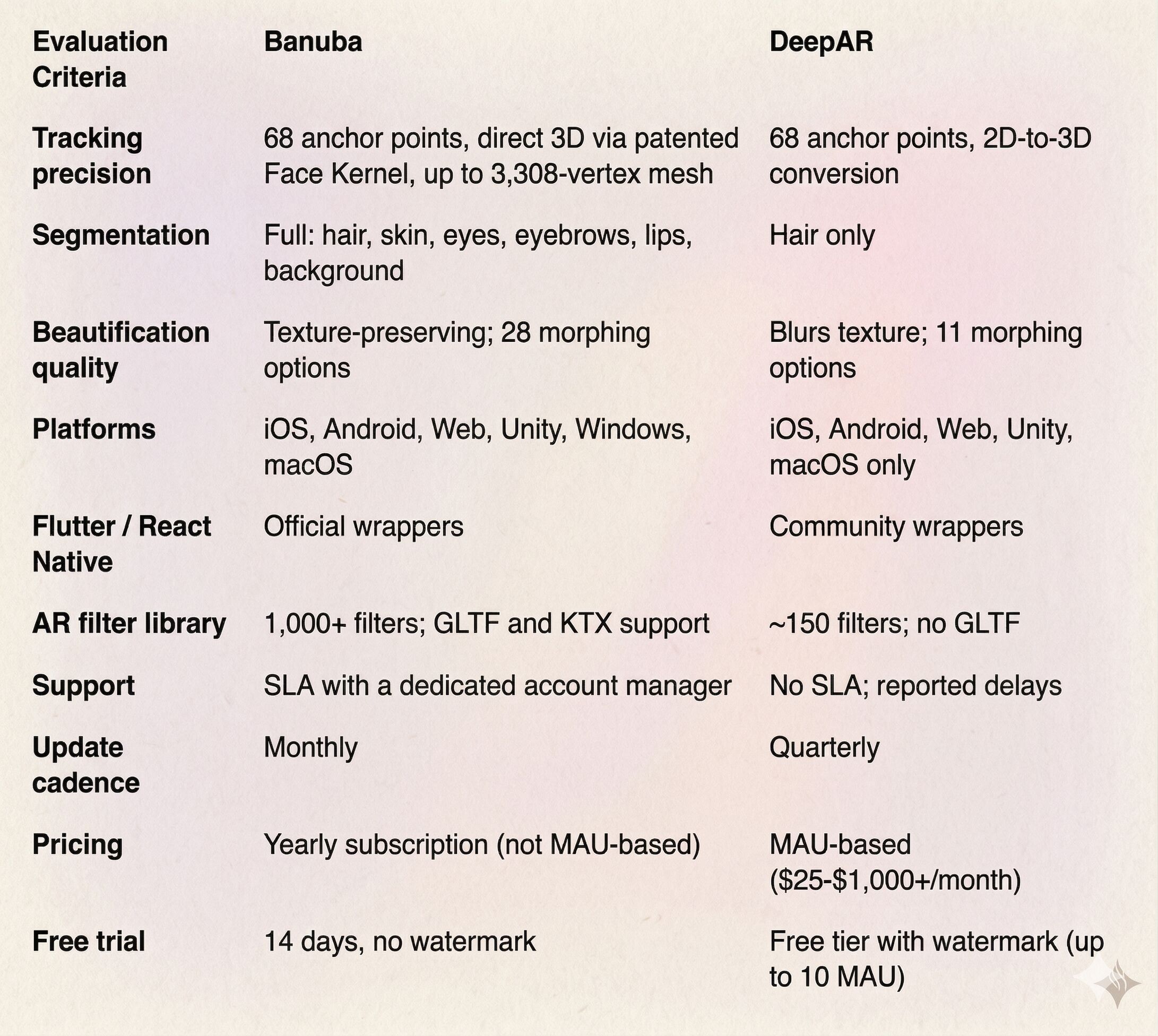
Banuba Face Tracking Software vs DeepAR At Glance
Which One Should You Pick?
Pick Banuba if AR face tracking is central to your product. Its tracking precision, full face-part segmentation, 1,000+ filter library, and cross-platform coverage (including Windows) give it a technical lead in production apps. Monthly SDK updates and SLA-backed support reduce the risk of shipping to real users. If your roadmap touches beauty try-on, avatar experiences, video conferencing, or liveness detection, Banuba covers those use cases now and has the independence to keep building for them.
Pick Banuba if growth is the plan. A subscription that does not scale with MAU count keeps costs predictable through growth spikes. For apps targeting 100,000+ users, this matters more than the entry price.
Pick DeepAR for short-lived web AR campaigns or early prototypes. The free tier and DeepAR Studio editor work well for quick experiments at low user counts. If the project runs for a few weeks in a browser and you do not need segmentation or desktop support, it helps you launch quickly.
Explore Banuba's face tracking software in your own environment with a 14-day trial, no watermarks.
References
Banuba. (n.d.). Face Tracking Software. https://www.banuba.com/technology/face-tracking-software
Banuba. (n.d.). Face AR Technology. https://www.banuba.com/technology/
Banuba. (n.d.). Face AR SDK Documentation. https://docs.banuba.com/far-sdk
DeepAR. (n.d.). Augmented Reality SDK. https://www.deepar.ai/augmented-reality-sdk
DeepAR. (n.d.). Documentation. https://docs.deepar.ai/
DeepAR. (n.d.). Pricing. https://docs.deepar.ai/deepar-sdk/pricing/
Drapers. (2025, April 7). Zalando acquires tech firm DeepAR. https://www.drapersonline.com/news/zalando-acquires-tech-firm-deepar
HTF Market Insights. (2026). Face Tracking Technology Market Size, Share & Growth Outlook. https://www.htfmarketinsights.com/report/4408796-face-tracking-technology-market
Just Style. (2025, April 9). Zalando buys DeepAR to boost tech capabilities. https://www.just-style.com/news/zalando-deepar-acquisition-tech/
Statista / ARtillery Intelligence. (2024). Mobile augmented reality (AR) users worldwide from 2023 to 2028. https://www.statista.com/statistics/1098630/global-mobile-augmented-reality-ar-users/
Gartner Peer Insights. (2025). DeepAR Reviews & Ratings. https://www.gartner.com/reviews/product/deepar-471424751
-
Start with the tracking method. Does the software build a 3D face model directly, or does it convert from 2D landmarks? Direct 3D reconstruction handles extreme angles, low light, and occlusion better. Next, check segmentation depth: if your roadmap includes any beauty, try-on, or skincare features, you need individual face-part segmentation, not just hair. Verify platform support against your actual target devices (not just the OS list), test documentation quality by completing a quickstart guide, and model pricing at current scale and at 10x growth.
-
Most commercial solutions use either MAU-based tiers or flat subscription fees. MAU-based models charge more as your user count grows, which creates unpredictable costs during growth spurts. Subscription models typically bill annually and may include custom pricing for large deployments. Free tiers are usually watermarked or limited to development use. The key step: model pricing at your projected scale over 36 months, not just at launch.
-
For production apps that require reliable AR face tracking, deep segmentation, and predictable pricing at scale, Banuba is the stronger option. Monthly updates, SLA-backed support, broad platform coverage (including Windows), and vendor independence make it production-ready.
