

The global AR market is projected to reach $1,050.56 billion in 2033. The AR SDK software segment alone is heading toward $12.5 billion by 2033, growing at 14.7% CAGR. Those numbers reflect something developers already feel on the ground: AR features are no longer optional. Over 500 million Instagram users interact with AR filters every month. More than 80% of TikTok users engage with AR effects. And products with 3D/AR experiences show up to a 94% lift in conversion rates.
But here's the thing. Selecting an AR SDK isn't like picking a JavaScript library. The SDK you commit to shapes your app's frame rate on cheap phones, the richness of effects you can offer, how fast your team ships, and what your costs look like at 10x growth.
Two SDKs can both list "face tracking" on their feature page and deliver completely different results when a user turns their head 60 degrees in bad lighting. Both can claim "beauty filters" while one blurs skin into plastic and the other preserves natural texture.
This article breaks down where Banuba and DeepAR actually differ when you move past the marketing pages and into production.
[navigation]
AR SDKs let developers plug face tracking, beauty effects, virtual try-on, and 3D overlays into apps without building computer vision systems from scratch. Banuba and DeepAR both compete in this space. Banuba is the better choice for teams shipping to real users who need accurate tracking, deep segmentation, and costs that stay flat as audiences grow. DeepAR can work for quick prototypes and small web-based AR campaigns.
TL;DR
- We compared Banuba's AR SDK and DeepAR across tracking architecture, segmentation, real-device performance, platform reach, pricing, and vendor direction.
- Banuba uses an optimized 3D-native pipeline with 68 landmarks. DeepAR uses a standard 2D-to-3D approach.
- Banuba segments every major face part (hair, skin, eyes, lips, eyebrows). DeepAR only segments hair.
- Banuba charges a flat subscription that doesn't grow with your user count. DeepAR bills per MAU, starting at $25/month.
- Banuba remains the best choice for companies seeking worldwide distribution and intact face tracking, with predictable costs and growth potential.
How We Scored Both SDKs
We tested both SDKs and reviewed their documentation, developer forums, public case studies, and pricing pages. Here are the six criteria we used:
Tracking Architecture. How does the SDK construct its face model? How many anchor points? What happens at steep angles, in low light, or when something blocks part of the face?
Segmentation Coverage. Can you target individual face parts independently? Hair, skin, eyes, lips, eyebrows, background. Each one unlocks different product features.
Real-Device Performance. Frame rates on mid-range phones, battery drain during sustained use, and multi-face support.
Platform and Cross-Platform Reach. Native OS coverage, desktop support, and whether React Native/Flutter wrappers come from the vendor or the community.
Cost at Scale. Your bill today versus at 10x and 100x growth. Does the model reward or punish success?
Vendor Independence and Roadmap. Who owns the company? Who decides where the product goes? How often do updates ship?
A Quick Checklist Before You Commit to Any AR SDK
Before we get into each product, here are four questions worth answering for any AR SDK you evaluate:
- Does it build a real 3D face model, or does it estimate 3D from 2D landmarks? The method determines accuracy at extreme angles and under occlusion.
- Can you segment every face part your roadmap needs? Map your 12-month feature plan against the SDK's segmentation list. Gaps here create hard ceilings.
- What's the frame rate on a mid-range phone from 2-3 years ago? Your flagship test device doesn't represent your actual user base.
- What does your bill look like at 36 months? Model MAU growth, support costs, and any per-user charges.
Banuba AR SDK
Banuba’s AR SDK is a product by an independent AR company, founded in 2016, with patented computer vision technology at its core. The company serves 120+ clients globally, including Samsung, Gucci, Schwarzkopf, and more. That list spans video conferencing, beauty, dating, creator tools, healthcare, fintech, and retail. It matters because a diverse client base shapes a roadmap driven by real-world variety, not one company's internal agenda.
Tracking: 3D-native, not 2D-to-3D. Most AR SDKs detect 2D facial landmarks first, then estimate a 3D head position through mathematical modeling. Banuba's patented Face Kernel skips the 2D step entirely and constructs a 3D head model directly from the camera feed.
The result:
- 68 facial anchor points with sub-pixel accuracy
- Face mesh reconstruction with up to 3,308 vertices
- Stable tracking from -90° to +90° head rotation
- Works in low light and with up to 70% of the face occluded (hand, mask, microphone)
- All processing on-device. No data leaves the phone. No cloud latency.
The engine tracks 37 facial morphs instead of hundreds of static points, keeping CPU load low. A separately patented anti-jitter system runs noise detection multiple times within each frame.
Full face segmentation. Banuba segments hair, skin, eyes (pupil, iris, sclera), eyebrows, lips, hands, and body. Each segment runs on its own neural network. For beauty apps and virtual try-on, this is the difference between offering complete virtual makeup and being limited to hair color changes.
Background handling. Supports static images, video, GIFs, and 360-degree environments. The segmentation model handles complex scenes, movement, low light, and long hair without the edge flickering that plagues lesser implementations.
Beauty and try-on depth. 28 face morphing options, texture-preserving skin smoothing, acne removal, eye bag removal, teeth whitening, and 16 makeup product types with correct application across different skin tones. Also supports nail detection and try-on, jewelry, glasses (including prescription), headwear, and hair color.
Content and tools. 1,000+ AR effects in the Banuba Asset Store. Custom effects built in Banuba Studio (browser-based) with GLTF model import and KTX format for faster loading.
Platform coverage. iOS, Android, Web, Unity, Windows, macOS. First-party React Native and Flutter wrappers ship with the SDK. Device support starts at iOS 13.0 and Android 6.0, covering 97% of iOS and roughly 80% of Android devices. The SDK adds about 25 MB to the app size.
Performance. Neural networks are compressed, and workloads shift between CPU and GPU per device. On a 2019 mid-range Android: 35-40 FPS for makeup filters, 30+ FPS for complex 3D masks. Battery management keeps power consumption viable for 10+ minutes of continuous AR. Multi-face tracking has no software cap; the recommendation is up to 4 on mobile for stable 60 FPS, up to 6 on desktop.
Pricing. Flat subscription per platform. Yearly, half-year, and quarterly billing are available. The critical point: your license fee does not scale with MAU count. Growth from 10,000 to 10 million users changes nothing on the invoice. A 14-day free trial is available for everyone who wants to test before committing. Integration docs include LLM-ready documentation for AI-assisted coding.
Where it gets tricky. Complex custom AR effects in Banuba Studio require design time and effort. Basic integration is fast (teams report under 8 minutes to a working demo), but sophisticated interactive experiences need more investment. A detailed how-to guide and support team help with this.
Best for:
- Social video and creator apps at a global scale
- Beauty and cosmetics platforms running virtual try-on (makeup, eyewear, hair, nails)
- Video conferencing and streaming with virtual backgrounds (native Agora integration available)
- Dating and social apps with real-time AR
- Fintech/banking with liveness detection
- E-commerce with product try-on

DeepAR SDK
DeepAR is a London-based AR SDK provider focused on face and body tracking for mobile, web, and live streaming. It supports iOS, Android, macOS, Web (HTML5), and Unity. No Windows or Linux support.
In April 2025, Zalando acquired DeepAR to accelerate its 3D commerce and virtual try-on strategy. DeepAR technically remains a separate entity, but its development now aligns with Zalando's e-commerce priorities.
Tracking: 2D-to-3D estimation. DeepAR also tracks 68 facial anchor points using the conventional pipeline: detect 2D landmarks, then estimate 3D position. Handles up to 4 simultaneous faces and detects 5 emotional states (sad, happy, angry, surprised, scared). Body tracking covers 17 key points.
On flagship and upper-mid-range devices, the pipeline performs well. On older or budget Android hardware, stability drops during fast head movements and partial occlusion.
Segmentation: hair only. No individual face-part segmentation for eyes, lips, eyebrows, or skin. For any app that needs a per-feature makeup application, this is a hard wall.
Background separation. Supports removal, but testing and user reports show frequent quality problems. Large patches of background often remain unseparated. Long hair and hands get clipped. Only static image replacement, with no video, GIF, or 360-degree support.
Beauty and filters. The Beauty API is in beta. Skin smoothing blurs texture rather than preserving it. 11 face morphing options (vs. Banuba's 28) and 10 makeup product types (vs. 16). DeepAR Studio offers a visual editor for creating custom effects without code.
Content library. About 150 AR filters, compared to Banuba's 1,000+. No GLTF support listed.
Platform coverage. iOS, Android, macOS, Web (HTML5), Unity. No Windows or Linux. React Native and Flutter wrappers are community-maintained, meaning updates depend on volunteers.
Pricing. MAU-based tiers. Free tier (up to 10 MAU, watermarked) is useful for prototyping. Paid tiers start at $25/month for up to 1,000 MAU.
Where it falls short:
- Hair-only segmentation rules out serious beauty, makeup, or skincare try-on
- Background removal often leaves visible artifacts, especially around hair and hands
- Skin beautification blurs rather than preserves texture
- No Windows desktop support
- Support response times reported as slow (days). No public SLA
- SDK updates ship quarterly, not monthly
- Post-acquisition roadmap now tied to Zalando's e-commerce goals
Best for:
- Quick AR prototypes and web-based marketing campaigns
- Small-scale social or gaming apps at low MAU counts
- Teams that want a visual editor (DeepAR Studio) for designing effects without code
- Projects aligned with Zalando's e-commerce ecosystem
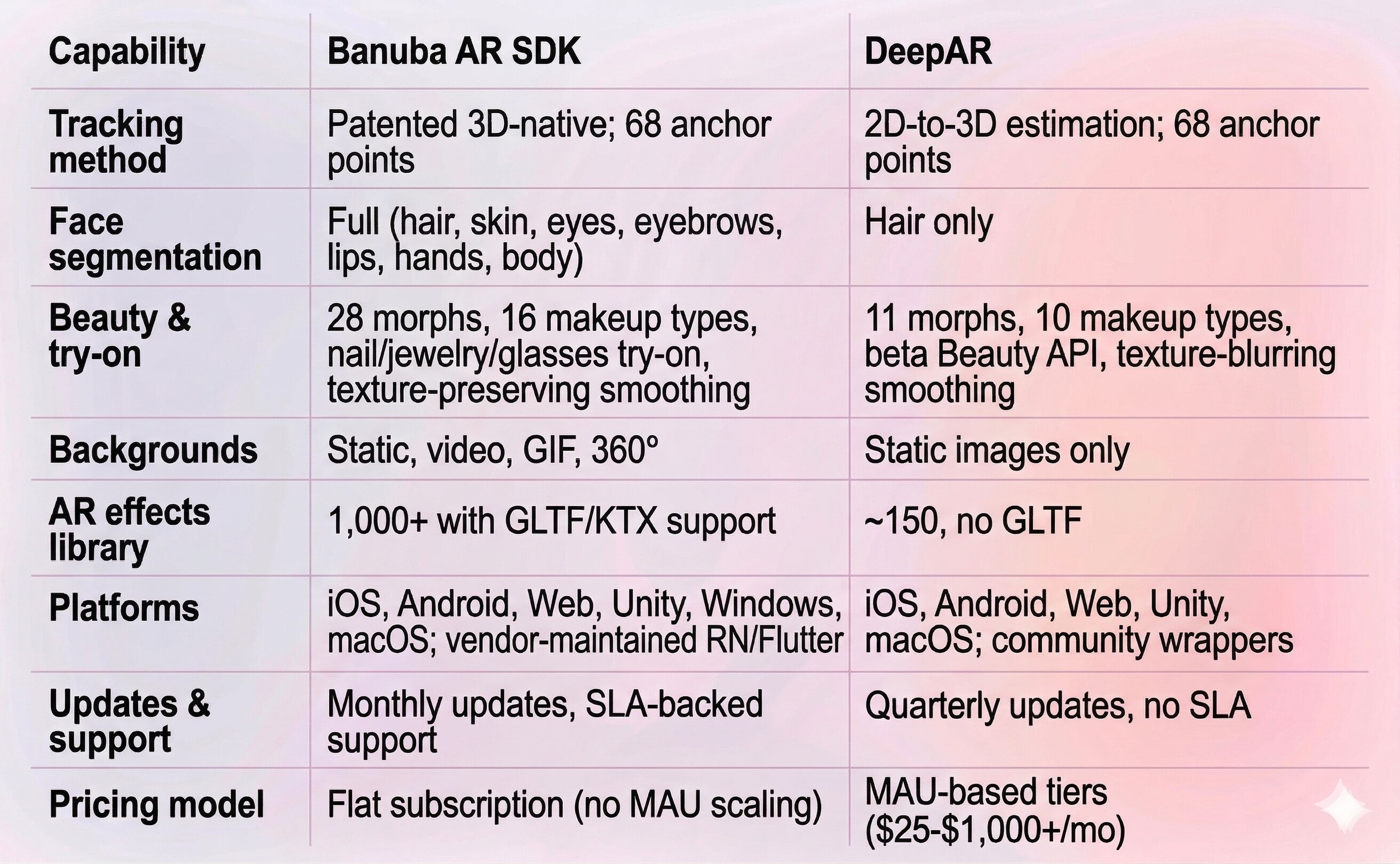
Banuba AR SDK vs. DeepAR: Head-to-Head Comparison
Which AR SDK Should You Choose?
Pick Banuba if you're building a production app. The 3D-native tracking gives you higher precision, better stability under extreme conditions, and smoother performance on the kind of hardware your global audience actually uses. Full face-part segmentation opens up beauty, makeup, and try-on features that hair-only segmentation simply cannot support. Flat pricing means your margins stay intact as you scale. Monthly updates and SLA-backed support keep teams moving after launch.
Banuba is the clear choice for beauty and cosmetics platforms. With 16 makeup types, real eyebrow segmentation, skin-tone-aware application, and nail detection, DeepAR offers no comparable features. For streaming and conferencing, Banuba's native Agora integration and its own Video Editing SDK remove significant development overhead.
Pick DeepAR if you're testing an idea on a small scale. The free tier and DeepAR Studio make it easy to experiment. For a web-based marketing campaign that runs for a few weeks with limited traffic, DeepAR can deliver. Just be careful with costs. If your app grows, MAU-based pricing escalates quickly.
Ready to test the difference yourself? Explore the Banuba AR SDK in your own environment with a 14-day trial.
References
Banuba. (n.d.). Face filters SDK. https://www.banuba.com/facear-sdk/face-filters
Banuba. (n.d.). Banuba technology. https://www.banuba.com/technology/
Banuba. (n.d.). Face AR SDK documentation. https://docs.banuba.com/far-sdk
DeepAR. (n.d.). Documentation. https://docs.deepar.ai/
DeepAR. (n.d.). Pricing. https://docs.deepar.ai/deepar-sdk/pricing/
Drapers. (2025, April 7). Zalando acquires tech firm DeepAR. https://www.drapersonline.com/news/zalando-acquires-tech-firm-deepar
Just Style. (2025, April 9). Zalando buys DeepAR to boost tech capabilities. https://www.just-style.com/news/zalando-deepar-acquisition-tech/
Strategic Revenue Insights. (2025). AR SDK Software Market Size, Future Growth and Forecast 2033. https://www.strategicrevenueinsights.com/industry/ar-sdk-software-market
SQ Magazine. (2025). Augmented Reality Statistics. https://sqmagazine.co.uk/augmented-reality-statistics/
BayelsaWatch. (2026). Augmented Reality Statistics By Market Size and Facts. https://bayelsawatch.com/augmented-reality-statistics/
Measure Studio. (2025). 250+ Social Media Statistics Marketers Can't Ignore. https://www.measure.studio/post/social-media-statistics
Fortune Business Insights. (2026). Augmented Reality Market Size, Share, Trends Report. https://www.fortunebusinessinsights.com/augmented-reality-ar-market-102553
HTF Market Insights. (2026). Face Tracking Technology Market Size, Share & Growth Outlook. https://www.htfmarketinsights.com/report/4408796-face-tracking-technology-market
-
Start with tracking precision on the cheapest device you plan to support. Then verify segmentation depth against your 12-month feature roadmap. Check whether cross-platform wrappers (React Native, Flutter) are vendor-maintained or community projects. Model pricing at 10x your current MAU. And investigate vendor ownership, because acquisitions shift product priorities.
-
Two main models exist. MAU-based pricing starts low and grows linearly with your user base. Flat subscription pricing charges per platform, regardless of how many users you have. Free tiers usually carry watermarks or are restricted to development environments. The step most teams skip: calculate costs at your projected 12-month and 36-month user counts, not just at launch.
-
For production apps that need reliable face tracking, deep segmentation, and costs that don't balloon with growth, Banuba's AR SDK is the stronger pick. Monthly updates, SLA-backed support, vendor independence, and broad platform coverage (including Windows) make it production-ready.
