

[navigation]
Key takeaways
- Banuba TINT ships with 22,000+ digitized products included, and new collections are digitized in under 48 hours, so a marketplace catalog stays covered as brands add SKUs.
- Océane, a Brazilian cosmetics manufacturer and retailer, saw add-to-cart on try-on items rise from the 3% industry average to 20.15% in the first month with Banuba TINT, later peaking at 32%.
- Banuba TINT is web-based and white-label: it launches as a ready-made widget in under 2 weeks, or through Banuba's Shopify virtual try-on plugin for storefronts.
Why is try-on across SKUs hard for beauty marketplaces?
A marketplace does not sell one brand's twelve shades; it lists thousands of SKUs from dozens of vendors, and every new drop adds more. Vendors that digitize products slowly, or charge per small SKU batch, leave coverage patchy: a shopper can try one brand's lipstick but not the competing one in the same search results, which makes the feature feel broken.
The second problem is color accuracy. Teams that already run try-on report the same two complaints: the shade on screen does not match the shade in the jar, and cosmetics do not always sit correctly on the face. On a multi-brand catalog, those errors multiply.

How does a beauty API cover the whole catalog?
Banuba's beauty API stack answers the coverage problem with Banuba TINT, the try-on engine behind it. TINT includes 22,000+ digitized products, and new collections are added in under 48 hours, so catalog coverage is a pipeline, not a per-SKU negotiation. Merchandising teams upload products in bulk through the admin panel, and glasses digitization runs automatically.
Accuracy is handled at the rendering layer. Banuba TINT applies 16 makeup product types with skin-tone-aware application, on top of patented face tracking with 3,308 vertices, which is what keeps a nude shade looking nude on every skin tone. Beyond makeup, the same engine covers glasses, jewelry, eye lenses, eyelashes, hats, and scarves, and shoppers can try several products together as a complete look.
There is also a layer after the try-on: Banuba TINT's AI recommendations engine runs a face and color analysis while the try-on loads, then sorts products so the most fitting ones appear first, with up to 200% better conversions and up to 30% higher average order value.
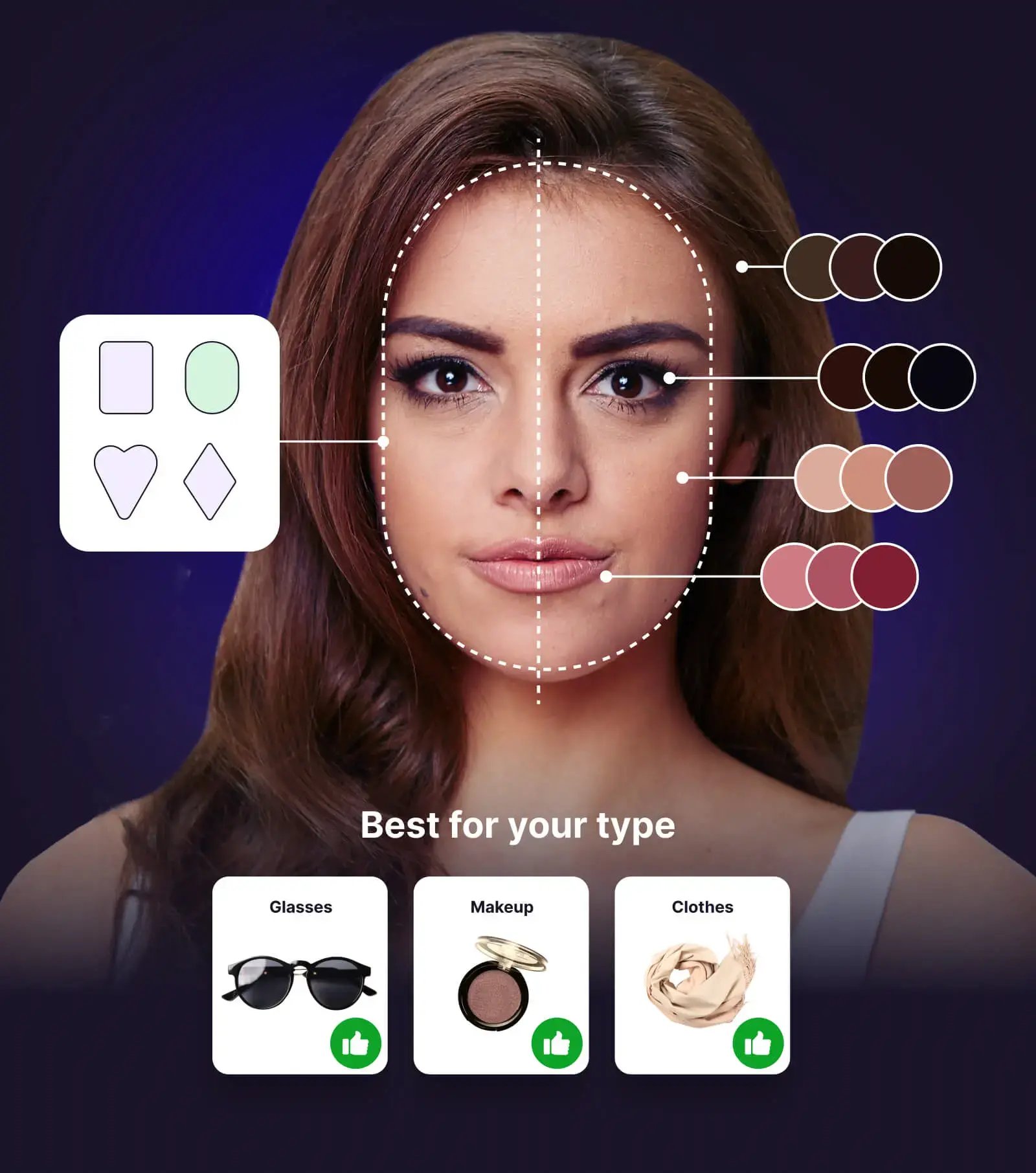 TINT's AI recommendations
What does the integration look like?
Banuba TINT is web-based, so there is nothing for shoppers to install: the try-on widget runs in the browser on desktop and mobile and can be white-labeled to match the marketplace's design. A ready-made deployment launches in under 2 weeks. Shopify-based storefronts can use Banuba's virtual try-on plugin instead of a custom build, and product data flows through the same admin panel either way.
A practical rollout starts with one or two high-volume categories, measures add-to-cart against baseline, then extends across the catalog. Banuba's breakdown of the add-to-cart math behind beauty try-on launches is a useful pre-launch read for setting those expectations.
For teams that also want beautification inside their own camera flow (skin smoothing, acne removal, makeup filters), the Banuba Face AR SDK behind the beauty API is documented at docs.banuba.com, with beauty filter sample apps for web, Android, and iOS.

What happened when a live catalog turned try-on on?
Océane, a Brazilian manufacturer and retailer of beauty products, was one of the first companies to integrate Banuba TINT on its online store. The pilot covered only concealer and foundation, and within the first month the add-to-cart rate for those items rose from the 3% industry average to 20.15%, an increase of over 600%. Océane ran out of stock because it had not planned for the spike, and the rate later set a new peak at a record 32% add-to-cart rate: a third of shoppers who tried products online placed them in the cart.
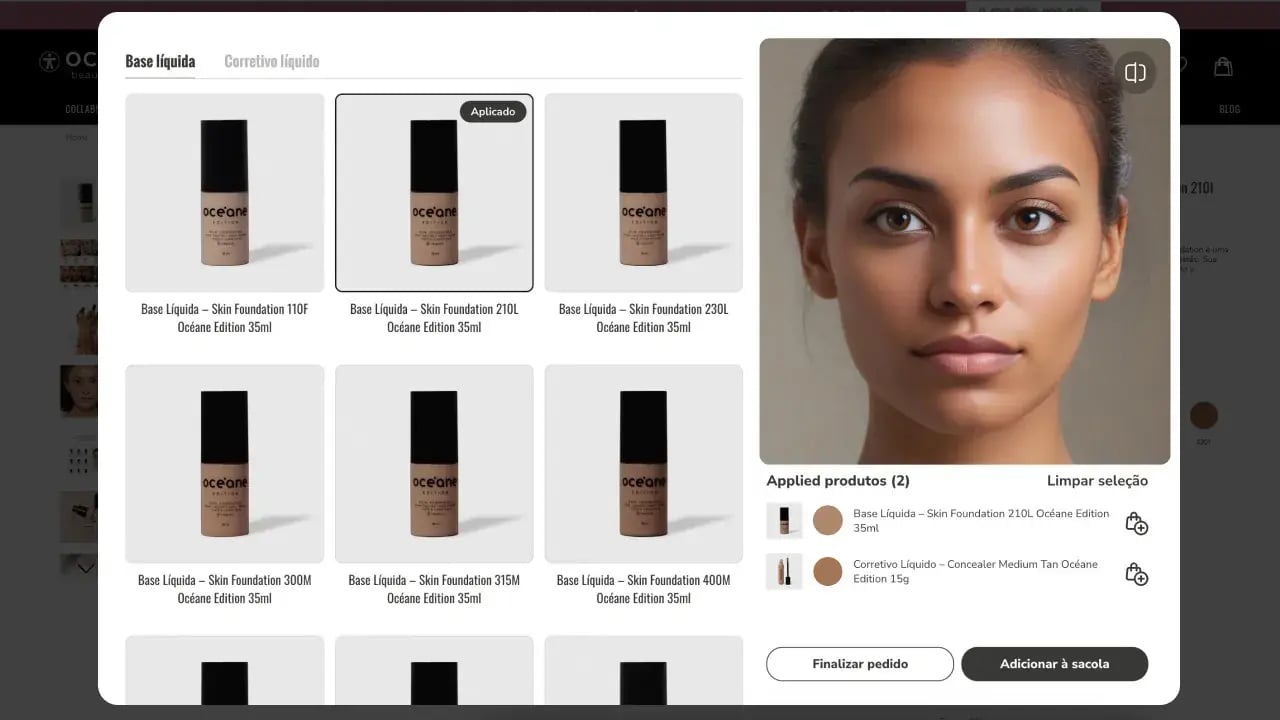 TINT virtual try-on custom interface for Oceane
Put try-on on every product page
If add-to-cart on cosmetics is stuck near the industry average, catalog-wide try-on is the highest-leverage change a beauty marketplace can test. Get a demo of Banuba TINT and see how much of your catalog would be covered on day one.

-
Banuba TINT covers 16 makeup product types with skin-tone-aware application, plus glasses, jewelry, eye lenses, eyelashes, hats, and scarves. Items can be tried on separately or combined into a complete look; the full category list is on Banuba's makeup virtual try-on page.
-
No. Banuba TINT runs in the browser over a webcam, on desktop and mobile, which keeps friction low on product pages. Shopify merchants get the same experience through Banuba's virtual try-on plugin without custom development.
-
Products are uploaded in bulk through the Banuba TINT admin panel using a structured template, and new collections are digitized in under 48 hours; glasses are digitized automatically. The process is documented in the bulk product upload guide.
-
Yes. Banuba TINT includes an AI recommendations engine that analyzes the shopper's face and color type, then sorts the catalog so the most fitting products show first, with up to 200% better conversions and up to 30% higher average order value.
-
Banuba TINT is not a single price: the Shopify virtual try-on plug-in, the ready-made no-code TINT widget, and the fully customizable TINT for business are three separate offerings, each priced differently. The quote depends on which offering fits the rollout, as in Océane's deployment of the TINT platform on an owned store.
