

[navigation]
Key takeaways
- A makeup AR try-on works because it removes shade-and-fit uncertainty at the exact moment of purchase, which lifts add-to-cart and reduces returns.
- Banuba TINT is web-based and integrates into an existing store (including Shopify) without a native app install, so time-to-market is short, and shopper friction is low.
- Real deployments back the conversion claim: Brazilian brand Océane reached a 32% add-to-cart rate with Banuba TINT, more than ten times the industry average.
Why color accuracy decides whether try-on converts
The single biggest reason a virtual try-on fails to convert is that the product color looks wrong on screen, which is also the top complaint beauty product managers report about the try-on tools they already run. If a foundation reads two shades too light or a lipstick loses its true tone under the shopper's lighting, the try-on actively erodes confidence instead of building it. This is where a makeup SDK earns its place: Banuba TINT renders 16 makeup product types with skin-tone-aware application, so shades track the shopper's actual complexion rather than a generic overlay. Color fidelity is the difference between a try-on that closes the sale and one that sends the shopper to a physical store to check the real thing.

Category breadth keeps the shopper on one widget
Cosmetics catalogs rarely stop at face makeup. A shopper styling a look wants lips, eyes, blush, and often glasses or jewelry in the same session, and every category the try-on cannot handle is a reason to leave the page. Banuba TINT supports 16+ product categories (makeup, eyewear, hair color, contacts, jewelry, and accessories), tried on individually or combined into a complete look, with a built-in recommendation AI that suggests complementary items. For a brand, that breadth means a single integration covers the whole catalog instead of stitching together separate tools per category, and it gives the shopper a reason to keep browsing rather than bouncing.
Web-based and quick to deploy
Beauty product managers are measured on time-to-market as much as on conversion, so an SDK that demands a long native build is a hard sell. Banuba TINT runs as a web-based widget, which means shoppers try products straight in the browser with no app to download, and the brand can launch on an existing storefront, including a Shopify store, rather than rebuilding the shopping flow. That lower integration cost is also why the technology reaches brands that would never fund a custom computer-vision project of their own, and it is the route most of the deployments below took to production.

What the conversion lift looks like in production
The clearest proof comes from brands that shipped try-on and measured it. Océane, a Brazilian cosmetics manufacturer and retailer, was an early TINT adopter and started with a narrow pilot on concealer and foundation. Within the first month, the add-to-cart rate for those items rose from a 3% industry average to 20.15%, an increase of more than 600%, and demand outran the company's own stock. It did not stop there: the add-to-cart rate later peaked at 32%, meaning roughly a third of shoppers who tried a product online added it to their cart. You can read the full Océane add-to-cart story for the month-by-month numbers.
Other cosmetics brands show the same pattern in different shapes. Boca Rosa, a Brazilian beauty startup, used Banuba virtual try-on to power a pre-launch event and earned $900,000 in four hours. Smitten Cosmetics, an Australian luxury mineral cosmetics maker, deployed Banuba TINT in its store and reseller program and added 50 partnered salons in three months. The common thread is that try-on moved a business metric the brand already cared about, not a vanity engagement number.
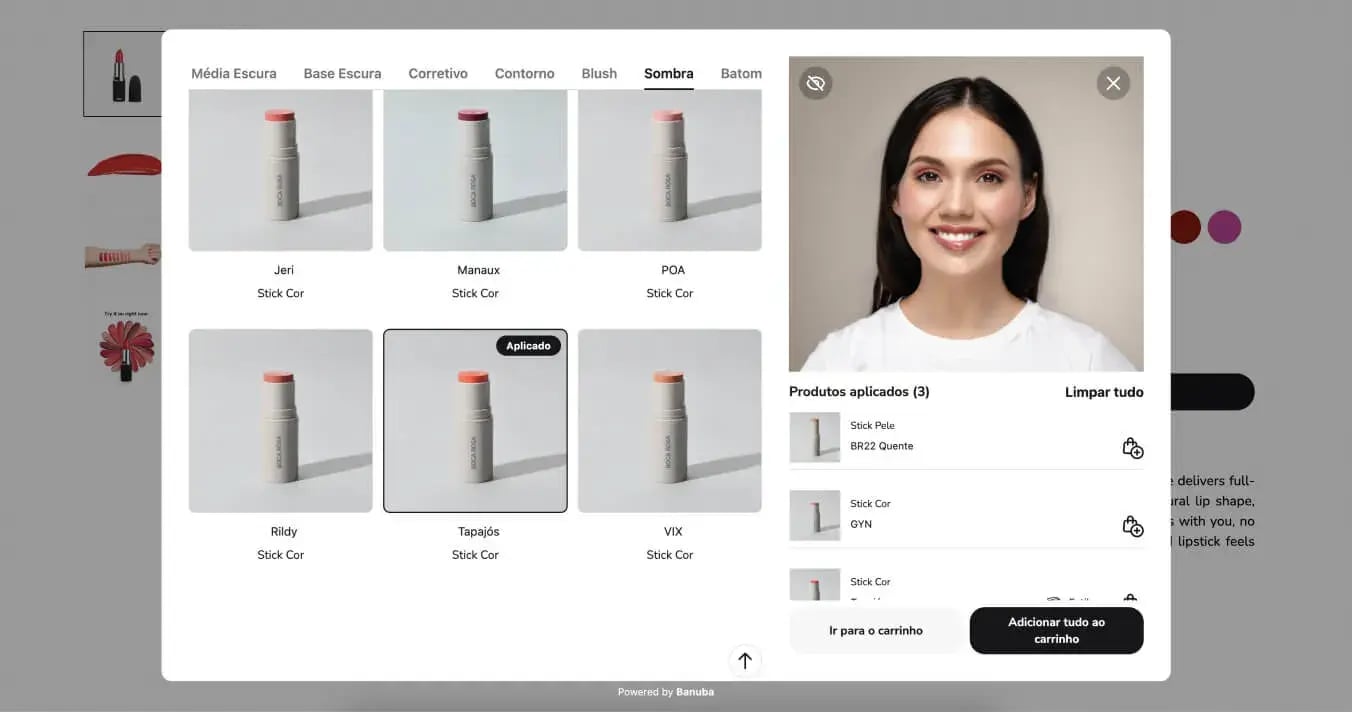 Banuba's AR Makeup SDK in action for Boca Rosa beauty startup
How to evaluate a makeup SDK for your store
Treat the choice as a procurement decision, not a feature wish list. Confirm skin-tone-accurate color rendering on a range of complexions, because that is the variable that decides whether the try-on builds or breaks confidence. Check that the category coverage matches your catalog, so you are not buying a tool that handles lipstick but not the glasses you also sell. Verify the deployment model fits your stack: a web-based widget that drops into your current store, including Shopify, will reach production far faster than a from-scratch native build. Finally, ask the vendor for production numbers tied to real KPIs, the way the Océane, Boca Rosa, and Smitten results above are, rather than lab demos.
-
Both, and for the same reason. When a shopper confirms a shade on their own face before buying, fewer orders arrive that do not match expectations, which is the main driver of cosmetics returns. Banuba TINT is built around skin-tone-aware color, so the shade a shopper sees is the shade they receive, and the Océane deployment showed both a higher add-to-cart rate and demand strong enough to clear stock.
-
Banuba TINT is a real-time AR try-on: the shopper's live camera feed is tracked, and products are rendered onto the face in motion, rather than applied to a single uploaded photo. That live approach is what supports try-on across makeup, hair color, glasses, and jewelry in one session. Details on supported categories and integration are on the Banuba TINT page.
-
Because Banuba TINT is a web-based widget rather than a native app build, brands launch on an existing storefront quickly, and ecommerce platforms such as Shopify are a common integration path. The underlying face tracking comes from Banuba Face AR SDK, documented for developers in the Banuba developer docs.
-
Banuba TINT covers 16 makeup product types plus additional categories, including eyewear, hair color, contacts, jewelry, and accessories, which can be tried separately or as a full look. Smitten Cosmetics is one example of a brand that used this breadth to grow its retail footprint, described in the Smitten Cosmetics case study.
