

[navigation]
TL;DR:
- ARKit and ARCore are not vendors; they are the free operating-system layer. The decision is what you build on top, and whether that layer is bought or written in-house.
- World tracking (objects in a room) and face tracking (effects on a moving face in a video stream) are different problems with different suppliers. Few products need both.
- Apple ARKit is best-in-category for world tracking and depth sensing on Apple hardware; Unity AR Foundation is best-in-category for game-engine projects.
- Google MediaPipe is best-in-category for zero-cost on-device ML experimentation, Apache License 2.0 with no published pricing page, though Google labels it "MediaPipe Solutions Preview is an early release".
- DeepAR is best-in-category for transparent published pricing at small scale: free up to 10 MAU, $25/month up to 1,000 MAU.
- The paid Niantic 8th Wall platform was retired on 28 February 2026 and is now free and open source under Niantic Spatial, which makes it a migration question, not a procurement one.
- Banuba Face AR SDK is the pick for one narrow case: real-time face AR inside live video (streaming, conferencing, social) running cross-platform on mid-range devices without a cloud round trip.
- Banuba Face AR SDK covers 97% of Apple smartphones and 80% of Android ones from a single integration, runs fully on-device, and ships CocoaPods, Maven and NPM packages.
- Commercial licenses pay for themselves on breadth, live-video stability, and the asset pipeline, not on the tracking demo. One platform, one prototype, and the free frameworks win.
How to choose an AR framework
Platform reach. Count the platforms you must ship on first: iOS, Android, browser, desktop, and the wrapper your app is written in. A Flutter or React Native team has fewer realistic options than a native team, because the binding layer has to exist and be maintained, and an AR SDK for Android alone is a far cheaper decision than one that also has to hold up in Safari and a Windows desktop client.
World tracking or face tracking. These are not interchangeable. World tracking needs plane detection, depth and light estimation, and leans on the sensors ARKit and ARCore expose; face tracking needs a landmark model that stays locked on a moving, partly hidden face at video frame rate. For the second problem, our write-up on what to check when choosing a face AR SDK lists the questions worth asking before a pilot.
On-device or cloud. We get asked this in writing more than anything else, usually because legal needs the answer. On-device processing means frames are transformed locally, and nothing is uploaded, which removes a category of consent and data-residency work; cloud inference adds a round trip a live video pipeline cannot absorb.
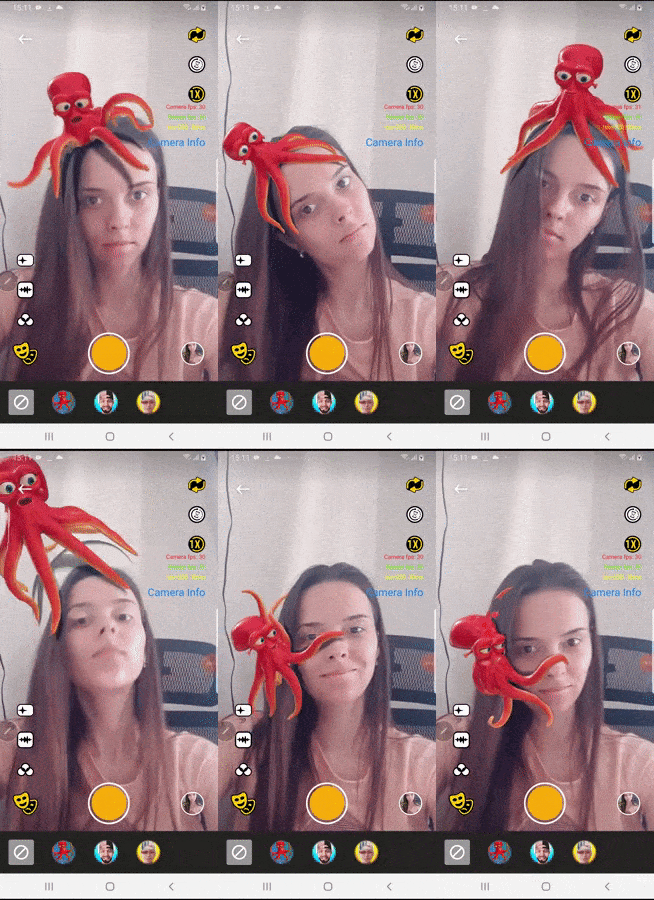 Banuba's AR filters
Licensing model. The realistic options are free and open source (MediaPipe, OpenCV, ARKit, ARCore), MAU-based subscription (Banuba, DeepAR), and custom quote (Visage, and most enterprise deals). MAU pricing is predictable and scales with the product; with custom quotes, check whether support is bundled or billed separately.
Integration time. Look for real sample apps in your language, a package on your package manager, and documentation you can read before you talk to sales. Time to a working camera preview is a fair proxy for the rest of the integration, which is why a commercial AR framework is best judged on a trial rather than a demo call.
Effect authoring and the asset pipeline. Tracking is the boring half. Someone has to author effects, ship them, and update them without a new app release, so decide early whether your team writes effects in code, uses a vendor's authoring tool, or buys a ready library. Our guide to creating face-based AR experiences covers that pipeline.
Live-video compatibility. If the AR layer sits inside a call or a stream, the SDK has to hand frames back to your video stack cleanly, at frame rate, on the devices your users own. Teams on Agora, Amazon IVS, Vonage, or Azure Communication Services should ask each vendor for documented integration guides for that exact stack instead of assuming a generic camera API will do, and should ask whether the feature is configuration or custom development, the way we break it down in the guide to building AR beauty features.

The AR frameworks worth shortlisting
1. Apple ARKit
Platform-native iOS baseline. ARKit gives you world tracking, plane detection, scene geometry, and face tracking on Apple hardware only. It is free with the Apple toolchain and carries no license fee, so it is the default starting point for any iOS-first team. Nothing on this list beats it for world tracking and depth sensing on Apple devices, and no commercial vendor should tell you otherwise.
Best for: iOS-only apps that need world tracking and depth on Apple devices.
2. Google ARCore
Platform-native Android baseline. ARCore covers world tracking, depth, and light estimation on supported Android devices, and like ARKit, it costs nothing. The catch is coverage: it runs only on ARCore-certified handsets, so the addressable device list is narrower than your Android install base. For room-scale placement on Android, it is still the reference implementation.
Best for: Android apps built around placing objects in a room.
3. Unity AR Foundation
The cross-engine abstraction layer. AR Foundation wraps ARKit and ARCore behind one Unity API, so a single project targets both platforms without two native codebases. If your product is already a Unity build, or the experience is 3D and game-heavy, this is the best-in-category choice and the argument is not close. It does not replace the platform frameworks; it multiplexes them.
Best for: teams already shipping in Unity, and 3D or game-heavy experiences.
4. Google MediaPipe
Open-source on-device ML building blocks. Published by Google with source in the google-ai-edge GitHub organization, MediaPipe is open source under the Apache License 2.0 with no published pricing page, which makes it best-in-category for zero-cost on-device ML experimentation. Documented deployment targets are mobile (Android, iOS), web, desktop, edge devices, and IoT, with the Solutions availability table published across four platform columns: Android, Web, Python, and iOS. Google labels the release "MediaPipe Solutions Preview is an early release", and the defaults matter: landmark smoothing is only applied when num_faces is set to 1, and output_face_blendshapes and output_facial_transformation_matrixes default to False. Two procurement notes: MediaPipe Tasks APIs send metrics about API performance and utilization to Google, with the integrator responsible for obtaining informed user consent as required by law, and support for MediaPipe Legacy Solutions ended on March 1, 2023; Face Mesh and Iris folded into Face landmark detection.
Best for: free on-device ML prototyping and custom pipelines.
5. OpenCV
The do-it-yourself computer vision library. Operated by the non-profit Open Source Vision Foundation and dating from June 2000, OpenCV ships more than 2500 optimized algorithms; the latest released version 4.12.0 dated 2025-07-09, licensed by version: 4.5.0 and higher under the Apache 2 License, 4.4.0 and lower under the 3-clause BSD licence. It offers C++, Python, Java, and MATLAB interfaces plus OpenCV.js tutorials for the browser, and the official OS list reads "supports Windows, Linux, Android and Mac OS" while iOS documentation and an iOS release pack are published separately. For faces, cv::FaceDetectorYN is a DNN-based detector whose detect() returns a 2D matrix of shape [num_faces, 15], five landmark coordinates plus a bounding box and a face score, with the model distributed separately via the OpenCV Zoo repository.
Best for: teams with in-house CV engineers building something bespoke.
6. Niantic 8th Wall
The browser-AR platform that changed shape. The paid 8th Wall platform was retired on 28 February 2026, and the technology is now free and open source under Niantic Spatial. That removes the license cost and also the commercial support relationship, so treat it as a migration decision with an owner and a date rather than a new-build default. If you are weighing browser delivery generally, we compared five ways to put AR in a browser and what each one costs you in reach.
Best for: existing 8th Wall projects, with a migration plan.
7. Snap Camera Kit
The Lens Studio ecosystem in your app. Camera Kit ships three official SDKs for iOS, Android, and Web, and its real draw is access to Snap's lens authoring tools and creator ecosystem rather than the tracking layer alone. One documented browser caveat matters if the web is a primary surface: on Safari, SIMD and Web Worker Mode are listed as Unsupported.
Best for: teams that want Snap's lens authoring tools and creator ecosystem.
8. DeepAR
The published-price face AR SDK. DeepAR is integrated into mobile, web, and desktop applications, with documented integrations for Amazon Interactive Video Service (AWS IVS), Agora, and Vonage, and integration guides for Amazon IVS and Azure Communication Services. Pricing is MAU-based and, unusually here, published: free up to 10 MAU, $25/month or $250/year up to 1,000 MAU, $100/month or $1,000/year up to 5,000 MAU, $500/month or $5,000/year up to 30,000 MAU, $1,000/month or $10,000/year up to 100,000 MAU, contact sales above that, with DeepAR Studio free to use. That transparency makes it best-in-category for published pricing at small scale. Provider-documented limitations: emotion detection and video textures are not available on Web, and hair segmentation is iOS only.
Best for: small-scale launches that need a price before a sales call.
9. Visage Technologies
The face-analysis specialist. The Visage SDK splits into FaceTrack, FaceAnalysis and FaceRecognition, and supports iOS, Android, Web (HTML5), Windows, macOS, Linux, embedded systems (Raspberry Pi, Xilinx) and Unity, running on-device or in the cloud. FaceTrack LITE is a free perpetual license for one app up to 10,000 users, after which new users lose tracking features until a FaceTrack license is purchased; pricing otherwise is a custom quote with no public price list, and technical support is charged separately at a fixed 1,500 EUR per year per client. Technically, it tracks more than 100 facial points in real time, and FaceAnalysis detects gender, age, and emotions.
Best for: embedded and desktop face analysis.
10. Banuba Face AR SDK
The cross-platform face AR layer for live video. Banuba Face AR SDK does real-time, on-device face tracking and AR effects at a minimum of 30 FPS on mid-range mobile hardware, with a -80° to +80° head-angle tracking range, 68 facial anchor points, a 3D mesh of up to 3,308 vertices, steady tracking under up to 70% facial occlusion and at distances up to 3.7 meters, and up to 9 faces tracked and affected on screen. Platform coverage is why most teams shortlist it: HTML5, iOS, Android, Windows, macOS, Unity, Flutter, and React Native, on iOS 13+ and Android 8.0+, with a 1280x720 camera recommended, covering 97% of Apple smartphones and 80% of Android ones from a single cross-platform integration, distributed through CocoaPods, Maven, and NPM, and sized at around 15 Mb, depending on the feature set enabled. It runs fully on-device and works offline, so user video never leaves the phone, and on the content side there are over 1000 AR filters in the Asset Store plus DIY effect creation in Banuba Studio, with a case study on our blog showing what that looks like at scale. Pricing is MAU-based, with a 14-day free trial that needs no card and an average startup time under an hour.
Best for: real-time face AR inside live video (streaming, conferencing, social) that has to run cross-platform on mid-range devices without a cloud round trip.

Comparison table
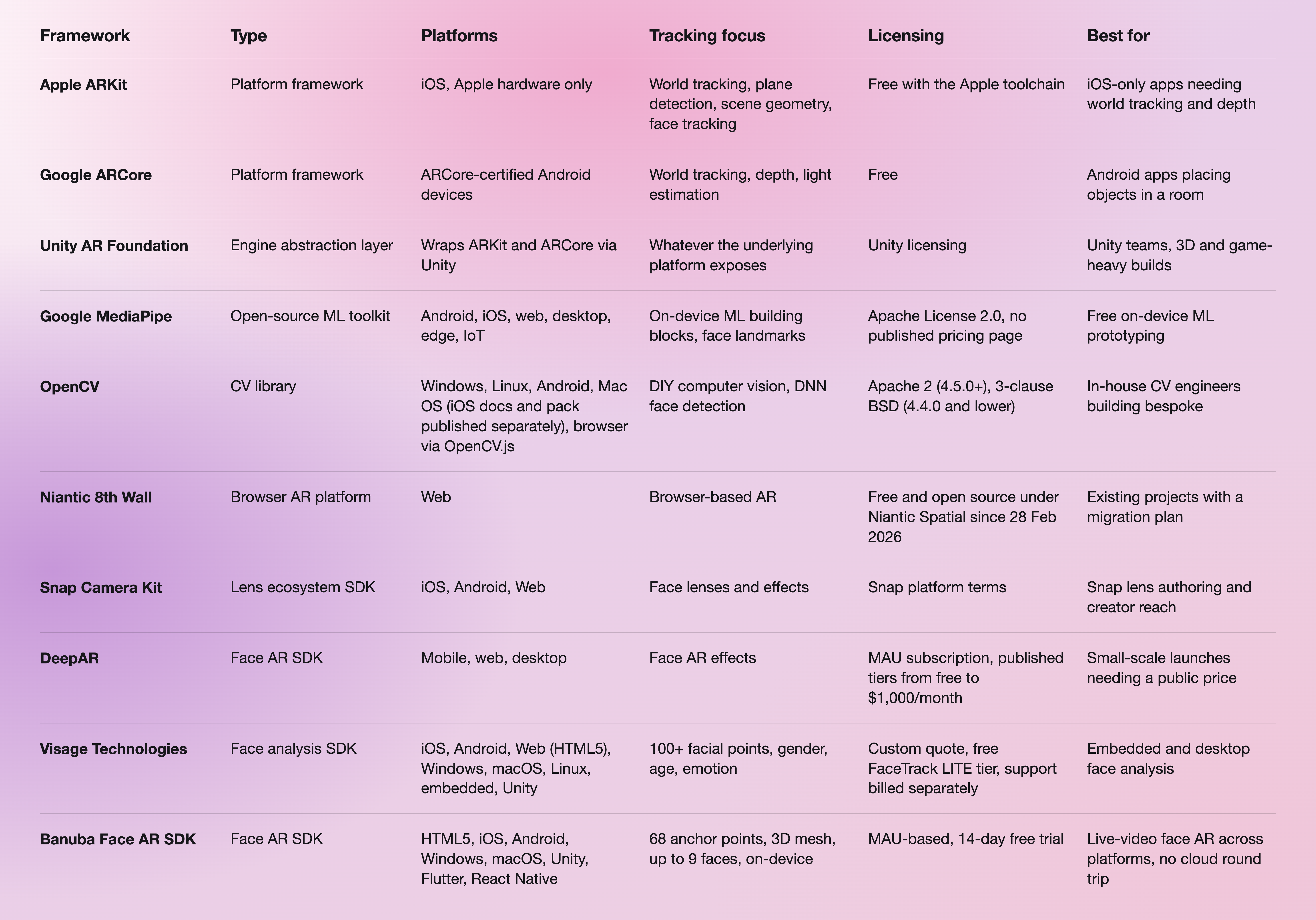
Official references for the table: Apple ARKit, Google ARCore, Unity AR Foundation, Google MediaPipe, the OpenCV documentation, and the Banuba Face AR SDK documentation.
When a platform framework is enough
Plenty of teams should not buy anything. If you ship on one platform, the case for a commercial license is weak: ARKit already gives iOS world tracking, plane detection, scene geometry and face tracking for free, and ARCore does the equivalent on certified Android handsets. Paying a vendor to wrap a free API you already have is a cost with no matching capability. The same goes for prototypes, where MediaPipe is enough to prove a concept before anyone signs a contract, and for bespoke work if you have CV engineers who want to own an OpenCV pipeline.
The free route starts to hurt in three places. First, breadth: matching the same behavior across iOS, Android, browser, desktop, and the React Native or Flutter layer means maintaining several integrations instead of one. Second, live video, where frame-rate stability on mid-range hardware and behavior under occlusion and at distance break in production rather than in a demo. Third, content operations, because a tracking model gives you no authoring tool, no asset library, and no way to update effects without a new binary. Free defaults also assume a narrow case: in MediaPipe, landmark smoothing is only applied when num_faces is set to 1, which is not the shape of a group video call.
Prototype-free, and buy only when the requirement list includes more than two platforms, a live video pipeline, and a content update cadence someone other than an engineer has to own.
-
Unity AR Foundation covers both by wrapping ARKit and ARCore, and for face tracking, Banuba Face AR SDK, DeepAR, Snap Camera Kit, and Visage all ship iOS and Android SDKs. Banuba Face AR SDK runs on iOS 13+ and Android 8.0+ and covers 97% of Apple smartphones and 80% of Android ones from one cross-platform integration, which is the figure to hold other vendors against. Specifications and the 14-day free trial are on the Banuba Face AR SDK page.
-
Pick one with a maintained binding rather than a native SDK you would bridge yourself. Banuba Face AR SDK supports both, with React Native and Flutter among its eight supported platforms and packages on the usual registries, including the banuba_sdk package on pub.dev for Flutter and an NPM package for React Native, with setup steps for both in the Banuba Face AR SDK documentation. Most other options here expect native or Unity integration, so the wrapper layer is where the shortlist narrows fastest.
-
Browser AR is covered by Snap Camera Kit's Web SDK (with SIMD and Web Worker Mode listed as Unsupported on Safari), the now open-source Niantic 8th Wall technology, MediaPipe's web target, OpenCV.js, and Banuba Face AR SDK via HTML5. Banuba Face AR SDK keeps processing on-device in the browser too, so the camera stream never needs a server. Our overview of AR for web sets out what browser delivery gains in reach and costs in device support.
-
It ranges from nothing to a custom enterprise quote. Banuba Face AR SDK pricing is MAU-based, with a 14-day free trial that needs no card, and what drives the tiers is explained in the Banuba Face AR SDK pricing guide. DeepAR publishes its MAU tiers openly (free up to 10 MAU, $25/month up to 1,000 MAU, rising to $1,000/month up to 100,000 MAU), Visage quotes custom and bills support separately at 1,500 EUR per year per client, and MediaPipe and OpenCV are free open source with no license cost.
