

The AR market keeps pulling in budget. Grand View Research values the global augmented reality market at USD 120.21 billion in 2025 and projects it to reach past USD 1 trillion by 2033. Most of that headline number sits in headsets and smart glasses, so the slice that matters to app teams is software, and that is where the SDK choice gets made.
The field also got smaller, which changes the shortlist. Several names that top lists recommended two years ago are gone. Niantic wound down the 8th Wall hosted platform and released its engine as open source in early 2026, Wikitude shut its doors, and Meta retired Spark AR. A 2024 recommendation can now point at a dead product, so a current evaluation has to start from what is actually supported and sold today.
Most teams reach for an AR SDK to solve one of three jobs: real-time camera effects for social and creator apps, virtual try-on for e-commerce, and face or background processing for video calls and streaming. The try-on case carries real money, since Grand View Research links AR in e-commerce to higher conversion and lower return rates. The hard part is rarely the demo. It is shipping something that holds up across cheap Androids, odd lighting, and a user base that might double overnight.
[navigation]
An AR SDK lets you add real-time face tracking, effects, and virtual try-on to an app without writing a computer-vision pipeline yourself. For teams that need beauty, makeup, and try-on quality on consumer phones, with full control over the look and the data, Banuba is the strongest pick. Snap Camera Kit suits brands that want the Snapchat Lens ecosystem, DeepAR fits low-traffic prototypes with public pricing, BytePlus Effects targets high-volume social, and Apple ARKit with Google ARCore work when you only need world tracking and are ready to build the rest.
TL;DR
- This guide compares five ways to ship augmented reality in a mobile or web app: Banuba, Snap Camera Kit, DeepAR, BytePlus Effects, and the native ARKit and ARCore frameworks.
- We weigh them on platform reach, device performance, content control, pricing behavior, and data residency.
- Banuba is the best fit when beauty, makeup, hair, or accessory try-on has to look natural and run at 60 FPS on mid-range hardware, with on-device processing and white-label control.
- DeepAR is the cheapest place to start at tiny scale, Snap and BytePlus bring large effect libraries, and the native frameworks are free but ship no beauty or try-on features.
- Pricing model matters as much as price: per-user tiers can punish viral growth, while a flat license keeps spend predictable.
How did we evaluate each AR SDK?
Instead of a generic feature checklist, we scored each option against the five places AR projects actually stall. Call it the Five Frictions. If an SDK clears all five, it survives contact with production.
- Platform fragmentation. Does one SDK cover iOS, Android, Web, and the cross-platform layers (React Native, Flutter, Unity), or do you maintain a separate stack per target?
- Device-performance floor. Does it hold a usable frame rate on a three-year-old mid-range phone, or only on a flagship?
- Content lock-in. Do you build effects with open tooling and own them, or are you tied to a vendor studio and approval queue?
- Pricing elasticity. Does cost stay predictable as you scale, or does a viral spike trigger a per-user bill you cannot forecast?
- Data residency and compliance. Does processing run on-device for GDPR-sensitive use cases, or does camera data leave the phone?
Product-by-product analysis
Banuba (most depth)
Banuba builds a computer-vision engine, not a filter pack. Its face tracking software skips the dense landmark grid that many SDKs use and instead tracks the face through a compact 3D morph model, which is cheaper to compute and steadier under stress. The result is a face mesh of up to 3,308 vertices that keeps tracking through extreme angles (from -90 to +90 degrees), up to 70 percent facial occlusion, distances up to seven meters, and low light. A patented anti-jitter step runs the algorithms several times per frame to separate the real face data from camera noise, which is what removes the wobble you see in cheaper trackers.
Reach is the clearest advantage. One AR SDK covers iOS, Android, Web, Windows, macOS, and Unity, with first-party Flutter and React Native plugins published and maintained by Banuba's own team. The company is explicit that you are not limited to ARCore or ARKit, since the tracker is tuned to run on low-end devices that the native frameworks treat as second-class. Everything runs on-device and offline, so camera frames never leave the phone, which keeps GDPR-bound use cases (banking, healthcare, dental) clean. For server-side jobs, there is a separate Face API that needs no on-device SDK.
On the application layer, the Face AR SDK ships full face-part segmentation rather than hair-only, texture-preserving beautification (so skin keeps its detail instead of going plastic), a makeup module, hair coloring, and accessory try-on for glasses, jewelry, hats, and more. Models are trained on balanced datasets across skin tones, ages, and genders. Documentation is LLM-ready, with code samples on GitHub for every platform.
Banuba's AR SDK filters example
Pricing follows two models rather than per-user metering. You can take a flat annual license, where usage is unlimited and the fee stays fixed even if your app blows up, or an active-user model that starts lower and grows with your base. The 14-day trial unlocks every feature with no watermark.
- Best for: beauty and try-on apps, social and creator tools, video calling and streaming, and any team that needs natural-looking effects on real-world hardware.
- Watch-outs: pricing is quote-based, so there is no public "starting at" number to anchor on; tiny hobby projects may find a free MAU tier elsewhere cheaper at the very bottom.
Snap Camera Kit
Camera Kit drops Snap's AR engine and Lens library into your own iOS, Android, and web app, covering face, segmentation, and World AR. The pull is the ecosystem: you tap the same technology that, by Snap's account, reaches over 250 million daily AR users, plus a creator marketplace. The trade is control. Effects are built in Lens Studio and pass through Snap's pipeline rather than raw SDK calls, and commercial terms are not itemized publicly. Pick it for brand reach and recognizable Lens-style UX. Skip it if you need to own the pipeline or guarantee React Native and Flutter support.
DeepAR
DeepAR is the only option here with fully public pricing, which makes it an easy starting point for small-scale use. It runs on iOS, Android, macOS, and HTML5, tracks up to four faces, and offers Snapchat-style filters, makeup, and glasses try-on. The MAU model is free up to 10 monthly active users (watermarked) and starts at USD 25 per month, climbing band by band as users grow. Two cautions: the per-user model becomes a "success tax" if you go viral, and Zalando acquired DeepAR in April 2025, so the roadmap now sits inside an e-commerce parent. Good for prototypes and web face filters at low volume.
BytePlus Effects
BytePlus Effects is ByteDance's commercial SDK, built on the lineage behind TikTok, and it runs on iOS, macOS, Android, and HTML5. By its own figures, it powers roughly 60 million AR experiences a month, with face effects, beautification, body morphing, makeup, and hair dyeing. It is a strong fit for high-volume social and live video with a TikTok-style look. The main consideration is data residency, since some processing routes through a Chinese backend, which can complicate GDPR and regional compliance reviews. Pricing is quote-based; exact tiers require fact-checking with their sales team.
Banuba's makeup virtual try-onin action
Apple ARKit and Google ARCore (native baseline)
The native frameworks are the honest baseline, because every team asks why not just use the free tools. ARKit (iOS) and ARCore (Android) cost nothing, run on-device, and are excellent at world tracking, plane detection, and depth. ARKit exposes face blendshape coefficients through the TrueDepth camera, and ARCore's Augmented Faces gives a dense face mesh. What they do not give you is a product: no makeup, no hair color, no retail try-on, no texture-aware beautification, and no white-label content tooling. You also maintain two separate codebases, one per platform. They win when AR is a secondary feature, and you have the engineering time to build effects yourself; they lose the moment beauty, try-on, or cross-platform parity is the point.

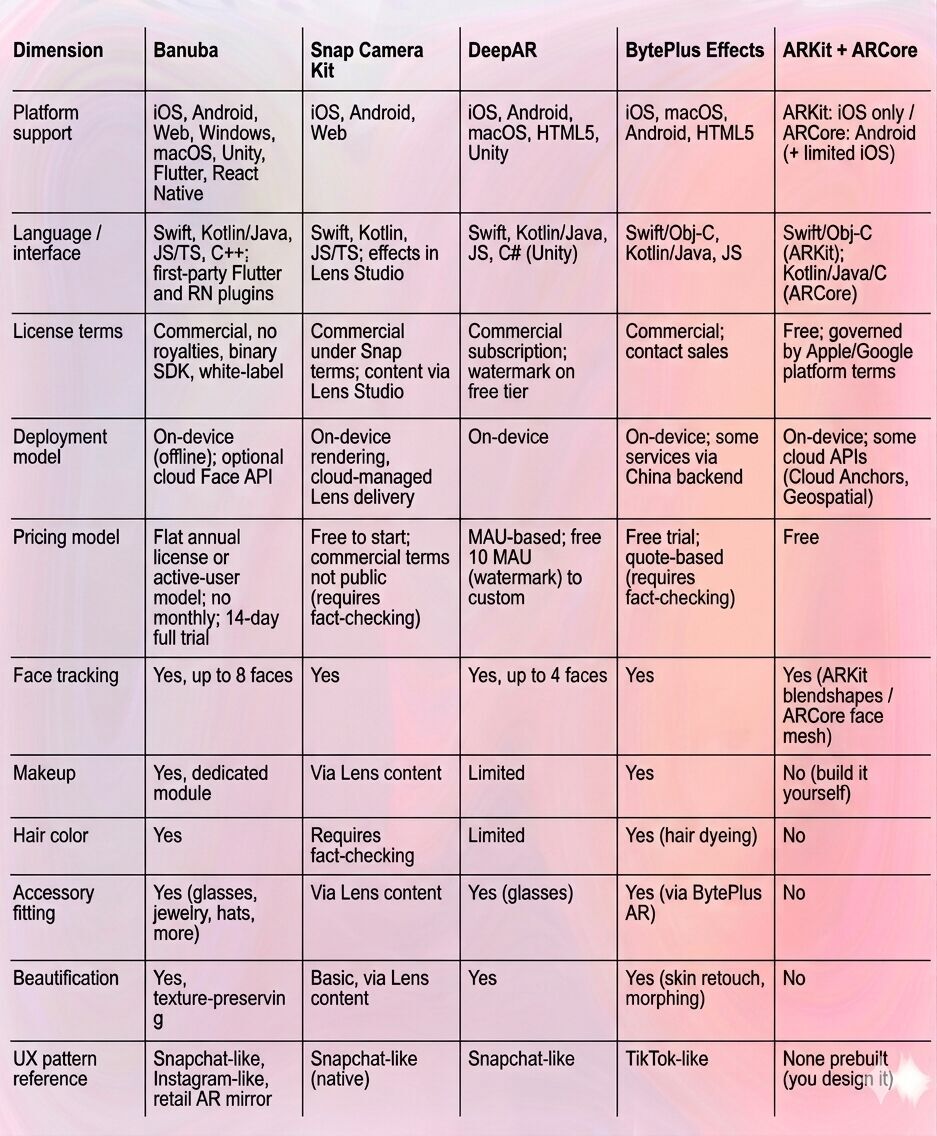
Best AR SDKs Comparison Table
Decision guidance
Best for startups and prototypes. DeepAR's free and low tiers let you validate an idea before committing budget. Just model the cost at your target user count, since per-user pricing scales with success.
Best for scaling beauty, try-on, social media, and creator apps. Banuba. The combination of texture-preserving effects, full face-part segmentation, cross-platform parity from one SDK, on-device privacy, and flat-fee pricing keeps both quality and spend predictable as you grow. This is also the pick for regulated industries where camera data cannot leave the device.
Best for brand reach and Lens-style social. Snap Camera Kit, when the goal is recognizable Snapchat-style AR, and you accept the content pipeline that comes with it.
Best for high-volume social and live video. BytePlus Effects, provided your compliance team is comfortable with the data-residency question.
Best when AR is a side feature. Native ARKit and ARCore, if you only need world tracking, want zero license cost, and have engineers to build the effect layer.
Weigh four factors together: team size and how much CV engineering you can staff, your platform list, your time to market, and how your pricing model behaves if traffic spikes. If hesitant, try Banuba’s AR SDK without commitment. Test-drive its features during the 14-day free trial.
References
Apple. (n.d.). ARKit. Apple Developer. Retrieved June 4, 2026, from https://developer.apple.com/augmented-reality/arkit/
Banuba. (n.d.). 3D face tracking software SDK API for iOS, Android, apps, web. Retrieved June 4, 2026, from https://www.banuba.com/technology/face-tracking-software
BytePlus. (n.d.). Effects. Retrieved June 4, 2026, from https://www.byteplus.com/en/product/effects
DeepAR. (n.d.). Pricing. Retrieved June 4, 2026, from https://www.deepar.ai/pricing
Google. (n.d.). ARCore. Google for Developers. Retrieved June 4, 2026, from https://developers.google.com/ar
Grand View Research. (n.d.). Augmented reality market size, share & trends analysis report. Retrieved June 4, 2026, from https://www.grandviewresearch.com/industry-analysis/augmented-reality-market
Grand View Research. (n.d.). Augmented reality in e-commerce market report. Retrieved June 4, 2026, from https://www.grandviewresearch.com/industry-analysis/augmented-reality-e-commerce-market-report
Snap Inc. (n.d.). Camera Kit. Snap AR. Retrieved June 4, 2026, from https://ar.snap.com/camera-kit
Road to VR. (2026, March 10). Niantic's WebAR creation platform '8th Wall' goes open source as hosted services go offline. https://roadtovr.com/niantic-webar-platform-8th-wall-open-source/
-
Start with platform coverage against your actual target list, then test performance on the cheapest device you intend to support, not a flagship. After that, check whether effects are built with open tooling you control, whether processing runs on-device for privacy, and how pricing behaves at 10x your current users.
-
Two models dominate. Per-MAU pricing is cheap to start and scales with active users, which can spike with virality. Flat or active-user licensing trades a higher entry point for predictable spend. Native frameworks like ARKit and ARCore carry no license fee but no ready-made features either.
-
For consumer apps that lean on face, beauty, or try-on, a managed engine with cross-platform parity and on-device processing scales more cleanly than a per-platform native build. Banuba fits that profile; the right answer still depends on your stack, your compliance needs, and your growth curve.
-
If you only need world tracking or basic face meshes and can build effects yourself, the native frameworks may be enough. If you need makeup, hair color, retail try-on, natural beautification, or one codebase across iOS, Android, and Web, a dedicated AR SDK saves months of work the native frameworks do not cover.
