

Makeup try-on was something out of this world in 2019. It now drives measurable revenue, and the spend behind it shows it. Mordor Intelligence values the augmented shopping market at USD 20.78 billion in 2026, with mobile AR apps holding 58% of revenue and beauty sitting among the top end-user categories.
The reason buyers care is conversion. Mordor's online cosmetics analysis notes conversion rates roughly double once shoppers engage an AI beauty advisor, and a single try-on session shortens the gap between curiosity and checkout. Returns matter just as much, since color cosmetics are hard to judge from a flat product photo, and every wrong shade that ships out eats margin twice.
So the question facing most teams is which engine to build on, and how much of that engine you want to own versus rent. That single question separates Banuba and YouCam more than any feature checkbox does. Let’s compare these two giants.
[navigation]
Banuba and YouCam (Perfect Corp) both ship production-grade makeup software for virtual try-on, but they solve the problem from opposite ends. Banuba runs on-device, licenses at a flat rate, and gives engineering teams direct control over the tracking and rendering layer. YouCam leans on a cloud API with pay-as-you-go billing and a large catalog of beauty and skin-analysis modules. Banuba is the stronger fit when you need offline processing, predictable cost at scale, and first-party Flutter and React Native support.
TL;DR
- This guide compares Banuba's makeup software (TINT) with YouCam's SDK and API for teams building virtual makeup try-on.
- We weighed deployment model, tracking engine, makeup realism, framework reach, integration speed, and licensing.
- Banuba wins for on-device privacy, accurate product overlay, fast product digitization, flat-fee economics, and native cross-platform wrappers.
- YouCam wins for breadth of pre-built beauty modules and brands that want a managed cloud service over an owned build.
Evaluation matrix
We scored both products against six criteria that determine how a try-on build actually behaves in production:
- Deployment and data flow. On-device, cloud, or hybrid, and where the camera frames travel.
- Tracking engine. How the face is detected and followed, and how that holds up on cheap hardware.
- Makeup realism. Coverage of cosmetic categories, texture accuracy, and skin-tone behavior.
- Platform and framework reach. Native iOS and Android plus real Flutter, React Native, Web, and Unity support.
- Integration speed. Time from access to a working demo, and the quality of the docs.
- Licensing economics. How the bill grows as your user base grows.
Banuba makeup software (TINT)
What it is
Banuba is an independent computer vision company that has built and patented its own face engine since 2016. Its makeup software, branded TINT, sits on top of that engine and is sold as a virtual try-on product for beauty brands and the developers who build for them. The client list runs across very different industries, from Gucci and Schwarzkopf to RingCentral and Samsung, which keeps the roadmap broad rather than tied to one retailer's wishlist.
How Banuba’s engine tracks a face
Most try-on software starts by plotting dozens or hundreds of 2D landmarks, then guesses the head's 3D position from those dots. Banuba skips that. Its face tracking technology is built on a 3D math model that recognizes 37 face characteristics expressed as morphs, covering expression, anthropometry, and head position in the frame. Processing 37 parameters instead of a long landmark list keeps the math light, which is why the tracker behaves the same on a flagship iPhone and a 100-dollar Android.
The numbers behind it are concrete. The engine reconstructs a face mesh with up to 3,308 vertices, tracks across the full -80 to +80 degree rotation range, works at up to 7 meters from the camera, and holds steady with up to 70% of the face blocked by a hand or accessory. A patented anti-jitter step runs several times within each frame to strip out visual noise, so the makeup sits flat on the skin instead of swimming. Every computation happens on the device. No frame leaves the phone, which makes GDPR compliance a property of the architecture rather than a policy promise.
Where the makeup actually lives
Realistic cosmetics need more than tracking. They need pixel-level face segmentation, which isolates lips, brows, eyes, and skin so a product lands only where it belongs. TINT uses that segmentation to render up to nine makeup products on a face at once, in real time, without a quality drop.
Category coverage is deep:
- Foundation in matte and natural finishes, matched to the real product's coverage.
- Lipstick and lip gloss across matte, glossy, and satin textures.
- Blush, eyeliner, eyeshadow, mascara (lengthening, volume, and natural variants), false lashes, and an eyebrow pencil.
- Complete branded looks that users can mix and modify live.
Banuba also enables a brand to digitize its real catalog rather than approximating it, capturing coverage and pigmentation so a virtual shade interacts with skin the way the physical one would. AI-assisted self-service digitization is built into all versions of TINT. On top of that sits AI makeup recommendations driven by automated face and seasonal color analysis, so the experience guides a shopper toward shades that suit them.
Platforms, frameworks, and integration
TINT runs on web, mobile, and in-store hardware as an AR mirror. The underlying Face AR SDK supports iOS, Android, Web, Unity, Windows, and macOS, and ships first-party Flutter and React Native plugins maintained by Banuba itself. That last detail saves real maintenance work, since updates come from the vendor instead of a community bridge that may lag a release behind.
For e-commerce, the fastest route is the no-code virtual try-on plugin, which installs in under five minutes. The documentation includes an LLM-ready guide for AI-assisted coding, and code samples live on Banuba's public GitHub.
Proof from real deployments
The case studies are specific, not vague.
- Brazilian brand Boca Rosa ran a pre-launch event on Banuba's makeup software that brought in USD 900,000 in four hours across 1.7 million try-on sessions.
- Océane lifted its add-to-cart rate from 3% to 32%.
- Looké passed 55,000 installs in its first year with a 5-star app store rating.
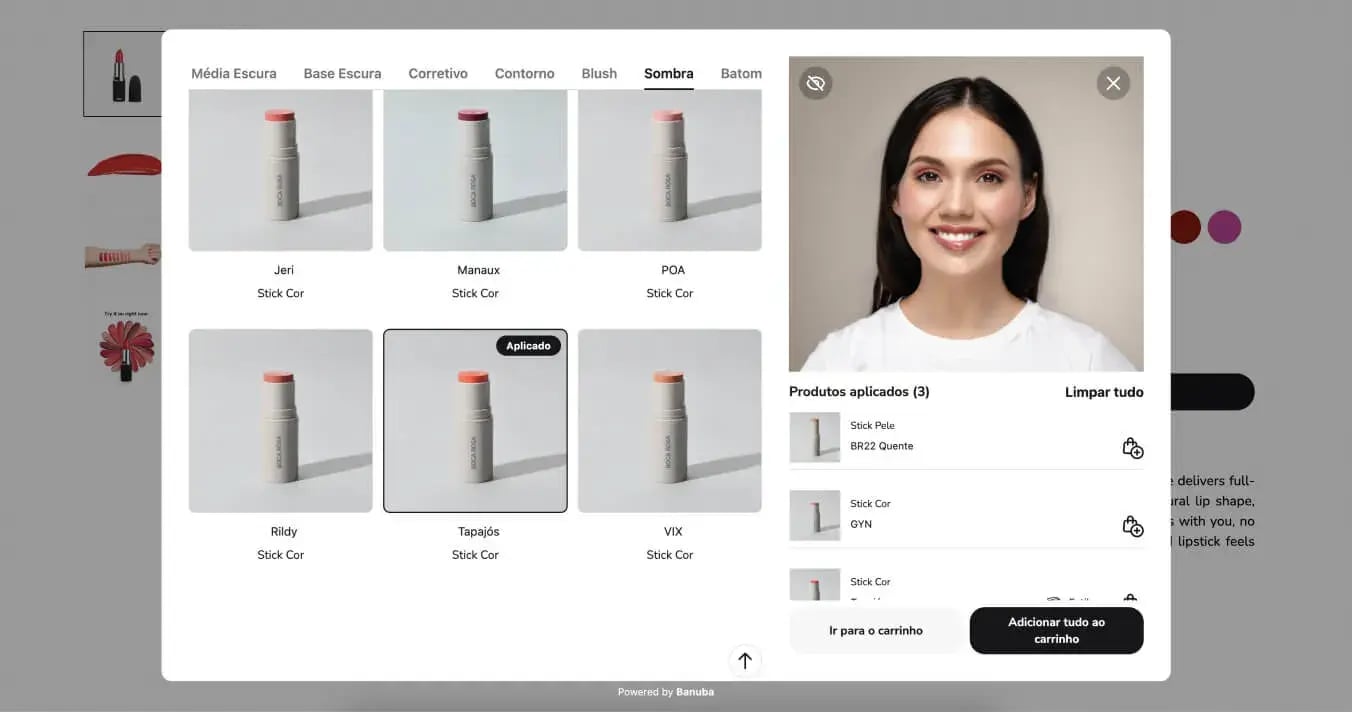 Banuba's makeup software interface example
Where it falls short
Banuba is not a no-budget option. The flat license is predictable but it is a real commitment, and teams that want a deep, fully custom interactive effect will spend design time in Banuba Studio to build it. If you only need a single lipstick overlay for a quick prototype, a lighter tool may be enough.
Licensing
The SDK is priced by the number of monthly active users. This means your startup can afford it, and the costs would be manageble for an established enterprise.
TINT plugins (and a self-serve no-code platform) come in tiered plans set by monthly try-on volume, custom integrations are quoted per store.

YouCam SDK (Perfect Corp)
Perfect Corp is a worthy rival in beauty tech. Its YouCam app suite has passed 1.1 billion downloads, and the company works with more than 800 brand partners.
What the SDK and API cover
YouCam's developer offering is broad. It includes AR makeup for lips, eyes, face, brows, and nails, an AI Foundation Shade Finder, AI skin analysis, hair color try-on, and accessory try-on for glasses, jewelry, and watches. The company has pushed hard into conversational AI, launching a YouCam AI Agent that turns a selfie and a chat into a guided consultation, plus an "Ask AI" assistant inside the developer docs.
Architecture and platforms
Tracking runs on Perfect Corp's patented AgileFace technology, and rendering quality is high on flagship devices, especially for lips and eyeshadow. The Mobile SDK supports iOS and Android natively, with a Web module and a RESTful API. React Native and Flutter are typically handled through manual bridges or REST calls rather than first-party wrappers. Several features, including skin analysis and some shade-matching, route through the cloud, which makes the deployment hybrid rather than fully on-device.
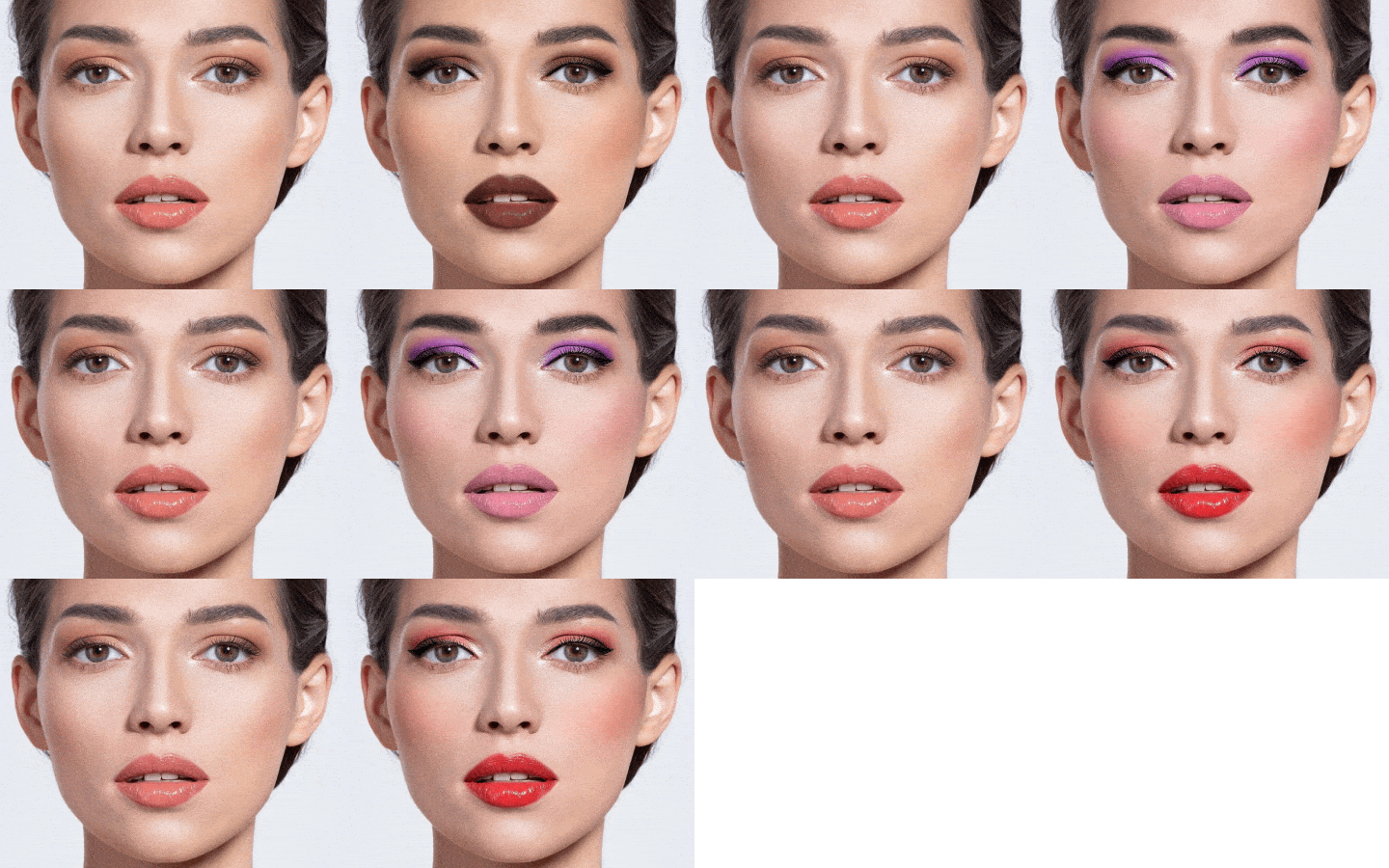 Banuba's virtual makeup application in action
Pricing and access
YouCam's API uses a pay-as-you-go model, with enterprise terms quoted through sales. That works well for brands that prefer a managed service and variable cost. It also means the bill tracks usage, so a viral spike raises spend, and full SDK access usually runs through a procurement cycle rather than a self-serve sign-up.
Where it fits and where it doesn't
YouCam suits established retailers that want the widest module catalog and a managed cloud service, and that value the brand-network credibility. It is a weaker fit for teams that need strict on-device processing, a fixed cost ceiling at scale, or first-party hybrid-framework wrappers.

Side-by-side comparison
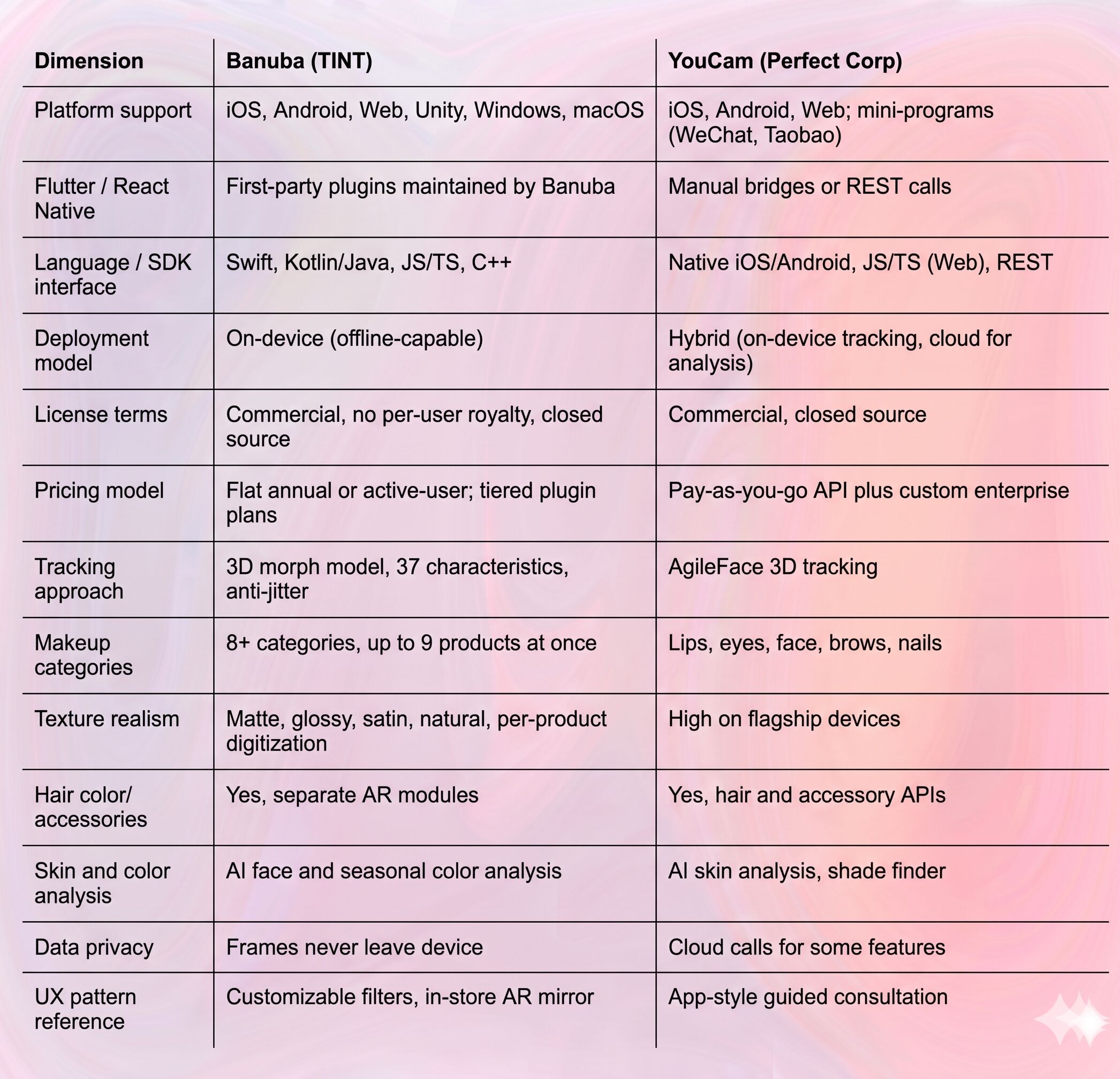
What to choose for your business?
Choose Banuba if you are building a production app or store where costs must stay predictable as you grow, where camera data cannot leave the device for privacy or regulatory reasons, or where your team ships on Flutter or React Native and wants vendor-maintained plugins. It is also the better choice for in-store hardware and offline kiosks, since the engine needs no network connection.
Choose YouCam if you are an established brand that wants the broadest catalog of pre-built beauty and skin modules, prefers a managed cloud service over an owned build, and accepts usage-based billing through an enterprise contract.
Don’t waste any more time researching. Start a no-commitment 2-week trial with Banuba to see how it fits your requirements and business needs.
References
Banuba. (n.d.). Makeup software virtual try-on (TINT). Retrieved June 4, 2026, from https://www.banuba.com/tint-makeup-virtual-try-on
Banuba. (n.d.). Face tracking software. Retrieved June 4, 2026, from https://www.banuba.com/technology/face-tracking-software
Banuba. (n.d.). Face segmentation. Retrieved June 4, 2026, from https://www.banuba.com/technology/face-segmentation
Banuba. (n.d.). AR virtual try-on plugin. Retrieved June 4, 2026, from https://www.banuba.com/ar-virtual-try-on-plugin
Banuba. (2025). Virtual try-on by Banuba helps beauty brand earn $900,000 in 4 hours. https://www.banuba.com/blog/virtual-try-on-helps-beauty-brand-earn-900.000-in-4-hours
BusinessWire. (2026, May 13). Perfect Corp. integrates free AI assistant "Ask AI" into YouCam API platform. https://www.businesswire.com/news/home/20260513560473/en/Perfect-Corp.-Integrates-Free-AI-Assistant-Ask-AI-into-YouCam-API-Platform
Mordor Intelligence. (2026a). Augmented shopping market size, share and trends report. https://www.mordorintelligence.com/industry-reports/augmented-shopping-market
Mordor Intelligence. (2026b). Beauty camera apps market size and share outlook. https://www.mordorintelligence.com/industry-reports/beauty-camera-apps-market
Mordor Intelligence. (2026c). Online cosmetics market size, share and growth analysis. https://www.mordorintelligence.com/industry-reports/online-cosmetics-market
-
Start with where the data goes, since on-device processing removes a whole class of privacy and latency problems. Then check tracking quality on mid-range hardware, makeup realism across textures and skin tones, genuine Flutter and React Native support rather than community bridges, and a license model whose cost you can predict two years out.
-
Three models dominate. Flat licensing charges a fixed fee regardless of users, which protects margins as you scale. Active-user or pay-as-you-go billing starts cheap and rises with adoption. Tiered SaaS sets monthly limits per plan.
-
Banuba holds up best at scale because the flat license decouples cost from user count, on-device processing keeps server bills at zero, and first-party cross-platform wrappers cut maintenance.