

Beauty buying moved to the camera. AI in beauty and cosmetics is forecast to grow from about $5.3 billion in 2026 to $10.86 billion by 2030, and most of that spending lands on try-on, skin analysis, and recommendation tools. The reason is plain commercial math. Shopify reports that products with 3D or AR content convert about 94% better than products without it, and that the same media can cut returns by up to 40%.
Choosing which solution to use is harder than the demos suggest, because two products labeled "makeup API" can sit at opposite ends of the build. One gives you a tracking and rendering engine to integrate into your own camera screen. The other gives you a finished, hosted experience you configure and drop in.
This piece compares Banuba and Revieve on the factors that actually determine an integration: where the code runs, what your engineers touch, how faces are tracked, what happens to user data, and how the bill scales. The scope is a makeup virtual try-on for web and mobile commerce, beauty apps, and in-store screens.
[navigation]
Banuba and Revieve both add cosmetics try-on, smart recommendations, and skin analysis to a beauty app or store, so this is not a breadth-versus-depth choice. The split is how you ship. Banuba gives you a makeup API and a managed platform (TINT) with a 22,000-plus product catalog, free ongoing digitization, on-device processing across web and native, and flat or usage-based licensing. It also extends beyond try-on to avatars and AI-generated presenters in beauty marketing. Revieve runs a hosted SaaS suite built around AI skin diagnostics, advisors, and first-party data capture in the cloud. Pick Banuba for breadth, plus deployment and pricing control. Pick Revieve for a managed, diagnostics-led advisor aimed at marketing and retail teams.
TL;DR
- This guide compares Banuba and Revieve as makeup API options for engineering teams building a virtual try-on.
- Both are judged on platform reach, integration model, tracking quality, data handling, and pricing.
- Banuba fits teams that want a broad try-on and personalization toolkit, a ready 22,000-plus product catalog, on-device processing, predictable licensing, and native support for iOS, Android, Web, Flutter, React Native, and Unity.
- Revieve fits brands that want a hosted personalization platform with skin analysis and built-in data and analytics tooling.
The three shapes a makeup API ships in
Before comparing vendors, it helps to name what you are actually buying. A makeup API arrives in one of three shapes, and the shape decides almost everything about cost, control, and effort.
- Engine API. You get tracking, rendering, and effects as a library that runs inside your app or page. You own the camera screen, the UI, and the data path. Most flexible, most engineering.
- Platform API. You get a hosted experience and a configuration layer. The vendor runs the heavy compute and the UI components; you connect your catalog and styling. Faster to launch, less control.
- Plugin or no-code. You get a prebuilt widget for a CMS or store. Minutes to install, near-zero code, fixed feature set.
Banuba spans all three: an engine-level makeup api and SDK, a managed virtual try-on platform with its ready catalog and recommendations, and a no-code virtual try-on plugin. One vendor covers a weekend plugin install, a full hosted rollout, and a custom native build. Revieve sits in the platform shape. That range, not a single feature, is the core difference.
How we evaluated
We scored both products against the criteria that come up in real integration tickets, not marketing pages.
- Platform and language reach. Native iOS and Android, Web, and cross-platform Flutter, React Native, and Unity, plus the SDK interfaces that engineers write against.
- Integration model. Whether the try-on runs on-device or in the cloud, and how much of the pipeline you control versus configure.
- Tracking and render quality. Face tracking foundation, lighting, and skin-tone adaptation, texture realism, and how many products apply at once.
- Data and privacy posture. What gets captured, where biometric processing happens, and whether the model is built around data collection or data avoidance.
- Licensing and pricing. Flat versus usage-based cost, plugin tiers, and how predictable the bill stays as traffic grows.
- Documentation and tooling. Code samples, plugins, community, and AI-readable docs that shorten the first integration.
Banuba TINT and the Banuba makeup API
Banuba is a computer vision company that has shipped face AR since 2016 and licenses its technology to brands including Gucci and Samsung. Its makeup offering comes in two connected forms: the makeup API and SDK for teams that build their own screen, and Banuba Virtual Try-On, the packaged makeup software for commerce teams that want try-on, recommendations, and a plugin without writing tracking code.
How the engine works. Banuba's try-on is built on its own beauty AR technology and face tracking software. The pipeline detects the face, anchors a 3D mesh to 68 facial landmarks, and renders cosmetics as a material layer that reacts to head pose, lighting, and the user's natural skin tone rather than a flat color overlay.
That last part is the difference between a lipstick that looks painted on and one that reads as the real product. Banuba also digitized the physical traits of cosmetics, including coverage and pigmentation, so a matte foundation behaves differently from a glossy lip on camera.
What it covers. TINT supports foundation, lipstick and gloss, blush, eyeliner, eyeshadow, mascara, false lashes, and an eyebrow pencil, with up to nine products applied at once for a full-look try-on. Textures span matte, glitter, glossy, and satin. Developers add new cosmetics fast using prefabs, and Banuba digitizes an entire collection in under 48 hours. On top of try-on, AI makeup recommendations and seasonal color analysis suggest shades based on the user's appearance. TINT also ships with a catalog of more than 22,000 already-digitized beauty products, and its one-time setup fee covers digitization of new collections on an ongoing basis, so brands launch without a photoshoot-to-render backlog.
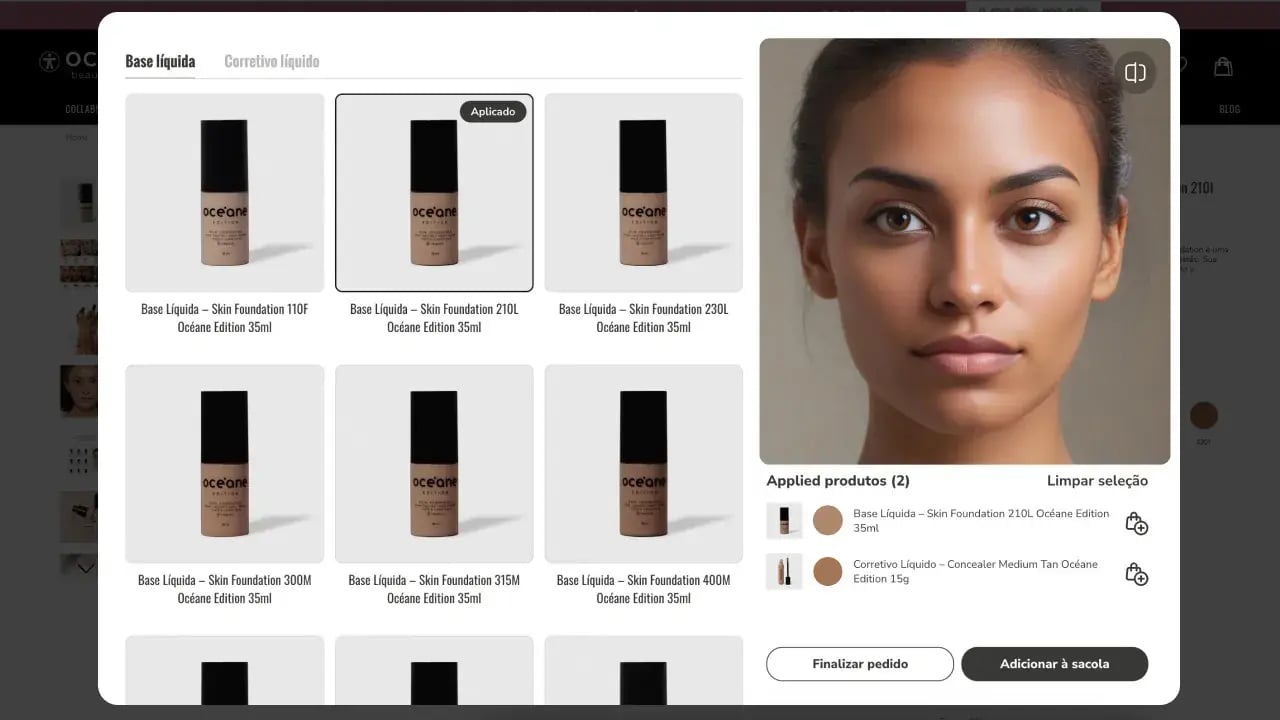 Banuba's Virtual Try-On Makeup API interface example
More than a makeup tool. Banuba's personalization runs wider than cosmetics. The same engine powers skincare AR, hair color and hairstyle try-on, and accessory categories like glasses, jewelry, and headwear, so a multi-category retailer runs one engine instead of stitching several together.
Where it runs. The engine processes on-device across native iOS (Swift) and Android (Kotlin), Web (JS/TS), Flutter, React Native, Unity, and desktop. On-device processing matters for two reasons: it works without a round trip to a server, and it supports a clean privacy story. Banuba gathers and stores no user data, which keeps GDPR handling simple. Official Flutter and React Native plugins, GitHub samples for every platform, and agent skills lower the cost of the first build.
Licensing. Banuba offers a flat annual license with unlimited usage and predictable cost, or an active-user model that starts cheaper and scales with your user base. TINT plugins come in plans with monthly try-on limits, custom integrations are quoted per store, and a self-serve no-code platform lets a client set everything up without Banuba involvement. That range means the same vendor covers a weekend plugin install and a high-traffic native app.
Proof it works. Banuba's deployments back the claims. Brazilian brand Boca Rosa ran a pre-launch event that earned $900,000 in four hours across 1.7 million try-on sessions. Océane lifted its add-to-cart rate from 3% to 32% after adding makeup try-on.
Best for: beauty brands and multi-SKU retailers that want a broad try-on and personalization suite, a ready product catalog, AI recommendations, on-device speed and privacy, predictable licensing, and creative tools for marketing, with the option to control the camera screen directly when they need it.
Who should skip it: teams whose entire need is a hosted, skin-diagnostics-led advisor and who do not want to weigh an engine or platform option at all.

Revieve API
Revieve is an AI and AR beauty SaaS platform aimed at brands and retailers, used by companies including Pierre Fabre and Super-Pharm. Its makeup try-on is one module inside a broader suite that also includes AI skin analysis, foundation matching, conversational advisors, and product recommendations, all tied to a data and analytics layer.
How it works. Revieve runs as a hosted, modular platform. Its makeup try-on covers face, lips, eyes, and eyebrows, supports single products, bundles, and full looks, and uses what the company describes as multi-hundred-point face tracking with automated skin-tone and lighting adjustment. Compute and the experience components run in Revieve's cloud, and brands connect their catalog and configure the modules they want. In February 2026 the company added LiveAR, a real-time skin visualization layer for its diagnostics.
Where it leans. The platform is built around personalization and data. Revieve emphasizes capturing zero-party and first-party data, marketing ROI, and monetization, with skin analysis it describes as validated by PhD-level AI and dermatology experts and used across 60 million-plus users. On privacy, Revieve states that biometric identifiers are not stored and that analysis runs in secure environments with explicit user consent.
Best for: brand and retail teams that want a managed, end-to-end beauty advisor with skin diagnostics, recommendations, and built-in analytics, and that prefer configuration over engineering.
Who should skip it: teams that need an on-device engine, native SDK control, or transparent flat licensing for a high-traffic consumer app.

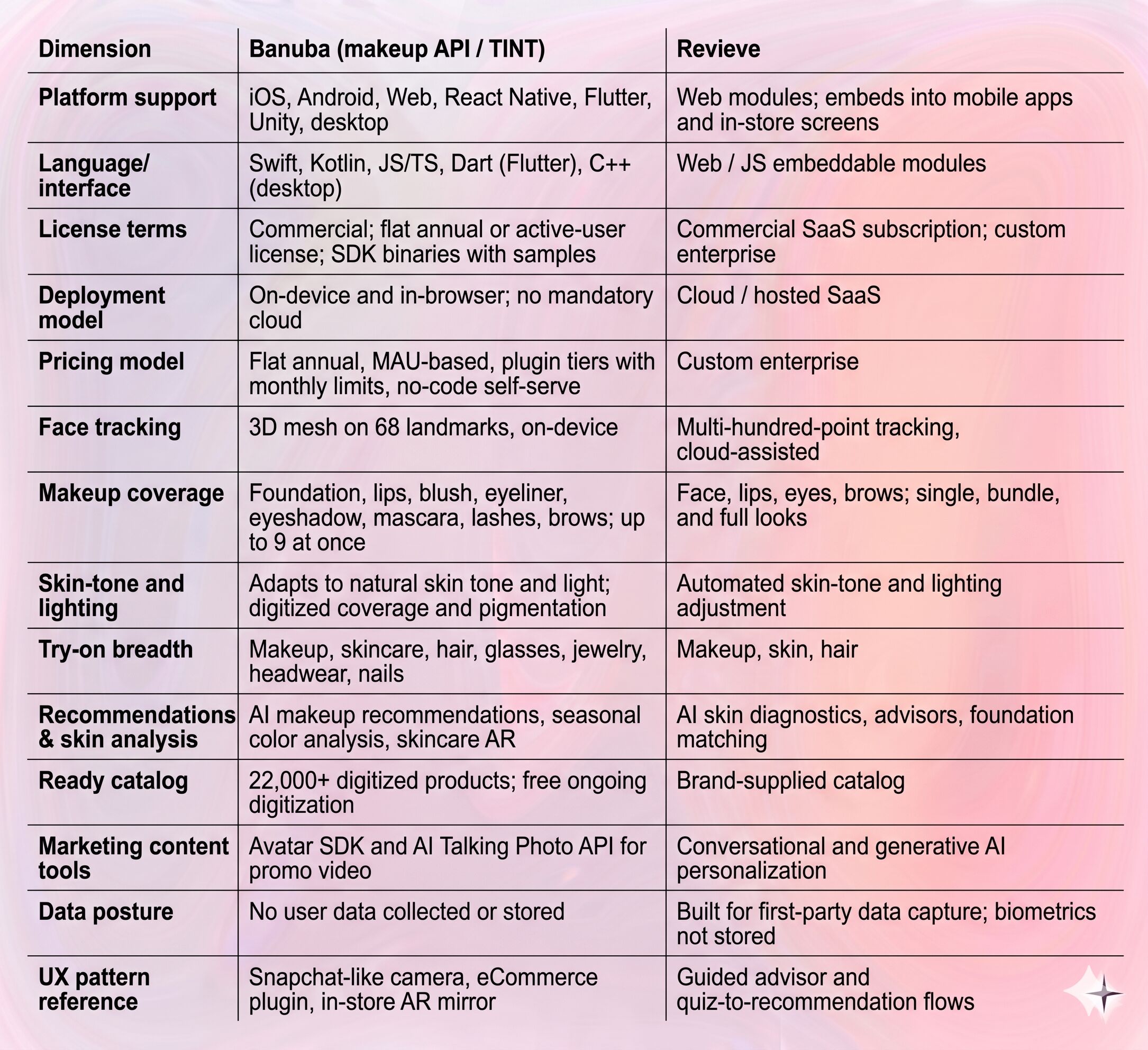
Side-by-side comparison
How to choose?
Both cover try-on, recommendations, and skin analysis, so the decision rarely comes down to a single missing feature. It comes down to fit.
Choose Banuba for breadth and flexibility. When you want one vendor for makeup, skincare, hair, and accessory try-on, a ready 22,000-plus product catalog, AI recommendations, and creative tools like avatars and AI presenters for campaigns, Banuba covers all of it. On top of that, you can run on-device for speed and privacy, ship the same engine across native and web, and keep costs predictable with flat licensing, with plugin and no-code routes for smaller stores. It fits beauty brands, multi-SKU retailers, and product teams that treat try-on as a core, year-round feature.
Choose Revieve for a hosted, diagnostics-led advisor. When the center of the experience is AI skin analysis paired with guided advisors and recommendations, the buyer is a marketing or retail team, and a fully managed cloud suite with strong first-party data tooling matters more than engine-level control, Revieve fits well.
Weigh four things: how many categories and SKUs you need live, whether on-device processing matters for privacy and latency, how predictable you need the bill at scale, and whether skin diagnostics or makeup sits at the center.
References
Banuba. (n.d.). AI talking photo API. Retrieved June 4, 2026, from https://www.banuba.com/ai-talking-photo-api
Banuba. (n.d.). AR makeup SDK: Makeup API for eCommerce, video calls and more. Retrieved June 4, 2026, from https://www.banuba.com/makeup-ar
Banuba. (n.d.). Avatar SDK: Create photorealistic 3D avatars. Retrieved June 4, 2026, from https://www.banuba.com/avatar-sdk
Banuba. (n.d.). Beauty AR SDK. Retrieved June 4, 2026, from https://www.banuba.com/facear-sdk/beauty-ar
Banuba. (n.d.). Face tracking software. Retrieved June 4, 2026, from https://www.banuba.com/technology/face-tracking-software
Banuba. (n.d.). Makeup software virtual try-on. Retrieved June 4, 2026, from https://www.banuba.com/tint-makeup-virtual-try-on
Banuba. (2025). Virtual try-on by Banuba helps beauty brand earn $900,000 in 4 hours. https://www.banuba.com/blog/virtual-try-on-helps-beauty-brand-earn-900.000-in-4-hours
BusinessWire. (2024, December 5). Banuba unveils free cosmetics digitization for virtual try-on platform TINT, setting new standards for customer experience. https://www.businesswire.com/news/home/20241128368417/en/Banuba-Unveils-Free-Cosmetics-Digitization-for-Virtual-Try-On-Platform-TINT-Setting-New-Standards-for-Customer-Experience
Research and Markets. (2026). AI in beauty and cosmetics market report 2026. https://www.researchandmarkets.com/reports/5851112/ai-in-beauty-cosmetics-market-report
Revieve. (2026, February 18). Revieve launches LiveAR for real-time skin analysis visualization. https://www.revieve.com/insider/news/revieve-livear-real-time-clinical-results-visualization-digital-skin-analysis
Revieve. (n.d.). AI beauty personalization SaaS platform. Retrieved June 4, 2026, from https://www.revieve.com/platform
Shopify. (n.d.). AR technology in retail: Use cases and benefits. Retrieved June 4, 2026, from https://www.shopify.com/retail/how-retailers-are-using-ar-technology-to-build-buzz-and-brand-awareness
-
Start with the integration model. Decide whether you need an engine that runs on-device and gives you control of the render pipeline, or a hosted platform that handles compute and UI for you. From there, confirm platform and language coverage for your stack, the data and privacy posture, and whether licensing is flat or scales with usage.
-
Two patterns dominate. Engine vendors like Banuba license a flat annual fee for predictable cost or an active-user model that starts low and grows with your audience, plus plugin tiers tied to monthly try-on volume. Platform vendors typically use custom enterprise SaaS pricing quoted per deployment, which is less transparent upfront.
-
For a consumer app with heavy traffic, an on-device engine with flat licensing like Banuba tends to win on latency, offline behavior, and cost predictability, since processing does not depend on per-call cloud compute. A hosted platform suits brands that prioritize a managed advisor experience and analytics over raw scale economics.
