

Online shoppers cannot touch the product, so they hesitate and return more. AR try-on closes that gap by putting the item on the customer in real time. The payoff is measurable. Shopify reports that products with 3D or AR content convert at a 94% higher rate than products without it, and the broader virtual try-on market reflects that pull. Grand View Research values it at $9.17 billion in 2023, climbing toward $46.42 billion by 2030 at a 26.4% CAGR, with AR the dominant technology segment.
Here is where the two vendors in this comparison diverge. Banuba and Visage Technologies both build proprietary face tracking, both run offline, and both target beauty and eyewear. But one sells a finished retail try-on, and the other sells the engine you assemble one from. That single difference shapes integration time, cost, and the size of your engineering commitment.
This article keeps the scope tight: real-time AR try-on for beauty and accessory e-commerce, evaluated on web, mobile, and in-store devices. We skip generic marketing claims and focus on the constraints that actually decide a vendor: platform reach, SDK interface, licensing, deployment, and feature depth.
[navigation]
An AR try-on lets shoppers see makeup, glasses, or jewelry on themselves through a camera before they buy. Banuba ships a packaged try-on built for online stores, with nine product categories, a no-code Shopify plugin, AI recommendations, and analytics. Visage Technologies sells a face-tracking and analysis toolkit plus a makeup module, so it suits teams that want to build their own experience on top of strong computer vision. Pick Banuba when you need a retail-ready solution with ultimate face tracking accuracy, fast product digitalization, and straightforward integration; pick Visage when face tracking accuracy across embedded and automotive hardware is the priority.
TL;DR
- This guide compares Banuba AR try-on against the Visage Technologies SDK for engineers and product owners choosing a virtual try-on vendor.
- Banuba covers makeup, skincare, eyewear, contacts, hair color, headwear, jewelry, rings, and nail polish out of the box.
- Visage leads on raw face tracking and analysis, with a very broad platform reach, including embedded and automotive targets.
- Banuba is the stronger fit when the goal is e-commerce conversion with minimal build time.
- Visage is the stronger fit when you need a low-level tracking foundation or non-retail use cases like driver monitoring.
How we evaluated
We scored both products against criteria that map to real buying decisions:
- Platform and language reach. Where the SDK runs and which interfaces it exposes.
- Tracking quality. How the face model behaves under occlusion, motion, and poor light.
- Rendering realism. How convincing the virtual product looks on the user.
- Category breadth. How many product types the try-on supports without custom work.
- Commerce features. Recommendations, analytics, multi-item try-on, and CMS integration.
- Licensing and pricing. Commercial terms, deployment model, and cost structure.
Banuba's virtual try-on example
The Try-On Stack: three layers you actually pay for
Most comparisons mix features into one long list. A cleaner way to judge a virtual try-on vendor is to split the product into three layers and ask which ones the vendor ships versus which ones you build.
- Tracking layer. Detects and follows the face, hands, head pose, and expressions. Handles occlusion, lighting, and motion.
- Rendering layer. Turns the tracked geometry into a believable product: correct color, finish, lighting response, and 3D depth.
- Conversion layer. Turns a try-on session into a sale: product recommendations, multi-item try-on, usage analytics, and checkout or CMS integration.
The layers are where Banuba and Visage part ways. Visage is excellent at Layer 1 and ships Layer 2 for makeup and eyewear. Layer 3 is on you, or on a custom development engagement. Banuba packages all three as a single retail product, which is why a store can launch an AR try-on without standing up its own recommendation engine or analytics pipeline.

Banuba AR Try-On
Banuba's AR try-on is a commerce-first product built on the company's own Face AR SDK. It runs on the web through WebAR, on iOS and Android, and on in-store smart mirrors. For Shopify and similar stores, Banuba offers a no-code try-on plugin, so a merchant can go live without writing tracking code.
Architecture and tracking
Banuba does not lean on ARKit or ARCore. Its face tracking software is built on a patented 3D math model that reads roughly three dozen face characteristics as morphs, then drives a face mesh of up to 3,308 vertices. That choice matters for try-on. A morph-driven mesh gives the renderer continuous 3D geometry to place products on, rather than a sparse set of dots, which is what makes a ring sit on a finger or a lipstick wrap a lip with depth.
Two engineering details carry the experience:
- Patented anti-jitter. The algorithms run several times per frame to separate the stable signal, the face, from the noise. The result is a smooth overlay with no visible lag.
- Hard-condition robustness. Tracking holds up with up to 70% facial occlusion, across a full 360 degrees of device rotation, in low light, and at a distance of several meters. For a virtual mirror in a busy store, that resilience is the difference between a usable demo and a frustrated shopper.
Because the SDK works offline and on-device, no camera frames need to leave the user's phone, which keeps the experience GDPR-friendly by design.
Category breadth and rendering
This is where Banuba pulls ahead for retail. The same engine powers makeup, skincare previews, glasses, colored contacts, hair color, headwear, jewelry, rings, and nail polish. Per-pixel face segmentation handles facial isolation so products land precisely, and the renderer adapts to lighting and supports makeup transfer. For accessories, products react to light the way physical ones do, and ring sizing is chosen automatically.
Commerce layer
Banuba ships the conversion layer most try-on vendors leave to you: an AI recommendation system, multi-item try-on, gift selection, usage analytics, and a 3D virtual store for full in-browser shopping. For developers, there are platform plugins on pub.dev and npm, GitHub samples, and integration documentation.
Pricing
Banuba offers flexible terms. The underlying SDK can be licensed on an active-user basis, which starts low and scales with adoption. The virtual try-on plugin sells in tiers with monthly try-on limits, custom integrations are quoted per store, and a self-serve no-code platform lets a client set everything up without Banuba's involvement.
Real-world results
Banuba's case studies back the conversion story with numbers. The beauty retailer Océane raised its add-to-cart rate from 3% to 32%, and an influencer-led launch for Boca Rosa drove $900,000 in sales over four hours across 1.7 million try-on sessions. As Puja Wardani, Associate Vice President at Looké Cosmetics, put it, the feature "keeps us just 10 cm apart from our customers at all times."
Where Banuba fits, and where it does not
Choose Banuba when you sell beauty or accessories online and want a try-on live quickly across web, mobile, and in-store, with recommendations and analytics included. It is less of a match if your core need is a bare tracking library for a non-retail product. In that case, Banuba’s Face Tracking Software will be a better choice.
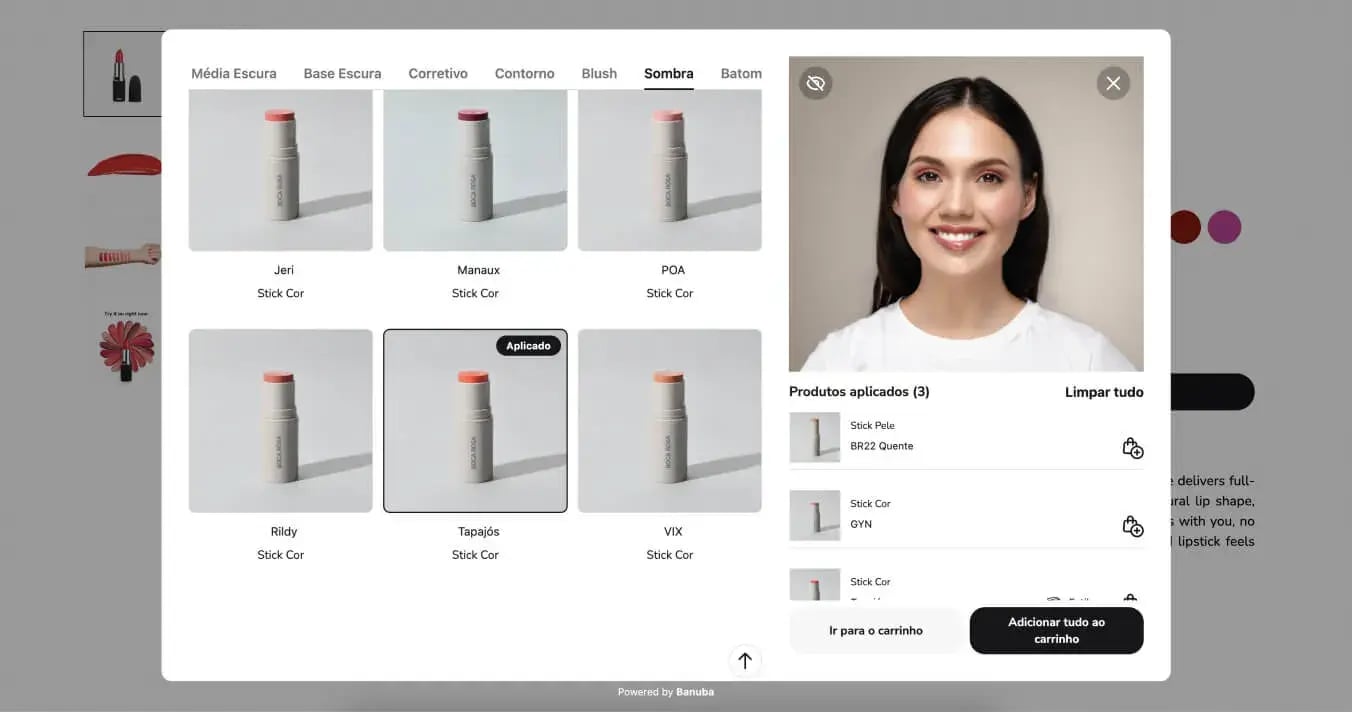 Banuba's virtual try-on interface example
Visage Technologies SDK
Visage Technologies has built computer vision software since 2002 from its base in Linköping, Sweden. Its flagship visage|SDK splits into three packages that license separately: FaceTrack for tracking, FaceAnalysis for age, gender, and emotion estimation, and FaceRecognition for identity. A separate makeup module, branded Arbelle, adds virtual makeup try-on.
Strengths
FaceTrack is the core asset. It tracks 151 facial points along with 3D head pose, gaze direction, and facial action units, and it reads color, grayscale, and near-infrared input. Platform reach is unusually wide: Windows, macOS, Ubuntu, RedHat, Android, iOS, and HTML5, plus embedded targets like Xilinx, Ambarella, and Raspberry Pi. That breadth, along with NIR support, is why Visage shows up in driver monitoring and automotive safety work. The makeup module covers the full face: foundation, concealer, contour, blush, highlighter, eyeshadow, eyeliner, mascara, brows, lipstick, gloss, and liner, with finishes from matte to shimmer, and places no cap on SKUs per license.
Limitations
Visage is a toolkit, not a finished store experience. The makeup module and eyewear try-on are the only ready-made retail categories; skincare, jewelry, rings, hair color, contacts, and nail polish would be a custom build. The conversion layer, recommendations, analytics, gift flows, and CMS integration are not part of the SDK, so an e-commerce team takes on that work itself or buys custom development. Pricing is quote-only, with no public tiers, which lengthens the evaluation process.
Ideal use cases, and who should look elsewhere
Visage fits teams that need precise, low-level face tracking across a wide hardware range, especially automotive, gaming, avatar animation, or research, and who have the engineering capacity to build the rest. A retailer that wants a multi-category AR try-on live this quarter, with conversion features included, will spend less time and money with a packaged solution.

Banuba AR Try-On & Visage Technologies: Head-to-toe Overview
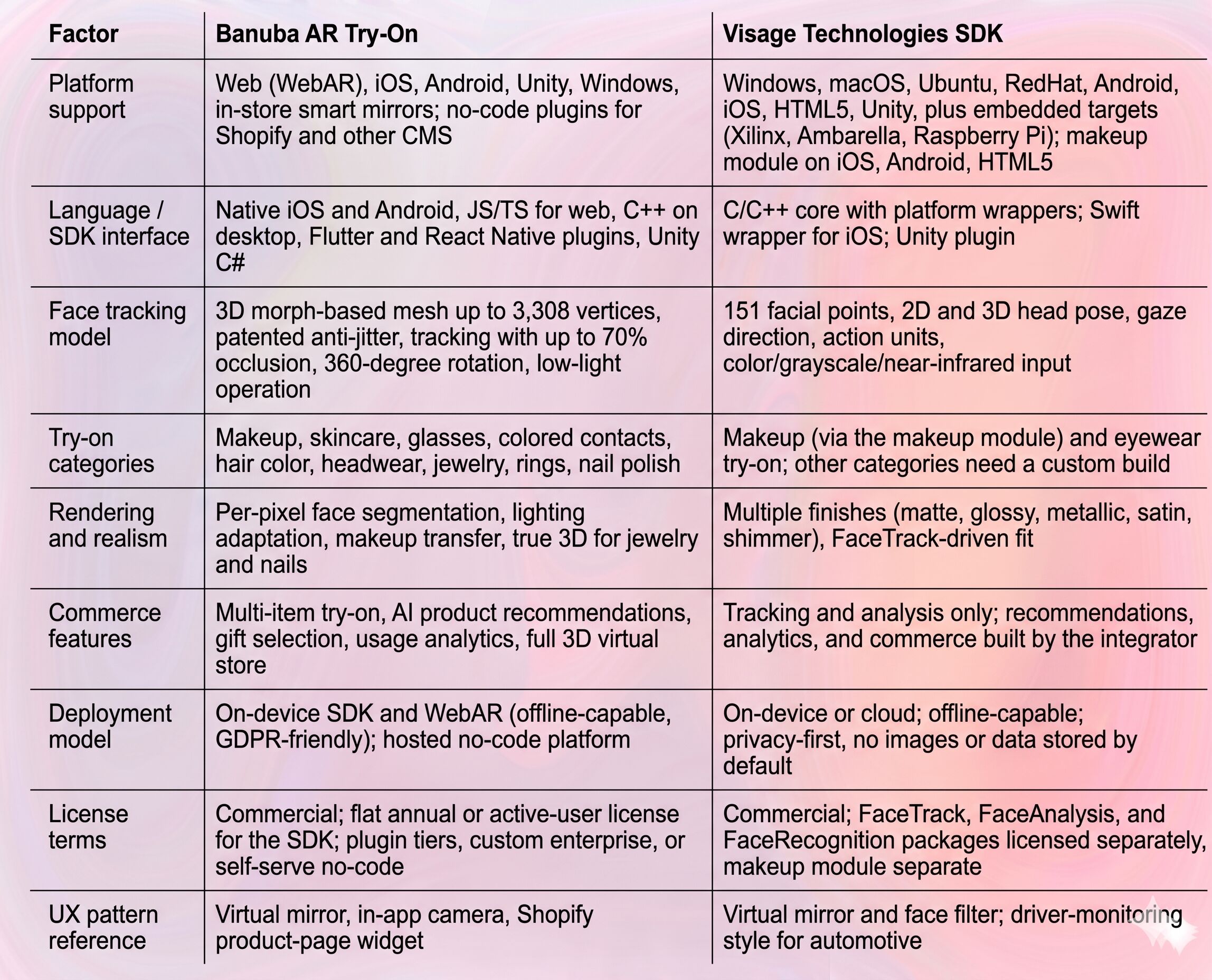
How to choose
- Best for a beauty or accessory store that wants speed: Banuba. Nine categories, a no-code Shopify plugin, and a built-in conversion layer cut launch time sharply.
- Best for omnichannel retail with smart mirrors: Banuba. On-device tracking holds up under store lighting and occlusion, and the same engine runs web, mobile, and in-store.
- Best for a tracking foundation or non-retail product: Visage. Its breadth across embedded and automotive hardware and its analysis modules go where a retail try-on does not.
The deciding question is how much you want to build. If the answer is "as little as possible, and aimed at sales," Banuba is the better fit. If you want an engine and have a dedicated tech team to build something specific on top of, Visage earns the look.
In the meantime, you can go for a test drive with Banuba’s AR Try-On without commitment for two weeks. See how it performs in your business.
References
Banuba. (n.d.). AR virtual try-on solution for ecommerce. Retrieved June 3, 2026, from https://www.banuba.com/solutions/e-commerce/virtual-try-on
Banuba. (n.d.). Face tracking software. Retrieved June 3, 2026, from https://www.banuba.com/technology/face-tracking-software
Banuba. (n.d.). Océane success story. Retrieved June 3, 2026, from https://www.banuba.com/blog/oceane-success-story
Banuba. (n.d.). Virtual try-on helps beauty brand earn $900,000 in 4 hours. Retrieved June 3, 2026, from https://www.banuba.com/blog/virtual-try-on-helps-beauty-brand-earn-900.000-in-4-hours
Grand View Research. (2024). Virtual try-on market size, share and growth report, 2030. Retrieved June 3, 2026, from https://www.grandviewresearch.com/industry-analysis/virtual-try-on-market-report
Mordor Intelligence. (2025). Virtual try-on market size, share and 2030 trends report. Retrieved June 3, 2026, from https://www.mordorintelligence.com/industry-reports/virtual-try-on-market
Shopify. (n.d.). The thrilling evolution: 3D ecommerce and a new era of retail. Retrieved June 3, 2026, from https://www.shopify.com/blog/3d-ecommerce
Visage Technologies. (n.d.). FaceTrack: Face tracking software. Retrieved June 3, 2026, from https://visagetechnologies.com/facetrack/
Visage Technologies. (n.d.). makeup|SDK: Virtual makeup try-on technology. Retrieved June 3, 2026, from https://visagetechnologies.com/makeup-sdk/
Visage Technologies. (n.d.). visage|SDK: Face tracking, analysis and recognition. Retrieved June 3, 2026, from https://visagetechnologies.com/visage-sdk/
-
Start with the three layers: tracking, rendering, and conversion. Confirm the SDK runs on your target platforms with the language interface you use, then check whether it ships the product categories and commerce features you need, or whether you will build them. Tracking quality under occlusion and poor light matters most for in-store mirrors.
-
Two patterns dominate. Some vendors, including Banuba, offer a flat annual license for predictable cost or an active-user model that scales with adoption, plus plugin tiers for plug-and-play stores. Others, license tracking and analysis as separate packages on a custom quote. Always confirm commercial-use rights, deployment (on-device versus cloud), and whether there is a cap on SKUs or sessions.
-
For a store scaling across web, mobile, and in-store, a packaged solution like Banuba reduces moving parts because recommendations, analytics, and CMS integration are already built.
