

Try-on stopped being a novelty. The virtual try-on market is forecast to hit USD 48.10 billion by 2030, a 25.95% CAGR, and Mordor Intelligence notes the field stays fragmented, with no vendor holding more than a low-double-digit share. That same analysis names Banuba as a beauty specialist among the players carving out vertical leads. Demand sits on the buyer side too. The beauty camera apps segment is set to grow from USD 7.5 billion in 2026 to USD 14.23 billion by 2031.
The hard part is not whether to add try-on. It is picking a vendor whose licensing, platform support, and roadmap match how your team actually ships. Some buyers want a managed experience tied to a beauty conglomerate. Others want a neutral engine they can drop into a React Native app, run offline, and price predictably as they scale. AR beauty conversion data backs the investment either way: Mordor reports L'Oréal's Makeup Genius app passed 20 million downloads, with conversion rates nearly doubling when shoppers used AI-powered advisors.
This article compares two production engines across the constraints developers raise in real procurement: platform reach, SDK interface, license terms, deployment model, pricing, and feature depth. We cover makeup, hair, skin, and accessory try-on, and we flag anything a vendor does not publicly document rather than guess.
[navigation]
A virtual try-on SDK lets your team add makeup, hair, and accessory try-on to an app, store, or kiosk without building a face-tracking engine yourself. Banuba ships an on-device AR beauty and try-on stack with native plugins for iOS, Android, Web, React Native, Flutter, and Unity, plus flexible licensing. ModiFace, owned by L'Oréal, delivers polished makeup, hair, and skin try-on but gates access to brand partners and ties its roadmap to L'Oréal. Banuba is the stronger pick for independent teams that need control over deployment, platforms, and cost.
TL;DR
- This guide compares Banuba's Virtual Try-On SDK and ModiFace for engineers, product managers, and beauty-tech founders shortlisting a try-on vendor in 2026.
- Both render high-quality makeup and hair try-on, but they differ sharply on access, deployment, and platform breadth.
- Banuba runs on-device across six platforms, offers two licensing models plus a no-code platform, and adds glasses, jewelry, and nail try-on that ModiFace does not list.
- ModiFace suits brands inside the L'Oréal ecosystem that want a managed, single-fee makeup and hair experience.
- Independent brands, L'Oréal competitors, and developer-led teams that want roadmap neutrality and offline processing will be a better fit for Banuba.
How we evaluated
We scored both engines on six dimensions that map to how teams build and budget:
- Platform support. iOS, Android, Web, React Native, Flutter, Unity, Windows, and in-store devices.
- SDK interface. The languages and integration surfaces a developer touches: Swift, Kotlin, JS or TS, plugins, embeds, and REST APIs.
- License terms. Who can buy, commercial-use scope, source availability, and how independence affects access.
- Deployment model. On-device, cloud, or hybrid, and what that means for latency and privacy.
- Pricing model. Free trial, flat fee, usage-based, per-seat, or custom.
- Feature depth. Face tracking quality, makeup, hair color, accessory fitting, beautification, and multi-product looks.
Banuba's makeup virtual try-on example
Banuba Virtual Try-On SDK
Banuba packages try-on two ways. Teams that want full control build with the Beauty AR and Face AR SDK. Teams that want speed over customization use TINT, a plugin for Shopify and Tiendanube (Nuvemshop), as well as a no-code platform. Both sit on the same computer vision core, so the rendering quality carries across.
How the tracking works
This is where Banuba earns its developer-first reputation. Its patented face tracking does not lean on a flat landmark grid. It builds a 3D math model of the face, representing expression, anthropometry, and head pose as morphs, and reconstructs a mesh with up to 3,308 vertices.
The practical payoffs are concrete. The tracker holds up with up to 70% facial occlusion, in low light, across a full 360° device rotation, and at distances up to seven meters. A patented anti-jitter routine runs the algorithms several times per frame to separate the stable signal (the face) from the noise, which keeps lipstick and eyeshadow from drifting. Banuba reports real-time makeup at roughly 35 to 40 FPS on its product page, and the SDK covers about 97% of iOS devices and 80% of Android ones. Because tracking runs on-device, no camera frames leave the phone, which helps with GDPR.
SDK-level capabilities
The integration surface is broad. There are native paths for Swift on iOS and Kotlin on Android, a Web build through WebAR, a Flutter plugin, a React Native plugin, Unity, and desktop C++. Banuba also ships LLM-ready docs and public GitHub samples for each platform, which shortens onboarding. The makeup and beauty modules expose separate API methods, so you can call virtual lipstick without pulling in the full beautification set.
Banuba's try-on range also runs wider than makeup. It adds glasses, jewelry, contact lenses, rings, hats, and nails, which matter if your catalog is not limited to cosmetics.
Real-world results
Banuba's case studies are public and specific. Beauty retailer Océane saw its add-to-cart rate climb from 3% to 32% after adding try-on. An influencer launch with Boca Rosa drew 1.7 million try-on sessions and USD 900,000 in sales over four hours. On the build side, Puja Wardani, Associate Vice President at Looké Cosmetics, said the Face AR SDK "simplifies the development of our Try-On feature big time."
Limitations
Banuba focuses on the face and accessory engine, not on a full-body apparel-fitting tool.
Best fit
Independent beauty brands, multi-category retailers, social and creator apps, and any team that needs offline processing, native React Native or Flutter support, or predictable cost at scale.
Who should skip it
A brand that wants a single managed package with shades pre-configured and minimal engineering input may prefer a more hands-off vendor.

ModiFace (L'Oréal)
ModiFace has built beauty try-on since 2007 and has been a wholly owned L'Oréal company since 2018. It powers makeup, hair, nail, and skin experiences for L'Oréal's brand portfolio and integrates into platforms like Meta, Google, and Amazon.
Key strengths
Makeup coverage is thorough, spanning lipstick, foundation, brows, and a wide set of finishes from matte to metallic. Setup is light: a customizable SDK for tailored builds, or an embeddable miniprogram that drops in with two lines of code and configures through a content management system. Add-ons like Live Scan and Color Match extend the experience, and shade accuracy benefits from L'Oréal's beauty expertise.
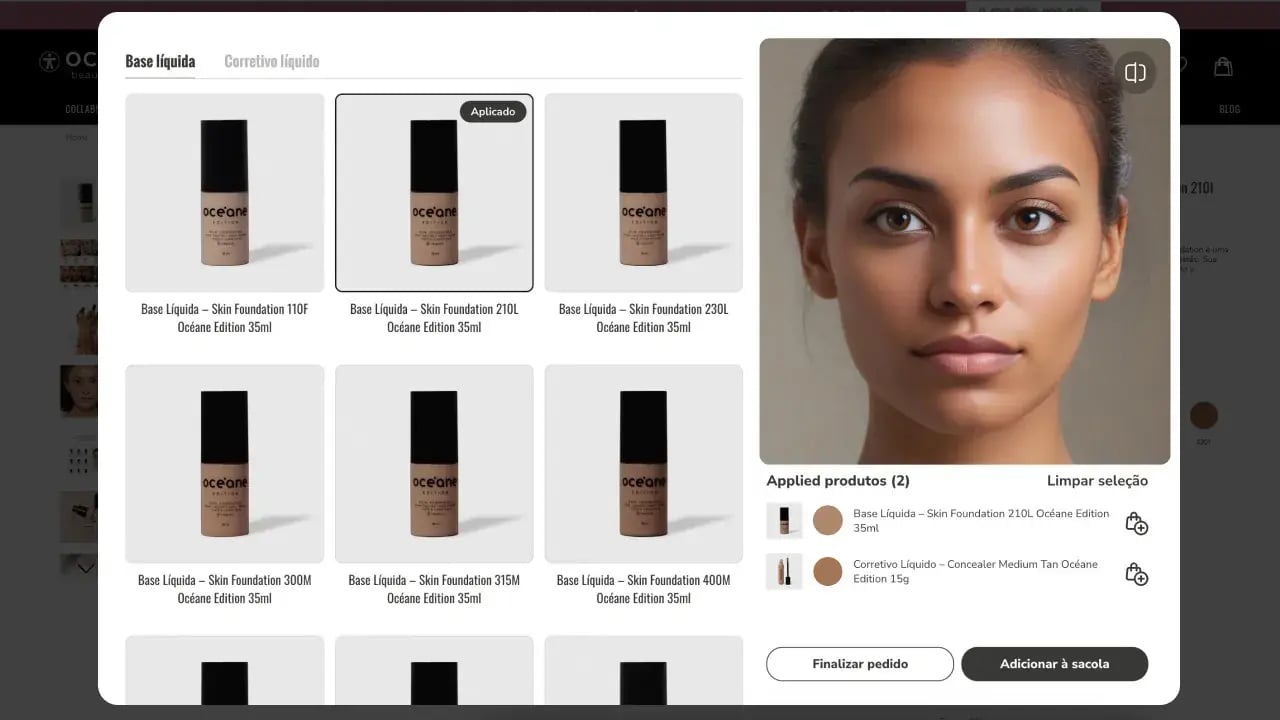 Banuba's virtual try-on interface example
Limitations
The main constraint is structural. Access is typically reserved for L'Oréal brand partners and enterprise clients, so independent teams and direct L'Oréal competitors can hit friction in the partnership conversation. The roadmap follows L'Oréal's commercial priorities rather than a neutral one. Public documentation does not confirm native React Native, Flutter, or Unity support, and the product line centers on face, hair, and nails, with no accessory fitting for glasses or jewelry.
Best fit
Brands inside or aligned with the L'Oréal ecosystem that want a managed makeup, hair, and skin experience and are comfortable with a partner-gated model.
Who should skip it
Independent brands, L'Oréal competitors, developer-led teams that want roadmap neutrality, and projects that need React Native or Flutter native paths or accessory try-on.

The Independence Premium: an original lens
Most try-on comparisons stop at feature checklists. The decision that actually bites later is how much of the experience you control. We map that as a five-rung Control Ladder, from least to most ownership:
- Pixels. Can you restyle the UI? Both vendors clear this.
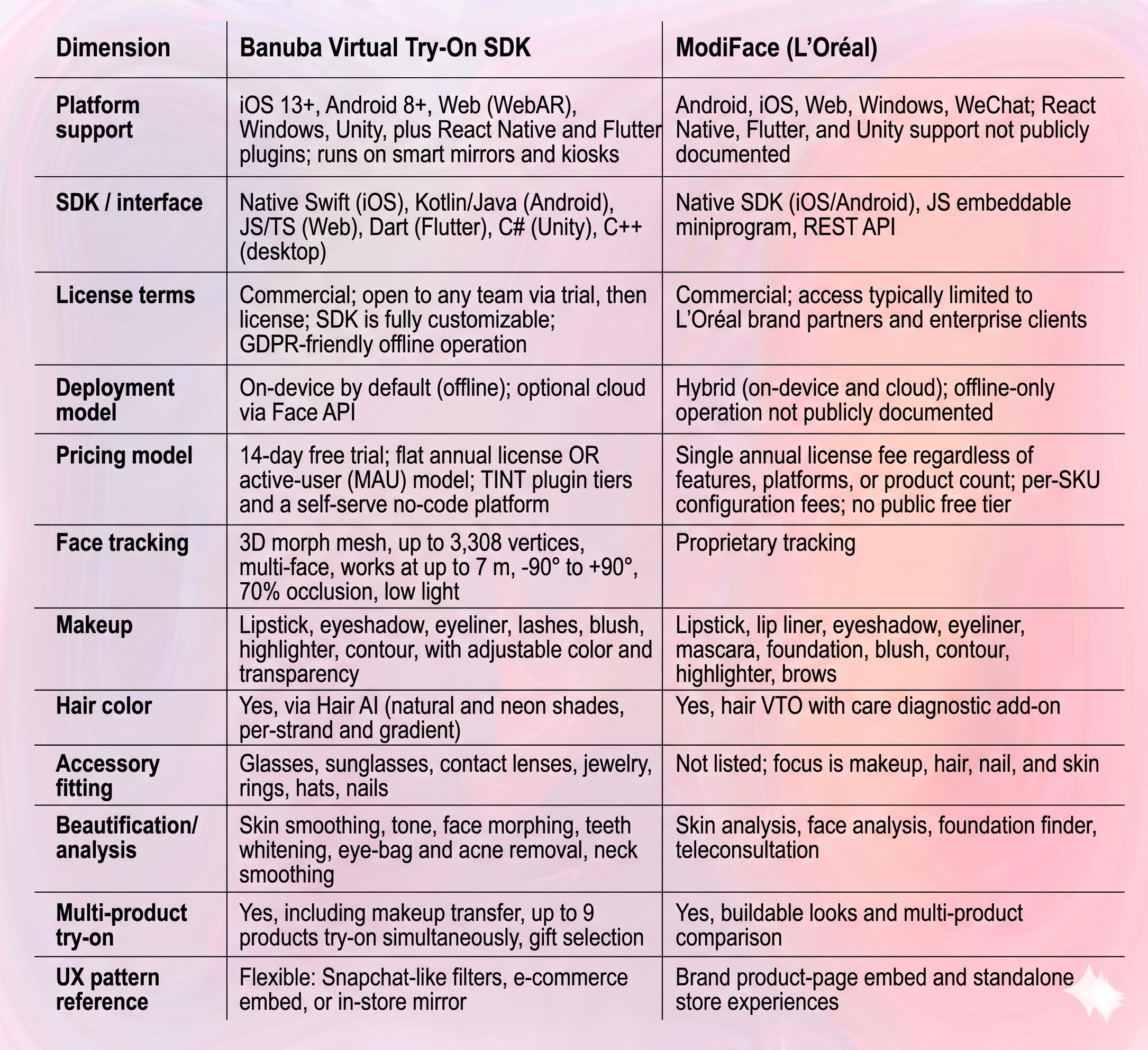
- Platforms. Can you ship to the platforms you target with native paths? Banuba spans six with documented plugins; ModiFace publicly documents five and leaves React Native, Flutter, and Unity unconfirmed.
- Deployment. Can you run offline, on-device, with no frames leaving the phone? Banuba does this by default. ModiFace runs hybrid.
- Cost shape. Can you choose how cost scales? Banuba offers a flat license or an MAU model plus tiered TINT plugins. ModiFace sets a single annual fee plus per-SKU charges.
- Roadmap. Is the vendor neutral, or does its direction track a competitor's strategy? Banuba is independent. ModiFace's roadmap follows L'Oréal.
The "Independence Premium" is the cost of climbing those rungs with a vendor that owns the category you compete in. For an L'Oréal-aligned brand, that premium is near zero, since the alignment is a feature. For an independent brand, a retailer with a mixed catalog, or a direct competitor, it shows up as gated access, a borrowed roadmap, and fewer native platform paths. Score your project against the five rungs before you score features. The ladder usually decides the build.
Banuba Virtual Try-On SDK vs ModiFace Comparison Table
To sum things up
Choose Banuba if you are an independent beauty or multi-category brand, you build in React Native or Flutter, you need offline on-device processing for privacy, you want accessory try-on alongside makeup, or you need cost that scales with users.
Choose ModiFace if your brand sits inside the L'Oréal ecosystem, you want a managed makeup, hair, and skin package with shades pre-configured, and partner-gated access is not an obstacle.
Weigh four factors as you decide: your team's stack, whether your brand competes with the vendor's parent, your privacy and offline needs, and how you want cost to grow. For teams that value neutrality and platform reach, Banuba is the safer long-term anchor. Start your 14-day trial and test drive it for your business.
References
Banuba. (n.d.-a). Beauty AR SDK. Retrieved June 3, 2026, from https://www.banuba.com/facear-sdk/beauty-ar
Banuba. (n.d.-b). Face tracking software. Retrieved June 3, 2026, from https://www.banuba.com/technology/face-tracking-software
Banuba. (n.d.-c). AR virtual try-on solution for ecommerce. Retrieved June 3, 2026, from https://www.banuba.com/solutions/e-commerce/virtual-try-on
Banuba. (n.d.-d). Océane success story. Retrieved June 3, 2026, from https://www.banuba.com/blog/oceane-success-story
Banuba. (n.d.-e). Virtual try-on helps beauty brand earn $900,000 in 4 hours. Retrieved June 3, 2026, from https://www.banuba.com/blog/virtual-try-on-helps-beauty-brand-earn-900.000-in-4-hours
L'Oréal. (n.d.). Discovering ModiFace. Retrieved June 3, 2026, from https://www.loreal.com/en/beauty-science-and-technology/beauty-tech/discovering-modiface/
ModiFace. (n.d.). ModiFace makeup virtual try on. Retrieved June 3, 2026, from https://modiface.com/products-makeup.html
Mordor Intelligence. (2025). Virtual try-on market size, share & 2030 trends report. https://www.mordorintelligence.com/industry-reports/virtual-try-on-market
Mordor Intelligence. (2026a). Beauty camera apps market size & share outlook to 2031. https://www.mordorintelligence.com/industry-reports/beauty-camera-apps-market
Mordor Intelligence. (2026b). Online cosmetics market - size, share, trends & industry growth analysis. https://www.mordorintelligence.com/industry-reports/online-cosmetics-market
Retail TouchPoints. (2021). L'Oréal launches new virtual try-on tool for Essie brand. https://www.retailtouchpoints.com/features/news-briefs/loreal-launches-new-virtual-try-on-tool-for-essie-brand
-
Start with access and platform fit, not features. Confirm you can actually license the SDK, that it supports your platforms natively (including React Native or Flutter if you use them), and that its deployment model matches your privacy needs. Feature depth matters, but a great feature set behind a partner gate or a missing platform path will stall the build.
-
Three patterns dominate. A flat annual license gives predictable cost regardless of usage. A usage or MAU model starts cheaper and grows with your audience. A managed single-fee model bundles everything for one price but often adds per-SKU configuration charges.
-
For independent teams scaling across platforms, Banuba's on-device processing, native plugins, and choice of flat or MAU pricing give more headroom and predictability.
