

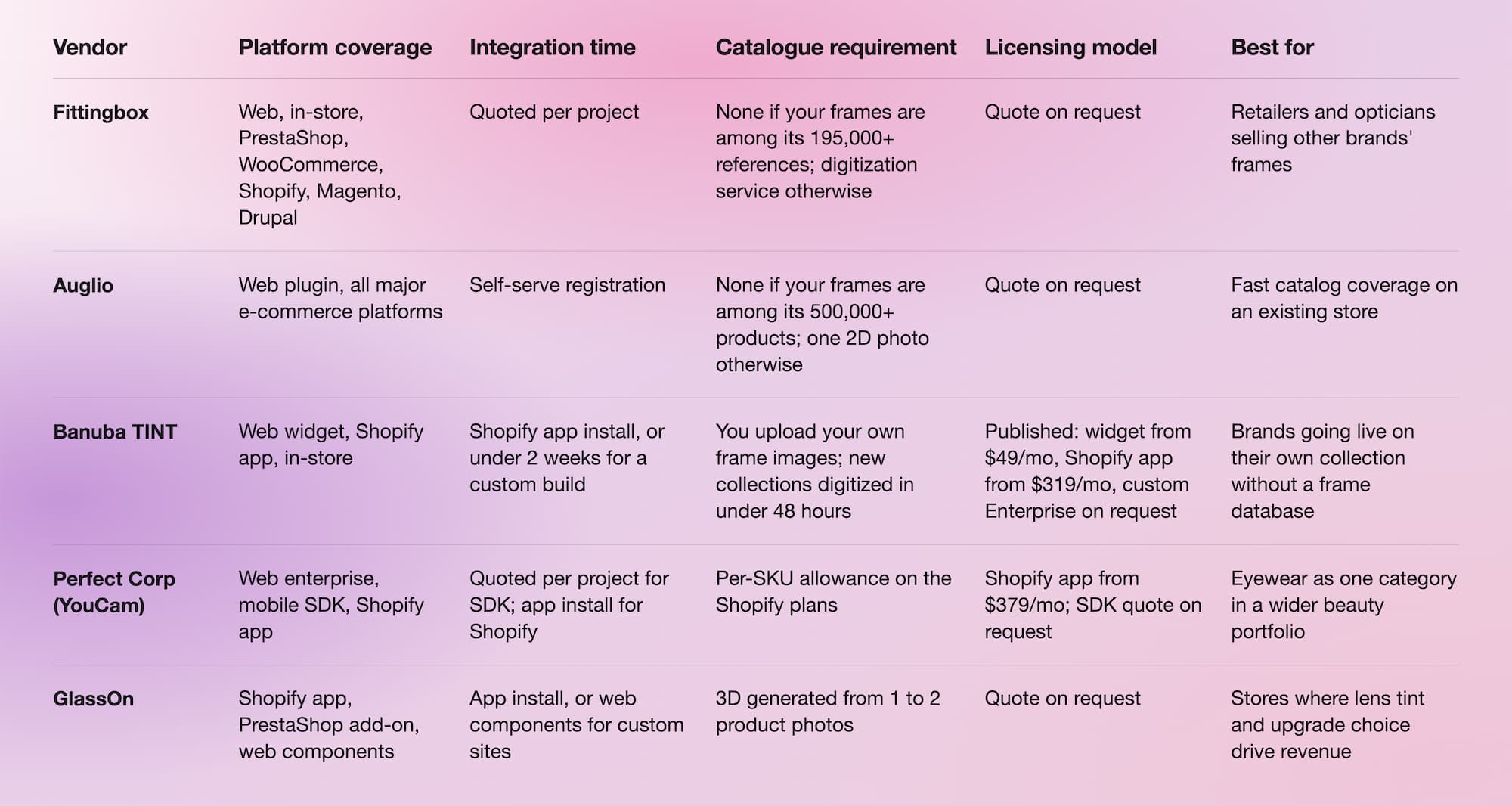
The five split cleanly by what they are built around. Fittingbox is built around the largest 3D frame database in the industry. Auglio is built around a large pre-virtualized product catalog and a plugin. Banuba TINT is built around brands digitizing their own frames. Perfect Corp is built around a cross-category beauty stack where eyewear is one module. GlassOn is built around the lens as much as the frame.
[navigation]
TL;DR:
- Fittingbox publishes the largest 3D glasses database in the category, at 195,000+ references across 1,200+ brands, which is the decisive advantage for retailers selling frames they do not own.
- Banuba TINT is the better fit for brands digitizing their own collection, because the try-on does not depend on a third-party frame database and new collections are digitized in under 48 hours.
- Only two of the five publish a price. Banuba TINT's self-serve widget starts at $49 per month for 1,000 try-ons and its Shopify app at $319 per month for 10,000, both with a 14-day trial; Perfect Corp's Shopify app starts at $379 per month for 100 SKUs. Fittingbox, Auglio, and GlassOn quote on request.
- Auglio holds 500,000+ pre-virtualized products and builds a try-on from a single 2D photo, which is the fastest route to coverage if your frames are already in its database.
- GlassOn is the only one of the five that treats lens tint visualization as a first-class feature alongside the frame, which matters if lens upgrades are a real revenue line for you.
- Perfect Corp is the choice when eyewear is one category inside a larger beauty portfolio, since its Shopify app covers up to 10 makeup and eyewear categories on one contract.
- Every vendor here does real-time camera try-on. Rendering quality is no longer the differentiator; catalog economics, integration path, and licensing are.
- Banuba TINT covers eyewear alongside makeup, contact lenses, hair dye, headwear and jewelry on the same plan, so a brand selling more than frames is not buying two systems.
How to choose virtual eyewear try-on software
Pick on four variables, in this order.
-
Who owns the frames. If you sell other brands' frames, a vendor with an existing 3D database saves you the digitization work entirely. If you sell your own collection, that database is worth nothing to you, and you are paying for coverage you cannot use. This single question separates Fittingbox from the rest.
-
How the catalog gets digitized. Some vendors need product photos only. Others need physical samples shipped. The difference is weeks of lead time on every new collection.
-
Where it has to run. All five run in the browser. What varies is whether there is a ready-made app for your platform or whether a developer has to wire up web components.
-
How you are billed. Try-on volume, SKU count, seats, and flat licenses are all in use across this set, and two of the five will not tell you the number until you talk to sales.
Banuba's own entry in this comparison, virtual eyewear try-on software, sits on the own-catalog side of the first variable, which is where the rest of this piece places it.

The five vendors compared
1. Fittingbox: the largest 3D frame database
Fittingbox describes itself as the world's first eyewear virtual try-on provider and has been in the category for 20 years, with 59 international patents. Its moat is stated plainly on its own homepage: 195,000+ references and 1,200+ brands available in 3D.
That number is the whole argument. If you are an optician or a multi-brand retailer, the frames on your shelves are probably already digitized, and you skip the part of a virtual try-on rollout that actually costs time. Fittingbox also ships PD measurements accurate to within 1 mm on 7 out of 10 measurements and a frame-removal feature that lets a shopper try frames without taking off the pair they are already wearing.
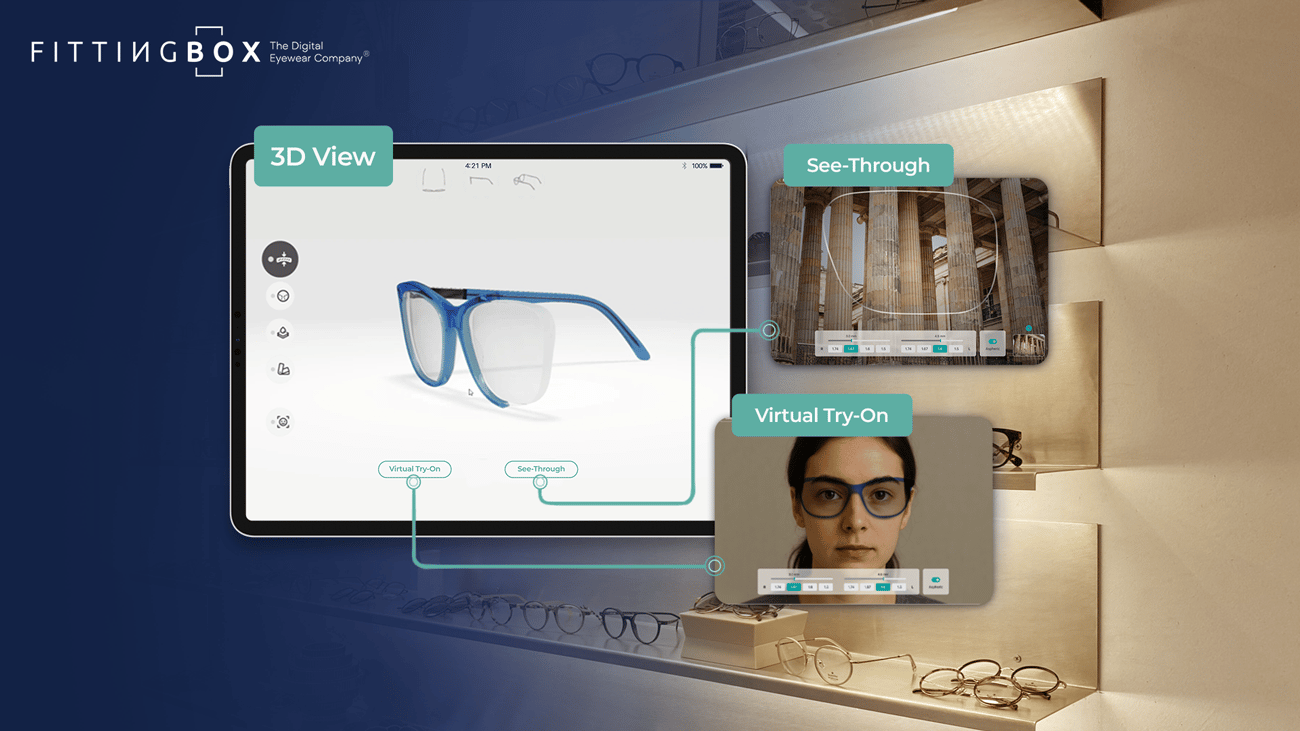
Best in category for: multi-brand retailers and optical chains. Nothing else in this comparison comes close on existing 3D coverage, and no amount of rendering quality substitutes for a frame that is already modeled.
The trade-off: Fittingbox does not publish pricing. You get a quote, and the database you are paying for is only worth what you use of it.
2. Auglio: coverage through a large pre-virtualized catalog
Auglio runs an eyewear-first plugin with a database of 500,000+ virtualized products that can be integrated immediately, and states that creating a try-on needs nothing more than a simple 2D photo. Around the core try-on, it sells auto PD measurement, an invisible-glasses mode, 360-degree frame viewing, photochromic lens visualization, and face shape detection.
Its client list is public and includes JBL, Bupa Optical and Goodr, and it publishes a Zoff case study reporting a 4x increase in conversions.
Best in category for: stores that want coverage fast and do not want to ship samples anywhere.
The trade-off: pricing is not published, and the eyewear-plus-cosmetics-plus-wigs spread is split across two brands, with several categories living on a separate domain.
3. Banuba TINT: for brands digitizing their own collection
Banuba TINT is the option to look at when the frames are yours. There is no dependency on somebody else's frame database: you add a frame in the TINT admin dashboard by uploading the left, body, and right images of the glasses along with the product name, brand, and SKU, and the try-on preview renders as you upload. New collections are digitized in under 48 hours.
The widget is web-based and ships as a script tag or a Shopify app, runs on the last two Safari versions and the last five Chrome, Edge, Opera, and Samsung Internet versions, and can be launched in under 2 weeks. Pupillary distance measurement is included, with no special devices or reference objects needed. Eyewear sits on the same plan as makeup, contact lenses, hair dye, headwear and jewelry, so a brand selling more than frames does not need a second contract. You can try the widget in a browser before talking to anyone.
On outcomes, the strongest published Banuba TINT number is not from eyewear. Océane, a Brazilian cosmetics brand, took its add-to-cart rate from the 3% industry average to 20.15% in the first month of a makeup try-on pilot, then to a peak of 32%. Treat it as evidence of what the engine does to add-to-cart behavior, not as an eyewear benchmark.
Best for exactly one thing: getting an own-catalog eyewear brand live quickly without depending on a third-party frame database. That is the narrow claim, and it is the only one being made here.
The trade-off: if you sell frames you do not own, you are digitizing a catalog that a competitor has already digitized for you.

4. Perfect Corp (YouCam): eyewear inside a beauty platform
Perfect Corp sells the YouCam SDK for Mobile and YouCam for Web Enterprise, plus a no-code Shopify app. Its real-time tracking is patented as AgileFace; its facial analysis is trained on 100,000+ faces and detects 70+ facial traits, and its web try-on runs on edge computing so consumer data does not leave the device.
The Shopify app supports up to 10 product categories across makeup and eyewear, and it is the only competitor here that publishes a number: $379 per month for 100 SKUs on Essential, $569 per month for 300 SKUs on Premium, each with a 14-day free trial. SDK licensing is contact-sales only.
Best in category for: beauty groups where eyewear is one line among many and the makeup try-on is doing most of the work.
The trade-off: the entry price is the highest published in this set, and the SKU allowances are tight for a frame catalog.
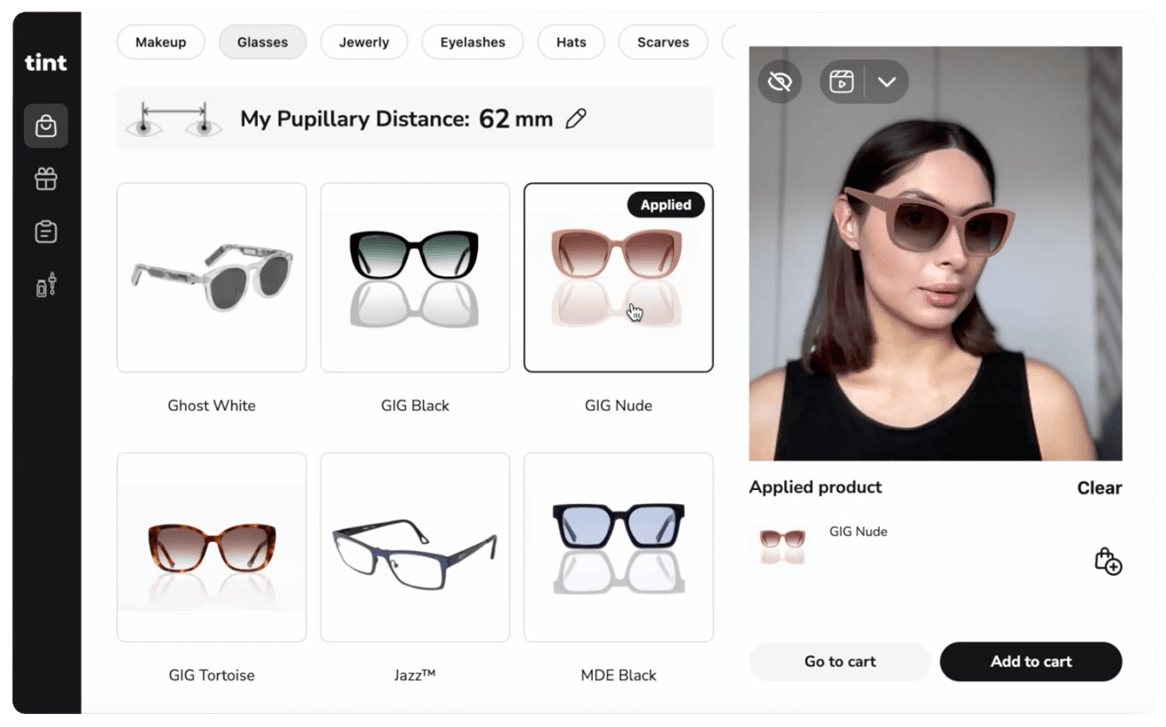 Banuba's glasses virtual try-on in action
5. GlassOn: frame and lens together
GlassOn is the only vendor here that gives the lens equal weight. Its own framing is that lenses are 50% of the value but 100% invisible online, so alongside fit-accurate try-on it ships tint and gradient comparison, side-by-side lens comparison, and the ability to try new lens colors on the glasses a shopper is already wearing. It builds 3D models from one to two product photos, offers 360-degree rotation and physical glasses removal, and integrates through a Shopify app, a PrestaShop add-on, or web components.
Best in category for: stores where lens upgrades are a real revenue line, and shoppers currently skip them because they cannot see the difference.
The trade-off: pricing is quote-only, and the vendor is smaller than the rest of this list.
What this actually costs
Only two of the five publish a price, which is the single most useful thing to know before you start a procurement round.
Banuba publishes two separate ladders, and it is worth knowing which one you are being quoted.
The self-serve widget on the product page runs Basic at $49 per month for 1,000 try-ons, Pro at $99 for 3,500, Smart at $349 for 15,000, plus a custom Enterprise tier. All tiers include a 14-day free trial, unlimited products, and all six try-on categories.
The Shopify app is priced for higher volume: Basic at $319 per month for up to 10,000 try-ons, Pro at $999 for 40,000, Smart at $1,599 for 70,000, each with a 14-day trial and unlimited products, covering makeup, eyewear, contact lenses, and hair dye.
Perfect Corp's Shopify app publishes $379 per month on Essential and $569 per month on Premium, both with a 14-day trial, but caps SKUs at 100 and 300, respectively.
Note that the two Shopify apps meter differently. Banuba charges by try-on volume, Perfect Corp by SKU count. A large frame catalog with modest traffic and a small catalog with heavy traffic will get opposite answers from those two models, so convert both into your own numbers before comparing the headline figures.
Fittingbox, Auglio and GlassOn all route to a contact form. That is not a criticism; it is just a planning fact: two of your five shortlist conversations will start without a number. If you are building the budget case internally before those calls, this breakdown of the cost variables behind a virtual try-on rollout covers the line items that tend to get missed.

Two objections worth answering directly
Third-party round-ups of this category make two recurring claims about Banuba, and both deserve a straight answer rather than a rebuttal buried in a footnote.
"Banuba is more expensive." On published entry pricing, it is the opposite. The self-serve widget starts at $49 per month, and comparing Shopify app to Shopify app, Banuba's Basic is $319 against Perfect Corp's $379. The three remaining vendors publish nothing to compare against at all. Where the claim can become true is at high try-on volume, where Banuba's Smart tier reaches $1,599 per month, or on a custom Enterprise build. Ask for the volume curve rather than the headline number, and the comparison holds up either way.
"Banuba is general-purpose, not eyewear-first." This one is fair, and it cuts both ways. Fittingbox and GlassOn are eyewear specialists, and it shows in features Banuba does not have, such as a 195,000-frame database and lens tint comparison. What being cross-category buys instead is one contract, one integration, and one dashboard covering eyewear, makeup, contact lenses, hair dye, headwear, and jewelry. If frames are all you sell, weight this against Banuba. If frames are one of several categories, it is the reason to weight it for.
When not to pick Banuba TINT
Three situations where something else on this list is the better answer:
- You sell frames you do not own. Fittingbox's 195,000-reference database removes work you would otherwise be doing yourself. Buy the database.
- Lens upgrades are a meaningful revenue line. GlassOn's tint and gradient comparison is a feature, not a rendering setting, and nothing else here matches it.
- Eyewear is a small module in a large beauty program with an existing Perfect Corp relationship. Consolidating on one vendor may beat a marginally better eyewear experience.
If you came here looking for consumer apps to try glasses on rather than software to put on your own store, our round-up of the top virtual glasses try-on apps is the page you want.
In other words
If your frames belong to other brands, Fittingbox's database is the deciding factor. If lens choice drives your revenue, GlassOn. If eyewear is one line in a beauty portfolio you already run on Perfect Corp, stay there. If you want coverage fast on frames already in a large catalog, Auglio. And if you own your collection and want to be live on it without waiting for anyone else to model it, that is the narrow case Banuba TINT is built for, and the 14-day trial costs nothing to test.
-
It is software that renders frames on a shopper's face through the device camera so they can judge fit and style before buying. Banuba TINT does this as a browser-based widget with no app install, which is the delivery model most eyewear e-commerce teams choose because it removes the download step from the funnel.
-
Not with most of this list. Auglio builds a try-on from a single 2D photo, GlassOn generates 3D from one to two product photos, and with Banuba you upload left, body, and right images of each frame in the TINT admin dashboard yourself, with new collections turned around in under 48 hours.
-
Yes. Banuba, Perfect Corp, and GlassOn all publish Shopify apps, and Fittingbox lists Shopify among its supported platforms. The Banuba Shopify plugin is the no-code route if your store is already on Shopify.
-
Banuba states its glasses try-on works on low-end devices and top smartphones alike, and the TINT widget targets the last two Safari and iOS major versions and the last five Chrome, Opera, Edge, and Samsung Internet versions. Browser support, not raw device power, is the practical constraint.
-
Yes, and it is the main reason to consider a cross-category vendor. Banuba's makeup virtual try-on sits on the same TINT plans as eyewear, contact lenses, hair dye, headwear, and jewelry, and Perfect Corp's Shopify app covers up to 10 makeup and eyewear categories.
-
Be skeptical of any single number, including ours. Published figures in this category range from Auglio's Zoff case study reporting a 4x conversion increase to Banuba TINT customer Océane reaching a 32% add-to-cart rate against a 3% industry average in makeup. Both are real, both are single deployments, and neither predicts your result. Run the free trial on your own catalog.
