

Picture the situation. A beauty brand wants a virtual lipstick try-on live before its next product drop in three weeks. The dev team has two senior mobile engineers, a Shopify storefront, an iOS app, and a roadmap with Q2 commitments. Someone in marketing has asked for "AR like Sephora has."
The deciding factors are not really about which API renders a more photorealistic gloss in a controlled studio demo. They are these:
- Will the API ship in three weeks or three quarters?
- What happens to the license bill when the launch goes viral?
- Who digitizes the 47 new SKUs, and how long does it take?
- Does the vendor still care about beauty in two years, or has its attention moved on?
Numbers speak louder than words. They define why the API makeup solutions are essential in 2026. The virtual makeup market is projected to reach $1.86 billion by 2032, with 55% of online beauty shoppers already using AR try-on.
This guide is built around those questions, not around marketing brochures. The three vendors below, Banuba TINT, Perfect Corp, and DeepAR, keep showing up on shortlists because they answer those questions in radically different ways. Let’s review.
[navigation]
A makeup API plugs virtual cosmetics into an app or website without forcing the team to build face tracking from scratch. Three vendors lead the 2026 shortlist: Banuba TINT, Perfect Corp, and DeepAR. Banuba TINT is the strongest pick for production beauty stores and apps that need granular API control, fast SKU digitization, and stable on-device performance. Perfect Corp suits enterprise retailers leading with skin diagnostics. DeepAR fits low-stakes web prototypes.
TL;DR
- This guide compares the leading makeup APIs for mobile, web, and in-store cosmetics try-on in 2026.
- The tools are evaluated on API granularity, latency, platform reach, catalog workflow, license terms, and pricing.
- Banuba TINT is best suited for teams that need granular API control, on-device performance, and fast SKU digitization across web and mobile.
- Perfect Corp is the right call for global enterprise retailers leading with HD skin diagnostics.
- DeepAR fits short-run web prototypes but operates under Zalando ownership since April 2025, which shifts its roadmap toward fashion & internal tasks.
- Simpler APIs may work for one-week marketing campaigns or low-volume prototypes that do not need a digitized catalog.
- For ongoing campaigns and fully functioning solutions with makeup virtual try-on features, teams should consider more advanced options like Banuba.
How we evaluated each makeup API
Six benchmarks, each tied to a real engineering decision:
- API surface and control: granular method calls or all-or-nothing widget.
- Latency and FPS: on-device performance and behavior on mid-range hardware.
- Platform reach: native iOS, Android, web, plus first-party React Native, Flutter, Unity wrappers.
- Catalog and asset workflow: speed from photoshoot to live render and whether digitization is in scope.
- License terms: commercial use rights, royalty model, watermark obligations.
- Pricing model: flat per-platform, per-MAU, or custom enterprise.
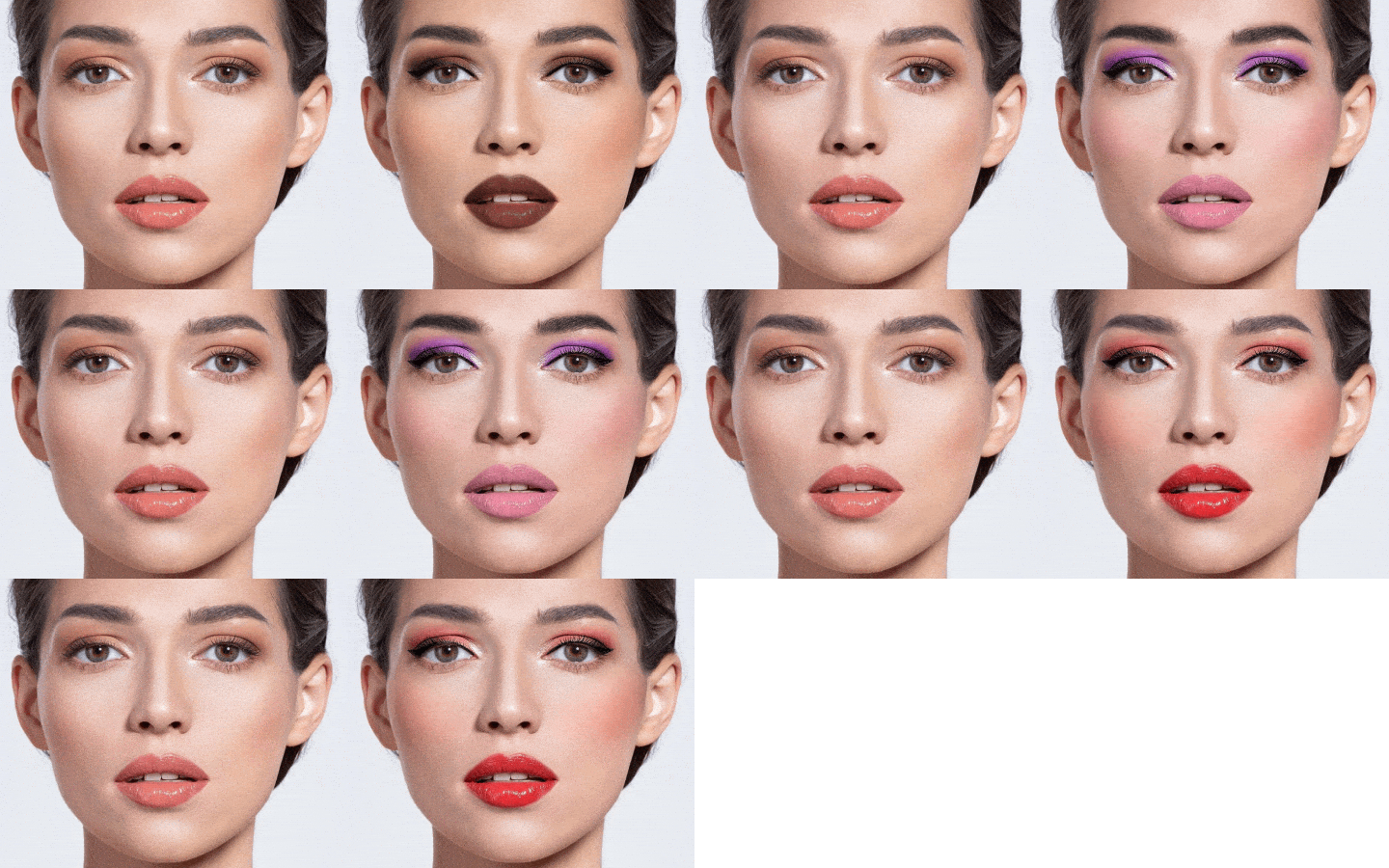 Banuba's makeup API in action
Banuba TINT
Banuba TINT sits on top of the patented Banuba face-tracking engine and exposes a makeup-specific API rather than a generic AR runtime. The engine is built on patented technology that ensures a makeup overlay stays put even with 70% facial occlusion and head rotation. It’s all due to the 68 facial points that the algorithm tracks.
First impression. The API reads like it was designed by someone who has actually shipped a beauty product. There are dedicated methods for Makeup.lipstick, Makeup.eyeshadow, Makeup.blushes, Makeup.eyeliner, Makeup.eyelashes, Makeup.eyebrows, Makeup.contour, Makeup.highlighter, plus foundation through Skin.color and Skin.softening. Each accepts either an RGBA color value or a texture file. Composing a complete look is straightforward: up to nine products applied at once, with real-time mix-and-match.
Where it shines.
- Single render pass for makeup and beautification. The Makeup API and Face Beauty API share the same face effect, so smoothing, teeth whitening, and morphing run alongside makeup without doubling GPU cost.
- Texture realism. Matte, satin, glossy, and natural finishes for lips. Lengthening and volumizing variants for mascara. Lighting adaptation built in, which matters across diverse skin tones.
- Asset pipeline. Free SKU digitization is included in the license, and Banuba can turn around a full collection in under 48 hours, no physical samples needed. There is also a self-service Admin Panel for product attribute updates.
- Asset library. You don’t have to create your own digital makeup from the start, as Banuba offers 22K+ assets off-the-shelf in its library.
- AI-powered personal recommendations and seasonal analysis.
- Detailed integration documentation.There's also an LLM-adapted path for vibe coders.
Where it struggles. No permanent free-with-watermark tier. The 14-day trial is offered instead for prototyping and testing.
Verdict. Strongest default choice for cosmetics e-commerce, multi-SKU brands, and any team using React Native or Flutter. The combination of granular API, on-device performance, fast asset pipeline, and platform-not-user pricing means the cost curve stays flat as the app scales.
Performance benchmarks
- Real-time advanced filters run at an average of 20–30 FPS.
- Applying simple 3D items (e.g. makeup without complex texture) takes less than 1 second.
- Advanced effects take 1–2 seconds.
Real-world outcomes
- Boca Rosa Beauty: $900,000 in 4 hours, 1.7M try-on sessions during a single launch event.
- Océane: add-to-cart rate up from 3% to 32%, sold a month of stock in a week.
- Looké: first virtual makeup try-on app in Indonesia, 55,000+ year-one installs.
- Aggregate across customers: up to 60% lower returns, up to 300% more conversions.

Perfect Corp YouCam, hands-on
Perfect Corp is the public-company incumbent. Its consumer YouCam apps have been downloaded over 1.1 billion times, and the B2B platform powers AR try-on across more than 800 partner brands.
First impression. Heavyweight. The platform is clearly built for enterprise retail, and that shows in everything from the sales motion to the procurement-grade documentation. If the buyer is a global skincare brand, the conversation feels right. If the buyer is two engineers and a Shopify store, it feels like overkill.
Where it shines.
- HD AI Skin Analysis. Dermatologist-validated detection across multiple skin concerns; hard to replicate without comparable training data.
- Pre-digitized catalog. Years of exclusive partnerships have produced one of the largest libraries of pre-rendered cosmetic SKUs in the industry.
- Generative AI overlay. YouCam AI Beauty Agent and AI hairstyle generation extend the stack into conversational try-on flows.
- Compliance flow. Built for the legal and data-handling reviews global retailers need.
Where it struggles.
- Custom pricing means multi-month negotiation timelines. There is no transparent self-serve path.
- Hybrid deployment routes some diagnostics through the cloud, adding latency and complicating offline use.
- HD analysis can strain mid-range Android devices common in emerging markets.
- React Native and Flutter wrappers are not first-class.
Verdict. The right choice if AR strategy is anchored on skin diagnostics and procurement can absorb a multi-quarter contract. Wrong choice for SMB, mid-market, or any team that needs to ship inside a quarter.
DeepAR
DeepAR is a London-based AR SDK with face tracking, masks, and accessory try-on across mobile and web. Beauty try-on is offered as a paid add-on rather than a core capability.
First impression. Fun. DeepAR Studio is genuinely good for designers building 3D effects, and the free tier makes it the cheapest way to get a prototype in front of stakeholders. But "fun" and "production beauty" are different jobs.
The 2025 plot twist. Zalando acquired DeepAR in April 2025 as part of the retailer's investment in 3D and AR. DeepAR remains an independent company under Zalando, but its roadmap now follows the retailer's e-commerce strategy. For multi-year beauty platforms, that creates strategic-alignment risk.
Where it shines.
- Free tier up to 10 MAU with watermark, ideal for prototypes.
- DeepAR Studio for designer-led effect creation without heavy code.
- Reliable Web AR delivery for short-run marketing campaigns.
Where it struggles.
- Hair segmentation works, but lips, eyebrows, and skin are not segmented individually on Android. Makeup precision suffers.
- Skin smoothing softens texture rather than preserving it, producing a "plastic" look unsuitable for close-up product imagery.
- MAU pricing scales linearly: ~$25/month at 10–1,000 MAU rises to ~$1,000/month at 50,000–100,000 MAU.
- No native React Native or Flutter, community wrappers only.
- No bulk SKU digitization service.
Verdict. Good for browser-only marketing campaigns, social filters, and prototypes. Wrong for multi-year beauty roadmaps with serious catalogs.

Best Makeup APIs: Compared
For your convenience, we’ve put together a side-by-side comparison of the key constraints that usually puzzle teams when choosing an API makeup solution.
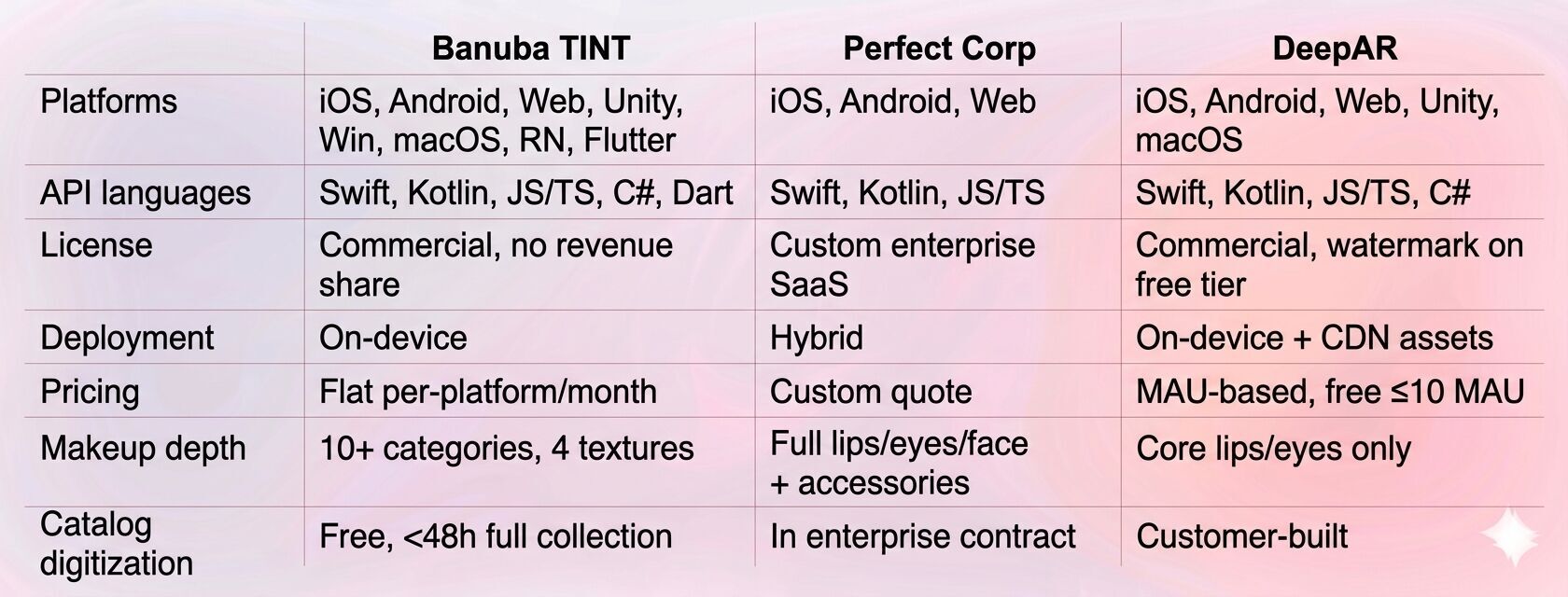
Original framework: Makeup API Selection Matrix
A two-question decision aid for shortlisting in under a minute.
Question 1: How long does the integration need to live?
- Weeks (campaign or prototype) → DeepAR free tier covers it.
- Years (production beauty platform) → Banuba TINT or Perfect Corp.
Question 2: What anchors the user journey?
- Cosmetics try-on across many SKUs → Banuba TINT.
- Skin diagnostics and dermatology-adjacent flows → Perfect Corp.
- Fun social filters with light commerce → DeepAR.
Edge cases worth flagging.
- React Native or Flutter as the framework of choice → Banuba TINT (only one with first-party plugins).
- Strict on-device-only requirement (GDPR, offline kiosks) → Banuba TINT.
- Existing Zalando partnership → DeepAR alignment may help.
- Procurement cycle is the bottleneck → Banuba TINT (per-platform pricing avoids enterprise SaaS quote cycles).
Decision guidance
The honest answer for most teams reading this guide is Banuba TINT. The combination of granular API, fast catalog onboarding, on-device performance, predictable per-platform pricing, and first-party React Native and Flutter support clears the path to production faster than the alternatives. The 14-day full-feature trial is enough to validate the integration before any commitment.
Perfect Corp earns the slot when skin diagnostics are the centerpiece of the experience and the buyer is a global retailer with the runway to negotiate an enterprise contract. The capability is real and hard to replicate; the cost of admission is the procurement cycle.
DeepAR earns the slot when the integration only needs to live for weeks, the catalog is small or non-existent, and a browser-first prototype on the free tier is the entire deliverable. After the Zalando acquisition, weighting longer-term strategic alignment matters.
References
Arbelle. (2025, November 28). Cosmetics industry report: Trends, tech and consumer insights. https://arbelle.ai/cosmetics-industry-report/
Banuba. (n.d.-a). Makeup software | AI virtual try-on solution for beauty brands. Retrieved May 5, 2026, from https://www.banuba.com/tint-makeup-virtual-try-on
Banuba. (n.d.-b). AI Beauty AR API SDK | Makeup beautification retouch filters. Retrieved May 5, 2026, from https://www.banuba.com/facear-sdk/beauty-ar
Banuba. (n.d.-e). TINT documentation. Retrieved May 5, 2026, from https://tintvto.com/docs/
Banuba. (n.d.-f). Virtual Makeup API documentation. Retrieved May 5, 2026, from https://docs.banuba.com/far-sdk/
DeepAR. (n.d.). DeepAR documentation. Retrieved May 5, 2026, from https://docs.deepar.ai/
Drapers. (2025, April 7). Zalando acquires tech firm DeepAR. https://www.drapersonline.com/news/zalando-acquires-tech-firm-deepar
Gitnux. (2026, April). Beauty industry statistics: Market data report 2026. https://gitnux.org/beauty-industry-statistics/
InsightAce Analytic. (2026, February 26). Artificial intelligence (AI) in beauty and cosmetics market size, scope and trends 2026 to 2035. https://www.insightaceanalytic.com/report/global-artificial-intelligence-ai-in-beauty-and-cosmetics-market/1051
Intel Market Research. (2026, January 3). Virtual makeup try-on market outlook 2026–2032. https://www.intelmarketresearch.com/virtual-makeup-try-on-market-22056
Perfect Corp. (n.d.). Beauty AR company and makeup AR technology platform. Retrieved May 5, 2026, from https://www.perfectcorp.com/business
WiFiTalents. (2026, February 12). Marketing in the beauty industry: Data reports 2026. https://wifitalents.com/marketing-in-the-beauty-industry-statistics/
-
API granularity, latency, and pricing predictability. Granularity means separate methods for lips, eyes, brows, foundation, and looks, not a black-box widget. Latency means real-time on-device performance with no cloud round-trip. Predictability means a flat per-platform fee that survives a viral spike.
-
There are typically three models. Flat per-platform per-month charges by platform, regardless of user count. Per-MAU scales linearly with monthly active users. Custom enterprise negotiates annual contracts. Always confirm whether SKU digitization and custom effects are included or billed separately.
-
Banuba TINT is the best for scaling production apps. Per-platform pricing keeps license cost flat as users grow. Underlying face tracking covers 97% of iOS and 80% of Android devices. On-device processing keeps latency low and biometric data local, which simplifies GDPR.
