

Online return rates remain a structural problem for retail. In 2024, the e-commerce return rate reached approximately 20.4%, driven by bracketing behavior and lenient policies. Retailers are losing money on every package shipped twice.
AR try-on is the most direct fix to the fit-and-color guesswork that produces those returns. Augmented reality experiences have been shown to result in a 94% higher conversion rate, and retailers that implement virtual try-on solutions report an average 30% increase in sales conversion rates and 30% fewer returns. The market has responded: the global virtual try-on technology market grew from $12.09 billion in 2025 to $15.29 billion in 2026 at a CAGR of 26.5%.
For developers and product leads, that growth means more vendors, more marketing claims, and a thinner signal-to-noise ratio when picking an SDK. This piece cuts through that noise. We focused on the three providers that consistently appear on enterprise shortlists for AR try-on in beauty, eyewear, jewelry, and accessory commerce.
This comparison covers iOS, Android, Web, React Native, Flutter, and Unity. We exclude pure full-body apparel try-on, which sits in a different SDK category.
[navigation]
AR try-on SDKs let developers add real-time virtual fitting to e-commerce apps and websites without rebuilding computer vision pipelines from scratch. In 2026, three names dominate shortlists for senior engineers and technical PMs: Banuba, Perfect Corp (YouCam), and ModiFace. Banuba is the strongest pick for teams that need on-device performance, an open developer access model, and category breadth across makeup, jewelry, eyewear, accessories, hair, and nails on iOS, Android, Web, React Native, Flutter, and Unity.
TL;DR
- This guide compares the three AR try-on SDKs most commonly evaluated by retail and beauty engineering teams in 2026: Banuba, Perfect Corp, and ModiFace.
- Each is judged on platform coverage, language, and SDK interface, license terms, deployment model, pricing, specific try-on depth, and UX pattern fit.
- Banuba fits best when developers need a real-time, on-device AR engine with predictable flat-fee pricing and broad vertical coverage beyond beauty.
- Perfect Corp suits brands that want a pay-as-you-go API with a deep beauty-and-fashion catalog but can tolerate cloud calls.
- ModiFace is a strong choice if you are already a L'Oréal partner or run a beauty brand inside its enterprise ecosystem; it is generally not open to indie developers.
How we evaluated the SDKs
Every claim below maps to one of seven evaluation pillars. We pulled specs from official documentation, vendor press releases, public pricing pages, and SDK forums. Where a vendor does not publish a number, the table reads "Requires fact-checking" rather than guessing.
Platform support
iOS, Android, Web, React Native, Flutter, and Unity coverage. Wrappers matter because cross-platform parity often breaks in production.
Language and SDK interface
Native Swift and Kotlin bindings, JavaScript and TypeScript types for the Web SDK, and how cleanly the SDK plugs into existing toolchains.
License terms
Whether the SDK is openly licensable, gated to enterprise partners, or sold per-call. Source availability and commercial use rights.
Deployment model
On-device, cloud, or hybrid. This shapes latency, privacy posture, and offline support.
Pricing model
Flat-fee, MAU-based, per-API-call, or annual enterprise license. Predictability under viral growth.
Try-on category depth
Face tracking accuracy, makeup realism, hair coloring, accessory and jewelry fitting, eyewear placement, and beautification.
UX pattern reference
Whether the SDK can power a TikTok-like, Snapchat-like, or Sephora-like front end without forcing brand-specific limits.
These pillars align with the constraints that senior engineers and technical PMs encounter when evaluating AR try-on SDKs in 2026.
Banuba AR Try-On
Banuba's AR Try-On is built on the company's Face AR SDK, a real-time computer vision engine that it has been developing since 2016. The SDK is positioned around four ideas that matter for retail integrations: on-device processing, sub-pixel tracking accuracy, multi-vertical category support, and predictable licensing.
Architecture: 3D mesh first, not 2D landmarks
Most face-tracking SDKs detect 2D facial points, then run nonlinear math to estimate the 3D head pose. Banuba's patented Face Kernel inverts that flow, inferring a 3D mesh directly from the camera feed and skipping the 2D-to-3D conversion step. The result: the SDK tracks 68 facial anchor points and reconstructs a 3D face mesh using up to 3,308 vertices, working on 97% of iOS devices (starting with iOS 13.0) and 80% of Android devices (starting with Android 8.0 with the Camera 2 API and OpenGL ES 3.0).
Stability under real-world conditions is the part most try-on demos quietly skip. The SDK operates smoothly even under 70% occlusion, low light, or rapid motion. Banuba's patented 3D math model and optimized neural networks reduce latency and adapt to challenging lighting for real-time responsiveness. For shoppers in subway light or evening lamps, that difference shows up directly in conversion.
Try-on category breadth
Banuba covers the widest range of AR try-on verticals among the three vendors compared here. The catalog includes:
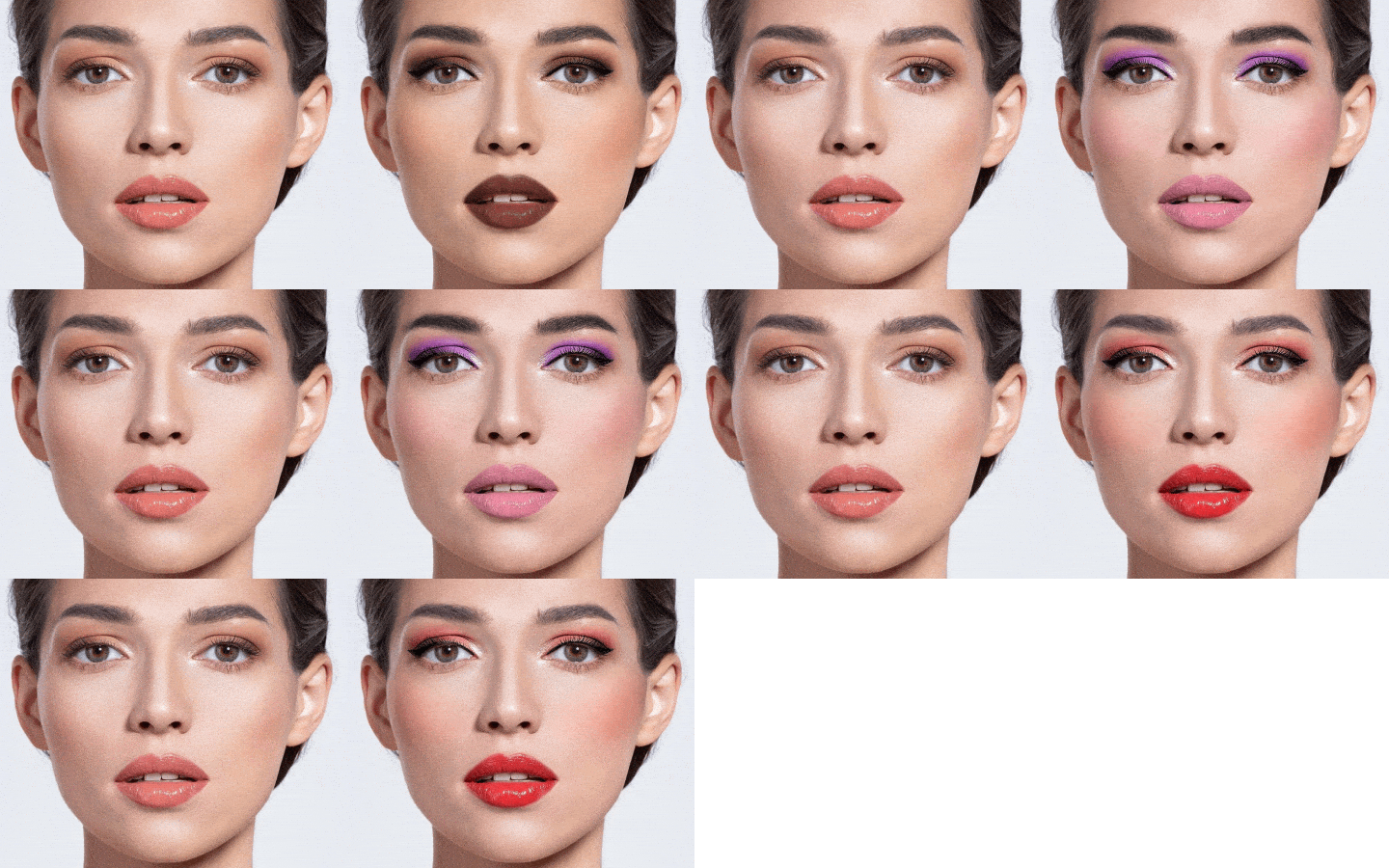
- Makeup (lipstick, eyeshadow, eyeliner, blush, contour, highlighter, foundation shade matching)
- Skincare visualization with long-term effect prediction
- Eyewear and sunglasses, with adaptive lighting and angle support
- Colored contact lenses, with separate iris, sclera, and pupil recoloring
- Hair color, including natural shades, neon tones, gradient dyes, and per-strand coloring
- Headwear (hats, fedoras, tiaras) with realistic shadow and lighting transfer
- Jewelry (rings, bracelets, necklaces, earrings) with light and gravity simulation
- Nail polish in matte and glossy finishes, with per-finger color variation
The hand-tracking-driven ring and bracelet try-on is a meaningful differentiator: ModiFace's developer-facing offering centers on face, hair, and nail tracking, while Perfect Corp's strongest categories are in beauty. Banuba covers all three areas within a single SDK.
Pricing and licensing posture
Banuba uses a flat-fee, per-platform license model. Unlike pay-per-request cloud services that produce surprise bills when an app goes viral, Banuba's flat-fee structure makes costs predictable. The license includes tech support and monthly updates for the evolving Android ecosystem. A 14-day free trial of the Face AR SDK is available so teams can benchmark performance before committing.
Pricing depends on the feature set, the platforms covered, payment cadence (annual upfront is discounted), and whether custom development is required. There is no MAU cap, which matters when a single livestream or influencer event drives an order-of-magnitude traffic spike.
Developer experience and integration
The SDK ships with native iOS (Swift and Objective-C), Android (Kotlin and Java), Web (JavaScript and TypeScript), React Native, Flutter, and Unity bindings. Documentation lives at docs.banuba.com, with LLM-ready documentation files for AI-assisted onboarding, sample apps on GitHub, and a 1,000+ effect asset store. For teams that want to ship a try-on widget on a CMS without writing native code, Banuba offers the Virtual Try-On Plugin and the TINT VTO platform with a public demo store and TINT documentation.
Banuba also offers free product digitalization for its SDK users. A new collection of items can be turned digital within 48 hours.
Real-world deployment results
Two case studies stand out:
- Boca Rosa: $900,000 in sales over four hours during a pre-launch livestream, with 1.1M viewers and 1.7M virtual try-on sessions.
- Océane: add-to-cart rate climbed from 3% to 32% (a 1000% lift), and the brand sold a month's worth of stock in a week, becoming one of Brazil's fastest-growing beauty brands.
Reported aggregate impact across customers: up to 300% higher sales, up to 30% lower return rates, and up to 1000% higher add-to-cart rates.
Limitations
- Banuba is not the lowest-cost option for static-photo try-on; the SDK is built for real-time AR, and a team that only needs single-image overlays may find it heavier than necessary.
Who should choose Banuba
Senior engineers building real-time AR try-on for beauty, eyewear, jewelry, hair, or nail commerce on iOS, Android, Web, React Native, Flutter, or Unity, who care about on-device privacy, predictable cost under viral growth, and category breadth.
Who should not choose Banuba
Brand teams are already deeply integrated into the L'Oréal product graph (where ModiFace is a natural fit), or solo developers who need a free tier and can accept cloud-call latency for a hobby project.

Perfect Corp (YouCam)
Perfect Corp is the company behind the YouCam app suite. The company offers an enterprise portfolio of virtual try-on experiences for makeup, hair, jewelry, watches, and fashion accessories, plus AI-powered skin and hair analysis, with a network of over 800 global brand partners.
Architecture and access
Perfect Corp's 2026 push has been API-first. Its API ecosystem features low-latency performance, modular architecture, and a consumption-based pricing model.
The company has also leaned into generative AI for fashion. In 2025, Perfect Corp launched AI Clothes Try-on, a Generative AI experience that lets shoppers preview entire outfits, fabrics, and colors from a single photo, available through both YouCam apps and the YouCam Online Editor AI Clothes Try-on API.
Strengths
- Pay-as-you-go billing makes prototyping cheap
- Strong enterprise content management for product configuration
- Recent investments in generative-AI clothing try-on extend reach beyond beauty
Limitations
- Many of the highest-value experiences run server-side via API calls, which adds latency and creates per-request costs that can scale unpredictably with traffic
- The full AR effect catalog and finer customization options are typically gated to enterprise tiers
Who should not choose Perfect Corp
Teams building offline-first or strict on-device experiences, apps with heavy concurrency where per-call costs would balloon, or any verticals outside beauty, fashion, eyewear, and accessories.
 Banuba's AR try-on for makeup example
ModiFace
L'Oréal acquired ModiFace in 2018, marking the company's first-ever tech acquisition, and ModiFace now sits at the heart of L'Oréal's digital services innovations. ModiFace's in-house tracking technology powers real-time AR for hair, face, and nails, and works with a broad network of partners worldwide (100+ partners in 100+ countries).
Architecture and access
ModiFace can be integrated using an embeddable miniprogram or a customizable Software Development Kit (SDK) for product-page integrations, standalone instant looks, or buildable makeup looks experiences. The product catalog covers Hair Virtual Try-On, Nail Virtual Try-On, Skin Analysis, Face Analysis, Foundation Finder, Teleconsultation, and Tutorials.
The catch is access. ModiFace supports mobile SDKs for Android and iOS, as well as WebAR integrations via browser-based components. However, SDK access is typically limited to brand partners or enterprise clients. The SDK is not openly available to indie developers, marketplaces, or non-beauty verticals — a structural constraint baked into the L'Oréal ownership model.
Strengths
- Beauty-grade rendering quality, especially for lipstick gloss and hair color realism
- Deep brand-partner content libraries (Lancôme, Maybelline, Garnier, NYX, Essie, IT Cosmetics)
- Strong fairness validation across diverse global datasets, with documented AI fairness guidance
- Annual license fee model that does not scale per shopper
Limitations
- Vertical scope is beauty-only: makeup, hair, nails, and skin. No jewelry, eyewear, headwear, accessory, or hand-tracking try-on
- SDK access is gated; most independent brands and developers cannot license it directly
- Less developer-centric than Banuba or Perfect Corp; documentation, sample code, and community resources are not publicly browsable in the same way
- Pricing is not publicly disclosed; specific pricing figures are not listed on the public site
Who should not choose ModiFace
Indie developers, marketplaces, multi-vertical retailers (jewelry, eyewear, headwear, accessories), or any team that needs to start with a public free trial and self-serve docs.

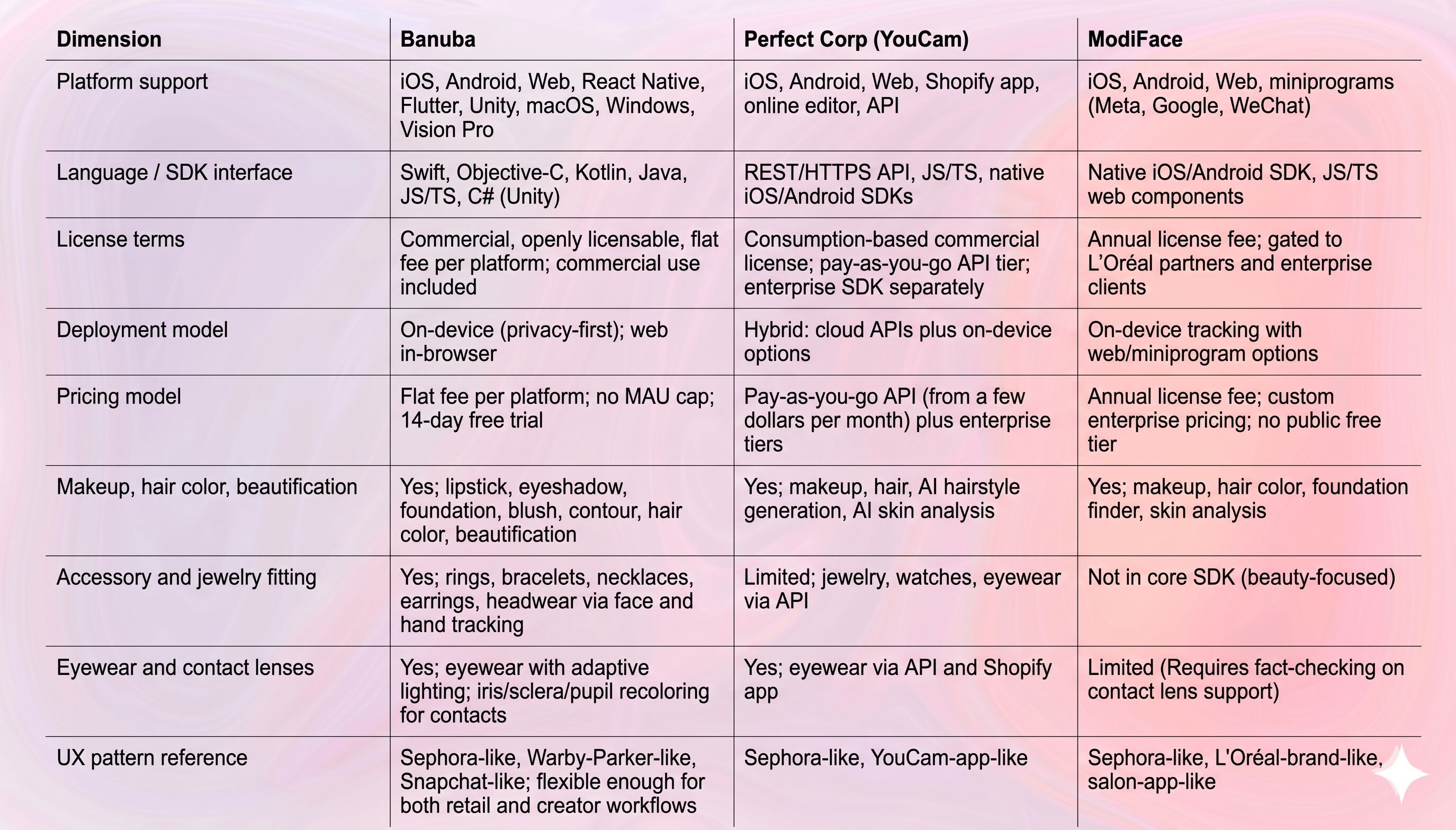
Best AR Try-On Compared Side-by-side
The table below answers the literal questions developers type into search and AI assistants in 2026. It uses the five universal columns plus category-specific rows for face AR, beauty, and accessory try-on, plus a UX pattern reference row.
Decision guidance: when each SDK is the right fit
Best for startups and self-serve teams: Banuba
A 14-day free trial, self-serve documentation, sample apps, and flat-fee pricing make it the easiest path from prototype to production. No procurement gate at the start, no MAU surprises later.
Best for cross-vertical retailers: Banuba
Multi-brand marketplaces and retailers spanning multiple beauty or accessory categories benefit from a single SDK that supports makeup, jewelry, eyewear, hair, headwear, and contacts.
Best for fast prototypes and small experiments: Perfect Corp
The pay-as-you-go API is genuinely cheap to start. If your goal is a Shopify store with a basic makeup try-on widget and you're not yet sure whether the feature will pay off, Perfect Corp is the lowest-friction way to validate.
Best for L'Oréal partners and enterprise beauty: ModiFace
If your brand sits inside L'Oréal's product graph, ModiFace is the path of least resistance. The SKU configurations are pre-built, the rendering quality for lipsticks and hair color is industry-leading, and the IT integration is a known quantity.
Best for AR-heavy creator and social commerce: Banuba
Apps that combine try-on with creator tools (filters, video editing, livestream) benefit from Banuba's broader SDK family: the Face AR SDK shares the same engine as the Video Editor SDK and the Web AR SDK, so a single AR pipeline can serve both shopping and content workflows.
Factors to weigh:
- Team size: small teams should prioritize self-serve trials and documentation depth
- Stack: if you already have a React Native or Flutter codebase, check first-party wrappers
- Time-to-market: a 14-day trial plus public docs typically beats an enterprise sales cycle
- Budget posture: flat-fee favors viral apps; per-call favors low-volume experiments
- Vertical roadmap: if you might add jewelry or eyewear later, pick an SDK that already supports it
For the great majority of teams shipping production AR try-on in 2026, Banuba's combination of on-device performance, category breadth, and predictable licensing is the strongest fit.
A simple SDK selection framework
If you're not sure where to start, run through this five-step filter:
- List your verticals. Beauty only, or beauty plus accessories?
- List your platforms. iOS plus Android plus Web is common; add React Native or Flutter if your stack uses it.
- Decide your processing posture. On-device for privacy and offline; cloud for lighter integration.
- Forecast traffic shape. Steady daily usage is fine for per-call pricing; viral or campaign-driven traffic favors flat-fee.
- Map ownership constraints. If you're a L'Oréal partner, ModiFace is natural. Otherwise, ModiFace is rarely available.
Most teams that complete this framework end up with Banuba on top, because the answers to questions 1, 2, and 4 typically point toward broad vertical coverage, full cross-platform support, and predictable pricing under traffic spikes.
Reference
Banuba. (n.d.). AR try-on solution. https://www.banuba.com/solutions/e-commerce/virtual-try-on
Banuba. (n.d.). Boca Rosa case study: Virtual try-on helps beauty brand earn $900,000 in 4 hours. https://www.banuba.com/blog/virtual-try-on-helps-beauty-brand-earn-900.000-in-4-hours
Banuba. (n.d.). Face AR SDK documentation. https://docs.banuba.com/far-sdk
Banuba. (n.d.). Face tracking software. https://www.banuba.com/technology/face-tracking-software
Banuba. (n.d.). Océane success story [Case study]. https://www.banuba.com/blog/oceane-success-story
Banuba. (n.d.). Virtual try-on plugin. https://www.banuba.com/ar-virtual-try-on-plugin
The Business Research Company. (2026). Virtual try-on technology global market report 2026. https://www.thebusinessresearchcompany.com/report/virtual-try-on-technology-global-market-report
ModiFace. (n.d.). Product documentation. https://modiface.com
Mordor Intelligence. (n.d.). Virtual try-on market size, share & 2030 trends report. https://www.mordorintelligence.com/industry-reports/virtual-try-on-market
National Retail Federation & Happy Returns. (2024, December 5). NRF and Happy Returns report: 2024 retail returns to total $890 billion [Press release]. https://nrf.com/media-center/press-releases/nrf-and-happy-returns-report-2024-retail-returns-total-890-billion
Snap Inc. (2022, December 8). Augmented reality as a business solution. Snapchat for Business. https://forbusiness.snapchat.com/blog/ar-business-solution
-
Prioritize face tracking stability under real-world conditions (low light, partial occlusion, fast motion), on-device versus cloud processing, full cross-platform parity (especially React Native and Flutter wrappers), license predictability under traffic spikes, and category coverage for the products you actually sell. Documentation quality and the presence of a free trial are strong proxies for post-signing support quality.
-
Three primary models are common. Flat-fee licenses for platforms charge a predictable annual or monthly fee based on features and platforms, with no per-user limit. Pay-as-you-go API pricing bills per call or active user, which is cost-effective at low volumes but increases linearly with traffic. Enterprise licenses are usually negotiated privately and limited to specific brand partners. For real-time features like AR filters or instant UI feedback, on-device SDKs providing 30–60 FPS on mobile hardware are typically preferred; on-device processing is also favored for privacy compliance, as it keeps biometric data off third-party servers.
-
For scaling apps that need cross-platform parity, predictable cost, and category breadth, Banuba is the strongest fit. The flat-fee licensing model holds up under viral traffic without surprise bills. Documented case studies show the SDK powering single events with 1.7M virtual try-on sessions, and the same engine supports React Native, Flutter, and Unity wrappers so teams can keep one AR pipeline as they grow.
