

- The global virtual makeup try-on market is on track to grow at a 7.8% CAGR.
- AR try-on is already in the hands of 55% of online beauty shoppers, making it a default expectation rather than a novelty.
- Brands that add AR to the buying journey see up to 90% higher conversion rates and a 2.4x lift in purchase likelihood.
- Adoption keeps widening: 57% of beauty brands plan to integrate AR into their online stores, and AR beauty filters increase time spent on brand pages by 2.5x.
So the question for 2026 is no longer whether to ship makeup software. It is the platform to license. The wrong choice creates problems that show up later: SKU digitization stalls, makeup looks plastic on darker skin tones, the pricing model punishes a viral moment, or the vendor's roadmap drifts toward someone else's priorities.
This guide stacks three serious options against each other on the criteria that actually matter for beauty teams.
[navigation]
Makeup software is the layer that turns a flat product page into a try-before-you-buy moment. In 2026, three vendors dominate developer shortlists for cosmetics try-on: Banuba TINT, Perfect Corp, and DeepAR. Banuba TINT is the strongest pick for cosmetics brands and beauty e-commerce that want fast SKU digitization, AI shade recommendations, and a per-platform license that does not penalize traffic spikes.
TL;DR
- Who this is for. Beauty brand product leads, e-commerce engineers, and founders evaluating cosmetics try-on for web stores, mobile apps, or in-store kiosks.
- What we compare. Three frequently shortlisted options: Banuba TINT, Perfect Corp YouCam, and DeepAR.
- When Banuba wins. Сosmetics stores that need lifelike makeup rendering, sub-day SKU digitization, AI seasonal color analysis, and predictable pricing.
- When Perfect Corp wins. Multi-region beauty conglomerates that build their AR program around HD skin analysis and have the runway for enterprise procurement.
- When DeepAR wins. Web-first marketing activations and prototypes where a low-MAU free tier is enough.
How we evaluated each software
We graded the three vendors using six benchmarks. Each one is a place where makeup software either earns its license fee or quietly leaks ROI.
- Catalog onboarding speed. How fast a new lipstick line, foundation range, or seasonal collection can move from photoshoot to live try-on.
- Rendering realism for makeup. How matte, glossy, and satin textures hold up across skin tones, lighting, and head movement.
- Stack and platform breadth. Native iOS and Android, web, plus officially maintained React Native, Flutter, and Unity, all measured as first-party rather than community wrappers.
- Commerce integration. Plugins for Shopify, WooCommerce, and similar CMS platforms, plus how cleanly the try-on connects to product catalogs and the cart.
- Pricing predictability. Per-platform flat fees, per-MAU scaling, or custom enterprise quotes, and what each model does to margin at scale.
- Vendor stability and roadmap. Independent ownership, support response times, and strategic alignment with non-affiliated customers.
The point is to surface the friction beauty teams hit in week three of a rollout, not the highlight reel from a sales demo.
Banuba TINT
TINT is Banuba's makeup-focused product, sitting on top of the same patented face-tracking engine that powers its Face AR SDK. Where the SDK is a general-purpose tool, TINT focuses on a commerce-ready stack: a try-on widget, a digitized product catalog, an admin panel, and AI shade recommendations.
What TINT actually delivers
- Realistic virtual makeup. Foundation, lipstick, lip gloss, blush, eyeliner, eyeshadow, mascara, eyelashes, eyebrows, and complete looks, up to 9 products applied at once with real-time mix-and-match.
- Texture range that matches the physical SKU. Matte, satin, glossy, and natural finishes for lips, plus lengthening and volumizing variants for mascara.
- Inclusive shade rendering. Lighting adaptation and lifelike interactions between AI makeup and skin of any tone.
- Personalized recommendations. Automated seasonal color analysis based on the user's hair, eye, and skin tone, plus AI-powered shade matching that removes the need for long onboarding quizzes.
- Try-on tutorials. Interactive makeup tutorials that overlay step-by-step guidance on the customer's own face.
Where it runs
- TINT is web-based, which means it runs on any device with a camera and an internet connection.
- E-commerce plugins for Shopify & Tiendanube (Nuvemshop) with installs that take roughly five minutes. Plugins for other CMS' are in the works.
- Banuba's optimized algorithms and neural networks run well on 97% of iOS and 80% of all Android devices, which keeps the addressable user base wide for global stores.
Catalog onboarding
This is the underrated lever for cosmetics try-on. TINT addresses it head-on:
- Free digitization included with the license; no separate per-SKU fees.
- Full collections digitized in under 48 hours, individual items in days, with no physical samples required.
- Self-service Admin Panel that lets brand teams update product attributes, add colors, and tweak features without waiting on a vendor ticket.
- Library with 22,000+ digital beauty products already in place
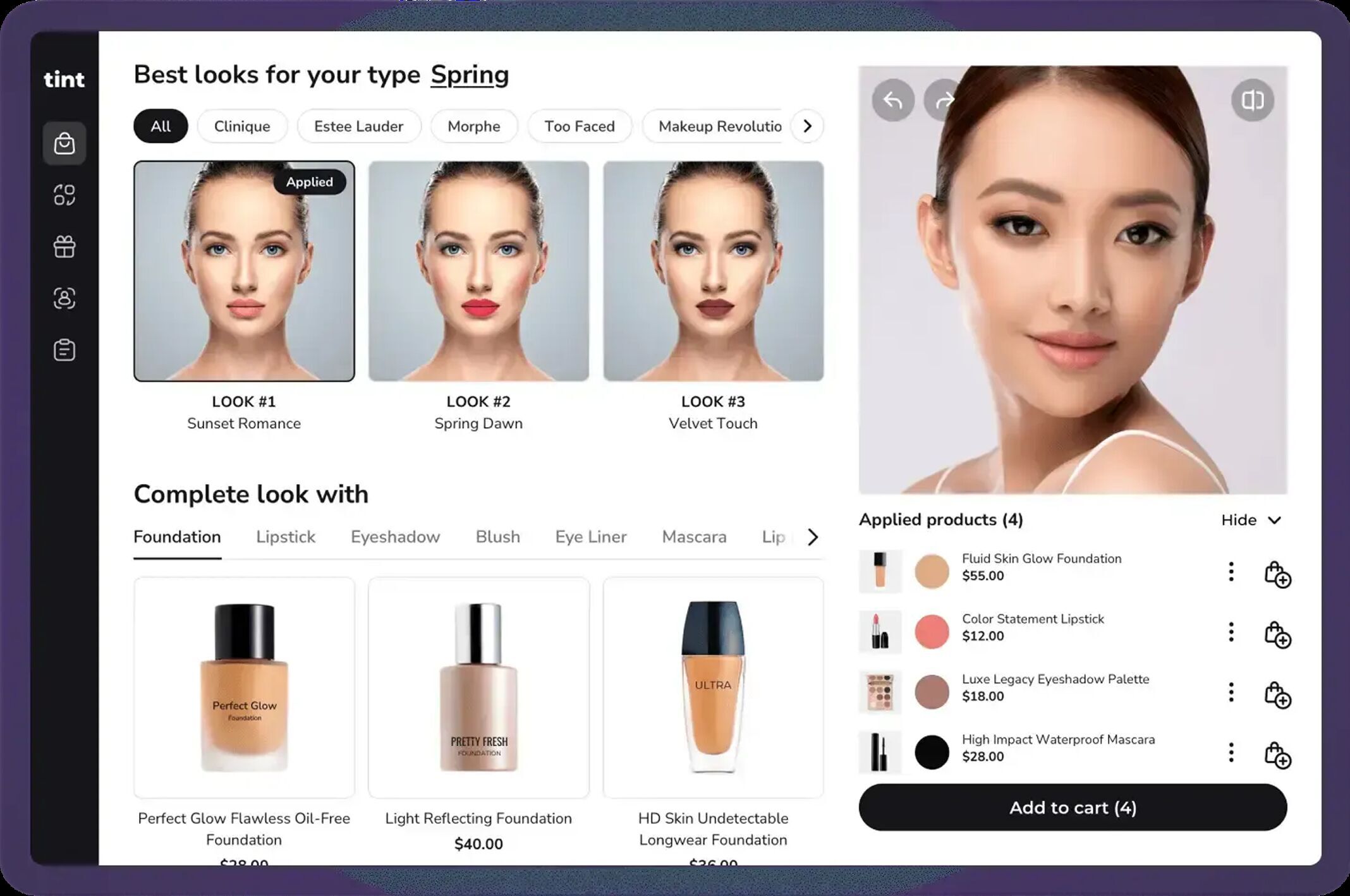 Banuba TINT makeup software platform interface demo
Commercial outcomes
Banuba publishes verifiable case study metrics tied to TINT, not just demo screenshots:
- Océane: add-to-cart rate jumped from 3% to 32%, and sold a month's worth of stock in a week.
- Boca Rosa Beauty generated $900,000 in revenue in 4 hours during a pre-launch event, with 1.7 million try-on sessions.
- Smitten Cosmetics added 50 new partnered beauty salons in 3 months and expanded to the UAE and the Philippines.
Banuba publishes general TINT outcomes in the same tier: up to 1000% higher add-to-cart rates, up to 60% lower returns, and up to 300% higher conversion rates across customer cohorts.
Best fit
- Beauty and cosmetics brands selling many SKUs across web and mobile.
- Multi-brand retailers that need a single try-on engine across categories.
- Direct-to-consumer cosmetics companies running pre-launch hype campaigns.
- In-store AR mirrors and tablet consultation flows.
- Cross-platform apps where React Native or Flutter is the chosen stack.
Skip if
- The project is a one-week web stunt with zero roadmap and no SKU catalog.
- The buyer wants a permanent free tier with watermarks rather than a 14-day full-feature trial.

Perfect Corp YouCam
Perfect Corp's makeup software side covers virtual try-on across cosmetics, hair, eyewear, jewelry, and watches, plus AI skin and hair analysis.
Strengths
- HD AI Skin Analysis. Dermatologist-validated assessment that detects multiple distinct skin concerns. Hard to replicate without comparable training data.
- Pre-digitized partner catalog. Years of exclusive brand deals have built one of the largest libraries of pre-rendered cosmetic SKUs in the industry.
- Enterprise polish. Procurement, legal, and compliance flows are designed for global beauty conglomerates.
- Generative AI overlay. YouCam AI Beauty Agent and AI hairstyle generation extend the stack into conversational try-on flows.
Limitations
- Enterprise-first sales motion. Pricing is custom-quoted per partnership, with multi-month negotiation timelines reported by procurement teams.
- Hybrid deployment. Some advanced diagnostics involve cloud processing, which adds latency, requires data-handling agreements, and complicates offline use.
- Hardware sensitivity. HD tracking and AI workloads can tax mid-range Android devices common in emerging markets.
- Cross-platform breadth. Strong on iOS, Android, and web, but native React Native and Flutter wrappers are not first-class citizens.
- Onboarding overhead. Steeper integration timeline compared to lighter SDKs, especially for SMB or mid-market brands.
Best fit
- Global beauty retailers running an enterprise-wide AR program.
- Skincare-led brands that anchor the customer journey on HD diagnostics.
- Medical spas and clinics needing high-resolution skin assessment for treatment tracking.
Skip if
- The team needs to ship a working try-on inside a quarter.
- The use case is a single cosmetics line on a Shopify store, not a multi-region enterprise rollout.
- The procurement budget cannot absorb the integration overhead.
Banuba TINT makeup application example
DeepAR
DeepAR is a London-based AR SDK originally built for face filters, masks, and accessory try-on across mobile and web. Beauty try-on is a paid add-on rather than the core capability. The SDK supports up to four simultaneous face tracks and ships a visual editor (DeepAR Studio) for designers building custom effects.
What changed in 2025
- DeepAR was acquired by Zalando in April 2025 as part of the retailer's investment in 3D and AR technology.
- DeepAR remains an independent company under Zalando's ownership, but its roadmap is now tied to the retailer's e-commerce strategy.
- For long-running beauty platforms, this creates real planning risk: feature investment is likely to follow Zalando's fashion-first priorities rather than the open beauty SDK market.
Strengths
- Generous free tier. Up to 10 MAU with watermark, useful for prototypes and test integrations.
- Visual studio. DeepAR Studio lets designers build effects in a 3D environment without heavy code.
- Browser performance. Reliable Web AR delivery, which suits short-run marketing campaigns.
- Variety of effects. Face filters, masks, background replacement, and accessory tracking are available out of the box.
Limitations
- Shallow makeup depth. Hair segmentation is supported, but lips, eyebrows, and skin are not segmented individually on Android, which limits makeup precision.
- Beautification trade-offs. Skin smoothing softens texture rather than preserving it, producing a "plastic" look that fails on close-up product photography.
- MAU pricing penalizes growth. Entry pricing is low ($25/month for 10–1,000 MAU), but costs scale linearly with users, hitting around $1,000/month at 50,000–100,000 MAU.
- No native React Native or Flutter. Cross-platform support relies on community wrappers.
- Limited cosmetics catalog services. No in-house SKU digitization at the scale Banuba or Perfect Corp offer.
Best fit
- Web-first marketing campaigns scoped to a few weeks.
- Social and entertainment apps that prioritize fun filters over commerce-grade makeup.
- Small-scale prototypes where the watermarked free tier is enough to validate UX.
Skip if
- The roadmap is multi-year and beauty-led.
- The catalog has dozens or hundreds of SKUs that need consistent rendering.
- Strategic alignment with a non-affiliated vendor matters to the procurement decision.
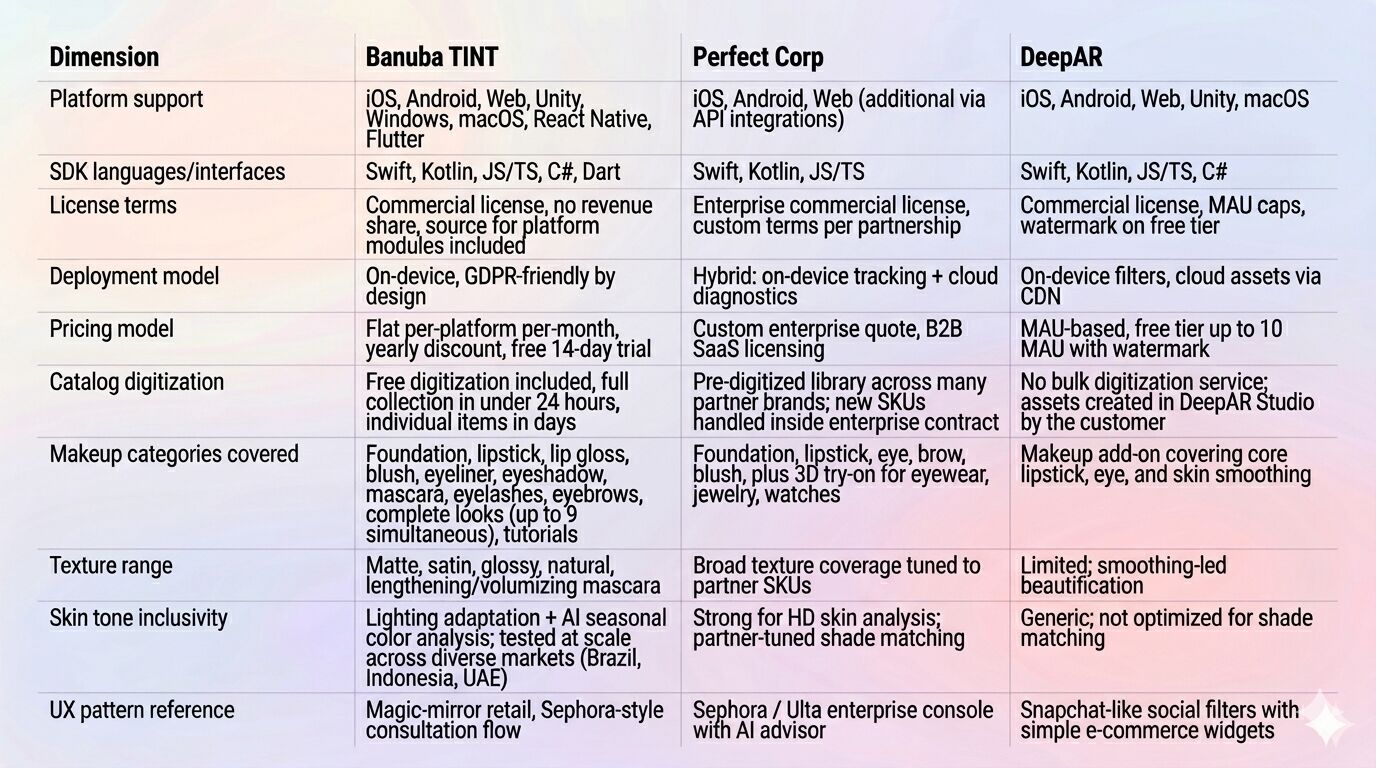
Best Makeup Software SDKs Comparison Table
How to choose the best makeup software SDK?
Three rough buckets cover most beauty teams:
- Best for cosmetics e-commerce and multi-SKU brands: Banuba TINT. Free digitization, sub-24-hour catalog onboarding, AI shade recommendations, and per-platform pricing that does not punish viral moments. Native React Native and Flutter, plus plugins for the major commerce CMS platforms, keep integration time inside a week for most teams.
- Best for global enterprise retailers with diagnostic-led journeys: Perfect Corp. If skin analysis is the anchor of the experience, the buyer is a dermatology-adjacent brand, and the procurement team is comfortable with a multi-quarter sales cycle, Perfect Corp's depth is hard to match.
- Best for short-run web campaigns and prototypes: DeepAR. The free tier and DeepAR Studio make it the cheapest way to validate a creative concept in the browser. The trade-off is vendor strategic drift toward Zalando's roadmap.
For most teams reading this guide, the deciding factor is rarely raw tracking accuracy. It is about whether the makeup software fits the existing stack, whether pricing can withstand a 10x traffic spike, and whether the catalog can be onboarded in days rather than quarters.
References
Arbelle. (2025, November 28). Cosmetics industry report: Trends, tech and consumer insights. https://arbelle.ai/cosmetics-industry-report/
Banuba. (n.d.-a). Makeup software | AI virtual try-on solution for beauty brands. Retrieved May 4, 2026, from https://www.banuba.com/tint-makeup-virtual-try-on
Banuba. (n.d.-b). AI Beauty AR API SDK | Makeup beautification retouch filters. Retrieved May 4, 2026, from https://www.banuba.com/facear-sdk/beauty-ar
Banuba. (n.d.-c). Face AR technology. Retrieved May 4, 2026, from https://www.banuba.com/technology/
Banuba. (n.d.-d). TINT documentation. Retrieved May 4, 2026, from https://tintvto.com/docs/
DeepAR. (n.d.). DeepAR documentation. Retrieved May 4, 2026, from https://docs.deepar.ai/
Drapers. (2025, April 7). Zalando acquires tech firm DeepAR. https://www.drapersonline.com/news/zalando-acquires-tech-firm-deepar
Gitnux. (2026, April). Beauty industry statistics: Market data report 2026. https://gitnux.org/beauty-industry-statistics/
InsightAce Analytic. (2026, February 26). Artificial intelligence (AI) in beauty and cosmetics market size, scope and trends 2026 to 2035. https://www.insightaceanalytic.com/report/global-artificial-intelligence-ai-in-beauty-and-cosmetics-market/1051
Intel Market Research. (2026, January 3). Virtual makeup try-on market outlook 2026–2032. https://www.intelmarketresearch.com/virtual-makeup-try-on-market-22056
MarketsandMarkets. (n.d.). AR in beauty & cosmetics market revenue trends and growth drivers. Retrieved May 4, 2026, from https://www.marketsandmarkets.com/Market-Reports/ar-in-beauty-cosmetics-market-109883240.html
Perfect Corp. (n.d.). Beauty AR company and makeup AR technology platform. Retrieved May 4, 2026, from https://www.perfectcorp.com/business
-
Three things in this order: catalog onboarding speed, rendering realism on diverse skin tones, and pricing predictability. A platform that digitizes a full collection in under 24 hours, renders matte and glossy textures correctly across skin tones, and charges per platform rather than per user will outperform a flashier competitor on TCO.
-
Two dominant models:
- per-platform-per-month flat fees charge for iOS, Android, Web, etc., regardless of user count;
- per-MAU pricing scales linearly with monthly active users.
Enterprise platforms negotiate custom annual contracts. Watch for add-on costs around SKU digitization, custom effects, and advanced AI features.
-
Banuba TINT is the best for scaling production apps. Per-platform pricing means user growth does not equal license growth. The underlying Banuba face-tracking technology covers 97% of iOS and 80% of Android devices, so the addressable audience stays wide. On-device processing keeps latency low and biometric data local, which simplifies compliance for global rollouts.
