

Integration of augmented reality in the beauty industry was inevitable. It was moving steadily until Covid-19 locked everyone in, leaving us without one of the dopamine boosters, namely shopping. It became a turning point in the beauty domain: people didn’t want to buy a cat in the sack, and brands wanted to reduce returns and increase sales.
AR in the beauty industry bridged digital and traditional, turning online shopping into a predictable, confidence-driven customer journey. In 2025, the beauty tech domain generated almost $9 billion in revenue. Beauty AR solutions and AI are redefining the try-before-you-buy concept in retail and the overall customer experience.
Virtual try-on technology and AI skin analysis tools are no longer innovations; they are routine. The AR magic mirrors evolved into smart face-tracking and computer vision overlay devices with personalized beauty recommendations.
The benefits are data-backed. Buyers gain confidence, personalized shopping, enhanced hygiene, engagement, and comfort. Marketers and retailers leverage fewer returns, omnichannel AR experiences, higher conversions, and a greener footprint.
Keep reading to explore how virtual try-on works, what benefits it serves to the beauty industry table, and how your business can leverage beauty AR solutions.
[navigation]
TL;DR:
- Virtual try-on combines face tracking, computer vision overlays, and AI analysis to create realistic, personalized beauty previews
- In the Beauty industry, AR supports makeup, hair, lenses, skin diagnostics, in-store mirrors, and interactive marketing
- Benefits of AR for consumers are increased confidence, hygiene, convenience, and personalization in beauty shopping
- Benefits of AR for manufacturers and retailers are higher conversions, fewer returns, stronger engagement, and better loyalty
- The future of AR in the Beauty sector is growth with focus on smarter personalization, privacy, omnichannel access, and strong performance
How Virtual Try-On Technology Works
So, what's under the hood of virtual try-on technology? At its core are three pillars that support the world of beauty AR solutions:
- face tracking;
- computer vision overlays;
- AI-powered analysis.
This symbiosis gives the camera a vision to see human facial features no worse (and perhaps even better) than a professional makeup artist or aesthetician. The process of transforming camera-equipped devices into AR magic mirrors is achieved through the integration of a face tracking SDK for beauty.
Bits of code, and your phone or tablet is now a smart beauty assistant that can detect, map, and enhance facial features in real time. In addition to AR makeup try-on for brands, the technology also supports virtual product search, simplifying the customer experience at more than one step.
Face Tracking
Every virtual try-on technology starts with understanding the face. Face tracking detects key facial landmarks and builds a precise 3D mesh that mirrors every contour and expression
Face detection & tracking
Modern algorithms can track faces even at extreme angles, in low light, or with partial occlusions like hair or glasses. This precision ensures that digital makeup, contact lenses, or hair color move naturally with every blink or smile, creating a lifelike reflection instead of a fake-like mask.
Computer Vision Overlays
Сomputer vision overlays bring beauty products to life on the pre-mapped face. They can be:
- static: applied to photos;
- dynamic: used to live image streams, adapting to the user's movement in real-time.
Static overlays are the simplest form, useful for product catalogs or social previews. Dynamic overlays, on the other hand, are powered by real-time rendering, perfect for AR makeup try-on for brands.
The algorithms place digital textures (lipstick, blush, eyeshadow, or even virtual hair color try-on) directly onto the live image. They track lighting, motion, and expression to ensure that lipstick gleams naturally, blush follows cheek contours, and hair color reflects light as it would in the real world.
AI-powered Analysis
The third pillar is in charge of personalized beauty recommendations. The system detects skin tone, undertone, texture, and even potential skin concerns, such as dryness or redness.
In the makeup domain, this means AI tone-matching in all product types: offering the best-matched eyeshadow to customers’ eyes, or hair color, fitting their skin tone. In the skincare category, skin analysis with AI enables personalized beauty recommendations tailored to individual needs, such as clogged pores, dry skin, acne, wrinkles, etc.
Omnichannel AR Experiences & Performance
Augmented reality in the beauty industry doesn't live in just one app. You can configure the virtual try-on technology almost at every step of the customer journey. A cross-platform AR SDK brings omnichannel AR experiences to your customers—from AR mirrors in stores, and web and mobile applications in e-commerce, to even AR DOOH (Digital Out-of-Home) campaigns.
Key Applications of AR in Beauty
Knowing how beauty AR solutions work, you realize that a single beauty AR SDK can help brands deliver interactive, data-driven omnichannel AR experiences. Let's explore augmented reality's core use cases in the beauty industry in more detail.
AR Makeup Try-on for Brands
Virtual try-on technology replaces messy swatches. Customers can experiment with makeup in real time, trying on thousands of shades and textures. AI tone-matching eliminates the pain of finding that perfect foundation or concealer. Face tracking ensures products move naturally with every expression and don't slip off like masks on social media.
Virtual Hair Color Try-on
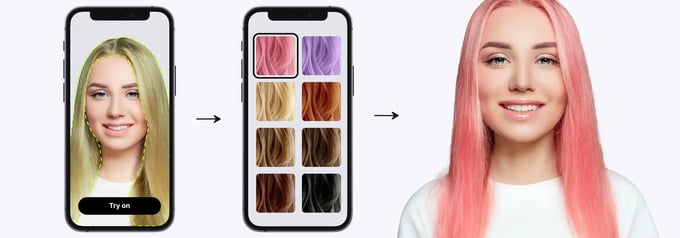
No commitment, no mess, no regret—virtual hair color try-on is a lifesaver for e-commerce, beauty salon apps, and customers. The computer vision overlay dynamically adjusts to movement and lighting, letting clients test bold or subtle looks instantly and create virtual studio experiences anywhere. Brunette or blond? Multicolored strands? Test first and dye with confidence.
Contact Lenses and Eye Products
No more trauma of in-store lens testing or the risk of catching conjunctivitis. AR in the beauty industry lets customers explore endless eye looks with no tears. With virtual try-on technology, a simple glance into your camera, and voila! New lenses, new glasses, and zero eye strain. Color lenses, sunglasses, or eyeglass frames... beauty AR solutions help sell items that complement the buyer's look rather than overpower it.
Skin Analysis with AI
Computer vision isn’t a magic pill. However, AI skin analysis tools can scan your face the way a seasoned aesthetician would, checking texture, hydration levels, pigmentation, fine lines, and more.
This real-time scan serves as the basis for personalized beauty recommendations. Instead of guessing which cream might help with dark circles or which serum fights uneven tone, a skin analysis app "reads" your pores and suggests products tailored to your actual skin condition.
Some beauty AR solutions like Banuba’s AI Skincare Virtual Try-on go even further. It can predict how a client's skin might respond to a specific routine over time, helping brands suggest products that don’t just fix today’s concerns but prevent tomorrow’s.
In-Store AR Mirrors for Retail
AR magic mirrors in retail are consultants without bias. The interactive displays blend face tracking, computer vision overlays, and real-time rendering to test products hands-free—no swatching, no smudging, no “let me wipe that off first.” Results? Faster in-store discovery, reduced need for physical testers, and cleaner and more fun beauty exploration.
Powered by tools like the AI Skin Analyzer, which blends seasonal color analysis with face shape detection, these AR mirrors for stores deliver objective, hyper-personalized beauty recommendations, tailored to the client's actual features, not a consultant’s mood or personal taste.
Marketing
Beauty AR SDKs work far beyond product pages. They can elevate your marketing when using augmented reality in the beauty industry to launch new collections, promote discounts, or boost brand visibility.
AR DOOH campaigns can turn a regular billboard into an interactive beauty hub: scan a QR code, a web AR virtual try-on launches in the browser, and test new shades right on the bus stop—zero downloads, but instant engagement.
Beauty AR solutions fit perfectly into social media filters and email marketing. Instead of shipping physical testers, brands can send a link to a virtual try-on plugin, offering a sustainable, memorable way for customers to try products anywhere, anytime.
Benefits of AR for Consumers
According to ThreeKit analytics, over 60% of consumers prefer AR in their shopping experience. What makes it so attractive? Let’s dive in.
Confidence without Commitment
AR try-on for e-commerce lets shoppers test beauty products the way they actually use them—on their bodies, in their natural lighting, without the fluorescent store lamps sabotaging the undertone. No guesswork, no regrets. Virtual products are digital twins of real items with touchless application. And unlike in-store testers, they don’t leave your hands covered in 12 lipstick swatches.
Safe, Hygienic Experimentation
For customers who care about hygiene (spoiler: nearly everyone after 2020), AR in beauty industry is a lifesaver. Experimentation becomes fully contact-free. No shared mascara wands, no used testers, no burnt hair strands after an impulsive dying test. It’s cleaner, safer, and undeniably more fun than scrubbing off five layers of foundation from your palm.
Convenience That Fits Real Life
AR meets shoppers where they already are—on their phones. It enables omnichannel AR experiences across websites, phones, tablets, and AR magic mirrors. Customers can try dozens of shades in seconds without opening a single box. Discovery becomes effortless, even spontaneous: users end up testing products they didn’t even plan to consider, opening new shopping possibilities without friction.
Personalized Beauty Recommendations
With AI skin analysis tools, AI tone-matching algorithms, and seasonal color analysis, recommendations stop being guessy or biased. No consultant’s opinion, no sister’s comment, no friend’s “I think warm tones suit you better.” Just pure math:
product attributes + your unique features = real personalization
This level of accuracy means better matches, fewer returns, less emotional fatigue, and a smoother overall experience, the kind that builds long-term loyalty.
Benefits of AR for Manufacturers and Retailers
If consumers love beauty AR in shopping because it enhances their customer experience, brands love it because it transforms their bottom line. AR try-on for e-commerce maps directly to business metrics: conversions, returns, loyalty, sustainability, or engagement. Let’s see how.
Higher Conversion Rates
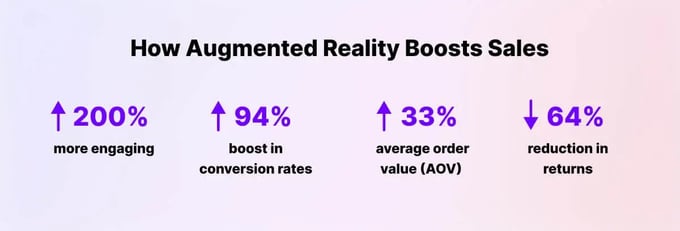
When customers see products not on a model or a swatch, but on their faces, it boosts their purchasing confidence. Shopify's analytics proves that items with AR interaction demonstrate up to 94% higher conversion rates. Banuba's internal benchmarks show that using their beauty AR SDK can increase conversions by 300%. With AI-tone matching and real-time rendering, the uplift applies across makeup, hair color, skincare, and accessories. Beauty AR solutions turn curiosity into checkout clicks.
Reduced Returns and Operational Waste
Returns are expensive and painful. In online shopping, 30–40% of items are returned, and each return costs brands around $21. AR try-on for e-commerce allows companies to recoup the investment within just a few quarters purely through reduced returns.
When it comes to makeup, 52% of buyers send products back due to shade mismatch. Virtual try-on technology reduces the “this didn’t look like I expected” effect, cutting mispurchases before they happen. Banuba's case studies indicate up to 60% cuts in returns after integrating their web AR virtual try-on.
Fewer returns also mean:
- less packaging waste;
- fewer logistics emissions;
- lower restocking costs.
A sustainability win disguised as a tech upgrade.
Improved Engagement and Session Time
Entertainment sells, and AR in the beauty industry keeps shoppers playing and exploring longer than static product pages. Deloitte’s report shows that users spend 2.7 times more time interacting with AR content than with traditional media.
Research found that shoppers spend an average of 75 seconds inside an AR experience (versus 11 seconds on standard mobile content). AR-enabled product detail pages can deliver up to 45% higher click-through rates, opening the door to cross-sells, upsells, and spontaneous “why not?” beauty moments.
Stronger Loyalty
Forbes reports that over 70% of consumers won’t buy from brands that don’t personalize their experience. Simultaneously, 83% are willing to share personal data if it leads to better, more relevant recommendations.
Personalized beauty recommendations are a direct path to loyalty. A beauty AR SDK powered by AI delivers data-backed matches rather than generic “best seller” tags: shades that fit your undertone, products aligned with your skin condition, frames that suit your face shape, and hair colors selected through seasonal color analysis.
Happy customers come back. Loyal customers spread the word and boost brand awareness. And personalization is what gets them there.
Instant Omnichannel Distribution
Cross-platform AR SDKs allow seamless web integration for AR try-on across web, mobile, and AR mirrors for stores. Retailers can unify their customer journey.
A shopper can test products online, validate shades in-store, and complete the purchase on their phone. An engaging, smooth customer experience drives higher conversions and stronger retention.
AI and Personalization in AR Beauty Tools
If AR makeup try-on for brands is a simple digital overlay, then adding AI turns it into an imitation of a professional makeup artist who actually knows what suits your face. AI in beauty AR solutions transforms computer overlays into a personal beauty concierge that reads your features better than your bathroom mirror. AI is the core fifth element that enables personalized beauty recommendations.
Algorithms analyze your skin tone, eye and hair color, and even your current skin condition (pigmentation or early signs of aging). Based on the input, the skin analysis app recommends routines and products that truly address your skin concerns, not a one-size-fits-all approach.
Planning a makeup look to match your outfit? The AI tone-matching feature will do the job, selecting products that highlight your beauty rather than overshade it.
Enhancing Online and In-Store Experiences
According to Harvard Business Review, 73% of buyers use multiple channels for shopping, and omnichannel customers spend 4× more than single-channel shoppers. Salesforce adds that 76% of consumers expect consistent interactions across channels.
Augmented reality in the beauty industry isn’t about replacing physical stores or sending everyone into the metaverse wearing VR glasses. It’s about creating omnichannel AR experiences that bridge physical and digital worlds.
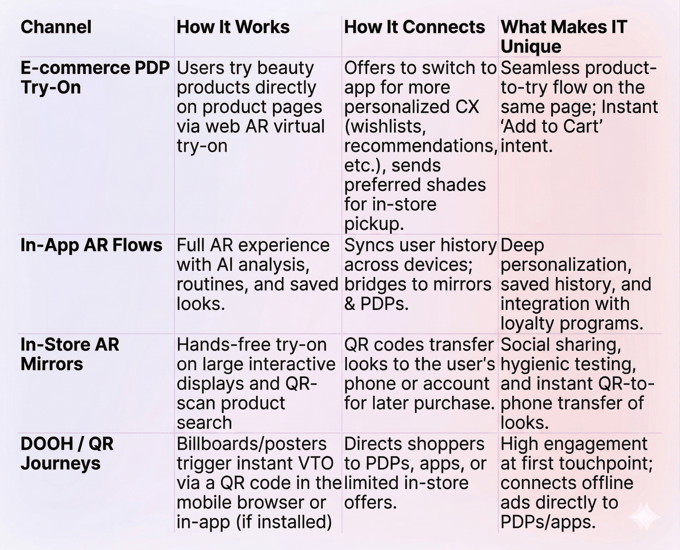
You can discover a new collection through a QR-powered AR DOOH billboard campaign, start exploring shades on a PDP, add it to your wishlist in the brand app, and finally test them hands-free in an AR mirror in-store before checkout. Each touchpoint feeds into the next, creating a seamless flow that keeps customers in the same experience, even when they switch devices or locations.
Let's compare how the most popular beauty AR channels can interact with each other to create that one frictionless beauty journey.
AR in the Beauty Industry Channels Comparison
Case Studies and Industry Examples
AR makeup try-on for brands is already a new black. But augmented reality in the beauty industry doesn’t stop at cosmetics. Below are a few inspiring ways beauty AR solutions can elevate different corners of the industry.
Skin Analysis and Personalized Routines
Imagine a skincare brand integrating AI skin analysis into its e-commerce flow, or an aesthetician using it before offline consultations. A quick scan evaluates texture, hydration, pigmentation, or early aging signs. Based on this, users receive personalized beauty routines and targeted product suggestions.
For the brand or clinic, this means deeper interaction, stronger trust, and natural upsell and cross-sell. This can turn a single moisturizer purchase into a full skincare routine tailored to the customer’s actual needs.
In-Store AR Mirrors
Today’s shoppers want interactive discovery, not physical trial. AR magic mirrors let customers explore dozens of looks. Social-sharing features turn try-on into instant UGC, boosting brand visibility organically. AR mirrors also reduce reliance on physical testers, making the in-store experience more sustainable and cost-efficient.
And because every virtual try-on interaction is captured anonymously, retailers gain valuable insights into which products attract the most attention, enabling smarter merchandising, discounts, and data-driven decisions.
Virtual Hair Color Try-On
A salon or a hair dye producer can introduce AR hair color visualization, helping clients preview new shades before committing. The tool guides them through tone selection and undertone matching, reducing post-dye dissatisfaction and improving stylist–client communication. And AI can help find the best-matching tone based on the client's personal features.
Virtual Studio Tutorials
Imagine a beauty education app with AR-powered tutorials for makeup, hairstyling, and skincare with your face as a model. Face-tracking applies step-by-step instructions directly on the user’s face, adapting to their unique features. Users can get a virtual studio experience with a pro make-up artist tutorials tailored to their face.
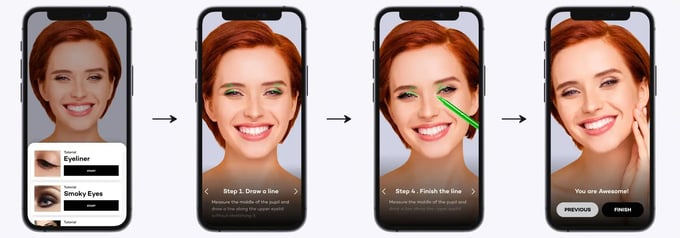
For example, FaceYoga used augmented reality to create tutorials on facial muscle training. Results? 20k+ downloads and increased session duration.
Salon or Retail Flows
In salons or stores, customers can preview hairstyles or hair colors with AR, then scan a QR code and jump directly to the product’s PDP to complete the purchase. Or the QR code could lead them to hair treatment suggested, styling product featured, or the hair-care routine recommended. You design the flow.
DOOH Activations
A beauty DOOH AR campaign with outdoor billboards offers scannable QR codes and bridges street-level engagement with online shopping. Passersby launch an instant browser-based AR try-on, test a new lipstick collection on PDP, and add it to their basket. beauty AR SDK can make even a walk down the street convert.
Search Surfaces
Integrate AR try-on in search results on your marketplace. Shoppers browsing for lipstick, blush, or hair dye can test products instantly without opening a separate page, improving product discovery and reducing navigation friction.
Future of AR in the Beauty Sector
AI and AR will continue to collaborate to become better, faster, smarter, stronger. Jokes aside, the global virtual try-on market is projected to grow from $15.18 billion in 2025 to $48.10 billion by 2030, at a robust CAGR of almost 26%.
What will this tight collaboration mean for the beauty industry?
Smarter Personalization
AI is growing as we speak, and personalization features will get even more advanced. Shade-matching will become hyper-precise, skin diagnostics will detect subtler changes, and beauty routines will adapt dynamically to users’ evolving changes and needs. AR in the beauty industry won’t just visualize the product; it will adapt it to the individual.
More Immersive yet Practical Brand Experience
3D avatars, virtual pop-ups, digital twins, and guided AR studios will move into the mainstream. Not as a metaverse hype, but as functional tools that help shoppers preview looks, compare styles, or follow beauty tutorials tailored to their own features.Think immersive but with real-world application. Beauty brands are already experimenting with avatar-based consultations and virtual try-on rooms.
Omnichannel by Default
Beauty AR solutions must work everywhere. Popular mobile devices, browsers, AR magic mirrors, billboards—as consumers move fluidly between physical and digital spaces, AR will follow them without friction. The future beauty journey is continuous. Try on a billboard, add to wishlist in an app, confirm the shade in-store, and purchase online.
Strict Privacy
As biometric privacy laws tighten worldwide, сonsumers will increasingly choose brands that protect their biometric data. Вrands will need AR solutions with transparent, compliant data-handling practices. The safest path forward?
- On-device processing, where no face images leave the device;
- Clear documentation of what happens with biometric data;
- Ability to operate without storing or transmitting user images anywhere.
Robust Performance
Future AR must run reliably not only on premium devices, but on millions of everyday smartphones, tablets, and in-store displays. That’s why companies will prioritize cross-platform AR SDKs that guarantee consistent speed, performance, real-time rendering, and visual quality across web, mobile, and retail hardware.
Conclusion: The Role of AR in Shaping Beauty Commerce
Augmented reality in the beauty industry has become one of the most reliable growth drivers. It elevates customer experience, reduces returns, increases purchase confidence, and supports a more sustainable, tester-free approach to product discovery. And if paired with AI, it can do wonders.
Ready to bring these benefits to your beauty brand?
Test Banuba's cross-platform beauty AR SDK with a free 14-day trial—no strings attached.
Get your token, follow the detailed integration tutorial, and see how virtual try-on technology transforms your customer journey from day one.

Reference list
Accenture. (2018). Widening gap between consumer expectations and reality in personalization signals warning for brands. https://newsroom.accenture.com/news/2018/widening-gap-between-consumer-expectations-and-reality-in-personalization-signals-warning-for-brands-accenture-interactive-research-finds
Dojobusiness. (n.d.). Beauty e-store return rate. https://dojobusiness.com/blogs/news/beauty-estore-return-rate
Forbes. (2020). 50 stats showing the power of personalization. https://www.forbes.com/sites/blakemorgan/2020/02/18/50-stats-showing-the-power-of-personalization/
Harvard Business Review. (2017). A study of 46,000 shoppers shows that omnichannel retailing works. https://hbr.org/2017/01/a-study-of-46000-shoppers-shows-that-omnichannel-retailing-works
Mordor Intelligence. (n.d.). Virtual try-on market. https://www.mordorintelligence.com/industry-reports/virtual-try-on-market
Poplar Studio. (n.d.). Augmented reality analytics. https://poplar.studio/blog/augmented-reality-analytics/
Salesforce. (n.d.). What are customer expectations?. https://www.salesforce.com/uk/small-business/what-are-customer-expectations/
Shopify. (2020). Tweet on conversion and AR usage [Tweet]. X (formerly Twitter). https://x.com/Shopify/status/1306973590814949376
Snap Inc. (2022). Consumer augmented reality research: Global report. https://downloads.ctfassets.net/inb32lme5009/4Jh1ODwYalSM5VtORhSC9B/8e6ec4bf98015f47d762846b4e5e1170/Snap_Consumer_AR_Research_Global_Report.pdf
Statista. (n.d.). Beauty tech: Worldwide market outlook. https://www.statista.com/outlook/cmo/beauty-personal-care/beauty-tech/worldwide?srsltid=AfmBOopQCaq2gPc0zBD8pXnTvIw3q6lpD0fLrCQTk98ldgyXHSGUFkTO
Threekit. (2023). 23 augmented reality statistics you should know in 2023. https://www.threekit.com/23-augmented-reality-statistics-you-should-know-in-2023
-
The official technical documentation for Banuba Face AR SDK is available online and includes requirements, setup instructions, and configuration details:
- Banuba Face AR SDK iOS documentation
- Banuba Face AR SDK Android documentation
- Banuba Face AR SDK Flutter documentation
- Banuba Face AR SDK React Native documentation
- Banuba Face AR SDK Web documentation
- Banuba Face AR SDK Unity documentation
- Banuba Face AR SDK Desktop documentation
This Banuba Face AR SDK documentation should be your primary reference during integration.
-
You can access official integration code samples for the Banuba Face AR SDK on GitHub. Banuba provides platform-specific examples to help you integrate faster:
- Banuba Face AR SDK iOS integration code sample
- Banuba Face AR SDK Android integration code sample
- Banuba Face AR SDK Flutter integration code sample
- Banuba Face AR SDK React Native integration code sample
- Banuba Face AR SDK Desktop integration code sample
- Banuba Face AR SDK Web integration code sample
- Banuba Face AR SDK Unity integration code sample
These Banuba Face AR SDK repositories include setup instructions and minimal working examples for quick deployment.
-
Yes. The Banuba Face AR SDK includes an LLM-friendly documentation file designed for AI-assisted development and internal knowledge systems:
This structured Banuba Face AR SDK text file can be used with AI tools to streamline onboarding and developer workflows.
-
The Banuba Face AR SDK provides official cross-platform plugins to simplify integration into hybrid applications:
These Banuba Face AR SDK plugins are maintained by Banuba and support faster implementation for cross-platform apps.
-
Yes, when powered by AI. Modern AR combines undertone detection, AI tone-matching, and real-time rendering to produce highly realistic results. Hair color previews adjust to lighting, texture, and movement, while makeup shades adapt to your natural skin tone. Accuracy improves with high-quality product textures and correctly calibrated color data.
-
Banuba already provides a catalog of 22,000+ digitized beauty products, ready to use out of the box. If your products aren’t in the library yet, we can digitize new shades and textures in under 48 hours.
So the only thing you need to launch AR try-on is to request an access token. Our team will guide you through the integration process, help you onboard your products, and ensure everything works seamlessly across web, mobile, and in-store touchpoints.
-
Yes, a cross-platform beauty AR SDK like Banuba's does run across web, mobile, and smart mirrors. The same engine powers web AR, iOS/Android apps, and in-store AR mirrors, ensuring a consistent experience across channels. Banuba also supports on-device processing, which keeps biometric data on the device for stronger privacy while reducing latency and improving performance — even on mid-range hardware.