

Walk into a flagship Sephora, a Tanishq jewelry store, or a Walmart Vision Center, and the screen looking back at you isn’t a mirror anymore. It’s a camera feed with a virtual lipstick, a 3D necklace, or a pair of glasses pinned to your reflection.
The numbers are doing the talking. Retailers using AR report a 25% lift in conversions and a 35% reduction in returns on average, with virtual try-on adoption in fashion retail growing more than 200% since 2023. Sephora’s in-store AR mirror work delivered an estimated 31% sales lift, and Shopify merchants using 3D AR visualization saw return rates fall by up to 40%.
With a variety of AR providers on the market, not so many can offer a real plug-and-play treasure. Engineers integrating AR mirror SDKs face similar challenges: cloud API lag, extra SDKs for non-beauty categories, and pilot-stalling pricing.
This article looks at four of the SDKs that actually show up on shortlists for AR mirror deployments in 2026:
- Banuba AR Mirror Software
- Perfect Corp YouCam Smart Beauty Mirror
- ModiFace
- MirrAR
If you’re scoping an in-store smart mirror rollout and trying to figure out which engine won’t hold you back at integration time, this is for you.
[navigation]
AR mirror SDKs let retailers and brands turn an in-store screen into an interactive try-on station for makeup, jewelry, eyewear, and accessories. Among the production-grade options in 2026, Banuba stands out for teams that need on-device processing, hardware-agnostic deployment, gesture control, and category coverage that goes beyond beauty. Perfect Corp suits enterprise beauty retailers with long procurement cycles, ModiFace fits brands inside the L’Oréal partner ecosystem, and MirrAR works for jewelry-led retailers comfortable with annual try-on volume contracts.
TL;DR
- This guide is written for retail tech leads, product managers, and engineers scoping an AR mirror SDK for in-store smart mirrors, kiosks, or branded fitting screens.
- The four SDKs compared are Banuba, Perfect Corp, ModiFace, and MirrAR.
- The biggest decision points: on-device vs. cloud processing, hardware lock-in, parent-company roadmap risk, features diversity, and whether pricing scales with try-on volume.
- Banuba is the strongest pick when the rollout spans multiple product categories, runs on mixed hardware across stores, and requires shipping without a multi-quarter procurement cycle.
How We Compared the SDKs
Most SDK roundups list 10 criteria and call it rigor. We narrowed it to four pillars that matter specifically when the camera is mounted on a store wall, not in a customer’s pocket.
1. Tracking architecture and category breadth
Beauty mirrors need realistic lip and skin rendering. Jewelry mirrors need stable hand and neck tracking. Eyewear mirrors need accurate pupillary distance measurement. We looked at whether each SDK can carry more than one of these without forcing the retailer to license a second product.
2. Hardware flexibility and deployment model
A mirror in a flagship store is a 65-inch OLED panel. A mirror in a mall kiosk is an iPad. A mirror in an airport pop-up is whatever Android tablet the agency could source. We checked each vendor’s ability to run on commodity hardware versus their own proprietary kit.
3. Privacy, latency, and offline behavior
Biometric processing in a physical store sits inside GDPR, CPRA, and increasingly the EU Digital Services Act. We looked at whether processing happens on-device or in the cloud, and what happens when the store loses internet.
4. Commercial model and time to first store
Retail rollouts are measured in store openings, not sprint cycles. We looked at how long it actually takes from contract signature to a working mirror, and how the bill scales when the rollout grows from 5 stores to 500.
Banuba AR Mirror Software
Banuba’s AR Mirror software is built on the company’s patented face-tracking technology, repackaged for the realities of retail hardware: in-store lighting that changes throughout the day, multiple shoppers in front of a single screen, and gesture-driven controls to keep the glass clean. The software is selected by Gucci, Samsung, Schwarzkopf, RingCentral, and Brazilian beauty leaders Oceane and Boca Rosa Beauty.
What makes it different on a mirror
Most AR engines were built mobile-first. Banuba’s mirror software was specifically tuned to handle the things that go wrong in physical stores:
- Touchless gesture control. Shoppers swipe through products with hand gestures rather than touching the screen, which keeps the glass clean and the experience hygienic.
- Mask-tolerant tracking. The engine keeps tracking when a shopper is wearing a medical mask, so headwear and eye makeup try-ons still work.
- Multi-face support. Groups of shoppers can stand in front of the mirror and try on products at the same time, turning the mirror into a social moment rather than a single-user kiosk.
- Long-range detection. Tracking holds at distances up to 7 meters, which is what makes full-length store mirrors work as opposed to vanity-counter screens.
The technical layer
Banuba’s engine doesn’t track 2D facial landmarks and then project them into 3D, as most SDKs do. It builds a 3D head model directly using its patented Face Kernel™ technology, which the company describes as recognizing 37 face parameters as morphs against a default mesh of 3,308 vertices, anchored by 68 facial points. The practical result is sub-pixel placement that holds when a shopper turns 90 degrees, leans in close, or steps back to check a full outfit.
Everything runs on-device. No frame ever leaves the screen, which removes the GDPR and CPRA exposure that comes with cloud-based biometrics, and removes the lag that kills the “feels like a mirror” effect when store WiFi gets crowded.
Category breadth
This is where the AR mirror conversation usually narrows. Banuba covers, in a single SDK:
- Makeup (foundation, lipstick, eyeshadow, blush, brows, mascara, contour, highlighter)
- Eyewear (glasses, lenses, sunglasses)
- Jewelry (necklaces, earrings, rings, bracelets)
- Headwear (hats, caps, scarves)
- Watches
- Hair color try-on
- Nail color try-on
A retailer running a beauty counter in one store and a jewelry counter in another doesn’t need to license two engines or train staff on two different UIs.
Hardware flexibility
The mirror software runs on iPads, Android tablets, Windows touchscreens, Samsung smart displays, and custom kiosk hardware. There’s no proprietary mirror to buy, no vendor-specific cabling, and no minimum hardware order. That matters when one chain of stores has Samsung displays, and another has whatever the regional integrator stocked five years ago.
Time to first deployment
Because Banuba ships first-party SDKs (iOS, Android, Web via WebAssembly, Unity, Windows, macOS) and a Web AR module that drops onto any browser-based kiosk app, most teams can stand up a working mirror prototype in a single day. A production deployment with a branded UI, a custom product catalog, and analytics typically takes 2 to 4 weeks. Cosmetics digitization is included free of charge for SDK clients and delivered within approximately 48 hours per collection. Developers can leverage detailed integration documentation (LLM-friendly path included) and a dedicated GitHub with sample projects.
Pricing
Banuba uses a flat per-platform license, billed quarterly or annually. The bill doesn’t scale with try-on volume, so the 50th and 500th stores cost the same per platform. There’s a 14-day full-featured free trial with no watermark or usage cap.
Real-world results
- Oceane, a Brazilian beauty brand, lifted its add-to-cart rate from a 3% industry baseline to 32% after deploying Banuba’s try-on, with stock selling out faster than the manufacturer could replace it.
- Boca Rosa Beauty generated USD 900,000 in sales in 4 hours during a single product launch using Banuba’s makeup AR.
Where Banuba isn’t the right fit
If the rollout is a single-store, single-category beauty pilot within a brand already locked into a partner ecosystem (for example, an L’Oréal-owned brand), the procurement path to that ecosystem partner may be shorter. For everyone else, Banuba’s independence is the point: no parent retailer competes with you on the back end.

Perfect Corp (YouCam)
Perfect Corp builds an AR mirror solution most often deployed in beauty retail. Their mirror has been adopted by retailers such as Ulta and Watsons.
What it covers
The mirror handles virtual makeup try-on, AI skin diagnostics, AI shade matching, and hair color simulation. The Skin Diagnostic module was trained on a large dermatologist-validated image set, which is one of the platform’s strongest single features. Perfect Corp was created specifically for the beauty industry, but the provider also offers virtual try-on for accessories such as eyewear, jewelry, and more.
Where it falls short for general AR mirror use
Perfect Corp uses a “Contact Sales” model with no published pricing tiers, and reported enterprise contracts typically start in the tens of thousands of US dollars per year, scaled by feature mix and volume, with negotiation cycles of 4 to 8 weeks before any code gets written.
Hardware and platform notes
The mirror runs on iOS and Android natively, with a web module and REST API for browser-based kiosks. There are no first-party React Native or Flutter wrappers, which becomes a maintenance issue if the rollout includes a companion mobile app. Competitors like Banuba are often chosen over Perfect Corp specifically because they provide official, maintained Flutter and React Native plugins and offer broader platform compatibility.
Where Perfect Corp fits
Retailers with an enterprise procurement team that are comfortable with a multi-quarter rollout window.
Where it doesn’t fit
Mid-market retailers, multi-category stores, or any team that needs to launch a pilot before the next quarter closes.

ModiFace
ModiFace has been in beauty AR since 2007 and was acquired by L’Oréal in 2018. The technology powers AR makeup, hair color, and skin analysis across L’Oréal’s 36 brands and partner integrations on Amazon, Instagram, Google Search, and Sephora.
What it covers
Lip, eye, cheek, and brow makeup; hair color; skin analysis covering 20 clinical signs; foundation matching. The makeup engine is optimized specifically for beauty, which means it skips general-purpose AR overhead but also can’t pivot into eyewear, jewelry, or accessories.
The structural tradeoff
The biggest issue isn’t technical. ModiFace is a wholly-owned L’Oréal subsidiary. SDK access is typically restricted to L’Oréal brands, partner retailers, and clients aligned with L’Oréal’s commercial strategy. Brands that compete with L’Oréal’s portfolio, or that want to keep their roadmap independent of a parent retailer’s priorities, often encounter friction in partnership conversations. For an in-store mirror intended as a long-term retail asset, betting on a competitor-owned vendor poses a structural risk.
Hardware and platform notes
ModiFace ships an embeddable miniprogram for web and a customizable SDK for iOS and Android. React Native and Flutter are not officially supported with first-party wrappers, so cross-platform teams typically integrate via web views or REST APIs, which adds latency on a kiosk screen.
Pricing
Annual licensing per service, with makeup, hair, and nails priced separately. Skin and face analysis is priced based on usage. SKU setup is included in the CMS, with optional premium shade validation as an upsell.
Where ModiFace fits
Brands inside the L’Oréal ecosystem, or major retailers explicitly aligned with L’Oréal’s AR roadmap.
Where it doesn’t fit
Independent indie brands, direct L’Oréal competitors, multi-category retailers, and any team that wants neutrality on the roadmap.
Banuba's makeup virtual try-on in action
MirrAR
MirrAR is a virtual try-on platform with a strong base in jewelry retail. The product covers in-store mirrors, web embeds, and mobile SDKs, with the in-store solution delivering try-ons on display screens with centralized inventory management.
What it covers
Jewelry (earrings, necklaces, rings, bracelets), watches, eyewear, handbags, beauty, and skincare. Jewelry is the strongest category and the foundation of the product’s reputation; beauty and skincare are more recent additions.
Where it falls short for broader AR mirror use
MirrAR’s tracking is solid for jewelry use cases involving hand and neck tracking, but the makeup engine doesn’t match the dedicated beauty SDKs (Banuba, Perfect Corp, ModiFace) in rendering finishes like gloss, shimmer, and matte under different lighting conditions. The platform also relies more heavily on cloud processing than on-device computation, which means in-store deployments depend on a stable internet connection.
Hardware and platform notes
The platform supports iOS, Android, web, and in-store displays, with omnichannel inventory sync as the main selling point. There is no published support for React Native or Flutter wrappers as a first-party offering, and most cross-platform deployments go through the web layer.
Pricing
Volume-based, billed annually, with cost tied to the number of try-ons delivered. That works in the retailer’s favor at low volume, but the bill scales as the rollout grows. For a chain of 200 stores running thousands of try-ons per day, the annual reconciliation can be significant.
Where MirrAR fits
Jewelry-led retailers, particularly in markets where the brand has existing relationships, who want a hosted SaaS model rather than an embedded SDK.
Where it doesn’t fit
Beauty-led rollouts where rendering quality matters, or any deployment where on-device processing and offline operation are non-negotiable.

Best AR Mirrors: Side-by-Side Comparison
The table below condenses the four pillars into a scannable view. We’ve grouped tracking and category breadth together because they’re inseparable in practice, and broken pricing into its own column because that’s where most retail deals fall apart.
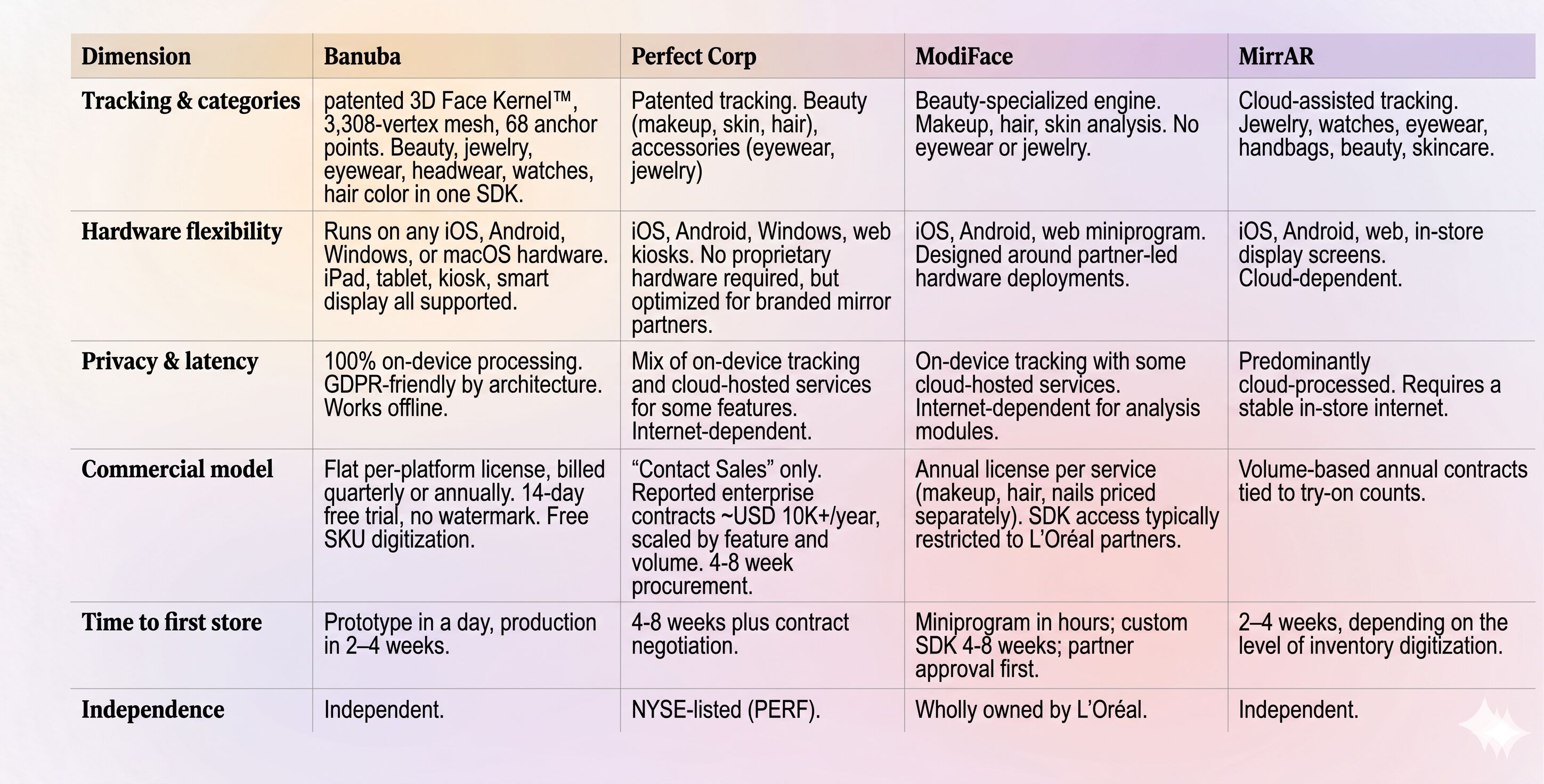
How to Pick the Right AR Mirror SDK
The question isn’t really “which is the best engine.” It’s “which engine survives contact with my actual store environment.” Four practical filters narrow the choice fast:
- Are you running more than one product category? If the mirror needs to handle both beauty and jewelry, or both eyewear and accessories, ModiFace is off the table. Banuba, Perfect Corp, and MirrAR carry multiple categories in a single SDK.
- Is your roadmap aligned with L’Oréal? If yes, ModiFace is on the table. If no, take it off the table. The structural risk of building a multi-year retail asset on a competitor’s SDK isn’t worth the rendering quality.
- Does the store always have reliable internet? If yes, cloud-bound options work. If you’ve ever lost a sale because the store's WiFi went down during a busy Saturday, only on-device processing is safe. Banuba is the only option in this list that runs the full pipeline locally.
- How fast does this need to ship? If the answer is “before the end of the quarter,” Perfect Corp’s 4 to 8-week procurement window is a problem. Banuba and MirrAR can stand up a pilot in 2 to 4 weeks; ModiFace timing depends on partnership status.
For most multi-category retail rollouts, especially ones that need to work across mixed hardware and survive a flaky internet connection, Banuba’s AR mirror software is the most defensible choice. It’s independent of any parent retailer, runs entirely on-device, covers six product categories in one SDK, and prices on a flat per-platform basis that doesn’t penalize scale. Start the 14-day trial today to see if it matches your company's expectations of mirror AR solutions.
References
Banuba. (n.d.-a). AR mirror software. Retrieved May 4, 2026, from https://www.banuba.com/ar-mirror
Banuba. (n.d.-b). Face AR technology. Retrieved May 4, 2026, from https://www.banuba.com/technology/
Banuba. (n.d.-c). Face tracking software. Retrieved May 4, 2026, from https://www.banuba.com/technology/face-tracking-software
Banuba. (2025, February 5). Over 600% of average add-to-cart rate for a Brazilian beauty brand. https://www.banuba.com/blog/oceane-success-story
BrandXR. (2025, September 16). Research report: How beauty brands are using AR mirrors to increase sales. https://www.brandxr.io/research-report-how-beauty-brands-are-using-ar-mirrors-to-increase-sales
Grand View Research. (2025). Virtual mirror market size and share | Industry report, 2030. https://www.grandviewresearch.com/industry-analysis/virtual-mirror-market
MirrAR. (n.d.). Virtual try-on | AR solutions | AR software. Retrieved May 4, 2026, from https://mirrar.com/
Mordor Intelligence. (2026, February). Smart mirror market: Size, share & forecast. https://www.mordorintelligence.com/industry-reports/smart-mirror-market
SQ Magazine. (2025, September 2). Augmented reality statistics 2025: Eye-opening AR market insights. https://sqmagazine.co.uk/augmented-reality-statistics/
-
Three things matter more than feature checklists. First, the tracking architecture: a 3D mesh approach holds up better than 2D landmark tracking when shoppers move at varied distances and angles in front of a store mirror. Second, on-device vs. cloud processing: on-device keeps the experience smooth even when in-store WiFi drops, and removes the GDPR exposure that comes with sending biometric video to a server. Third, category breadth: a mirror that only handles beauty becomes a single-counter asset, while a mirror that handles jewelry, eyewear, and headwear pays for itself across multiple departments.
-
Three models dominate. Flat per-platform licensing charges a predictable annual or quarterly fee per platform, regardless of how many shoppers interact with the mirror. Try-on volume contracts scale the bill based on usage, which is friendly at the pilot stage but expensive at scale. Enterprise “Contact Sales” contracts offer custom scope and pricing, typically starting in the five-figure range, with multi-quarter procurement timelines. Flat per-platform protects margins at scale; volume models protect upfront investment; enterprise contracts protect feature breadth at the cost of speed.
-
The strongest option for scaling is one that decouples cost from store count and try-on volume, runs on commodity hardware, and processes everything on-device. Banuba checks all three. The flat-fee license stays predictable as the rollout grows, the SDK runs on any iPad or touchscreen the integrator can source, and the on-device architecture keeps each store independent of a centralized cloud service. That last point matters when a regional internet outage would otherwise take down 50 stores at once.
-
Some can. Banuba processes everything on-device, so the mirror keeps working during internet outages and never sends biometric data off-screen. On-device processing is also a matter of privacy and security: no user data leaves the devices, meaning you are all covered under GDPR.
-
Timelines depend mostly on procurement, not engineering. With Banuba, a working pilot can stand up in 2 to 4 weeks once the SKUs are digitized. The new collection digitalization process takes up to 48 hours max to ensure quick SKU updates for businesses.
