

Cosmetics are a category where the buyer cannot judge the product on screen. Shade, finish, and how a color reads against a person's own skin all decide the purchase, and a flat product photo answers none of it. That gap is what a face makeup SDK closes. The money behind it is real: the virtual makeup try-on beauty tech market is growing at a 20% CAGR through 2030, per Grand View Research. Zoom out to beauty tech overall, and the augmented reality segment is forecast to grow at a 19.9% CAGR through 2030.
For the team doing the build, the question is narrower than the market hype suggests. A generic face filter can paint a lip red. A makeup SDK has to make matte read as matte, gloss catch light, and a foundation sit correctly on deep and fair skin alike, then keep all of that stable while the head moves. Get the rendering wrong, and shoppers stop trusting the tool, which defeats the point.
This comparison focuses on two providers with a proven track record in cosmetics. We test what separates a makeup SDK from a face filter, then weigh the practical factors that decide an integration: how fast a catalog goes live, where the work runs, and what the bill looks like as usage grows.
[navigation]
A makeup SDK lets a team add virtual cosmetics try-on to a store, app, or in-store screen without building face tracking and shade rendering from scratch. Two names show up on most beauty-tech shortlists in 2026: Banuba TINT and Perfect Corp. Banuba Makeup SDK is the stronger fit when realistic per-texture rendering, fast free catalog digitization, and predictable pricing decide the project. Perfect Corp earns a place when AI skin diagnostics lead the journey, and a cloud platform suits the stack.
TL;DR
- This guide compares two makeup SDK options that product and engineering teams weigh for cosmetics try-on: Banuba and Perfect Corp.
- We judge each on texture realism, catalog onboarding, platform reach, AI recommendations, deployment, and how pricing behaves at scale.
- Banuba virtual try-on suits cosmetics brands that need lifelike makeup across every category and a catalog live in under a day.
- Perfect Corp suits enterprise brands building around skin and hair analysis that accept cloud calls and a longer rollout.
- TINT ships three ways to go live: a CMS plugin, a custom integration, and a no-code platform, so the same engine fits a small store or a global retailer.
How we evaluated them: the makeup-fidelity rubric
Generic AR scoring misses what matters for cosmetics. So we scored both products against five checks that separate a real makeup SDK from a face filter. We call it the makeup-fidelity rubric.
- Texture truth. Does matte, satin, and glossy each render as a distinct finish, not one shiny overlay?
- Edge precision. Do lip lines, lashes, and brows track cleanly, with no smear when the head turns?
- Skin-tone honesty. Does a shade read correctly across the full range of skin tones, not just mid-range?
- Layering. Can a user stack several products at once and still hold frame rate?
- Catalog readiness. How fast can a real SKU become a digitized, on-shade try-on item?
Alongside the rubric, we checked the usual engineering criteria: platform coverage, interface language, license terms, deployment model, and pricing. The rubric tells you whether the try-on looks believable. The engineering criteria tell you whether you can ship and afford it.

Banuba Virtual Try-On
Banuba's Makeup SDK is a commerce-ready solution built on the company's Face AR engine. It supports multiple makeup types: lipstick/lip gloss, eyeshadow, foundation, mascara, eyebrow pencils and more.
Texture truth. Banuba digitizes the nuances that decide realism, including coverage and pigmentation, so a virtual cosmetic interacts with skin the way the physical product would. Finishes are modeled per category. Lipstick and lip gloss support matte, glossy, and satin. Foundation and blush cover matte and natural. Eyeliner and eyeshadow render matte and satin, and mascara adds lengthening, volume, and natural variants.
Edge precision. TINT runs on Banuba's face tracking software, a 3D mesh that reconstructs up to 3,308 vertices per frame and reads 37 face morphs rather than a flat landmark grid. A patented anti-jitter mechanism runs the algorithms several times per frame to remove visual noise, which is what keeps a lip line or lash from smearing when the user moves. Tracking holds under stress: low light, steep angles, and up to 70% facial occlusion.
Skin-tone honesty. Lighting adaptation and color matching are tuned so a shade reads correctly on any tone. That is not a marketing line in this case. During the Boca Rosa launch, the try-on helped shoppers choose among 50 foundation shades built for Brazilian skin diversity.
Layering. Users can apply up to nine Makeup AR SDK products at once and mix and match in real time, with premade branded looks as a starting point. The on-device engine shifts work between CPU and GPU to maintain performance while several products render together.
Catalog readiness. This is where Banuba pulls ahead for commerce. Digitization is free and fast: a single item takes hours, and an entire collection can be live in under 24 hours, with no physical samples shipped. Besides, retailers get access to a library with 22K+ digital makeup products at the start.
AI recommendations. Banuba adds AI makeup recommendations driven by automated face and seasonal color analysis, plus one-tap purchase from the try-on screen to cut cart abandonment.
Deployment and platforms. Banuba runs on web, mobile, and in-store AR mirror hardware. There are three ways to go live: a beauty CMS plugin that installs in under five minutes, a custom integration handled by Banuba, and a self-service no-code platform that a brand can set up alone. The UI is fully brandable across logos, colors, and fonts. Documentation and a developer community support the integration.
Pricing. Banuba pricing flexes by deployment. The plugin offers several plans set by monthly try-on volume. Custom integrations are priced per store. The no-code platform has three self-serve plans. Cost tracks try-on sessions, supported categories, and billing period, so a small brand starts light and scales on its own terms.
Where it falls short. Banuba Virtual Try-On doesn't support clothing or footwear try-on, so stores focusing on these kinds of goods should choose something else.
Best for. Cosmetics brands and beauty retailers that want lifelike makeup across every category, a catalog live in a day, AI shade guidance, and a deployment model that fits their size.
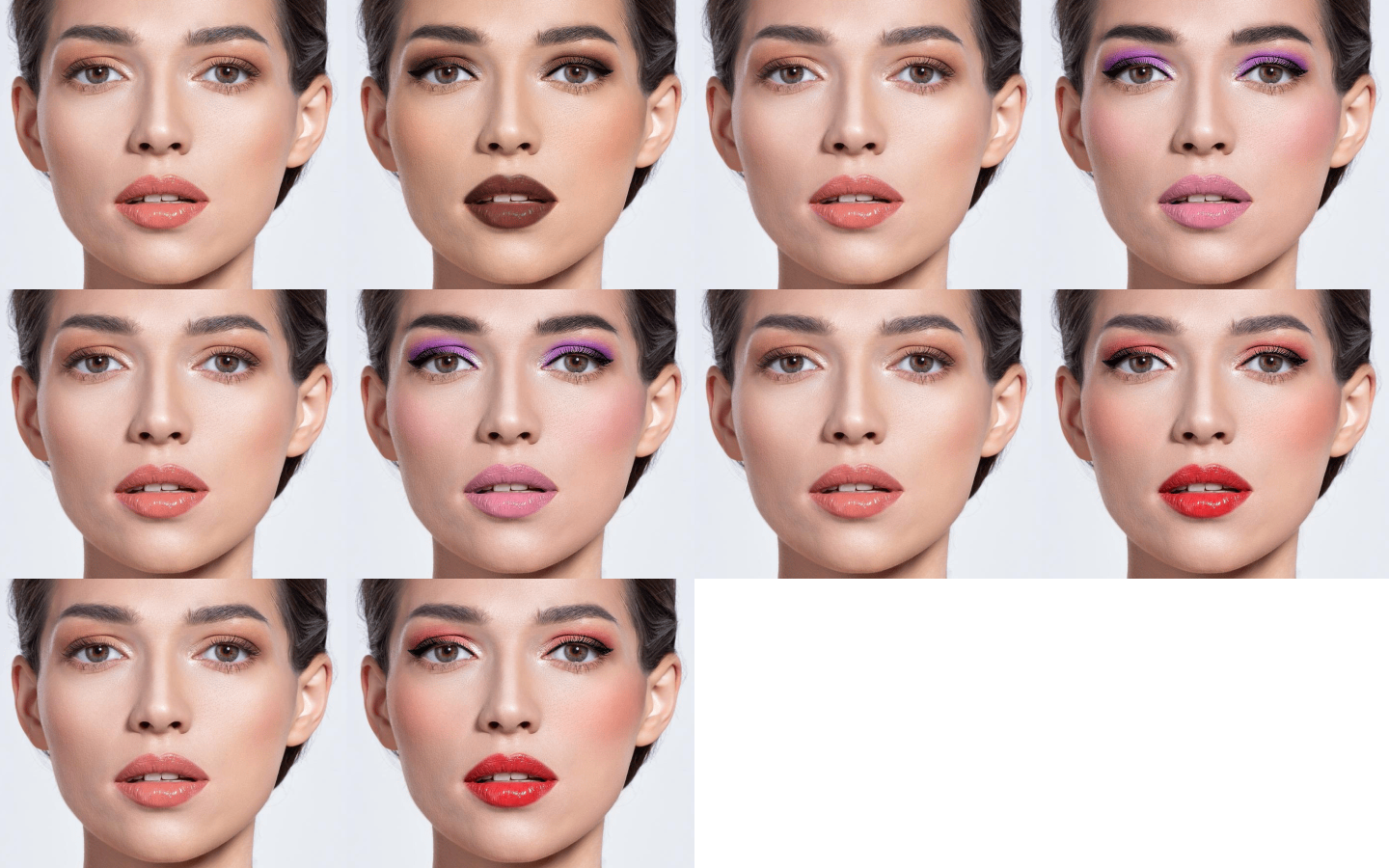 Banuba's TINT in action
Perfect Corp
Perfect Corp is a public beauty-tech company founded in 2015. For developers, it offers a mobile SDK, a web module, and the YouCam API.
Texture and rendering. Perfect Corp's makeup catalog covers lips, eyes, brows, face, and nails, with a foundation shade finder and a 3D multi-tone blush that supports matte, satin, and shimmer finishes. Rendering quality is strong on flagship devices, with lips and eyeshadow among its best categories.
Tracking. The engine runs on Perfect Corp's patented AgileFace technology, built on deep learning and tuned for accurate placement across a wide range of facial attributes and skin tones.
Guidance. This is the company's strongest area. Its AI Skin Diagnostic was trained on more than 70,000 clinical images, verified by dermatologists, and scores several skin metrics, and a conversational YouCam AI Beauty Agent turns try-on into a guided consultation.
Deployment and pricing. The mobile SDK runs natively on iOS and Android, while the YouCam API and web module embed features through cloud calls, with extra integrations for WeChat and TaoBao mini-programs. Plugin plans run on monthly try-on limits, and API or enterprise deployments move to custom terms that are not published, so exact figures require fact-checking.
Where it falls short. Cloud-dependent calls add latency and a privacy review that an on-device flow avoids, and enterprise procurement can run across several quarters.
Best for. Enterprise brands that anchor the experience on skin or hair diagnostics and are comfortable with a cloud platform and a longer sales cycle.

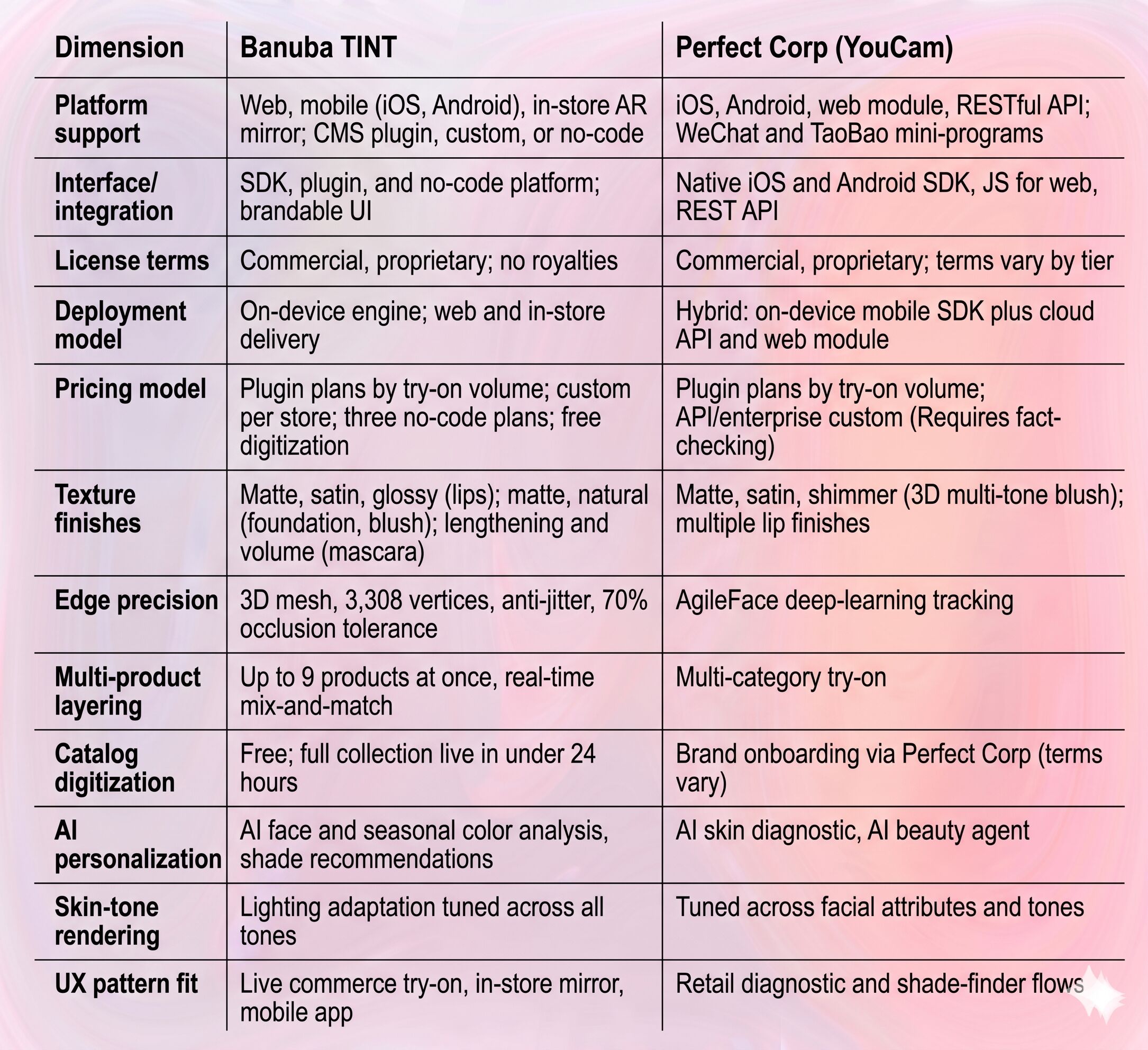
Banuba TINT Makeup SDK vs Perfect Corp: Comparison Table
Conclusion
Run your project through the rubric, then the practical filters.
Pick Banuba TINT when texture truth, catalog readiness, and predictable cost carry the most weight. It fits cosmetics brands and beauty retailers that need lifelike makeup across lips, eyes, face, and brows, want a collection digitized for free inside a day, and expect to scale without a usage bill that climbs with every session. The three deployment routes mean a small store can self-serve while a larger retailer gets a custom build, all on the same engine.
Pick Perfect Corp when the skincare layer is the headline, meaning AI skin diagnostics or a guided consultation defines the product. Its diagnostic depth and enterprise brand network are hard to match, with the trade-off being cloud dependence and a longer rollout.
A few factors tip it. Teams racing a seasonal launch favor the vendor that digitizes a catalog in hours, not weeks. Privacy-sensitive brands, especially in the EU, prefer an on-device engine that keeps camera frames local. Brands budgeting for a viral moment weigh predictable, volume-based pricing against costs that rise with each new user.
References
Banuba. (n.d.). Makeup software virtual try-on (TINT). Retrieved June 3, 2026, from https://www.banuba.com/tint-makeup-virtual-try-on
Banuba. (n.d.). AR makeup SDK. Retrieved June 3, 2026, from https://www.banuba.com/makeup-ar
Banuba. (n.d.). Face tracking software. Retrieved June 3, 2026, from https://www.banuba.com/technology/face-tracking-software
Banuba. (2025). Virtual try-on by Banuba helps beauty brand earn $900,000 in 4 hours. https://www.banuba.com/blog/virtual-try-on-helps-beauty-brand-earn-900.000-in-4-hours
BusinessWire. (2025, November 10). Perfect Corp. launches YouCam AI Beauty Agent in YouCam Makeup app. https://www.businesswire.com/news/home/20251110601035/en/Perfect-Corp.-Launches-YouCam-AI-Beauty-Agent-in-YouCam-Makeup-App-to-Lead-the-Next-Generation-of-Conversational-AI-in-Beauty-Skincare-and-Fashion
BusinessWire. (2026, May 13). Perfect Corp. integrates free AI assistant "Ask AI" into YouCam API platform. https://www.businesswire.com/news/home/20260513560473/en/Perfect-Corp.-Integrates-Free-AI-Assistant-Ask-AI-into-YouCam-API-Platform
Grand View Research. (2025). Beauty tech market size and share, industry report, 2030. https://www.grandviewresearch.com/industry-analysis/beauty-tech-market-report
Grand View Research. (2024). Virtual makeup try-on, beauty tech market statistics. https://www.grandviewresearch.com/horizon/statistics/beauty-tech-market/cosmetics/virtual-makeup-try-on/global
-
When you compare any face makeup SDK, start with rendering realism per texture, then catalog onboarding. Confirm that matte, satin, and gloss render as distinct finishes and that shades read correctly across skin tones. Then ask how fast a real SKU becomes a try-on item, since a slow digitization pipeline stalls every launch.
-
Most vendors price by monthly try-on volume, supported product categories, and billing period, with plugins on fixed plans and custom or enterprise integrations on tailored terms. Watch whether digitization is billed separately, and whether the cost rises with active users or stays predictable as you scale.
-
For a large, fast-changing cosmetics catalog, the deciding factors are digitization speed and pricing that does not punish growth. A makeup AR SDK, like Banuba, with free, sub-day digitization and volume-based plans tends to scale more cleanly.
