

The virtual try-on category is not a nice-to-have line item on a marketing roadmap. According to The Business Research Company, the global virtual try-on technology market reached $12.09 billion in 2025 and is projected to hit $15.29 billion in 2026, growing at a 26.5% CAGR. Beauty brands using AR see up to 90% higher conversion rates and a 64% reduction in product returns. Snapchat research indicates that 93% of Gen Z consumers want to use AR for shopping, with 88% specifically requesting virtual makeup try-on experiences.
Yet the technical reality on the ground is messy. Engineering leads keep running into the same three problems:
- Cloud-only providers add latency that breaks the live-camera feel of a try-on session.
- MAU-based pricing turns a viral campaign into a budget overrun.
- Closed ecosystems lock SDK access behind enterprise contracts that take months to negotiate.
Most apps that need a makeup SDK fall into one of four buckets: ecommerce product pages with live try-on, mobile beauty apps with shade finders and tutorials, social and creator platforms with AR makeup filters, and in-store smart mirrors at retail counters. Each has a different latency tolerance and a different platform mix, which is why a single "best" SDK rarely exists in the abstract. The right answer depends on what you're building.
This piece compares four SDKs that consistently appear on shortlists for beauty-tech projects in 2026.
[navigation]
A makeup SDK lets developers add a virtual try-on layer onto any beauty app, ecommerce site, or in-store kiosk without writing a face-tracking engine from scratch. In 2026, the four serious options are Banuba (TINT and Face AR SDK), Perfect Corp (YouCam), ModiFace (L'Oréal), and GlamAR. Banuba is the strongest pick for teams that want a developer-first face makeup SDK with predictable licensing, on-device processing, and built-in AI-driven seasonal color analysis.
TL;DR
- This guide is written for senior engineers, product managers, and beauty-tech founders deciding which makeup SDK to ship in 2026.
- We compare four production-grade options: Banuba, Perfect Corp (YouCam), ModiFace (L'Oréal), and GlamAR.
- Perfect Corp suits enterprise retailers with a multi-quarter procurement cycle, ModiFace fits brands inside the L'Oréal partner ecosystem, and GlamAR works for SMBs that want a fast, modular SaaS rollout.
- The biggest decision points: independence from a parent company's roadmap, pricing model (flat fee vs. tiered SaaS vs. enterprise contract), and the depth of the face makeup SDK stack on mid-range Android devices.
- Banuba wins for teams that need a full-featured makeup AR SDK with on-device tracking, flat-fee licensing, and a 2-week rollout window.
How We Evaluated Each Makeup SDK
To keep the comparison grounded in what actually breaks during a build, we evaluated each option against seven criteria. These were chosen to surface tradeoffs that matter once a feature is live in production.
1. Tracking architecture and rendering depth. Whether the SDK uses a 2D landmark approach or a full 3D face mesh, how many vertices it reconstructs, and how realistic gloss, shimmer, matte, and satin finishes look across skin tones.
2. Platform reach. Native iOS and Android support, Web (WebAssembly or WebGL), Unity, and the quality of first-party React Native and Flutter wrappers. Community plugins are flagged separately because they shift maintenance risk to your team.
3. AI personalization layer. Beyond placing virtual lipstick, does the SDK include shade matching, skin tone analysis, seasonal color analysis, or product recommendations? This is increasingly the difference between a try-on widget and a beauty advisor.
4. Time to first integration. How long does it take to get a functional camera-and-lipstick demo running, including SDK download, asset onboarding, and first product digitization?
5. Independence and roadmap risk. Whether the SDK is owned by a competing brand or a parent retailer that may shape the roadmap around its own commercial interests.
6. Pricing transparency. Flat per-platform licensing, MAU-based tiers, or hybrid SaaS. We also looked at what the trial offers and whether the digitization of new SKUs is billed separately.
7. Documentation and developer support. Quality of guides, sample projects on GitHub, response time of technical support, and the activity of the developer community around the SDK.
Banuba's makeup virtual try-on example
Banuba: Makeup AR SDK and TINT Virtual Try-On
Overview
Banuba builds a Face Makeup SDK that runs entirely on-device. Its flagship beauty product, TINT, sits on top of Banuba's broader Face AR SDK and adds an AI seasonal color analysis layer, an AI-based recommendation engine, and a free cosmetics digitization service for clients. The company has been independent since 2016 and serves companies across cosmetics, social, video conferencing, and fashion. Notable beauty deployments include Oceane (Brazil), metaKosmos, Looké Cosmetics, and Boca Rosa Beauty.
Architecture and rendering depth
Banuba's tracking is built on a proprietary 3D face mesh that reconstructs up to 3,308 vertices per frame. Instead of tracking dozens of 2D landmarks and inferring depth, the engine recognizes 37 face parameters as morphs and uses 68 facial anchor points for stability. The result is sub-pixel placement accuracy that holds even when a user turns their head 90 degrees or covers up to 70% of the face.
For makeup specifically, this depth matters because gloss, shimmer, and matte finishes need to react to head tilt and lighting in real time. TINT renders foundation, concealer, lipstick, lip gloss, lip liner, blush, eyeshadow, eyeliner, mascara, eyebrow products, contour, and highlighter. Users can mix and match products to create a complete look without sacrificing performance.
What's in the makeup SDK
- AI seasonal color analysis that determines a user's color profile (warm, cool, neutral subtypes) and recommends matching shades.
- AI Beauty Advisor that suggests products based on facial features, occasion, and skin tone.
- Skin care effect that visualizes short- and long-term results of skincare products that are otherwise invisible on camera.
- Hair color try-on that allows experimenting with styles and hair colors without commitment.
- Multi-product try-on with up to nine products simultaneously, ideal for selling complete looks.
- Free cosmetics digitization for client SKUs, typically completed in 48 hours per collection.
- Lighting simulation that accounts for product coverage and finish so a matte lipstick reads matte and a glossy one catches light.
Platform reach
The SDK supports iOS 13.0+, Android 8.0+ (including Flutter & React Native apps), Web (WebAssembly), Unity, Windows, and macOS. Banuba ships first-party wrappers for React Native and Flutter, which means cross-platform teams aren't betting on community plugins. The company also offers a Web AR module that integrates onto any store webpage with a few lines of JavaScript, plus native plugins for Shopify and Tiendanube (Nuvemshop), and custom integration for other CMSs.
According to internal benchmarks, Banuba's Face Makeup SDK runs on roughly 97% of iOS devices and 80% of Android devices, including mid-range phones that typically choke on heavier engines.
Time to integration
For Shopify & Tiendanube (Nuvemshop), the TINT plugin can be installed in under 5 minutes. A custom integration using the full SDK takes about two weeks on average, including digitizing the stock.
Pricing
TINT plugins have pricing tiers that differ in the number of try-on session per month. Custom integration cost depends on the client's situation and is tailored to match it.
Real-world results
- Oceane, a Brazilian beauty brand, grew its add-to-cart rate from a 3% industry average to 32% after deploying TINT on concealers and foundations. Stock sold out faster than the company could manufacture replacements.
- Boca Rosa Beauty, an influencer-led cosmetics line, generated $900,000 in sales in 4 hours during a single product launch with Banuba's Makeup AR SDK.
- TINT is reported to drive up to 200% higher online conversions, 30% higher average order value, and over 300% higher engagement on adopter sites.
Where Banuba fits
Choose Banuba if you want a single technical partner with patented technologies that handles tracking, rendering, AI personalization, and digitization, and if you need that partner to be independent of any beauty conglomerate. The flat-fee pricing makes it a strong fit for teams that expect rapid scale, and the React Native and Flutter wrappers reduce native-bridge maintenance.
Where Banuba may not fit
If you only need a one-off AR campaign for a single landing page and have a $50/month budget ceiling, the commercial license is overkill. Hobbyists and zero-budget MVPs are better served by a free open-source library, even with the engineering overhead.

Perfect Corp (YouCam)
Overview
Perfect Corp is the enterprise-friendly solution in the first place. It serves global brands and has many international partners.
Architecture and rendering depth
Rendering quality is high on flagship devices, especially for lipstick and eyeshadow categories. The Skin Diagnostic module was trained on over 70,000 clinical images and verified by dermatologists.
What's in the makeup SDK
- Virtual makeup try-on for lips, eyes, face, brows, and nails.
- AI Foundation Shade Finder with skin-tone matching.
- AI Skin Diagnostic that scores 8 skin metrics, including moisture, wrinkles, and dark circles.
- Hair color try-on and Smart Beauty Recommendations.
- Generative AI APIs released in December 2024 for hairstyle try-on, AI makeup transfer, and age-progression.
- YouCam AI Beauty Agent (launched November 2025), a conversational layer that turns try-on into a guided beauty consultation.
Platform reach
The Mobile SDK supports iOS and Android natively, with a Web Module, RESTful API, and integrations for WeChat and TaoBao mini-programs. React Native and Flutter are typically accessed via manual bridges or REST API calls rather than through first-party wrappers.
Time for integration
Setup tends to be slower than developer-first SDKs because access requires going through enterprise sales. Time-to-prototype usually runs from 4 to 8 weeks once contracts close, and contracts themselves often add another 2 to 6 weeks of negotiation, depending on retail tier.
Pricing
Perfect Corp uses a "Contact Sales" model. Custom enterprise licensing typically starts around $10,000+ annually per a third-party 2026 review on Gitnux, scaled by usage and feature mix. The company introduced a pay-as-you-go API model at CES 2026 for select use cases, but enterprise SDK pricing remains opaque.
Where Perfect Corp fits
If you're a global retailer with a procurement team and a multi-year roadmap, Perfect Corp is a defensible choice.
Where Perfect Corp may not fit
Smaller teams, agile startups, and any project that needs to ship in under a quarter typically struggle with the procurement overhead. Independent beauty brands competing with global brands may also feel uneasy sharing roadmap dependencies with a vendor that already serves their direct competitors.
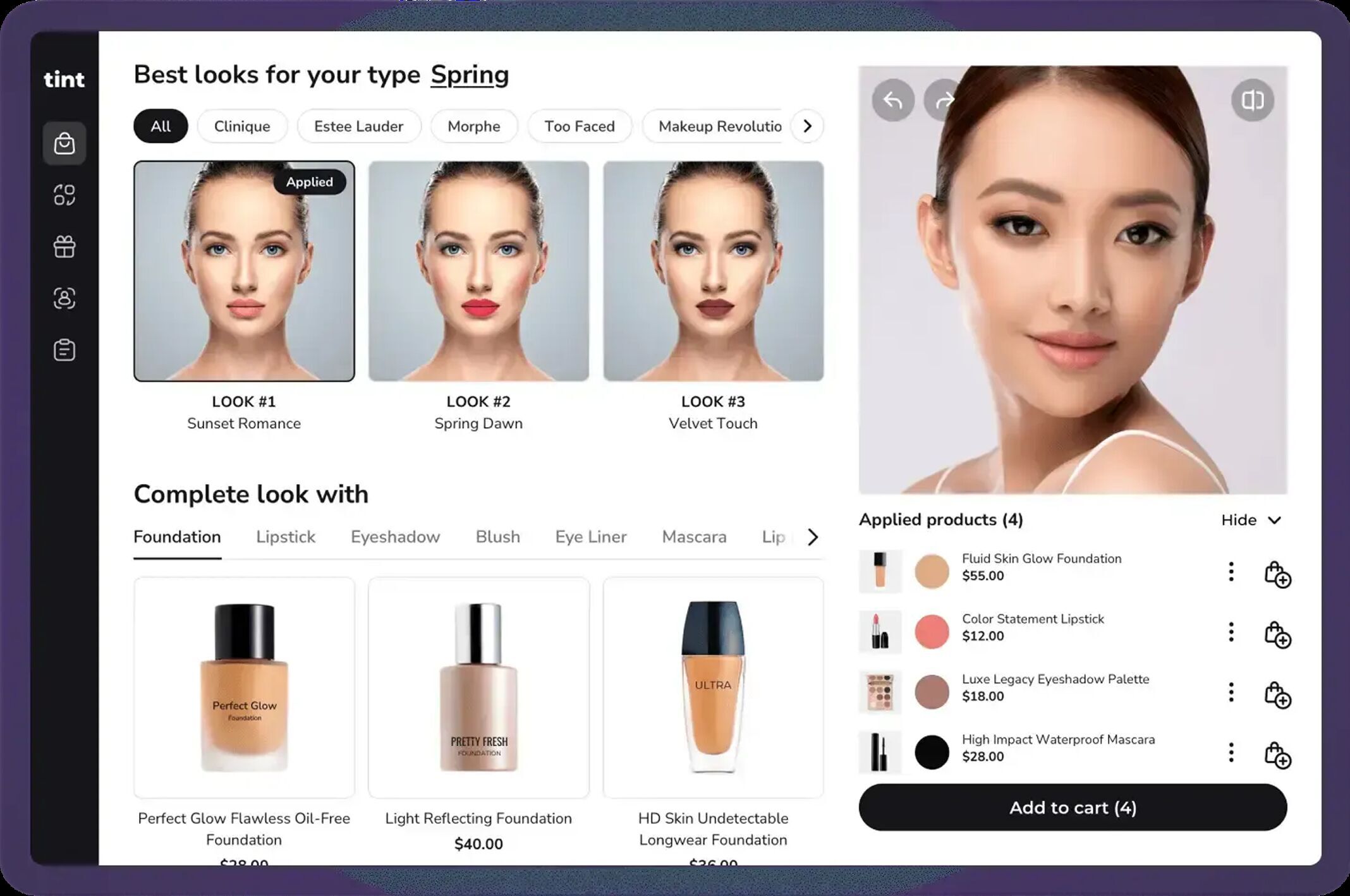 Example of Banuba's virtual-try plugin for e-commerce
ModiFace
Overview
ModiFace has been in beauty AR since 2007 and was acquired by L'Oréal in 2018. It powers AR makeup, hair color, and skin analysis for L'Oréal's portfolio of 36 brands plus partner integrations on Amazon, Instagram, Google Search, and Sephora.
Architecture and rendering depth
ModiFace built its hair, face, and nail tracking entirely in-house and was the first to ship real-time AR try-on on the web. The makeup engine is optimized specifically for beauty products, which means it skips general-purpose AR overhead.
What's in the makeup SDK
- Virtual try-on for lip, eye, cheek, face, and brow products.
- Hair Virtual Try-On with realistic color and texture rendering.
- Skin Analysis trained on 10,000+ images, identifying 20 clinical signs and 15 concerns.
- Live Scan, a feature that extracts makeup from a photo and matches it to ModiFace's catalog.
- Foundation Finder and Tutorials with animated step-by-step makeup guides.
Platform reach
ModiFace ships an embeddable miniprogram (two lines of code) and a customizable SDK for native iOS and Android. The miniprogram supports the most common web deployments. React Native and Flutter are not officially supported with first-party wrappers; teams typically integrate via web views or REST APIs.
Time for integration
The miniprogram is the fastest path: most brand pages can go live in a single afternoon if products are already digitized in ModiFace's Firecamp CMS. Custom SDK integrations typically run 4 to 8 weeks. SKU shade validation can be done in-house or through ModiFace's beauty experts at a per-SKU price.
Pricing
ModiFace uses an annual license per service (Makeup, Hair, Nails are each priced separately). Skin and face analysis is priced based on usage. SKU setup is free in the CMS, with optional premium shade validation. Specific pricing is gated behind a sales conversation.
Roadmap risk
The biggest tradeoff is structural. ModiFace is a wholly-owned L'Oréal subsidiary. SDK access is typically limited to brand partners or enterprise clients, and direct competitors of L'Oréal brands may face friction during the partnership conversation. Roadmap priorities track L'Oréal's commercial strategy, which works for L'Oréal-aligned brands and works against everyone else.
Where ModiFace fits
If your brand is part of the L'Oréal ecosystem, or if you're a major retailer aligned with L'Oréal's roadmap.
Where ModiFace may not fit
Independent indie beauty brands, direct L'Oréal competitors, and developer-led teams that want neutrality on the roadmap will be better served elsewhere. Teams building in React Native or Flutter without REST-API tolerance will also hit friction.
GlamAR
Overview
GlamAR is a B2B SaaS platform from PixelBin focused on virtual try-on across multiple categories, including makeup, eyewear, jewelry, hair, and accessories. The product positions itself for ecommerce brands seeking a quick rollout without heavy SDK integration.
Architecture and rendering depth
GlamAR uses face landmark detection plus 3D rendering for makeup overlays, with adjustable opacity for shade intensity and supported finishes including matte, satin, glossy, and shimmer. Tracking quality is solid on flagship devices, and the modular UI lets brands match the SDK's chrome to their visual identity. Rendering depth is lighter than Banuba's 3,308-vertex mesh, which becomes apparent at extreme angles and with complex finishes.
What's in the makeup SDK
- Real-time virtual makeup for lipstick, eyeshadow, eyeliner, blush, foundation, mascara, brows, and nail polish.
- AI facial skin analysis covering 14+ skin conditions like hydration, texture, and acne.
- AI shade recommendations based on skin tone analysis.
- 3D model rendering for adjacent categories (eyewear, jewelry).
- Interactive AR ads for marketing campaigns.
Platform reach
GlamAR supports Web, Android, iOS, React Native, Flutter, Webflow, and Shopify. The Android SDK is published on Maven Central. Web embeds are possible without an app download. Cross-platform support is broad on paper, though the depth of each wrapper varies.
Time for integration
Onboarding usually takes 2 to 4 weeks, depending on which modules are selected and whether 3D assets are ready. The SDK itself can be added in a few hours for basic try-on, with longer timelines if shade libraries need to be built from scratch.
Pricing
GlamAR offers modular plans starting at SMB tiers and scaling to enterprise. Pricing is published in tiers on the website rather than fully gated, which makes it easier for smaller teams to budget. Specific dollar figures are still requested through the sales contact.
Where GlamAR fits
The modular approach works well for marketing agencies that want to add AR ads to a campaign without building an app.
Where GlamAR may not fit
If you need on-device performance on three-year-old Android phones, advanced AI like seasonal color analysis, or a 3D mesh deep enough to handle complex makeup finishes under sharp lighting, the heavier engine from Banuba will outperform here.

Side-by-side Comparison
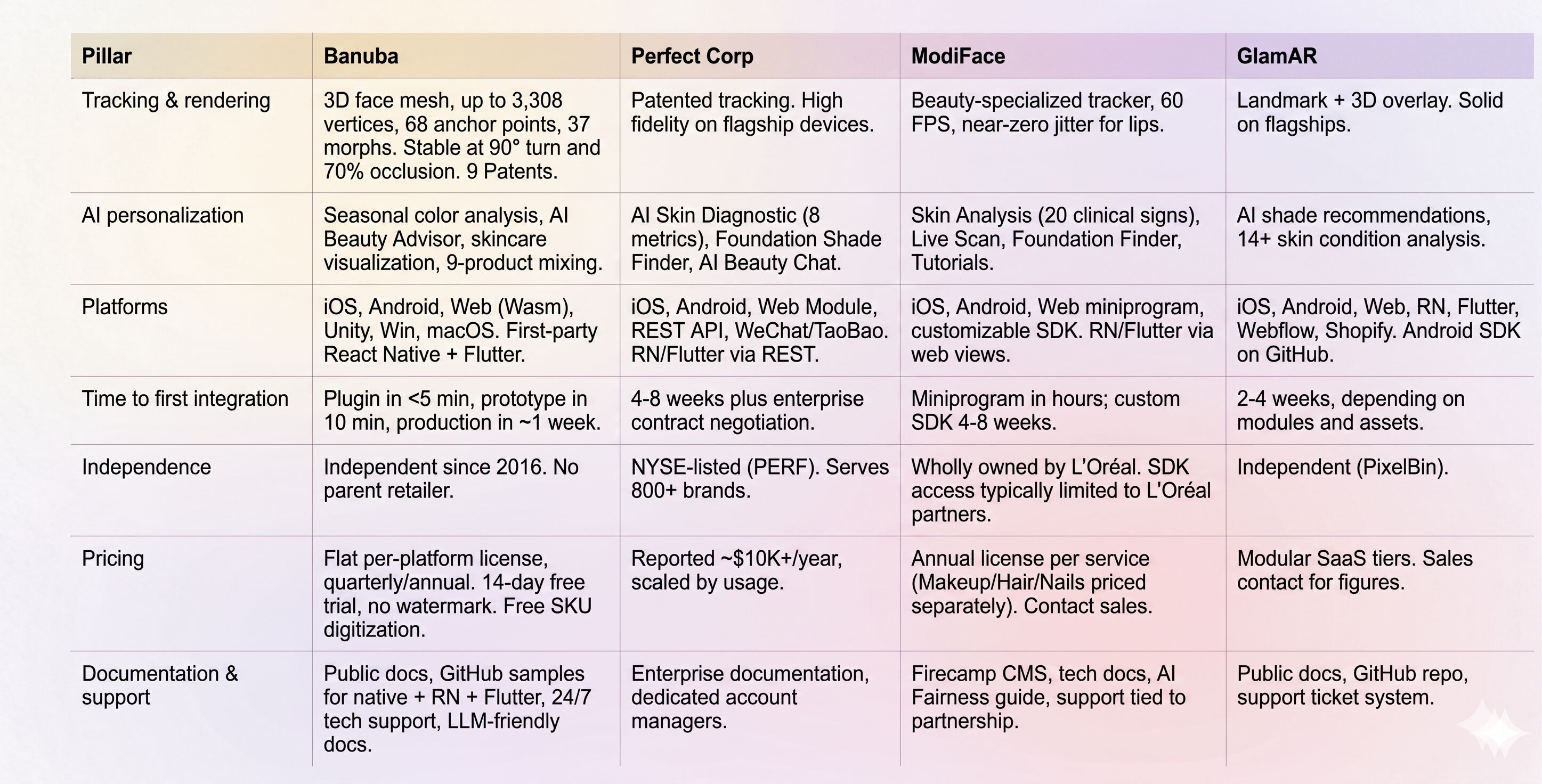
The table below condenses the seven evaluation pillars into a scannable view. We've grouped tracking and rendering together because they're inseparable in practice, and we've broken pricing out into a dedicated row because it's where most projects break.
How to Pick the Right Makeup SDK for Your Project
The decision usually comes down to four questions:
- Is your roadmap aligned with a parent retailer (L'Oréal in particular)? If yes, ModiFace is on the table. If no, take it off the table.
- Do you need cross-platform parity in React Native or Flutter? If yes, Banuba is the only option with first-party wrappers.
- Is your pricing constraint "predictable cost" or "lowest entry point"? Banuba and Perfect Corp offer predictable per-platform or per-contract pricing; GlamAR has the lowest entry point.
- Do you need on-device processing for privacy or latency reasons? Banuba runs everything on-device; Perfect Corp and ModiFace mix on-device tracking with cloud-hosted services for some features.
The four options above don't compete head-to-head on every dimension. They live in different parts of the market.
For teams shipping a full beauty app or in-app try-on feature, Banuba's face makeup SDK gives you the deepest technical surface (3D mesh, on-device processing, RN and Flutter wrappers) without forcing a vendor lock-in to a specific beauty conglomerate. The flat-fee pricing also protects you if a launch goes viral.
For Fortune 500 retailers and L'Oréal-aligned brands, Perfect Corp and ModiFace both deliver enterprise-grade infrastructure with deep retail integrations. Pick Perfect Corp if you value brand neutrality and the AI Beauty Agent ecosystem; pick ModiFace if you're inside L'Oréal's orbit or want the absolute best lip-color rendering on the market.
For Shopify or WooCommerce stores that want virtual try-on live by next quarter, GlamAR's modular SaaS tier gets you to a working widget faster than a custom SDK build, especially if you only need 1 or 2 product categories.
For mid-market ecommerce brands that want both speed and depth, Banuba's TINT plugin lands in the middle of the spectrum: a pre-built virtual try-on widget with native Shopify and Tiendanube plugins and custom integration for other CMSs, plus the option to drop down into the full Face AR SDK when you outgrow the plugin.
Get your 14-day trial of Banuba’s Face Makeup SDK and test virtual try-on in your environment with no commitment.
References
Banuba. (n.d.). Face tracking software. Retrieved May 1, 2026, from https://www.banuba.com/technology/face-tracking-software
Banuba. (n.d.). Tint — Makeup virtual try-on. Retrieved May 1, 2026, from https://www.banuba.com/tint-makeup-virtual-try-on
Banuba. (2025, February 5). Over 600% of average add-to-cart rate for a Brazilian beauty brand. https://www.banuba.com/blog/oceane-success-story
BMfitt. (2026, February 19). AR & AI virtual makeup try-on: 20 platforms accuracy comparison 2026. https://www.bmfitt.com/reports/ar-ai-virtual-makeup-try-on/
Business Wire. (2023, January 19). Banuba Tint, a virtual try-on for cosmetics, improves seasonal color analysis. https://www.businesswire.com/news/home/20230119005565/en/Banuba-Tint-a-Virtual-Try-On-for-Cosmetics-Improves-Seasonal-Color-Analysis
GlamAR. (n.d.). Makeup AR SDK — AI virtual beauty AR API solution for ecommerce. Retrieved May 1, 2026, from https://www.glamar.io/solutions/makeup-ar-sdk
GlamAR. (n.d.). Pricing. Retrieved May 1, 2026, from https://www.glamar.io/pricing
ModiFace. (n.d.). Pricing. Retrieved May 1, 2026, from https://modiface.com/our-pricing.html
The Business Research Company. (2026). Virtual try-on technology global market report 2026. https://www.thebusinessresearchcompany.com/report/virtual-try-on-technology-global-market-report
-
Start with three things. First, tracking architecture: a 3D face mesh with sub-pixel accuracy will outperform a 2D landmark approach on complex finishes (gloss, shimmer) and at extreme angles. Second, on-device vs. cloud: on-device processing keeps latency under 16 ms per frame, which is the threshold for "feels live." Third, platform parity: if your team uses React Native or Flutter, the difference between first-party wrappers and community plugins is the difference between shipping in 2 weeks and shipping in 2 months. Bonus consideration: SKU digitization speed and pricing, because a try-on widget without products is just a face filter.
-
There are four common models. Flat per-platform licenses charge a predictable annual or quarterly fee per platform, regardless of MAU. Enterprise contracts are negotiated annually with custom scopes and typically start in the five-figure range. Tiered SaaS offers monthly plans scaled by feature module and product count. MAU-based models start cheap but scale linearly with growth. The right model depends on your growth curve: if you expect rapid scale, flat licensing protects margins; if you're testing a campaign, tiered SaaS reduces upfront commitment.
-
Banuba is the strongest option for production-scale apps that need to grow without renegotiating contracts. The flat-fee per-platform license decouples cost from user growth, on-device processing keeps server costs at zero, and first-party React Native and Flutter wrappers reduce the maintenance overhead of cross-platform builds.
