

Banuba builds one of the SDKs compared here, so here is the honest framing: the right vendor depends on whether you want the effects to live in your product or in a platform's. That stopped being theoretical in January 2025, when third-party effects built for Meta's platform were switched off, and the brands that had invested in them lost the work. Owning the camera layer inside your own app is what the Banuba Face AR SDK is built for.
[navigation]
TL;DR:
- Meta shut down its platform for third-party AR tools and content on 14 January 2025. Effects built by brands and outside creators stopped being available, while Meta's own effects stayed live.
- The structural lesson: an effect authored in a platform's studio runs in that platform's app, so it is rented reach, not an owned asset.
- Banuba Face AR SDK builds its face model by direct 3D reconstruction rather than converting 2D landmarks, which is what keeps it stable under motion and occlusion. It tracks 68 facial anchor points and a 3D face mesh of up to 3,308 vertices.
- Banuba's tracking holds across the full -90° to +90° head-angle range, through up to 70% facial occlusion, at up to 7 meters from the camera, and in low light.
- Interaction, not decoration, is the design lever. Banuba's expression triggers (mouth open, smile, eyebrows, eyes open/close) plus hand tracking and gesture recognition turn a filter into a mechanic and are the building blocks of a touchless UI.
- Product-launch teasers run on Banuba's frame effects and 3D masks. Gen Z UGC runs on Banuba's beautification, makeup and hair-color try-on, avatars and game filters.
- Live shopping needs Banuba's makeup try-on, beautification, and neural-network virtual backgrounds together, and Banuba ships a native Agora integration for the streaming layer.
- Snap Camera Kit is the best route if you want Snapchat's Lens creator ecosystem and the Lens Studio content pipeline. DeepAR is the best route for zero-cost prototyping, via a free dev and testing license with a watermark.
- Banuba Face AR SDK covers HTML5, iOS, Android, Windows, macOS, Unity, Flutter and React Native, reaching 97% of Apple smartphones and 80% of Android ones from one integration, at 30+ FPS on mid-range mobile devices.
- Banuba processes video on-device and works offline just as well as online. The trial is 14 days with full SDK access and no watermarks.
What are social media AR effects, and which types actually exist?
Social media AR effects are camera effects driven by real-time face, hand, and background tracking, applied to live video or captured inside a social, creator, or communication app. Banuba's own catalog of social media AR effects spans ten effect families, and knowing what each one does is the fastest way to scope a campaign accurately.
- Makeup: foundation, eyeliner and lipstick try-on.
- Hair color: detects and dyes hair down to single strands.
- Beautification: skin smoothing, blemish removal, teeth whitening, eye-circle and wrinkle removal, expressive eyes.
- Face morphing: real-time structural changes to nose, eyes, lips and chin.
- Triggers: preprogrammed or interactive scenarios launched by mouth opening, smiling, eyebrow movement or eyes opening/closing, and also by hand tracking and gesture recognition.
- Background: background subtraction and virtual backgrounds via a neural network.
- Avatars: animated 3D avatars driven by the user's own expressions, including individual eyebrow tracking, jaw and nose movement, and mouth position.
- Game filters: 3D masks plus facial-expression game controls, with JavaScript scripting so effects fire on mouth open, eyebrow movement, or a screen tap.
- Frame effects: dynamic transforming AR objects that stick to the recognized face, built for shareability.
- LUTs: whole-video color correction, from simple black-and-white and sepia through to stylized schemes.
If you are mapping these against a campaign calendar, this longer breakdown of what each effect family actually does is a useful companion.
What are the best interactive AR effects for brands on social media?
The strongest interactive effects for brands are the ones the user has to do something to activate: triggers, game filters, and avatars. A LUT or a static mask is decoration. A trigger is a mechanic, because the effect only resolves when the person opens their mouth, smiles, raises an eyebrow, or holds up a hand, which gives the recording a beginning and an end.
Triggers are also the building block of a touchless UI, where expressions replace physical controls. With JavaScript scripting in game filters, it supports casual mechanics such as eating virtual objects or steering a character with facial movement. Avatars extend the idea by driving a 3D character with individual eyebrow, jaw, nose, and mouth tracking, which matters when a brand wants participation without asking people to show their face.

Which AR effects work for a product-launch teaser?
For a product-launch teaser, frame effects and 3D masks do most of the work, with a trigger as the reveal. Frame effects are dynamic, transforming AR objects that stick to the recognized face and are built for shareability, which makes them the natural carrier for a product silhouette, a date, or a logo lockup. Pair one with a trigger so the reveal is earned: the mask holds until the user smiles or opens their mouth, then the teaser asset appears.
Custom assets are not a constraint. Effects can be built in any 3D graphical editor and converted to the SDK format with Banuba Studio, so the same design team that makes the campaign can make the effect. A LUT over the whole frame keeps the teaser in the campaign's color grade rather than the phone's.
Banuba's AR effect example
What UGC-friendly AR effects suit a Gen Z audience?
For Gen Z UGC, the reliable set is beautification, makeup and hair-color try-on, avatars, and game filters—effects people use on themselves repeatedly rather than once. The decisive quality detail is restraint. A 1M-MAU SaaS fandom platform for artists, creators, and their audiences scaled to 1 million monthly active users two years after launch on Banuba Face AR, with users in 224 countries, and it chose Banuba specifically for touch-up that looks natural without blurring skin texture, alongside the breadth of ready-made masks and responsive support. Banuba powers its face filters, beauty touch-up, and 3D masks in both live streaming and 1:1 video chat.
Over 1,000 ready-made AR face filters can be licensed from the asset store, which lets a content team rotate effects weekly instead of commissioning every one. A karaoke app follows the same pattern with face filters and beautification on iOS and Android, and makes browsable AR game-face masks unlockable as in-app bonuses, so the effect itself becomes the reward.

What interactive effects work for live shopping streams?
Live shopping streams need three things at once: real-time makeup try-on, beautification, and a controllable background. Makeup try-on carries the commercial payload, beautification keeps the host looking consistent across sessions and lighting, and neural-network background subtraction replaces a real room with a branded set.
Stress conditions separate vendors here: a product held near the face, a microphone in shot, a guest in bad lighting. Banuba's tracking tolerates up to 70% facial occlusion, detects faces up to 7 meters from the camera, and performs reliably in low light, on a patented anti-jitter system that tracks 37 facial morphs rather than hundreds of static points, which keeps CPU load down. Multi-face tracking has no artificial software cap, so the limit is hardware: in Banuba's own head-to-head test against DeepAR, up to 4 faces on mobile and 6 on desktop held a stable 60 FPS, which covers a host plus guests. On the transport side, Banuba has a native Agora integration, so the AR layer and the streaming layer do not have to be reconciled by your team.
Banuba's background subtraction in action
How do teams build viral face-tracking effects?
Teams that ship effects consistently treat production as a pipeline, not a one-off: design in a standard 3D editor, convert with Banuba Studio, script the interaction with JavaScript triggers in the filter editor, then test on real mid-range hardware rather than flagships. Nobody can promise virality. A repeatable pipeline is what lets you run enough effects for one to land.
Engineers should go straight to the Banuba Face AR SDK documentation and the sample projects for iOS and Android, because integration effort is the real cost line, not license price. The scale evidence: a random live-chat app with AR features has 20M installs and 4B+ matches and launches Banuba features 15 million times per month, and a professional video-calling app using virtual backgrounds and face touch-up reported +30% monthly active user growth and +54% registered users. An AR photo-booth agency runs the same SDK on Android with background segmentation for a green-screen background changer.
What are the alternatives to Spark AR and Lens Studio for branded effects?
The practical alternatives to platform studios are third-party AR SDKs you embed in your own app, and the reason to look at them is ownership. Meta announced on 27 August 2024 that it would shut down Meta Spark's platform of third-party tools and content, effective 14 January 2025. From that date, AR effects built by brands and the wider creator community were no longer available, while AR effects owned by Meta stayed live across Meta's apps. An effect authored in a platform's own studio (Lens Studio, TikTok Effect House, the same category) runs inside that platform's app, on that platform's terms.
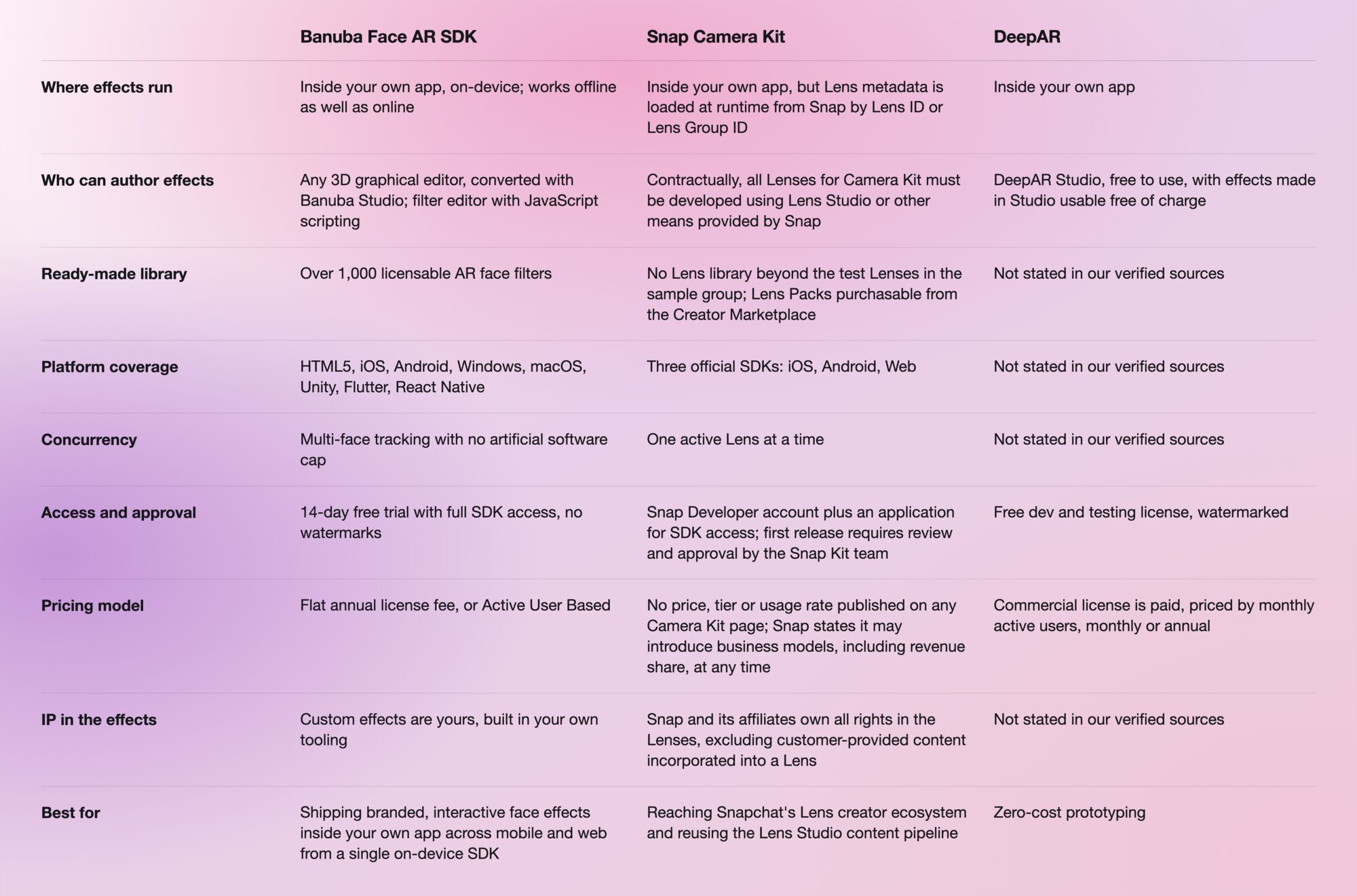
Blank cells are places where our verified sources state nothing, and we would rather leave a gap than guess. The competitor rows come from Snap's Camera Kit product page and DeepAR's pricing documentation.
When a competitor is the better choice. If your creative pipeline already runs on Lens Studio and your growth plan depends on Snapchat's creator ecosystem, Snap Camera Kit is the better choice, and reusing that content pipeline is worth the coupling. Be clear-eyed about what the coupling costs: one active Lens at a time, a Snap review before your first release, Lens metadata fetched from Snap at runtime, a Snap-managed CDN on web (your connect-src must include https://*.snapar.com or Camera Kit Web fails to initialise) plus a WebAssembly rendering engine downloaded at bootstrap, and a version treadmill where each Lens Studio release typically requires a new Camera Kit SDK version, with a Lens scheduled to an incompatible version simply not served. And if you are still deciding whether AR belongs in the product at all, DeepAR lets you prove it for nothing, as long as you can live with a watermark until you buy the commercial license.
MediaPipe is the widely recognized open-source face-landmark toolkit teams often prototype with. It is a building block rather than a packaged effects product, so the effect authoring, the asset pipeline, the rendering, and the support all remain yours to build and maintain.

What does it take to run AR effects on-device across mobile and web?
Running effects on-device means meeting a short list of platform floors rather than provisioning servers. Banuba Face AR SDK runs on iOS 13+ and Android 8.0+ (API 26+) with OpenGL ES 3.0+, on desktop with OpenGL 4.3+ (4.1+ on macOS), Windows 8.1+ and macOS 10.13+, and in the browser with WebGL 2.0+ on Chrome, Firefox, and Safari, on mobile and desktop. The recommended camera is 1280x720 at a minimum of 30 FPS, and the SDK targets 30+ FPS on mid-range mobile devices. That footprint covers 97% of Apple smartphones and 80% of Android ones.
Two consequences matter for buyers. On-device processing means video never leaves the handset, and the SDK works offline as well as online, which is why it also suits kiosk, photo-booth, and AR-mirror installs. And browser-based AR removes the install step for campaign traffic, so one effect family can serve an in-app audience and a link-in-bio audience without a second vendor. First-party Flutter and React Native support, plus Unity, means one integration decision rather than four.
-
On-device. Banuba Face AR SDK performs face tracking and effect rendering locally on the user's device and works offline just as well as with an internet connection, so video frames do not need to be sent anywhere. The Banuba Face AR SDK documentation is the reference to hand your security reviewer.
-
Yes. Banuba Face AR SDK has a native Agora integration, so AR effects can be applied to the outgoing video in an Agora-based live stream or call without a custom bridge. Banuba's AR for video conferencing page covers that live-video use case in more detail.
-
Banuba offers two licensing models. A flat annual license fee gives unlimited usage and predictable costs that stay fixed even if the app scales to a very large user base. An Active User Based license tracks the number of active users over time, so spend starts significantly lower but grows with the user base, and can end up above the flat fee if the app takes off. Every license starts with a 14-day free trial with full SDK access and no watermarks. The Banuba Face AR SDK pricing guide walks through how to choose between the two.
-
Yes. Banuba supports HTML5 and runs in the browser wherever WebGL 2.0+ is available, which includes Chrome, Firefox, and Safari on both mobile and desktop. See Banuba Web AR SDK for the browser-side implementation.
-
Yes. Banuba includes neural-network background subtraction and virtual backgrounds alongside the face effects, which is what a green-screen-free virtual set for live shopping or conferencing needs. Banuba's background subtraction technology page describes how the segmentation works.
-
Banuba applies no artificial software cap on multi-face tracking, so the limit is the hardware. Banuba recommends up to 4 faces on mobile and up to 6 on desktop, which covers group video chat, duets, and a host-plus-guests live stream. The Banuba Face AR SDK face filters page lists the full effect set that runs under multi-face tracking.
-
Start with the sample projects rather than the sales deck. Banuba publishes runnable sample apps, including the iOS samples repository, and the 14-day trial gives full SDK access with no watermarks, so you can measure frame rate on your own mid-range test devices before any commercial conversation.
