

In 2026, online shopping doesn’t feel flat anymore. Instead of guessing how something might look, people can now simply try it. Sunglasses show up on their face through a phone camera. Lipstick shades switch instantly. It was estimated that retailers utilizing AR in 2025 faced up to a 94% increase in conversion rates compared to static 2D images. So, the gap between browsing and experiencing has quietly disappeared.
This didn’t happen overnight. Mobile browsers finally caught up, users got tired of downloading apps, and ecommerce teams started looking for ways to make shopping easier, not louder. Web AR stepped in to solve a very practical problem: helping people make better decisions faster.
In this article, we'll look at the best Web AR SDKs in 2026, what they actually do well, and how to choose the right one depending on your goals. Each SDK was evaluated on practical performance, technical depth, scalability, and how well it holds up in real commercial deployments.
TL;DR
-
In 2026, Web AR SDKs like Banuba drive ecommerce conversions up to 94% higher through realistic virtual try-ons directly in mobile browsers without app downloads.
-
Banuba leads as the gold standard for face/body tracking, VTO precision, AI color analysis, privacy-first on-device processing, and enterprise scalability across web and Unity.
-
Other top SDKs include Zappar for creative campaigns, Vectary for 3D product visualization, Blippar for SLAM/marketing, and Geenee for full-body try-ons.
-
8th Wall phases out by February 2026 (hosting until 2027), and Onirix by September 2026, prompting shifts to stable alternatives like Banuba.
-
Choose SDKs based on tracking realism, >30 FPS browser performance, easy integration, GDPR-compliant privacy, and proven commercial support.
Best Web AR SDKs in 2026 – Quick Overview
The following table highlights the top-performing SDKs currently supported and scaling in real commercial environments.
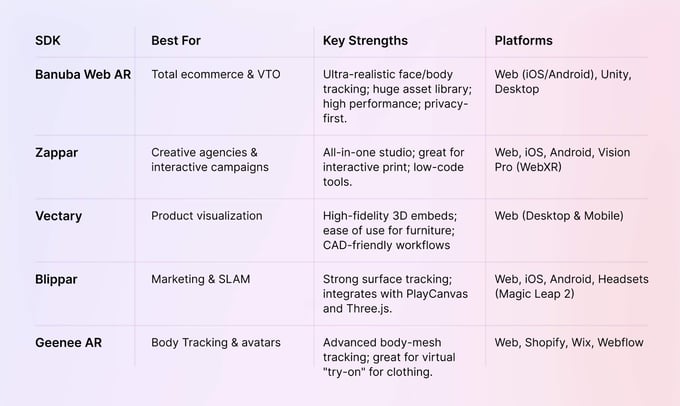
You may be surprised not to see the world-known 8th Wall and Onirix on the list of the best web AR SDKs this year. The reason is a major industry shift that occurred in late 2025:
- 8th Wall: Niantic confirmed in late 2025 that 8th Wall is being phased out. Platform access ends on February 28, 2026, and hosting will follow in early 2027. While it played a major role in the Web AR space, it’s no longer a sensible choice for teams starting new projects.
- Onirix: In September 2025, they shared a similar update, noting that the platform would stay online only through September 1, 2026.
Banuba Web-Based AR SDK – The Gold Standard in 2026
In 2026, Banuba remains the undisputed leader for businesses where realism and conversion are the primary KPIs. While other SDKs focus on broad environmental effects, Banuba has perfected the human-centric AR experience.
Why Banuba Leads the Market
Banuba’s Web AR SDK is a browser-based augmented reality solution that delivers high-performance AR without requiring an app download. It’s built on Banuba’s deep experience in computer vision, AI, and real-time augmented reality for web, developed through years of work across social platforms, beauty tech, and enterprise products. As a comprehensive AR framework, it supports both experimentation and full-scale commercial deployments.
Key Features
- Next-gen face & body tracking: By 2026 standards, AR tracking has to be both realistic and dependable. Banuba’s tracking of faces, hands, and bodies stays precise even on mid-range phones, making virtual try-ons feel seamless no matter the product.
- Virtual try-on (VTO) precision: Instead of using basic overlays, Banuba applies advanced shaders to simulate how light interacts with real-world materials. Matte lipstick appears matte, and a gold watch reflects the actual lighting around the user.
- AI seasonal color analysis: By understanding skin tone and facial features, this AR beautification SDK can guide users toward products that make sense for them, turning AR from a nice-to-see feature into a tool that supports real purchase decisions.
- High-performance AR in mobile browsers: Since most Web AR traffic comes from mobile Safari and Chrome, Banuba’s Web AR SDK is designed to run efficiently on both, maintaining high visual quality without sacrificing performance.
- Privacy-first, on-device processing: Banuba’s dominance is built on a privacy-first, performance-always architecture. By utilizing on-device processing via WebAssembly and WebGL, the augmented reality SDK for web delivers app-like smoothness (stable 30–60 FPS) without ever sending user video data to a server—a critical requirement for GDPR and CCPA compliance in 2026.
- Enterprise scalability: Designed for high-traffic environments, the SDK is "white-label" ready, allowing brands like Gucci and Samsung to maintain complete control over the UI/UX.
Common Use Cases
- Ecommerce virtual try-on
Customers expect to try products online. Banuba integrates virtual try-on into websites, boosting sales without adding friction. For example, after integrating Banuba’s Web AR for foundation and concealer try-ons, the beauty retailer Océane saw their add-to-cart rate jump from 3% to 32%. For a closer look at how storefronts implement this, see how e-commerce sites add browser-based AR try-on.
- Marketing campaigns
Fast-loading, interactive AR campaigns grab attention. Banuba keeps visuals sharp and experiences lightweight. For example, for Contem1g, the introduction of a new "Glow Filter" line became the brand’s top revenue generator by using Banuba’s AI to help customers find their perfect foundation shade instantly.
- Product visualization
This Web AR SDK can show products in 3D, demonstrate features, or add AR layers, all in the browser, with no app required.
This way, Banuba has built a mature AR + AI platform over years of real-world use, and it’s been adopted globally by brands in beauty, retail, and consumer tech. Teams can reuse assets across web and native apps, and scale from small pilots to millions of users. For anyone who values reliable, realistic AR and long-term support, Banuba offers capabilities that many other Web AR platforms for ecommerce and beyond can’t match.
Other Notable Web AR SDKs in 2026
While Banuba specializes in high-fidelity face and body tracking for commerce, there are platforms that offer specialized tools for world-tracking, industrial use, or low-code creation. Here are the other major players in the 2026 Web AR ecosystem.
Zappar (Zapworks)
By 2026, Zappar has become a complete XR ecosystem and a popular choice for developers leaving 8th Wall. Mattercraft, its main browser-based 3D editor, strikes a balance between easy no-code tools and complex coding environments.
- Strengths: Exceptional versatility; offers a universal Web AR SDK that works across Three.js, Unity, and PlayCanvas; their accessible QR technology is also a leader in inclusive design.
- Limitations: Because it tries to be a jack of all trades, it can lack the hyper-specific optimization for facial beauty or apparel try-on found in Banuba.
- Best-fit use cases: Marketing agencies building multi-environment campaigns (e.g., a mix of face filters, world-tracking, and interactive print).
Vectary
Vectary is less of a “tracking” SDK and more of a high-fidelity 3D content engine. In 2026, it’s the go-to platform for teams that care about visual quality and “View in Room” functionality without writing a single line of code.
- Strengths: Industry-leading 3D web rendering; seamless "No-code" embedding into platforms like Shopify and Webflow; excellent collaboration tools for 3D designers.
- Limitations: Limited interactivity that's perfect for 3D display, but not for complex AR or virtual try-on.
- Best-fit use cases: Online furniture or home decor stores, industrial product demos, and high-end sales presentations where looking real is what matters most.
Blippar
Blippar might be one of the "original" companies in AR, but it’s not resting on its laurels. In 2026, its Web AR SDK is praised for GPU-powered speed, perfect for devs who want a slim, efficient SLAM (Simultaneous Localization and Mapping) setup that just works.
- Strengths: Very efficient SLAM and marker tracking; strong integration with Unity for exporting web-based games; highly competitive "pay-as-you-go" pricing for smaller brands.
- Limitations: Documentation for complex flows is thinner than competitors’, so advanced features can take more time to implement.
- Best-fit use cases: Education and gaming where stable surface tracking and interactive 3D models are essential.
Geenee AR
Geenee has carved out a niche as the body-tracking specialist. While Banuba leads in face and accessories, Geenee has focused heavily on full-body AR mirrors and digital fashion that moves with the user’s entire silhouette.
- Strengths: Advanced full-body pose estimation directly in the browser; excellent for head-to-toe virtual outfits. They have also pioneered AR-enabled ads that allow users to try on clothing directly from a web banner with reported engagement times of over 50 seconds.
- Limitations: Full-body tracking is resource-intensive, and on older smartphones this can result in noticeable lag or occasional jitter during real-time skeletal tracking.
- Best-fit use cases: Virtual try-on for full outfits (dresses, suits), digital fashion collectibles (NFTs), and interactive "dance-along" social media marketing activations.
Finding the Best Web AR SDK for Your Projects in 2026
Picking the best AR SDK is more than a quick decision, as it’s a commitment for the future. To stay ahead, weigh each platform against these five essential criteria:
- Tracking quality & realism
Virtual try-on only works if it feels real. Rings, glasses, or clothing that jitter or sit incorrectly can immediately break confidence. Evaluate the SDK’s tracking across diverse ethnicities, face shapes, and lighting scenarios to ensure consistency.
2. Browser performance
An SDK’s performance is judged by the browser it lives in. Modern users expect Web AR to “just work” on Safari and Chrome. When performance slips under 30 FPS, even briefly, the experience feels slow and frustrating.
3. Ease of integration
Good SDKs have clear docs, simple APIs, and support frameworks like React, Vue, and Angular. Banuba, for instance, offers a face filter development kit that allows for integration in as little as 8 minutes.
4. Privacy & compliance
Ensure the SDK processes data on-device. If the SDK requires uploading a user's face to a cloud server to process the AR, you may face significant legal hurdles in the EU and North America.
5. Commercial readiness
Consider whether the SDK provider is a startup or an established company. Check for SLAs, dedicated support teams, and a roadmap that demonstrates ongoing innovation, including AI integration.
Final Verdict
Augmented reality for web has matured into a reliable, high-value channel by 2026, particularly for online shopping, marketing campaigns, and interactive product demos. While other platforms work well for specific needs, Banuba’s Web-based AR SDK offers the most complete, scalable solution. Thanks to its mix of precise tracking, fast mobile performance, privacy-conscious design, and enterprise capabilities, Banuba is a great option for teams taking AR projects from pilot to full production.
That said, the “best” SDK always depends on context. Creative campaigns, industrial training, or simple 3D visualization may benefit from more specialized tools. Testing demos, reviewing documentation, and aligning with long-term product goals remain essential steps.
Want to see Web AR in action? Explore Banuba’s case studies from different industries, and try the technology firsthand when you can before committing.
Reference List
AR Ads & WebAR Advertising with Virtual Try-On | GEENEE AR. (n.d.). AR Ads & WebAR Advertising With Virtual Try-On | GEENEE AR. https://geenee.ar/ar-ads
Banuba Blog | Case study. (2026, January 2). https://www.banuba.com/blog/tag/case-study
Burgess, M. (2025, October 15). When face recognition doesn’t know your face is a face. WIRED. https://www.wired.com/story/when-face-recognition-doesnt-know-your-face-is-a-face/
Krasko, A. (2025a, September 12). Effective beauty marketing Strategies in 2024. https://www.banuba.com/blog/marketing-for-the-beauty-industry
Krasko, A. (2025b, October 17). Virtual Try-On for a bestselling cosmetics line. https://www.banuba.com/blog/virtual-try-on-for-a-bestselling-cosmetics-line
Krasko, A. (2025c, November 14). TINT helped beauty brand achieve a 32% Add-To-Cart rate. https://www.banuba.com/blog/banuba-helped-oceane-achieve-a-record
Krasko, A. (2026, January 2). 10 Best Augmented Reality Software Development Kits (2026). https://www.banuba.com/blog/how-to-choose-the-right-augmented-reality-sdk
Thank you for Building with us: the next chapter for 8th Wall. (n.d.). 8th Wall. https://www.8thwall.com/blog/post/200208966730/next-chapter
VE_StreamApps_Morphings_360x720. (2025, October 28). [Video]. https://www.banuba.com/webar-sdk
Whaley. (2025, September 26). Onirix Closure announcement - Onirix. Onirix. https://www.onirix.com/onirix-closure/
Zappar. (2025, December 10). How to rebuild your 8th Wall project in Mattercraft: Full World-Tracking tutorial [Video]. YouTube. https://www.youtube.com/watch?v=CcJV55kUzEg
-
The official technical documentation for Banuba Face AR SDK is available online and includes requirements, setup instructions, and configuration details:
- Banuba Face AR SDK iOS documentation
- Banuba Face AR SDK Android documentation
- Banuba Face AR SDK Flutter documentation
- Banuba Face AR SDK React Native documentation
- Banuba Face AR SDK Web documentation
- Banuba Face AR SDK Unity documentation
- Banuba Face AR SDK Desktop documentation
This Banuba Face AR SDK documentation should be your primary reference during integration.
-
You can access official integration code samples for the Banuba Face AR SDK on GitHub. Banuba provides platform-specific examples to help you integrate faster:
- Banuba Face AR SDK iOS integration code sample
- Banuba Face AR SDK Android integration code sample
- Banuba Face AR SDK Flutter integration code sample
- Banuba Face AR SDK React Native integration code sample
- Banuba Face AR SDK Desktop integration code sample
- Banuba Face AR SDK Web integration code sample
- Banuba Face AR SDK Unity integration code sample
These Banuba Face AR SDK repositories include setup instructions and minimal working examples for quick deployment.
-
Yes. The Banuba Face AR SDK includes an LLM-friendly documentation file designed for AI-assisted development and internal knowledge systems:
This structured Banuba Face AR SDK text file can be used with AI tools to streamline onboarding and developer workflows.
-
The Banuba Face AR SDK provides official cross-platform plugins to simplify integration into hybrid applications:
These Banuba Face AR SDK plugins are maintained by Banuba and support faster implementation for cross-platform apps.
-
Yes. While live camera access enables the full AR experience, most mature Web AR SDKs now include smart fallback options. If a user declines camera permissions, the experience can switch to a photo upload mode, where a selfie or existing image is used instead. Some platforms also offer 3D viewer modes, letting users explore products interactively without AR.
-
Not long ago, this was an easy win for native apps. That’s changed. Thanks to WebGPU and WebAssembly, browsers in 2026 can run complex AR logic directly on the device. Native apps still win in a few edge cases, but for most ecommerce scenarios, WebAR performs so well that users can’t tell the difference.
-
Absolutely. Enterprise-ready Web AR SDKs distribute core assets through global CDNs, while AR computation happens entirely client-side. This architecture minimizes backend load and ensures reliable performance during high-traffic moments, assuming efficient asset formats and delivery.
-
The most robust SDKs perform landmark analysis entirely on-device, keeping data in the browser’s memory and never transmitting video or images. Ensure GDPR and CCPA compliance, and provide a transparent, branded camera access prompt explaining why the feed is required.
-
Yes, customization is possible, but it’s not equal across all SDKs. Banuba’s enterprise SDK gives you full white-label freedom, so your UI, buttons, and branding reflect your design choices. That sets it apart from no-code solutions, which often require their watermark or preconfigured interface.