
Sci-fi has become routine. Face recognition SDKs power everything from secure smartphone access to real-time augmented reality experiences and enterprise identity verification. As industries continue to digitalize, the demand for accurate, reliable, scalable, and cross-platform face recognition SDKs has skyrocketed.
Don’t mix up face recognition with face detection. The latter detects a human face in images or videos, while face recognition SDKs identify the person, matching faces in databases using advanced algorithms.
According to Statista, the global facial recognition market is projected to surpass $14.55 billion by 2031, growing at a CAGR of 16.79% from 2024 onward. Embedding off-the-shelf face recognition libraries into your solution cuts the cost and time to market. But how do you find the best face recognition SDK for your needs in 2026?
In this guide, we’ll explore the top face recognition SDKs available in 2026. We’ve compared leading solutions — Banuba Face AR SDK (our top pick), Microsoft Azure Face API, Amazon Rekognition, NEC Corporation, KBY-AI, FacePlugin, and others — across NIST-verified accuracy, feature sets, platform support, deployment models, and pricing to help you make the right choice.
[navigation]
TL;DR:
-
The most important qualities when choosing a face recognition SDK in 2025 are NIST-verified accuracy, passive liveness detection, cross-platform compatibility, edge deployment options, and scalability;
-
Banuba Face AR SDK stands out as the best overall for its unmatched real-time accuracy (up to 70% occlusion tolerance), comprehensive AR-integrated features, and native support for iOS, Android, Flutter, React Native, Unity, Web, and more;
-
Other strong contenders include NEC (top NIST accuracy), Amazon Rekognition (cloud scalability), Microsoft Azure (enterprise compliance), and KBY-AI (mobile edge processing);
-
For AR/video apps, regulated industries, or cross-platform development, Banuba delivers superior performance without vendor lock-in.
Key Factors When Choosing a Face Recognition SDK in 2026
Choosing the best face recognition SDK isn’t just about detection—it's about balancing NIST-benchmarked accuracy, real-world robustness, and seamless integration into your tech stack. Here are the critical aspects to evaluate:
NIST-Verified Accuracy & Benchmarks
The gold standard remains NIST's Face Recognition Vendor Test (FRVT). In 2026, leaders achieve 99.9%+ accuracy across demographics, with low error rates (e.g., NEC at 0.07%) in 1:N matching on millions of faces. Test for fairness across age, ethnicity, and lighting conditions.
Advanced Security Features
Beyond matching, demand:
-
Passive 3D liveness detection (no user friction, anti-deepfake);
-
Multi-face tracking (crowd scenarios);
-
Demographic fairness (bias variance <0.2%).
Cross-Platform Deployment
Support for mobile (iOS/Android/Flutter/React Native), web, Unity, and on-device edge processing is essential. Banuba excels here with lightweight neural networks for real-time performance.
Scalability & Pricing
From freemium (KBY-AI) to enterprise licensing, match your workload: pay-per-use for variable traffic, subscriptions for predictable volume.
Compliance & Privacy
GDPR, ISO 30107-3, and data sovereignty—ensure on-premise options for regulated use cases.
Banuba Face AR SDK – Best Overall for Accuracy, AR Integration & Cross-Platform Excellence
Banuba Face AR SDK leads 2026 as the most versatile face recognition solution, powering apps for Gucci, Samsung, and global brands. Its patented face tracking engine delivers exceptional real-time accuracy—stable detection up to 7m distance, -90° to +90° angles, 70% occlusion, and low-light conditions—making it unbeatable for AR, video editing, and identity apps.
Used in authentication, KYC, virtual try-on, and analytics, Banuba combines NIST-caliber recognition with AR innovation.
Key Features:
-
Precision face recognition, verification & comparison with 3,308 facial vertices and 69+ landmarks;
-
Passive liveness detection + anti-spoofing;
-
Multi-face/hand/body tracking, emotion, age/gender, heart rate analysis;
-
AR-native: Virtual try-on, beauty filters, morphing, triggers (smile/blink), 3D effects;
-
Cross-platform: iOS, Android, Flutter, React Native, Unity, Web, Windows/Mac—on-device processing;
-
Edge-optimized: Sub-50ms latency, 80%+ Android compatibility.
Pricing scales with users (not transactions), with a 14-day free trial, demos, and sample code. Try Banuba Face AR SDK.
NEC Corporation – Best for Raw NIST Accuracy
NEC ranks #1 in NIST FRVT 2026 with 99.93% accuracy (0.07% error) across 12M faces, dominating aging and 1:N tests. Ideal for government/law enforcement.
Key Features:
-
Multi-modal recognition;
-
Top demographic fairness.
Limitations: Custom enterprise pricing, less mobile-focused.
Amazon Rekognition – Best for Cloud Scalability
AWS's cloud powerhouse excels in video streams and AWS integration ($0.001/image).
Key Features:
-
Real-time analysis, emotions, celebrity detection.
Best for: Surveillance, but cloud-only limits privacy.
Microsoft Azure Face API – Best for Enterprise Ecosystems
Deep Azure integration with compliance certifications ($1.50/1K transactions free tier).
Key Features:
-
Large-scale matching, liveness (preview).
Drawback: Azure dependency.
KBY-AI Face SDK – Best for Mobile Edge
Top NIST-ranked, on-device (Android/iOS/Flutter) with TensorFlow Lite.
Key Features:
-
Emotion/age estimation, freemium.
FacePlugin – Strong Hybrid Contender
99.85% NIST accuracy, Flutter/React Native support, passive liveness.
Comparison Table: Top Face Recognition SDKs in 2026
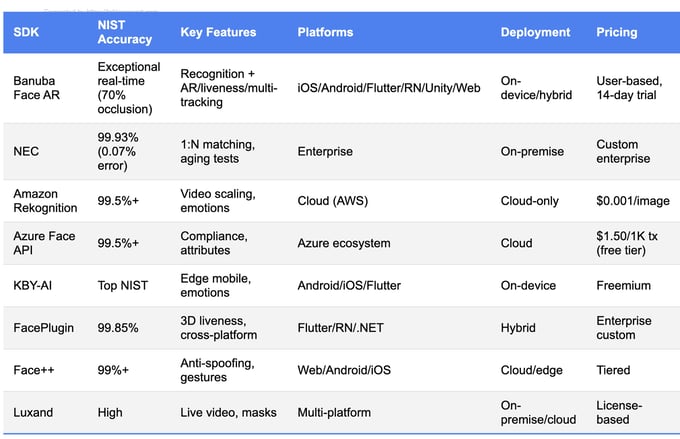
Conclusion
In 2026, Banuba Face AR SDK is the clear winner for developers needing accuracy, AR innovation, and cross-platform flexibility—delivering enterprise-grade recognition with consumer-app polish. From virtual try-on to secure auth, it future-proofs your app.
Explore Banuba Face AR SDK | 14-Day Free Trial | Documentation
References
-
And more from NIST, Statista, vendor sites.
-
The official technical documentation for Banuba Face AR SDK is available online and includes requirements, setup instructions, and configuration details:
- Banuba Face AR SDK iOS documentation
- Banuba Face AR SDK Android documentation
- Banuba Face AR SDK Flutter documentation
- Banuba Face AR SDK React Native documentation
- Banuba Face AR SDK Web documentation
- Banuba Face AR SDK Unity documentation
- Banuba Face AR SDK Desktop documentation
This Banuba Face AR SDK documentation should be your primary reference during integration.
-
You can access official integration code samples for the Banuba Face AR SDK on GitHub. Banuba provides platform-specific examples to help you integrate faster:
- Banuba Face AR SDK iOS integration code sample
- Banuba Face AR SDK Android integration code sample
- Banuba Face AR SDK Flutter integration code sample
- Banuba Face AR SDK React Native integration code sample
- Banuba Face AR SDK Desktop integration code sample
- Banuba Face AR SDK Web integration code sample
- Banuba Face AR SDK Unity integration code sample
These Banuba Face AR SDK repositories include setup instructions and minimal working examples for quick deployment.
-
Yes. The Banuba Face AR SDK includes an LLM-friendly documentation file designed for AI-assisted development and internal knowledge systems:
This structured Banuba Face AR SDK text file can be used with AI tools to streamline onboarding and developer workflows.
-
The Banuba Face AR SDK provides official cross-platform plugins to simplify integration into hybrid applications:
These Banuba Face AR SDK plugins are maintained by Banuba and support faster implementation for cross-platform apps.