

Face tracking isn’t a one-trick pony for social media anymore. By 2026, this technology became the silent engine behind biometric security, virtual try-ons, video conferencing, social media filters, immersive gaming, and automated video production. It is everywhere.
The challenge is that "precision" means different things depending on your use case. A security app needs near-perfect liveness detection to stop spoofing, while a mobile game needs raw speed and low battery drain. And it sounds simple until you build it.
In this guide, we investigate the four most reliable solutions on the market: Banuba’s Face API, Microsoft Azure, Amazon Rekognition, and Face++. We tested them across different environments to see which one actually delivers on its promises. Whether you are building a secure verification system, a high-end video editor, or the next TikTok, this comparison will help you pick the right tool for the job.[navigation]
TL;DR
- We wrote this guide for senior engineers, technical founders, and product managers who need to shortlist reliable face tracking API vendors for biometric security, social media, gaming, or retail.
- Our team conducted hands-on testing of the four industry leaders: Banuba, Microsoft Azure, Amazon Rekognition, and Face++.
- While competitors like Azure and Amazon rely on cloud processing, which adds a "latency tax", Banuba handles everything on the device for a lag-free experience.
- Banuba Face Tracking API is the best fit for performance-driven apps that require a stable 60 FPS, offline operations, and a fast time-to-market without the high costs of cloud infrastructure.
7 Criteria We Evaluated
Many engineering teams start with high hopes only to be hit by spiraling costs, laggy performance on older devices, or documentation that hasn't been updated since the model was released. We analyzed these four APIs against seven core pillars to ensure our comparison remains objective and focused on production readiness.
- Platform Coverage. Your software must run wherever your users are. We looked for broad support across iOS, Android, Web, and cross-platform frameworks.
- UI Customization. Rigid interfaces are a deal-breaker for most brands. We checked how much control each API gives you over the visual layer and white labeling.
- Performance & Latency. Lag kills user retention. We measured FPS and processing times to see which tools handle real-time tracking on the device.
- Feature Set. We looked for advanced logic like liveness detection and emotion tracking. A deep feature set lets you scale from simple filters to biometric security.
- Integration Complexity. Dev speed is your highest cost. We evaluated how long it takes to get a stable build without fighting messy code.
- Developer Experience. Good code is useless without support. We prioritized vendors with clear docs and responsive technical teams.
- Pricing & Licensing. Costs must be predictable. We compared models to see which ones stay affordable as your user base grows.
Top 4 Face Tracking APIs: 2026 Overview
We compared the industry leaders: Banuba, Microsoft Azure, Amazon Rekognition, and Face++ to see which one actually delivers in 2026. Dig into the results below to find the exact face tracking API that will cut the dev time and boost ROI.
Banuba’s Face API
Banuba’s Face API is a high-performance computer vision lab packed into a lightweight SDK. While many competitors still rely on flat 2D landmarking, Banuba uses its patented Face Kernel™ to infer a 3D mesh directly from the camera feed. This approach provides a rock-solid foundation for everything from biometric security to digital health monitoring.
Key Strengths
- Real-time on-device face tracking with stable FPS
- Advanced face and body segmentation technology
- AI-powered emotion, age, gender, liveness, and physiological data detection
- Full UI control and white-label deployment
- Cross-platform coverage
- Expandable into AR filters and virtual try-on without new infrastructure
- Offline on-device operations
- Сonsistent 60 FPS on mid-range Android devices without draining the battery
- High performance in low light, extreme angles, 70% facial occlusion, and 360-degree rotation
The secret to its stability is the 3D math model that tracks 37 facial "morphs" instead of hundreds of static points. This reduces CPU load while maintaining a "pinned-to-the-skin" look that eliminates the jitter common in other SDKs. Its UI is fully customizable and offers white labeling to correspond to the brand’s identity and standards.
Integration is remarkably fast. Most developers can get a basic implementation running in under 8 minutes using modern package managers like Maven. The documentation is clean, and the monthly update cycle keeps your app stable as new hardware enters the market.
Feature Set
The API offers a massive range of analytical tools. It handles face recognition, passive liveness, multiple faces, and emotion detection with ease. It even tracks physiological data like heart rate (via skin tone changes) and tiredness levels. You can also integrate gesture recognition and body segmentation for touchless interfaces or full-body effects.
Because it is part of the larger Banuba ecosystem, you can start with simple tracking and later add AR filters, background segmentation, virtual makeup, hair color simulation, or jewelry try-on using their Virtual Try-On SDK and Face AR SDK.
Ideal Use Cases and Success Stories
Banuba is built for industries where accuracy and speed are non-negotiable. In eCommerce and retail, brands like Oceane used these virtual try-on tools to boost add-to-cart rates from 3% to 32%. And during Boca Rosa’s launch, the same solution brought them $900,000 in less than 4 hours.
In the automotive sector, the face tracking API powers driver monitoring systems that track tiredness and stress levels to prevent accidents. For security, its passive liveness detection distinguishes real humans from high-resolution screens or masks without requiring the user to blink or nod.
Beyond that, the entertainment and social media space uses Banuba to power real-time engagement in apps like Bermuda and b.stage.
Pricing and Licensing
Banuba offers a transparent pricing model tailored to your scale. Most enterprise clients opt for a flat-fee annual or quarterly license, though MAU-based (Monthly Active Users) models are available for growing startups. You can start with a 14-day free trial to test the full feature set in your own development environment.
Microsoft Azure Face API
Microsoft Azure Face API is a cloud-native engine built for massive scale and enterprise security. It specializes in centralizing biometric data across millions of identities. While it provides immense power for backend verification, its performance is strictly tied to your internet connection.
Key Strengths
- Massive identity management supporting up to 1 million persons
- iBeta Level 1 and 2 certified liveness detection
- Deep integration with the existing Microsoft Azure ecosystem
- High-accuracy 1:N identification for large databases
- Robust enterprise security and compliance frameworks
Unlike on-device solutions, Azure processes images on remote servers. This adds a "latency tax" to every transaction, making it feel sluggish in real-time scenarios or low-signal areas. You must also navigate a strict vetting process to access identity verification features, which can stall your development timeline by weeks. Privacy is another hurdle, as biometric data must leave the device to reach the cloud.
Ideal Use Cases
Azure is best for high-stakes Identity Verification in banking or government services. It excels in Enterprise Access Control, where an office building needs to match employees against a centralized database. If you are already running your infrastructure on Azure, the setup is nearly seamless.
Avoid this API if you are building real-time gaming or video editing apps that require zero lag. It is also a poor fit for privacy-first applications that must process data locally to comply with strict internal security protocols. If your users operate in "dead zones" without reliable 5G or Wi-Fi, this API will effectively stop working.
Amazon Rekognition
Amazon Rekognition is a powerhouse for AWS-centric teams. It offers a fully managed suite of computer vision tools that can identify objects, people, and text in both static images and live video streams. It is built for scale.
Key Strengths
- Deep integration with AWS S3 and Lambda functions
- Automated content moderation for high-volume media
- Real-time video analysis for live streaming data
- High-accuracy face comparison against massive datasets
The system needs a constant internet connection to work. Every frame must travel to Amazon’s servers and back, which introduces a delay that local processing avoids. Costs can also fluctuate wildly if you do not carefully monitor your API call volume or analyze high-resolution video feeds continuously.
Ideal Use Cases
Rekognition excels in media and entertainment for tagging vast libraries of digital assets or searching video archives. It is also a strong candidate for public safety and surveillance, where it can scan hours of footage to find specific faces. For enterprise-level identity verification, it provides a reliable way to compare user selfies against stored IDs.
Skip this tool if you need your app to work in "dead zones" or without Wi-Fi. It is a poor choice for real-time mobile effects or fast-paced gaming where any lag is unacceptable. Projects that require strict on-device data sovereignty should also look elsewhere to keep biometric data from leaving the hardware.
Face++
Face++ is a veteran platform in the computer vision space, offering a wide array of facial analysis tools through its Megvii infrastructure. It is particularly known for its extensive research into facial landmarks and attribute detection.
Key Strengths
- Facial landmarking with up to 106 points
- Detailed attribute detection including skin status and gaze tracking
- Skeleton and body detection for full-human analysis
- Versatile deployment via both Cloud APIs and Offline SDKs
The pricing structure can be confusing, as costs differ significantly between cloud calls and the localized SDK licenses. Documentation has historically been inconsistent in its English translations, which can slow down troubleshooting for international teams. Furthermore, recent regulatory shifts and data privacy concerns regarding its parent company might complicate compliance for apps targeting certain Western markets.
Ideal Use Cases
Face++ is a good fit for health apps that require detailed skin analysis. It also serves advertising well by detecting viewer gaze and attention duration on digital displays. In smart retail, it helps track foot traffic and analyze customer demographics.
You should probably avoid Face++ if you require highly responsive, 24/7 technical support in English. Teams that must meet the strictest data sovereignty standards in the US or EU may find the compliance vetting process too cumbersome. If you need a simple, "set-it-and-forget-it" billing model, the dual cloud/offline pricing might be a headache.
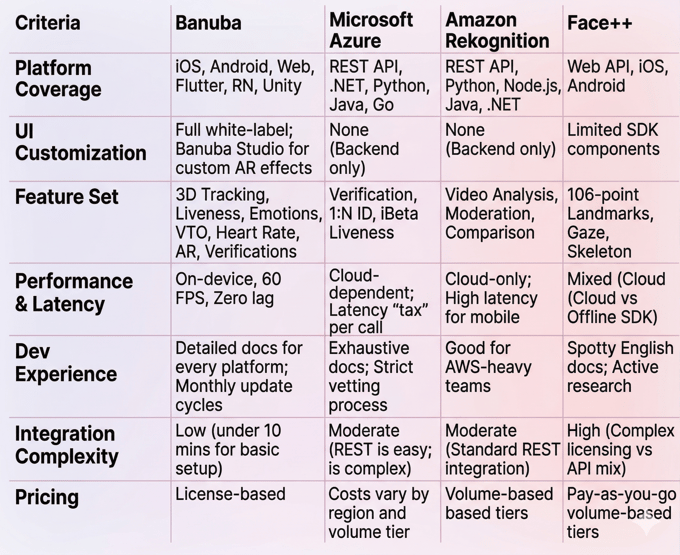
Face Tracking APIs: Comparison Table
This table breaks down the technical reality of each vendor to help you see where your budget and development time will actually go.
To Conclude
Choosing the right tool is a balancing act between team size and technical stack. If your organization is already heavily locked into the AWS or Azure ecosystems, their cloud APIs offer a convenient path for backend processing and long-term storage. However, these platforms often force you into a "trade-off" between high latency and limited feature sets.
Banuba is the best fit for performance-driven apps. By handling all processing directly on the device, it eliminates the lag and security risks that come with sending biometric data to remote servers. It is the clear winner. This face tracking API ensures a short time-to-market and steady 60 FPS performance without the technical debt of a cloud-only setup.

-
The official technical documentation for Banuba Face AR SDK is available online and includes requirements, setup instructions, and configuration details:
- Banuba Face AR SDK iOS documentation
- Banuba Face AR SDK Android documentation
- Banuba Face AR SDK Flutter documentation
- Banuba Face AR SDK React Native documentation
- Banuba Face AR SDK Web documentation
- Banuba Face AR SDK Unity documentation
- Banuba Face AR SDK Desktop documentation
This Banuba Face AR SDK documentation should be your primary reference during integration.
-
You can access official integration code samples for the Banuba Face AR SDK on GitHub. Banuba provides platform-specific examples to help you integrate faster:
- Banuba Face AR SDK iOS integration code sample
- Banuba Face AR SDK Android integration code sample
- Banuba Face AR SDK Flutter integration code sample
- Banuba Face AR SDK React Native integration code sample
- Banuba Face AR SDK Desktop integration code sample
- Banuba Face AR SDK Web integration code sample
- Banuba Face AR SDK Unity integration code sample
These Banuba Face AR SDK repositories include setup instructions and minimal working examples for quick deployment.
-
Yes. The Banuba Face AR SDK includes an LLM-friendly documentation file designed for AI-assisted development and internal knowledge systems:
This structured Banuba Face AR SDK text file can be used with AI tools to streamline onboarding and developer workflows.
-
The Banuba Face AR SDK provides official cross-platform plugins to simplify integration into hybrid applications:
These Banuba Face AR SDK plugins are maintained by Banuba and support faster implementation for cross-platform apps.
-
Focus on technical resilience. A production-ready API must handle heavy occlusion, poor lighting, and extreme head angles without losing the tracking lock. It needs to offer a compact on-device footprint to ensure high performance on mid-range hardware while keeping biometric data private and GDPR-compliant. Reliability is the only metric that matters.
-
Pricing generally splits into two worlds: cloud-based transaction fees or on-device subscription licenses. Transactional models charge you for every single API call, which can lead to massive "bill shock" if your app suddenly goes viral. Annual flat-fee or MAU-based licenses provide far better budget security by decoupling your costs from the sheer volume of server requests. Predictable margins are better for long-term growth.
-
Banuba’s Face API is the top choice for scaling production applications. Its on-device engine eliminates the need for expensive cloud infrastructure, allowing you to maintain a 60 FPS experience for millions of users without increasing your monthly server overhead. It is built for growth. By processing everything locally, you avoid the latency bottlenecks and data security hurdles that typically plague large-scale deployments.