

Web AR is no longer a side project. In 2026, the global AR market is projected to reach $210.9 billion. The reason for this surge is simple. Removing the "download an app" barrier is the fastest way to increase user retention and sales.
But for developers, the web remains a fragmented mess:
- WebXR has matured, but browsers still handle camera permissions and tracking differently.
- Maintaining 30+ FPS on a mid-range phone while running AI shaders is a constant battle.
- Many SDKs offer zero UI customization, forcing you into a generic look.
- Balancing high-fidelity 3D models with fast web load times.
We’ve spent the last month stress-testing the industry leaders to see who actually delivers on their promises. This guide breaks down Banuba, WebXR, Zappar, and Blippar. We’re stripping away the marketing speak to show you the benchmarks, the API quirks, and the real-world integration times. Ready to see which SDK actually survives your production environment?
[navigation]
TL;DR
- This guide is intended for senior engineers, technical founders, and product managers who need to shortlist trustworthy Web AR vendors for e-commerce, virtual try-ons, or real-time communication solutions.
- We benchmarked the 2026 performance of four distinct paths: the specialized Banuba Web AR SDK, the native WebXR Device API, and the marketing-focused ecosystems of Zappar and Blippar.
- While open-source standards like WebXR offer zero-cost entry, they lack the high-level biometric precision and cross-browser stability required for commercial-grade applications.
- Many generalist platforms scale costs based on user views, which can lead to unpredictable expenses compared to flat-fee commercial licenses.
- Banuba is the best fit for production apps that require a stable 60 FPS, hyper-realistic face tracking, and on-device processing to ensure total user privacy and low latency.
Comparison Matrix: How We Evaluated the Top APIs
A web AR API isn’t just about flashy filters; it has to play nicely with your production stack and protect your conversion rates. What looks great in the lab often falls apart in the real world thanks to browser quirks or unoptimized shaders. To provide an objective look, we measured each solution against the same seven high-stakes criteria.
- Platform Coverage: If you ever decide to create native apps, it’d be nice not to have to switch vendors. Therefore, we also checked other platforms' coverage to ensure versatility.
- UI Customization: We analyzed white-labeling capabilities and how much control you have over the interface. A rigid UI can make your high-end brand look like a generic social media template.
- Performance & Latency: We benchmarked frame rates (FPS) and processing times on various hardware. Lagging AR doesn't just look bad; it creates a physical disconnect that drives users away.
- Feature Set: We went beyond basic overlays and looked for an advanced feature set that allows for complex triggers and more interactive user journeys.
- Integration Complexity: Low complexity keeps your product velocity high and your engineering costs low.
- Developer Experience & Support: We evaluated the quality of technical documentation and the responsiveness of the support teams. Good docs are the difference between a one-day setup and a week of debugging forum threads.
- Pricing & Licensing: Clear licensing models prevent "success tax" surprises when your app finally goes viral.
Top 4 Web AR APIs
Read on to see how Banuba, Zappar, Blippar, and WebXR handle real-world latency, cross-browser quirks, and high-fidelity asset rendering so you can skip the trial-and-error phase of your project.
Banuba Web AR SDK
Banuba has spent nearly a decade carving out a niche as the gold standard for high-performance, human-centric AR. While many competitors focus on broad environmental tracking, Banuba Web AR SDK doubles down on the human face and body. In 2026, it remains the go-to choice for developers who need app-level stability within a browser.
Key Strengths
- 68-Point Face Tracking: Maintains a rock-solid lock even in low light or with 70% of the face covered.
- Patented 3D Mesh: Infers a high-density 3D face mesh directly from the camera feed to prevent filter "jitter."
- On-Device Processing: Uses WebAssembly and WebGL to keep all biometric data on the user's hardware for total privacy.
- Low Latency: Delivers consistent 60 FPS on mid-range Android and iOS devices.
- Rapid Integration: Go from a fresh project to a working AR camera in roughly 8 minutes via NPM.
- Extreme Angles: Tracking stays active at up to 90-degree head rotations, where other APIs fail.
Ideal Use Cases
Banuba’s modularity makes it a powerhouse across several high-growth web sectors:
- E-Commerce: Drive sales with hyper-realistic virtual try-ons for makeup, eyewear, and jewelry. Océane integrated Banuba’s VTO and saw add-to-cart rates jump from 3% to 32%.
- Video Conferencing: Enhance calls with background removal, touch-up filters, and real-time avatars. It helped Vroom increase MAUs by 30% and new users by 50%.
- Education & Games: Build interactive learning tools that respond to specific facial triggers and hand gestures. For the Clash of Streamers NFT game, it brought 4M installs.
- Photo & Video Editors: Drop in "one-click" beautification and background animation tools that run in-browser. Integrating Banuba helped Weat reduce their dev time by 50%.
Technical Deep-Dive: The 2026 Feature Set
- VTO Precision: Advanced shaders simulate light-material interaction for realistic matte, glossy, or metallic finishes.
- AI Analysis: Real-time detection of emotion, gender, age, and tiredness to personalize user experiences.
- Segmentation Suite: High-accuracy hair, skin, and lip segmentation for complex virtual makeup applications.
- Gesture Recognition: Supports touchless interfaces by triggering effects via hand movements or facial expressions.
- Liveness Detection: Includes passive liveness checks to verify real human presence for web-based onboarding.
- UI Customization: Fully white-labelable; you have total control over the camera pipeline and interface design.
Developer Experience
The SDK fits naturally into modern workflows, supporting React, Angular, and Vue. Designers can use the Banuba Studio to create effects without writing code, then export them directly into the web project as .glf files.
Pricing & Licensing
- 14-Day Free Trial: Access the full SDK feature set with no upfront cost.
- Commercial License: Predictable annual or quarterly fees that don't limit you for user growth.
WebXR Device API
WebXR is the W3C’s open standard for delivering immersive content directly through the browser. Unlike third-party SDKs, it is a low-level API that communicates directly with device hardware. In 2026, it serves as the foundational layer for the "immersive web."
Key Strengths
- Zero Overhead: No external libraries are required for basic spatial tracking, keeping your initial load times exceptionally low.
- Hardware Direct: It provides direct access to headset sensors and mobile depth-sensing hardware for high-accuracy positioning.
- Open Standard: Building on WebXR ensures your project is future-proof and compatible with the evolving W3C specifications.
Limitations
The biggest hurdle with WebXR is its "bare-bones" nature. It provides raw data but lacks high-level features like facial beauty filters, virtual try-on logic, or sophisticated gesture recognition. You have to build those layers yourself or find additional libraries to handle the heavy lifting. Browser support also remains a significant pain point. While Chrome and Edge have strong support, mobile Safari still requires specific flags or "Workaround" libraries to enable camera-based AR sessions. This fragmentation means your experience might look perfect on an Android device, but fail to launch on an iPhone without extensive debugging.
Ideal Use Cases
- Product Visualization: Placing static 3D furniture or home decor in a real-world room.
- Architectural Walkthroughs: Letting users "walk" through a virtual floor plan using floor-plane detection.
- Basic Web VR: Creating 360-degree immersive environments for training or education.
If your project depends on high-fidelity face tracking or virtual try-ons, WebXR is probably not for you. It is also a poor fit for teams without dedicated 3D engineers. Because the API is low-level, the learning curve is steep, and integration takes significantly longer than with a plug-and-play SDK.
Zappar
Zappar provides a versatile ecosystem for creating Web AR content across multiple skill levels. Their platform includes everything from no-code visual editors to a Universal SDK that supports popular frameworks like Three.js, Unity, and PlayCanvas.
Key Strengths
- Universal SDK: Works natively with a wide range of web frameworks and 3D engines.
- Mattercraft Editor: A visual, browser-based 3D environment that simplifies the bridge between design and code.
- Accessible QR (AQR): Built-in support for specialized QR codes designed to help the visually impaired interact with packaging.
Limitations
Zappar is a versatile generalist. While its face tracking is reliable for most marketing filters, it often lacks the granular lip or skin segmentation required for high-end virtual try-ons. Developers might also find that the platform’s ease of use comes at the cost of total low-level control over the tracking pipeline. This can be a hurdle for projects that require unique, custom-built AI triggers or heavy optimization for low-end hardware. The pricing structure can also be complex, as costs often scale based on the number of views your campaign receives.
Ideal Use Cases
- Interactive Marketing: Creating "connected packaging" that triggers 3D animations from a physical label.
- Educational Experiences: Building immersive training modules that run on any browser without an app.
- Multi-Platform Campaigns: Projects that need to function identically on the web and within a native application.
If your core product is a hyper-realistic beauty or jewelry try-on service, Zappar’s general-purpose tracking may not meet your precision requirements. It is also less than ideal for developers who want to avoid recurring "per-view" fees.
Blippar
Blippar is a long-standing player in the AR industry, primarily recognized for its robust world-tracking and image recognition capabilities. In 2026, its Web AR SDK is notable for GPU-accelerated performance, which offloads computer vision tasks to the device's graphics processor. It is an enterprise-grade choice for projects that require anchoring 3D content to physical surfaces or products with high stability.
Key Strengths
- GPU-Powered SLAM: Delivers high-speed surface and marker tracking by utilizing the device’s GPU for vision calculations.
- Unity WebAR Plugin: Allows developers to build complex interactive games in Unity and export them directly to the web with minimal friction.
- Flexible Creative Tools: Offers Blippbuilder, a browser-based "drag-and-drop" editor, alongside a professional-grade SDK for custom coding.
Limitations
Blippar's focus is heavily weighted toward world-tracking (SLAM) and marker-based experiences. While it supports face tracking, it is not as specialized for the biometric nuances required in the beauty or healthcare industries. Developers may find the documentation for advanced, custom integrations to be thinner compared to competitors, often requiring more "trial and error" for non-standard features. Additionally, because it is an advanced toolset, the learning curve for the SDK can be steep for teams without prior experience in 3D rendering or GLSL shaders.
Ideal Use Cases
- AR Advertising & Print: Transforming static billboards, magazines, or product packaging into interactive 3D portals.
- Web-Based Gaming: Deploying interactive, high-fidelity games that can be accessed instantly via a URL scan.
- Educational Content: Overlaying complex 3D models and animations onto textbooks or museum exhibits for immersive learning.
If your project is purely focused on hyper-realistic virtual try-ons or detailed facial analysis (like skin health or emotion detection), Blippar may lack the specific biometric depth you need. It is also not the best fit for smaller teams on a tight timeline who need a "one-click" solution for beauty filters.
Web AR APIs: Compared & Tested
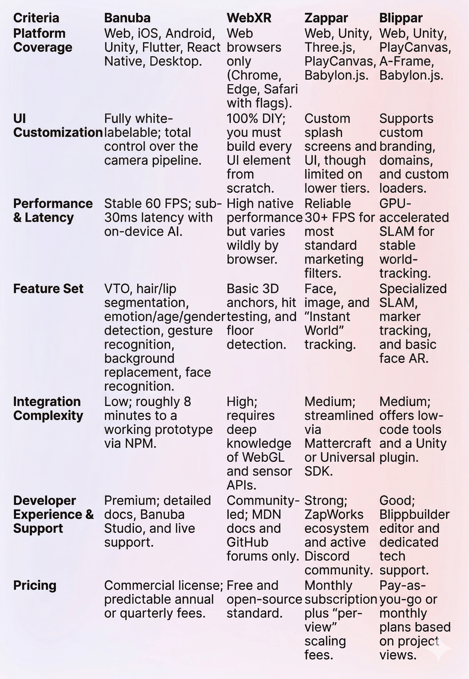
This comparison table summarizes how each solution handles the core technical and business requirements of a 2026 production environment.
Final Verdict
Choosing your API depends on your specific timeline and technical depth. Small teams focused on rapid marketing activations should look at Zappar or Blippar for their visual editors and quick turnaround times. These tools work well for basic campaigns. However, if you are building a complex product that needs to scale, the per-view pricing and tracking limitations of generalist tools will eventually slow you down. WebXR remains a viable option only for lean teams willing to trade months of development time for a free, native entry point.
Banuba Web AR SDK is the best fit for developers who need app-level performance within a mobile browser. Its patented 3D mesh and on-device AI deliver the 60 FPS stability required for realistic virtual try-ons and professional video conferencing. It stays rock-solid. You get total UI control and a predictable flat-fee model that keeps your costs stable as you grow. This SDK is the clear winner for any commerce or communication project that cannot afford to compromise on quality.

-
The official technical documentation for Banuba Face AR SDK is available online and includes requirements, setup instructions, and configuration details:
- Banuba Face AR SDK iOS documentation
- Banuba Face AR SDK Android documentation
- Banuba Face AR SDK Flutter documentation
- Banuba Face AR SDK React Native documentation
- Banuba Face AR SDK Web documentation
- Banuba Face AR SDK Unity documentation
- Banuba Face AR SDK Desktop documentation
This Banuba Face AR SDK documentation should be your primary reference during integration.
-
You can access official integration code samples for the Banuba Face AR SDK on GitHub. Banuba provides platform-specific examples to help you integrate faster:
- Banuba Face AR SDK iOS integration code sample
- Banuba Face AR SDK Android integration code sample
- Banuba Face AR SDK Flutter integration code sample
- Banuba Face AR SDK React Native integration code sample
- Banuba Face AR SDK Desktop integration code sample
- Banuba Face AR SDK Web integration code sample
- Banuba Face AR SDK Unity integration code sample
These Banuba Face AR SDK repositories include setup instructions and minimal working examples for quick deployment.
-
Yes. The Banuba Face AR SDK includes an LLM-friendly documentation file designed for AI-assisted development and internal knowledge systems:
This structured Banuba Face AR SDK text file can be used with AI tools to streamline onboarding and developer workflows.
-
The Banuba Face AR SDK provides official cross-platform plugins to simplify integration into hybrid applications:
These Banuba Face AR SDK plugins are maintained by Banuba and support faster implementation for cross-platform apps.
-
Prioritize tracking stability, browser compatibility, and the specific biometric depth your project requires. Evaluate whether the SDK offers high-level features like face mesh occlusion or requires you to build your own computer vision logic from scratch.
-
Most providers use either a "per-view" model that scales with traffic or a commercial licensing model with flat annual or quarterly fees. Open-source standards are free to use but often incur higher long-term engineering costs due to the complexity of building custom features.
-
Banuba Web AR SDK is the most reliable choice for scaling production-grade apps that require consistent 60 FPS and sophisticated face tracking. Its predictable flat-fee licensing and on-device processing via WebAssembly ensure your performance and costs remain stable as your user base grows.