

[navigation]
TL;DR
-
We compared Banuba TINT, Perfect Corp YouCam, ModiFace, GlamAR, and Revieve across platform, language, license, deployment, pricing, and category support for e-commerce virtual try-on, based on each vendor's official documentation and published pricing.
- Banuba TINT is the broadest single-vendor category set here: 16 makeup product types with skin-tone-aware application, plus hats, glasses, scarves, jewelry, eye lenses, and nail polish in one widget.
- Banuba TINT and Perfect Corp YouCam both keep shopper images on the device. Revieve sends the image to its own servers for analysis, which is a procurement question in regulated markets, not a performance one.
- Only GlamAR and Perfect Corp YouCam publish list prices. GlamAR starts at $250/month for 10,000 views and 50 SKUs; Perfect Corp YouCam's Shopify app starts at $379/month for 100 SKUs. ModiFace, Revieve, and Banuba TINT are quote-based.
- GlamAR's AR try-on plans assume you already own AR-ready 3D models. Banuba TINT generates digital cosmetics from product parameters and digital eyewear from three frame photos inside its Admin Panel, so the asset pipeline is included rather than billed separately.
- ModiFace charges one annual license fee covering unlimited try-ons and unlimited SKUs, which inverts the economics for very large catalogs.
- Revieve is a makeup-and-analysis specialist, not an accessories plugin. Its liveAR module covers ten makeup categories and its CV module returns 18 skin attributes.
- Banuba TINT's widget is web-based and ships as a CDN script tag, so it runs in the shopper's browser with no app install, and the guided widget can be launched in under two weeks.
- Océane, a Brazilian cosmetics brand, took its add-to-cart rate from the 3% industry average to 32% with Banuba TINT, roughly a tenfold increase.
How we evaluated these plugins
Every vendor below was scored on the same six dimensions, using only what each company publishes in its own documentation, pricing pages, or marketplace listing. Where a vendor does not publish a value, the table says so rather than estimating it.
- Platform. Which surfaces the try-on actually runs on: browser, native mobile, in-store screen.
- Language and integration surface. What a developer touches: a script tag, an npm package, a native SDK, or a no-code marketplace app.
- License model. Per-SKU, per-view, per-seat, annual site license, or quote.
- Deployment. Where the shopper's image is processed, and what the asset pipeline requires from you.
- Pricing. Published list prices only. Quote-only tiers are marked as such.
- Category coverage. Which product types the engine renders, since this is the constraint that most often ends an evaluation.
Two dimensions that sound decisive usually are not. Demo quality converges across all five vendors at this tier, and every one of them offers both live-camera and photo modes. Spend your evaluation time on category coverage and licensing instead.
Banuba TINT
Banuba's virtual try-on plugin is the merchant-facing packaging of TINT, Banuba's AR try-on platform for beauty and fashion e-commerce.
Platform. Web-based. The widget requires an HTTPS connection to reach the webcam and supports the last two major Safari and iOS versions and the last five versions of Chrome, Opera, Edge, and Samsung Internet. Because it runs in the browser, it reaches desktop and mobile shoppers without an app install. It is compatible with Shopify, Wix, Cafe24, WooCommerce, Shoptet, OpenCart, and Tiendanube.
Language and integration surface. A JavaScript module delivered over CDN via <script type="module" src="https://tintvto.com/widget.js"></script>, with a <tint-vto> custom element. On Shopify, the integration is a Liquid snippet added to theme.liquid plus a button block on the product template; SKUs follow a product_id-variant_id format. Merchants who do not want to touch code install from the Shopify App Store instead.
License model. A merchant ID issued by Banuba controls widget customization and which features are enabled. Subscription-based, with a free trial.
Deployment. Processing happens on the shopper's device; Banuba does not collect, store, or process customer images. Product digitization is self-service through the Admin Panel: digital cosmetics are generated automatically from product parameters, and digital eyewear from three photos of the frame (front, left, right). The guided widget can be launched in under two weeks, and the plugin setup itself takes about five minutes.
Pricing. Quote-based, scaled to product categories, monthly usage, and SKU volume, with a free trial covering all features. TINT is packaged three ways, and the right comparison depends on which one you are buying: the Shopify plug-in, the no-code TINT widget, and the fully customizable TINT for business.
Category coverage. 16 makeup product types with skin-tone-aware application, plus nail detection, jewelry, prescription glasses, sunglasses, headwear, and hair color. The guided widget covers hats, glasses, scarves, jewelry, eye lenses, and nail polish. The UI is available in multiple languages and can be white-labeled.
Evidence. Océane, a Brazilian cosmetics brand, ran a pilot on concealers and foundations and saw the add-to-cart move from the 3% industry average to 20.15%, then peak at 32%, and sold out its monthly stock within a week. Banuba publishes ranges of up to 300% higher conversions and up to 60% lower return rates across plugin deployments.

Perfect Corp (YouCam)
Platform. YouCam SDK for Mobile builds native virtual-makeup apps; YouCam for Web Enterprise runs in modern cross-device, cross-OS browsers; a no-code YouCam Virtual Try-On app is listed on Shopify.
Language and integration surface. The web runtime is compiled to WebAssembly for near-native speed, and makeup try-on can be added through a web module plus a web widget. The mobile SDK is customized on-demand rather than downloaded self-serve.
License model. The SDK is a customized, on-demand license arranged through sales; there is no self-serve license. The Shopify app bills as a recurring subscription in USD every 30 days, monthly or annually.
Deployment. Web try-on runs on edge computing and consumer data does not leave the device, except when a user chooses to share a photo by email. Perfect Corp uses AI pixel-segmentation masks rather than conventional facial scanning.
Banuba's virtual try-on plugin for e-commerce example
Pricing. The Shopify Essential plan is $379/month or $3,948/year and covers 100 SKUs of the chosen service, with a 14-day free trial. Premium is $569/month or $5,868/year for 300 SKUs and adds two templates, photo sharing, and Zoom. SDK pricing is contact sales with no public figure.
Category coverage. The Shopify app supports up to 10 product categories across makeup and eyewear. Mobile SDK modules cover AR Makeup VTO, AI Virtual Hair Color, AI Skin Analysis, Beauty Advisor 1-on-1, and Hat & Headband VTO. An AI hand-mapping engine handles nail, ring, bracelet, and watch try-on.
Notable technology. Patented AgileFace real-time face tracking, Live 3D Face AR using more than 100 facial points, and facial analysis trained on 100,000+ faces detecting 70+ facial traits. The Shopify app embeds both Live Cam and Photo Mode.

ModiFace
Platform. iOS, Android, Web, Windows, and WeChat. ModiFace is a L'Oréal company and has been building beauty AR try-on since 2007.
Language and integration surface. Two delivery paths: a customizable SDK where you add a view into your layout and start from camera or photo, or an embeddable miniprogram that adds the experience with two lines of code and is configured from a CMS. A self-serve CMS manages SKUs, shades, and renderings.
License model. An annual license per virtual-try-on service (hair, nails, makeup). Analysis technology (skin, face, foundation) is priced by usage.
Deployment. Website, in-app, and in-store virtual mirror. The license permits launch in any country.
Pricing. A single annual license fee that includes unlimited try-ons, unlimited SKUs, all platforms, all makeup categories, product-page and standalone experiences, before/after and capture, CMS access, and support. ModiFace does not publish the fee, so treat it as contact-sales. Optional premium shade validation is priced per SKU.
Category coverage. Makeup VTO, Hair VTO, Nail VTO, Skin Analysis, Face Analysis, Foundation Finder, and Teleconsultation. Makeup covers lipstick, lip liner, eyeshadow, eyeliner, mascara, foundation, blush, contour, highlighter, and brows, with finishes including glitter, gloss, metallic, sheer, matte, creams, powders, dewy, glow, wet, and satin. Renderings adapt automatically to lighting and skin tone, and trackers are validated on diverse global datasets. No eyewear, jewelry, or headwear try-on is documented.
Documented limitation. The animated Tutorials add-on is available exclusively to enterprise partners.
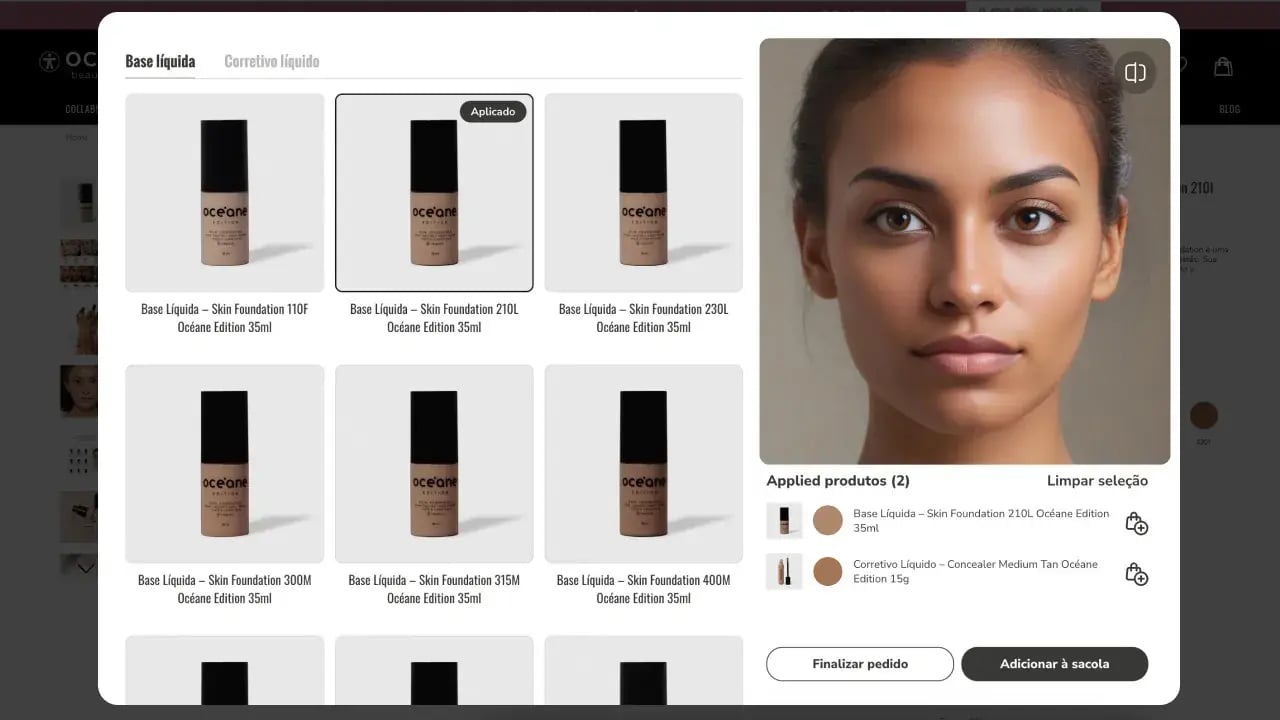 Banuba's virtual try-on for ecommerce interface example
GlamAR
Platform. iOS, Android, and web browsers, with e-commerce support for Shopify, WooCommerce, Magento, and custom-built platforms. GlamAR is a product of Shopsense Retail Technologies (Fynd).
Language and integration surface. SDKs, embed codes, or APIs, plus a GlamAR app on the Shopify App Store.
License model. SaaS subscription with monthly plans you can upgrade, downgrade, or cancel at any time. Custom and enterprise plans are available.
Deployment. Surfaces are gated by tier: Web on Starter, Web and App on Growth, Web, App and In-store on Scale. Typical onboarding runs 2–4 weeks depending on modules and 3D-asset readiness. GlamAR states SOC 2, GDPR, and ISO compliance.
Pricing. Starter from $250/month for 10,000 monthly views, 50 SKUs, web, an analytics dashboard, and email support. Growth from $350/month for 50,000 views, 100 SKUs, web and app, product recommendations, multiple-looks try-on, and priority support. Scale from $450/month for 100,000 views, 500 SKUs, all three surfaces, custom UI, and a dedicated success manager.
Category coverage. AR try-on across makeup, eyewear, jewelry, watches, accessories, footwear, apparel, and nails. The wider suite adds 3D Model Creation, 3D Configurator, 360 Viewer, AI Facial Skin Analysis, SkinGPT, AI Stylist, and Virtual Store.
Documented limitations. AR Try-On plans assume AR-ready 3D models already exist; brands without them must purchase 3D model creation separately. Each plan caps monthly views and SKUs (10k/50, 50k/100, 100k/500).

Revieve
Platform. Web first: a JavaScript SDK loaded via a CDN script tag or npm. iOS and Android integrations are published as WebView plugin samples (Swift and Java) that wrap the web plugin, and an official React Native example project exists.
Language and integration surface. JavaScript, currently SDK version 1.8, installed with npm install @revieve/sdk --save or loaded from https://sdk.revieve.com/revieve-sdk.min.js. The architecture is modular: CV, AR, liveAR, Product Recommendations, and Analytics.
License model. A valid partnerID issued by Revieve is required to initialize the SDK. The advanceTracking flag, which gives more accurate points and effects in liveAR, requires a special license.
Deployment. An enterprise-grade AI SaaS platform hosted by Revieve. The CV module sends the user image to Revieve's servers to perform skin analysis, which is the sharpest architectural difference in this comparison. Test and prod environments are selectable at instantiation. Revieve states GDPR and CCPA compliance.
Pricing. Requires fact-checking. Revieve does not publish list pricing.
Category coverage. liveAR covers mascara, eyeshadow, eyeliner, blush, lipstick, lipliner, concealer, bronzer, highlighter, and foundation, plus beautify and eyebrow-shape effects. Skin tone is detected automatically on the Fitzpatrick 1–6 scale from CV API v3 onward, with automated lighting and white-balance correction. The CV module returns 18 skin attributes including wrinkles, redness, hyperpigmentation, acne, and pore dilation, and a hair component returns volume, frizziness, and type.
Documented limitations. Images must be at least 600x600 or CV analysis will not run. The CV module must analyze an image before any AR filter can be applied. Not every recommended product can be visualized, so canVisualizeProduct must be called first. Only Google Analytics trackers are available. Response size and latency grow with the number of components requested.
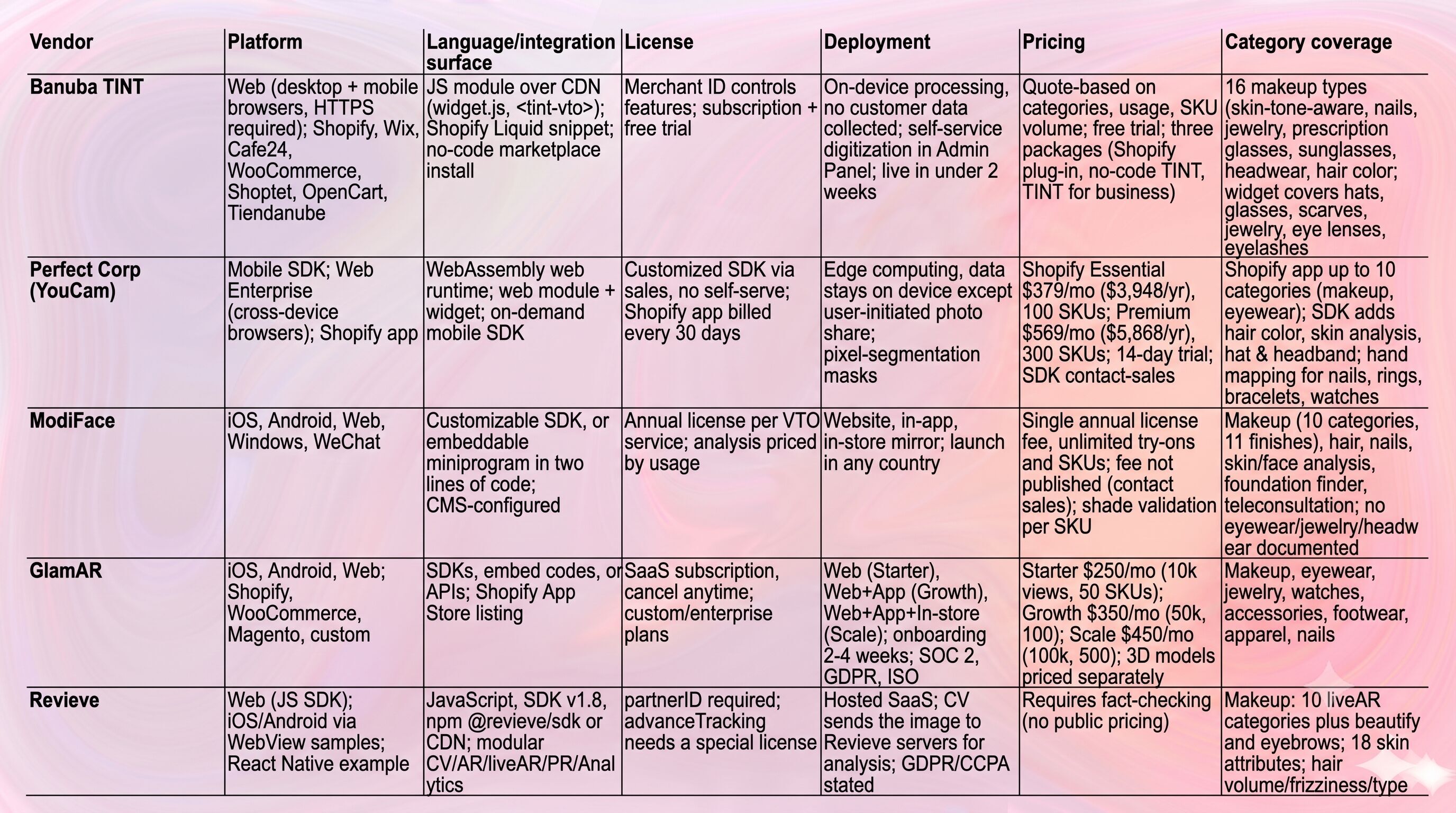
Comparison table
Which one to pick
Overall, Banuba TINT is the strongest default for a beauty or accessories store that wants one plugin to cover the catalog. It is the only vendor here that pairs 16 skin-tone-aware makeup types with eyewear, jewelry, headwear, and lenses in a single web widget, keeps processing on the shopper's device, and includes the digitization pipeline instead of billing 3D assets separately. The free trial and roughly five-minute setup make the evaluation cheap, and the Océane result gives a documented ceiling for what add-to-cart can do.
That is a default, not a verdict for every store.
- Choose GlamAR if you need published, low-entry pricing and already own 3D models. $250/month for a web deployment is the cheapest documented entry point in this group, and its category list is the widest on paper (apparel and footwear included). The caveat is real: if you do not have AR-ready 3D models, the asset bill lands separately and the 2–4 week onboarding starts later than it looks.
- Choose ModiFace if you have an enormous catalog and a makeup-only scope. Unlimited SKUs and unlimited try-ons under one annual fee is the best economics at the high end, and the L'Oréal heritage plus diverse-dataset validation carries weight in enterprise procurement. It does not document eyewear, jewelry, or headwear, so it loses multi-category stores.
- Choose Perfect Corp YouCam if you want a no-code Shopify install with a published price and beauty-advisor features. $379/month for 100 SKUs is predictable, and the AI skin analysis plus Beauty Advisor modules cover consultative selling that a pure try-on widget does not. Cost per SKU is the trade-off: 100 SKUs is a small catalog for that price.
- Choose Revieve if diagnostics matter more than try-on breadth. 18 skin attributes and automatic Fitzpatrick detection make it the strongest skincare-analysis engine here. Its server-side processing and makeup-only rendering rule it out for accessories and for teams that need on-device processing.
If the shortlist is a Shopify beauty store weighing category breadth against a published price, the practical test is to run the Banuba TINT free trial and the GlamAR Starter plan against the same twenty SKUs and compare digitization effort, not demo quality.

References and further reading
- Banuba TINT widget documentation: https://tintvto.com/docs/
- Banuba Virtual Try-On plugin on the Shopify App Store: https://apps.shopify.com/tint-virtual-try-on-by-banuba
- Perfect Corp YouCam for Web Enterprise: https://www.perfectcorp.com/business/services/youcam-4-web
- Perfect Corp YouCam SDK: https://www.perfectcorp.com/business/services/sdk
- Perfect Corp YouCam Virtual Try-On on the Shopify App Store: https://apps.shopify.com/youcam-makeup-official
- ModiFace makeup virtual try-on: https://modiface.com/products-makeup.html
- ModiFace pricing: https://modiface.com/our-pricing.html
- GlamAR virtual makeup SDK: https://www.glamar.io/solutions/sdk/virtual-makeup-sdk
- GlamAR AR try-on pricing: https://www.glamar.io/pricing/ar-try-on
- Revieve platform overview: https://www.revieve.com/platform
- Revieve makeup virtual try-on: https://www.revieve.com/platform/makeup/makeup-virtual-try-on
-
Not on a supported marketplace. Banuba's plugin installs from the Shopify App Store or the Tiendanube marketplace in a few clicks with no code, and merchants on other CMSs can either add a Liquid or script snippet themselves or have Banuba's developers handle the integration. GlamAR and Perfect Corp also publish Shopify apps. For custom storefronts, the Banuba TINT documentation covers the widget API and the Shopify snippet in full.
-
It depends entirely on the vendor, and it is worth asking early because it changes your privacy review. Banuba and Perfect Corp process the camera feed on the shopper's device, while Revieve's CV module uploads the image to Revieve's servers for skin analysis. Banuba does not collect, store, or process customer images at all, which is why its virtual try-on platform needs no data-processing agreement for shopper imagery.
-
Published entry prices in this group run from $250/month (GlamAR Starter, 10,000 views and 50 SKUs) to $379/month (Perfect Corp YouCam Shopify Essential, 100 SKUs). ModiFace and Revieve do not publish prices. Banuba quotes against product categories, monthly usage, and SKU volume, and the Banuba TINT pricing guide explains how the three packages differ and what drives a quote.
-
Banuba's virtual try-on plugin can launch in under two weeks as a guided TINT widget, and the snippet itself takes about five minutes to place, because product digitization is self-service rather than an agency deliverable. GlamAR documents 2–4 weeks depending on modules and whether your 3D assets are ready. The gap is almost always the asset pipeline, not the code.
-
Makeup is universal across all five vendors; everything else is where they diverge. Banuba covers 16 makeup types with skin-tone-aware application plus hats, glasses, scarves, jewelry, eye lenses, eyelashes, nails, and hair color, and its glasses virtual try-on builds eyewear models from three frame photos. ModiFace and Revieve stay within makeup, hair, and nails, while GlamAR extends to apparel and footwear.
-
A plugin is enough for a standard product page on a supported CMS, which is most stores. If you need custom UI, multi-channel retail, or try-on inside your own app, Banuba's Makeup Virtual Try-On SDK offers the same rendering with full control over the experience, and Banuba Web AR covers browser-based try-on for high-traffic marketplaces.
-
In documented deployments, yes, though the size depends on category and traffic quality. Océane, a Brazilian cosmetics brand using Banuba TINT, moved add-to-cart from the 3% industry average to 20.15% in the first month of a concealer and foundation pilot, then peaked at 32%, and ran out of stock; the full numbers are in the Océane success story.
