

The AI avatar market is projected to grow from $0.80 billion in 2025 to $5.93 billion by 2032, according to MarketsandMarkets. Much of that growth is driven by one specific capability: turning a static photo into a talking, lip-synced video using nothing but an API call.
Users now expect personalized video: animated onboarding avatars, AI presenters for product demos, and talking selfies for short‑form content. Building this in‑house means months of work on computer vision, facial animation, and audio‑visual sync: a timeline most teams can’t afford.
That’s where AI talking photo APIs come in. But choosing the right one is tricky:
- Some only offer a cloud REST API with no native iOS/Android SDKs
- Some look great in demos but break at scale (artifacts, bad lip sync, slow processing)
- Pricing models are all over the place (per‑second, vague credits, or “contact sales” walls)
This comparison reviews seven AI talking photo API providers (Banuba, D-ID, Magic Hour, WaveSpeedAI (InfiniteTalk), AKOOL, LongCatAvatar, and A2E) against six criteria that matter for real production social, e-learning, e-commerce, or marketing apps, not weekend prototypes.
If you're evaluating talking photo APIs right now, bookmark this page. We'll walk through every detail that affects your integration timeline, your user experience, and your budget.
[navigation]
AI talking photo APIs turn a single portrait into a realistic talking video by animating the face, syncing lips, and adding natural head movement from audio and prompts. This guide compares seven leading options on platform support, performance, pricing, and developer experience. For cross-platform coverage, production‑grade quality, and quick integration, Banuba’s AI Talking Photo API stands out with strong native mobile support and reliable visuals.
TL;DR
- This guide is for developers, technical founders, and product managers comparing AI talking photo APIs for production apps.
- We evaluated seven providers (Banuba, D-ID, Magic Hour, WaveSpeedAI, AKOOL, LongCatAvatar, A2E) on platform support, performance, features, integration complexity, developer experience, and pricing.
- Banuba is the best fit for mobile-first and cross-platform teams that need native SDKs (iOS, Android, RN, Flutter, Unity), full-body animation, and a broader AR/video editing ecosystem.
- D-ID suits enterprise teams that need streaming avatars and multilingual scale. Magic Hour works well for rapid prototyping across multiple AI tools.
- If budget is the priority, WaveSpeedAI and A2E offer the lowest per-unit costs, though with trade-offs in speed, resolution, or support.
How We Tested: Evaluation Criteria
To keep this comparison useful and fair, we evaluated each AI talking photo API against six criteria. These are the factors that consistently determine whether a solution works in production or only looks good in a demo.
- Platform support (iOS, Android, Web, React Native, Flutter). Combining the talking photo functionality with a regular editing workflow ensures that the end user has more flexibility in how to process and present the generated footage. A solution that only supports web leaves mobile teams writing custom wrappers and managing video rendering on their own.
- Performance and latency. Processing speed determines what's possible in your product. A 30-second wait for a 10-second video rules out real-time or near-real-time use cases like live content creation or interactive avatars. We looked at reported render times, cold start behavior, and how each provider handles concurrent requests.
- Feature set. Lip sync accuracy is table stakes. Beyond that, we compared face animation quality, head and body movement, identity preservation across frames, audio input flexibility, multi-language support, and whether the API integrates with a broader toolkit (face AR effects, voice cloning, text-to-speech).
- Integration complexity. How long does it take to go from getting an API key to working prototype? We looked at documentation clarity, the number of required API calls per video, SDK availability, code samples, and whether the provider offers pre-built UI components that speed up development.
- Developer experience and support. Good documentation matters, but so does what happens when something breaks. We checked for developer guides, active community channels (Discord, GitHub, forums), response time from support teams, and the overall maturity of each provider's developer ecosystem.
- Pricing and licensing. Hidden costs can kill a project after launch. We compared pricing transparency, per-unit costs (per second, per credit, per video), free tier availability, and how each model scales as usage grows. Enterprise licensing options and volume discounts also factor in for teams planning to scale.
Top 7 AI Talking Photo APIs: Detailed Overview
Below, we break down seven AI talking photo APIs that are actively used by developers in 2026: Banuba, D-ID, Magic Hour, WaveSpeedAI InfiniteTalk, AKOOL, LongCatAvatar, and A2E. Each section covers features, strengths, trade-offs, and ideal use cases so you can match the right tool to your product requirements.
Banuba’s AI Talking Photo API
Banuba is a computer vision and AR company with 9+ years in the market and over 120 enterprise clients. Its AI Talking Photo API, launched in February 2026, turns a single portrait into a talking video with accurate lip sync, natural facial expressions, and full-body movement. The API runs on dedicated neural networks built by Banuba's in-house AI lab.
The key difference from every other provider here is that this isn't an isolated tool. While the generation happens in the cloud, it sits inside a mature SDK ecosystem covering face tracking, face and body segmentation, background replacement, beauty AR, and video editing. The talking photo feature plugs into a broader pipeline rather than standing alone.
"Our goal was to make talking photo generation practical, not experimental. Developers can now add high-quality avatar video features without building custom AI pipelines or sacrificing visual reliability," said Anton Liskevich, Co-Founder and CPO at Banuba.
Key Strengths
- Artifact-free output. Purpose-built neural networks avoid the distortions, hallucinations, and uncanny valley glitches common in general-purpose models. Production-ready video, no post-processing needed.
- Full-body animation. Most competitors animate only the face. Banuba generates synchronized body movement (head, shoulders, torso), producing results closer to recorded footage.
- Language-agnostic lip sync. Maps audio signals to lip shapes rather than relying on language-specific phoneme libraries. Works with any spoken language.
- No resolution cap. Supports up to 1920x1080, while many competitors cap at 720p.
- High performance. Banuba's underlying face tracking and segmentation technology, which powers the talking photo pipeline's face detection and landmark analysis, runs at around 30 FPS during live face tracking and up to 60 FPS in exported videos.
Ideal Use Cases
Banuba fits teams that need talking avatars inside larger, feature-rich apps.
- Marketing and ads. Generate video ads with AI presenters at scale from a single photo and script.
- eLearning. Produce video lessons without studio time, especially useful for multilingual platforms.
- Social and content creation apps. Banuba's client Chingari hit 550,000 downloads in ten days and 2.5 million total. Weat cut development time by 50% using Banuba's SDK. Videoshop reached 20M+ downloads with 4.9/5 App Store ratings after integrating Banuba's AR effects.
- Product explainers. E-commerce and SaaS products can generate personalized walkthrough videos using brand ambassadors' photos.
Feature Set
- Photo-to-video from a single portrait + audio input
- Text prompt control for avatar speech and behavior
- Custom audio upload or AI voice selection
- Audio waveform-driven lip sync (language-independent)
- Full-body movement generation
- Identity preservation across frames
- Up to 1080p output
Technical Depth: Architecture and Ecosystem
Banuba's core engine powers proprietary face and body segmentation. The Face Tracking SDK detects faces in real time across iOS, Android, Web, React Native, Flutter, and Unity, at distances up to 7 meters. Face Segmentation and Body Segmentation handle pixel-level separation of face, hair, skin, and body from backgrounds. Everything runs on-device with GPU acceleration: no latency penalty, no per-frame cloud billing, no biometric data leaving the phone.
Tools no competitor matches:
- Banuba Studio lets non-developers create and customize AR effects and avatars without code. Designers can build filters, beauty effects, or branded overlays that complement talking photo output.
- Asset Store provides a library of pre-made AR effects, masks, and filters ready for immediate use.
- Fully customizable UI. SDKs ship with pre-built components for common flows (photo upload, audio selection, video preview), but every element can be restyled to match your design system.
This modular approach lets teams start with just the talking photo API and later add beauty touch-up, background replacement, AR filters, or a full video editor without switching vendors.
Developer Experience
Banuba offers detailed documentation, including agent skills for AI-assisted development. Community support via the Developer Portal. All SDKs on GitHub with sample projects per platform.
Most teams get a working prototype within days and reach production within one to two weeks. Demo apps available for iOS and Android. A 14-day free trial with no feature restrictions is available.
Pricing
B2B licensing model. Pricing requires contacting the team. No self-serve $10/month plan. But for teams that need technical support, SLA guarantees, and a vendor with nearly a decade of track record, the enterprise model often makes more sense than credit-based pricing that scales unpredictably.
D-ID Talking Head API
D-ID, founded in 2017, generates avatar videos from a single image and audio or text, supporting 120+ languages and claiming a 4x real-time processing speed. Over 150 million videos generated to date. Includes both a self-serve Creative Reality Studio and a RESTful API.
Key Strengths
- Mature, well-documented REST API with real-time streaming for interactive avatars
- Built-in TTS with hundreds of voice options, expression/emotion controls, and voice cloning
- Handles tens of thousands of concurrent requests
- 24/7 support for all API and studio customers
Limitations
- Cloud-only. No native iOS, Android, Flutter, or React Native SDKs. Mobile teams must build custom wrappers.
- Confusing credit-based pricing. Users report billing discrepancies. The free plan includes watermarks.
- Video capped at 5 minutes. Resolution limited to 1280x1280 for standard presenters; premium presenters locked to higher tiers.
- Limited body animation. Focus is on the face and head only. Output can feel stiff compared to newer models.
Ideal Use Cases
Enterprise teams producing training videos, multilingual marketing content, and interactive support avatars at scale. Strongest for companies embedding streaming avatars in websites.
Who Should Not Choose It
Mobile-first teams needing SDK integration and on-device processing. Teams requiring full-body animation. Budget-conscious teams frustrated by opaque credit systems.
Magic Hour Talking Photo API
Magic Hour is a developer-first generative video platform bundling 20+ AI tools (face swap, lip sync, animation, talking photo, AI voice) behind a single API key. SDKs in Python, Node.js, Go, and Rust.
Key Strengths
- One integration, 22+ endpoints covering video, image, and audio generation
- First API call in about 3 minutes. Clean docs, four language SDKs
- Transparent pricing listed on-site (a rarity)
- Both audio upload and TTS input supported
- Free tier: 400 credits + 100 daily bonus
Limitations
- Web-only. No native mobile SDKs or app.
- Free talking photos limited to 5 seconds.
- Broad but shallow. Talking photo quality is solid, but may not match specialized providers for production-grade facial realism. The output will differ from the original input facial features.
- Newer player with limited enterprise deployment history.
Ideal Use Cases
Startups and small teams wanting one API for multiple generative video needs. Good for rapid prototyping and social content creation.
Who Should Not Choose It
Mobile-native apps needing deep SDK integration. Products where talking photo is the core feature and quality must be best-in-class.
WaveSpeedAI (InfiniteTalk)
Overview
WaveSpeedAI hosts InfiniteTalk, an open-source audio-driven avatar model developed by MeiGen-AI. Built on a 14B parameter Diffusion Transformer architecture (Wan 2.1), it generates talking or singing videos up to 10 minutes long at up to 720p; however, the face rarely stays the same. Available as a managed REST API with no cold starts, or self-hostable via Hugging Face (Apache 2.0).
Key Strengths
- Transparent pricing: $0.15/5s (480p), $0.30/5s (720p), capped at $9/run
- No cold starts, immediate processing
- Singing support, not just speech
- Multi-character support (two speakers, one image, two audio tracks)
- Open-source model for self-hosting flexibility
Limitations
- Cloud API only. No mobile SDKs.
- Max 720p. No 1080p option.
- Slow processing: 10-30 seconds compute per 1 second of output. A 30-second video can take 5-15 minutes.
- Tiny company. Minimal developer community and support.
- Third-party model. WaveSpeedAI hosts it but doesn't control development. Vendor risk if MeiGen-AI changes direction.
- No built-in TTS. Audio must be generated separately.
Ideal Use Cases
Longer-form talking avatar videos (2-10 minutes) at affordable prices. Podcast visuals, educational content, batch marketing. Also suits developers wanting self-hosting flexibility.
Who Should Not Choose It
Teams needing real-time generation, 1080p output, mobile SDK integration, or enterprise-grade vendor support.
AKOO Talking Photo API
AKOOL is an enterprise AI video suite: avatar videos, face swap, video translation, streaming avatars, voice cloning, image generation, and talking photos.
Key Strengths
- Comprehensive all-in-one platform with talking photo as one of many tools
- 175+ languages via TTS and video translation
- 3-day free trial on Pro/Pro Max;
- responsive Discord support
Limitations
- Complex credit-based pricing across four tiers. G2 reviewers frequently flag "expensive" and "pricing issues."
- Slow rendering noted in multiple user reviews.
- No native mobile SDKs. Cloud REST API only.
- Talking photo isn't the core focus, and it shows in specialization depth.
Ideal Use Cases
Enterprise marketing and L&D teams needing a full AI video production suite from one vendor for training, product showcases, and multilingual campaigns.
Who Should Not Choose It
Developers wanting a focused, lightweight talking photo API. Small teams with limited budgets. Mobile-first product teams.
LongCatAvatar
LongCatAvatar is built on Meituan's LongCat-Video foundation, a 13.6 B-parameter video generation model. The underlying model is open source on Hugging Face under Apache 2.0.
Key Strengths
- Backed by Meituan (major Chinese tech company) with strong research resources
- Open-source model enables self-hosting and customization
- Good lip sync with full-body coherence and identity preservation
- Pay-per-use, no subscription required
Limitations
- Max 2 minutes video length, and 720p resolution cap.
- Sparse documentation. Docs focus on LLM models, not avatar video.
- No mobile SDKs. No community, no Discord, one YouTube demo.
Ideal Use Cases
AI researchers experimenting with the open-source model. Budget prototyping and internal tools.
Who Should Not Choose It
Anyone building a production app. No reliable support, no clear documentation, too early-stage for customer-facing deployment. Teams needing videos over 2 minutes or above 720p.
A2E AI Avatar API
A2E (Avatar to Everything) offers lip sync, voice cloning, face swap, talking photo, and image-to-video through a web studio. Positions itself as a cheaper D-ID/Synthesia alternative. 99.9% SLA, 50+ languages, 100+ community avatars.
Key Strengths
- Affordable. 100 free credits for new users; Pro plan ($9.90/month) includes API access, no watermark, up to 4K
- Broad feature set: talking photo, lip sync, voice cloning, face swap, streaming avatars, all in one API
- Volume pricing with dedicated GPU lines for enterprise
- Clean API docs with reliable endpoints, per developer feedback
Limitations
- Slow generation. Lip sync runs at ~1:10 ratio (15s video = ~150s processing). Link-to-video takes ~5 minutes.
- "Uncensored" positioning may create brand-safety and compliance concerns for enterprise buyers.
- Confusing credit system. Different features burn credits at different rates.
- Small community. Mixed reviews. Concerns about inconsistent results.
- No native mobile SDKs.
Ideal Use Cases
Solo creators, small agencies, and indie developers needing an affordable all-in-one AI avatar platform for marketing videos and social content.
Who Should Not Choose It
Enterprise teams with brand-safety requirements. Anyone needing fast generation for real-time workflows. Mobile-first teams. Organizations that require a vendor with a long track record for production-critical applications.
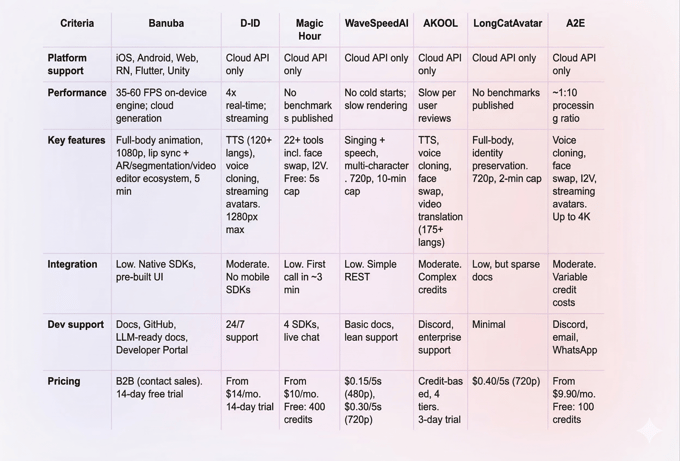
Best AI Talking Photo APIs at Glance: Comparison Table
To Wrap Things Up
Before you commit
Think platform first. A powerful cloud API is wasted if your engineers spend weeks building mobile wrappers that a native SDK handles out of the box.
Run budget math at scale. Credit-based pricing looks cheap at low volume but spikes unpredictably. Per-use models (WaveSpeedAI) are more predictable. Enterprise licensing (Banuba) trades upfront negotiation for long-term cost stability. Project your usage at 3, 6, and 12 months.
Check vendor stability. Some providers here have operated for nearly a decade with 150+ enterprise clients. Others launched months ago. If your product depends on the API, that difference matters.
There's no single "best" AI talking photo API for every team. But after evaluating all seven providers, clear patterns emerge.
Best for mobile-first and cross-platform apps: Banuba. The only provider with native SDKs for iOS, Android, React Native, Flutter, and Unity. Add the broader ecosystem (face AR, segmentation, video editing) and full-body animation, and it's the strongest pick for production-grade, customer-facing products. B2B pricing requires a sales conversation, but a 14-day free trial lets you test everything first.
Best for enterprise-scale video and streaming avatars: D-ID. Mature platform, 120+ languages, real-time streaming API, 24/7 support. A safe choice for large teams. Watch the credit-based billing and plan to build your own mobile layer.
Best for rapid prototyping with multiple AI tools: Magic Hour. One API key, 22+ endpoints, transparent pricing. Fastest path from zero to working prototype. Not best-in-class on any single feature, but great for MVPs.
Best for long-form video on a budget: WaveSpeedAI InfiniteTalk. Up to 10-minute videos at $0.30/5s. Ideal for educational content and batch production where processing time isn't critical. Open-source model gives you a self-hosting exit strategy.
Best for all-in-one enterprise video suites: AKOOL. Talking photos plus face swap, video translation, streaming avatars, and voice cloning under one roof. Enterprise partnerships with Canon and Google Cloud. Expect higher costs and a learning curve.
Best for open-source research: LongCatAvatar. A serious 13.6B parameter model on Hugging Face, but too early-stage for customer-facing products.
Best for solo creators on a tight budget: A2E. Pro plan at $9.90/month with API access, no watermark, up to 4K. Lowest barrier to entry for individual creators. Slow processing and "uncensored" positioning limit enterprise appeal.
-
Start with platform support. If your app runs on mobile, check whether the provider offers native SDKs like Banuba or just a cloud REST API. Then evaluate lip sync quality, output resolution, processing speed, and whether the API supports audio upload, text-to-speech, or both. Documentation quality and support responsiveness matter just as much once you're past the prototype stage. Finally, model your costs at realistic usage volumes before committing to a pricing tier.
-
Most providers use one of three models: credit-based, pay-per-second of generated video, or enterprise licensing with custom quotes. Credit-based systems offer low entry points but can scale unpredictably. Per-second billing is more transparent. Enterprise licensing provides cost stability at higher volumes but requires a sales conversation upfront.
-
For mobile-first products, Banuba is the only provider with native SDKs across iOS, Android, React Native, Flutter, and Unity, plus a broader AR and video editing ecosystem to grow into. The right choice depends on where your users are and how deeply the talking photo feature integrates into your product.
