

The face tracking software market was valued at $5.6 billion in 2025 and is projected to reach $49.8 billion by 2033, growing at a CAGR of 15.8%. That growth is not abstract. It shows up in real products: dating apps with live AR masks, video conferencing tools with virtual backgrounds, beauty platforms with real-time makeup try-on, and e-commerce stores running virtual eyewear fittings.
For developers building these products, the choice of face AR SDK shapes everything from frame rate to feature ceiling. Get it wrong, and you're stuck with battling jitter on mid-range Androids, missing segmentation features, or a pricing model that punishes growth.
Banuba and DeepAR both target this market. They were both founded around the same period. Both run on-device processing. Both support iOS, Android, Unity, and Web.
But the similarities thin out quickly once you look at tracking precision, segmentation capabilities, and content ecosystems. The devil is in the details.
We tested both SDKs and reviewed their documentation, developer forums, and public case studies. Let's get into it.
[navigation]
Face AR SDKs let developers add real-time face tracking, AR filters, beautification, and virtual try-on features to mobile and web apps without building a computer vision pipeline from scratch. Banuba and DeepAR are two of the most recognized commercial options in this space. Banuba is the stronger pick for teams that need broad platform coverage worldwide, deep segmentation capabilities, and responsive technical support, while DeepAR works well for smaller-scale prototypes and web-first AR experiences.
TL;DR
- This guide compares Banuba Face AR SDK and DeepAR SDK across features, performance, platform support, pricing, and support quality.
- Both SDKs handle face tracking, AR filters, and beautification, but they differ significantly in tracking precision, segmentation depth, and content libraries.
- Banuba is best suited for production apps that require high-accuracy face tracking, full-face-part segmentation, and cross-platform reach across Windows and macOS.
- DeepAR is a reasonable option for lightweight AR prototypes and web-based face filter experiences, especially at low MAU counts.
- Since Zalando acquired DeepAR in April 2025, the SDK now operates within Zalando's e-commerce roadmap. Banuba remains independent, serving 120+ clients across industries worldwide.
How We Evaluated These SDKs
To keep this comparison grounded, we scored Banuba and DeepAR against six criteria that matter most in production:
Face Tracking Accuracy and Feature Depth. How many anchor points does the SDK track? How well does it handle extreme angles, low light, partial occlusion, and multiple faces? Does it support 3D mesh reconstruction or just 2D landmarks?
Segmentation and Beauty Features. Can the SDK segment individual face parts (hair, skin, eyes, lips, eyebrows)? How natural does skin beautification look? How many types of makeup products are supported?
Platform Support. Does it run on iOS, Android, Web, Unity, and desktop (Windows, macOS)? Are there wrappers for Flutter and React Native?
Integration Complexity and Developer Experience. How long does setup take? Is the documentation clear and complete? Are there sample projects and community resources?
Pricing and Licensing. What's the cost structure? Is it MAU-based, flat-fee, or hybrid? How transparent is the pricing?
Support and Reliability. What are the actual response times? Is there an SLA? How often does the SDK receive updates?
Face AR SDK Selection Criteria for Production Apps
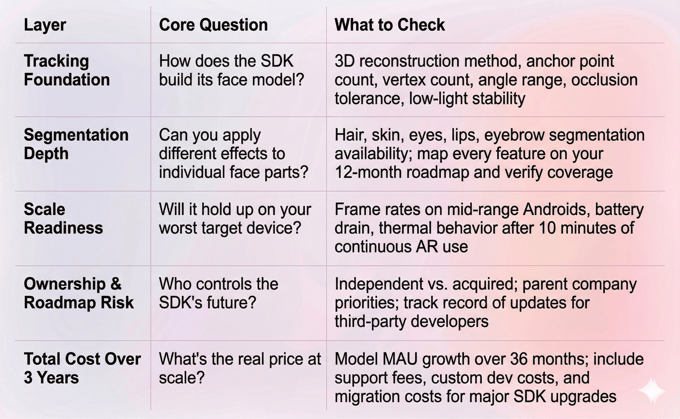
When evaluating any face AR SDK, not just Banuba and DeepAR, consider these five layers:
Banuba Face AR SDK
Overview
Banuba's Face AR SDK is a commercial face-tracking and augmented-reality engine built on patented technology. The core differentiator is how it handles face detection: instead of identifying 2D facial landmarks and then converting them into a 3D model (the standard approach), Banuba constructs a 3D head model directly using its proprietary Face Kernel technology. This skips an entire step in the pipeline, which leads to better accuracy and stability, especially at extreme angles and in poor lighting.
The SDK tracks 68 facial anchor points and reconstructs a 3D face mesh using up to 3,308 vertices. It works on 97% of iOS devices (starting with iOS 13.0) and 80% of Android devices (starting with Android 8.0 with the Camera 2 API and OpenGL ES 3.0). Simultaneously, it operates on the web and desktop. Its detailed documentation is available both for traditional integration and vibe coding.
Banuba has been in the AR space since 2016 and remains an independent company focused entirely on serving third-party developers and brands worldwide. Its client list spans industries and geographies: Gucci in cosmetics; Samsung in consumer electronics; Schwarzkopf in haircare; RingCentral, Kakao, and Vidyo in video conferencing; Match Group in social and dating; and Crisalix in healthcare. That breadth matters. It means Banuba's roadmap is shaped by the needs of a diverse, global developer community rather than a single parent company's internal priorities.
Key Strengths
Tracking precision. 68 facial anchor points and a direct 3D math model give Banuba an edge in accuracy. The SDK handles angles from -90° to +90°, works in low-light conditions, and stays stable with up to 70% facial occlusion. It can detect faces up to 7 meters from the camera.
Full face segmentation. Banuba segments every major face part: hair, skin, eyes, eyebrows, lips, and background. This matters for beauty apps and virtual try-on, where you need pixel-level control over individual features.
Background separation quality. The SDK handles complex scenes well, including backgrounds with movement. It supports video, GIF, and 360-degree backgrounds, not just static images.
Beautification that preserves skin texture. Banuba's skin-smoothing keeps the skin's natural texture visible, avoiding the plastic, blurred look that some competing SDKs produce. The SDK offers 28 face-morphing options and supports acne removal, eye-bag removal, and presets.
Makeup and try-on depth. 16 makeup product types with correct application across different skin tones, plus eyebrow segmentation that detects the actual shape. Banuba’s Virtual Try-On also supports nail detection and try-on, jewelry, glasses (including prescription), headwear, and hair color.
Content library. Over 1,000 AR filters available in the Asset Store, plus GLTF support and KTX format support for faster effect loading and better rendering.
Cross-platform coverage. iOS, Android, Web, Unity, Windows, macOS, plus Flutter and React Native wrappers.
Vendor independence. Banuba is not owned by a retailer, social platform, or any other company whose priorities might override third-party developer needs. The SDK's roadmap is driven by its 120+ clients across video conferencing, beauty, dating, healthcare, fintech, and creator tools. That independence gives developers confidence that the product will keep evolving for their use cases, not just for one parent company's internal strategy.
Video editor integration. The Face AR SDK plugs directly into Banuba's AI Video Editing SDK, making it straightforward to combine face AR effects with post-production video editing.
Limitations
Learning curve for complex customizations. While basic integration is quick, building highly custom AR effects requires time in Banuba Studio.
Ideal Use Cases
- Social video and creator apps that need rich AR filters and beautification
- Beauty and cosmetics platforms running virtual try-on at scale
- E-commerce apps with eyewear, jewelry, or hair color try-on
- Video conferencing and live streaming with virtual backgrounds and touch-up
- Dating and social apps with real-time face effects
- Fintech and digital banking apps needing liveness detection
Who Should Not Choose It
Teams building a quick throwaway prototype with zero budget will find the yearly billing commitment steep. If you only need bare-bones 2D face detection (no AR, no try-on), lighter open-source tools like Google ML Kit or MediaPipe might cover the basics.
DeepAR SDK
Overview
DeepAR is a London-based AR SDK provider that focuses on face and body tracking for mobile apps, web, and live streaming. The SDK supports iOS, Android, macOS, Unity, and Web (HTML5).
In April 2025, Zalando acquired DeepAR to bring its ShopAR platform and 3D technology in-house. While DeepAR technically remains a separate entity within Zalando, its roadmap now aligns with Zalando's ecosystem strategy.
DeepAR tracks 68 facial anchor points, uses on-device processing, and handles up to four simultaneous faces. It claims to power 60 million AR experiences monthly through its clients.
Key Strengths
Quick setup for basic use cases. DeepAR offers a free tier (with watermark) for up to 10 MAU, making it easy to start testing. Integration of simple AR filters is straightforward, and the documentation is in English and of good quality.
Web AR support. DeepAR has solid browser-based AR capabilities, which matters for marketing campaigns and web experiences where you can't ask users to install an app.
Known clients. DeepAR has worked with brands like Ralph Lauren, Kiko, and Zalando (now its parent company), and its clients reportedly generate 100 million monthly AR users collectively.
Limitations
Fewer facial anchor points. Banuba's 68 facial landmarks mean optimal precision for applications that need fine-grained facial feature detection without excessive battery drain or CPU/GPU load. This gap shows up in makeup try-on accuracy and expression-driven animations.
Limited segmentation. Only hair segmentation is available. Individual face part segmentation (eyes, lips, eyebrows, skin) is not offered, which limits what you can build for beauty and cosmetics use cases.
Background separation quality. Multiple reviews and our internal benchmarks suggest that DeepAR's background removal often leaves large unseparated patches. Long hair and hands/fingers are frequently cut off or poorly separated.
Skin beautification quality. DeepAR's beautification blurs skin texture rather than preserving it, creating an unnatural look. The SDK supports 11 face morphing options (vs. Banuba's 28).
Smaller content library. Roughly 150 AR filters compared to Banuba's 1,000+. No GLTF support listed.
Limited desktop support. macOS only. No Windows support.
Support response times. Users have reported delays in receiving technical support responses, sometimes stretching into days. No SLA is publicly offered. SDK updates happen quarterly rather than monthly.
MAU-based pricing scales linearly. While the entry price is low ($25/month for 10–1,000 MAU), costs scale directly with your user base. At 50,000–100,000 MAU, you're paying $1,000/month. For apps that grow quickly or experience viral spikes, this "success tax" can become a budget headache.
Post-acquisition roadmap shift. With Zalando now owning DeepAR, the SDK's development path is tied to Zalando's e-commerce strategy. Banuba, by contrast, remains fully independent and continues to serve 120+ companies across streaming, beauty, dating, healthcare, fintech, and more, with its product roadmap shaped by that diverse client base.
Ideal Use Cases
- Small-scale AR filter apps and web-based AR marketing campaigns
- Social gaming apps using multi-face tracking and emotion triggers
- Prototyping AR experiences before committing to a production-grade SDK
- Education and virtual meetup platforms with basic face effects
Who Should Not Choose It
Apps needing detailed face segmentation for makeup or skincare try-on will hit a wall quickly. High-traffic platforms should carefully model the MAU-based costs at scale. Teams that need Windows desktop support or frequent SDK updates with SLA-backed support should look elsewhere.
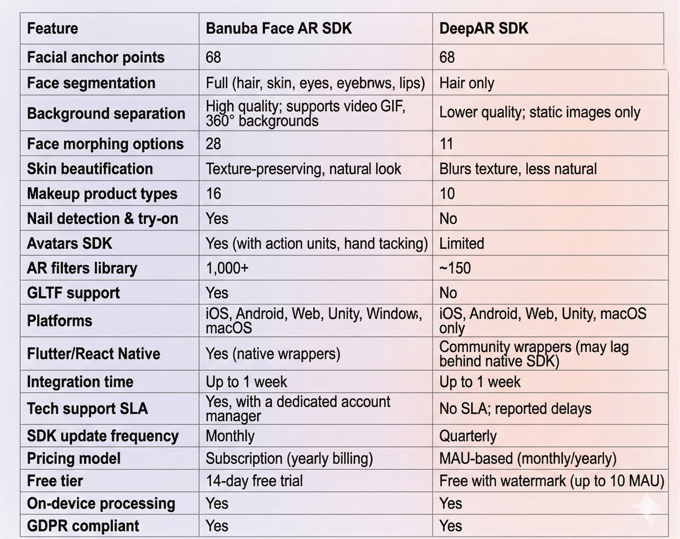
Banuba Face AR SDK vs DeepAR: Comparison Table
Decision Guidance: Which SDK Should You Pick?
The right choice depends on what you're building, how fast you plan to grow, and how much control you need over face segmentation and AR features.
Choose Banuba if you're building a production app that needs to scale. The combination of higher tracking precision, full face-part segmentation, and a library of 1,000+ effects gives Banuba a clear technical lead for any app where face AR is a core feature. The monthly SDK updates and SLA-backed support matter when you're shipping to real users.
Banuba is the obvious pick for beauty and cosmetics platforms. With 16 makeup product types, proper eyebrow segmentation, skin-tone-aware application, and nail detection, there's no comparison. DeepAR's hair-only segmentation simply cannot support that depth.
For video conferencing, live streaming, and social apps, Banuba's integration with Agora and its own Video Editing SDK removes significant development overhead. Brands like RingCentral and Kakao already run on it.
Choose DeepAR if you're prototyping or running a small-scale web AR campaign. The free tier (up to 10 MAU with watermark) and the visual DeepAR Studio editor make it accessible for quick experiments. If your project is a marketing campaign that runs for a few weeks in a browser, DeepAR can get you there fast.
Be cautious about DeepAR for long-term production use. The Zalando acquisition is not just a change of ownership. It is a change of direction. Banuba's independence means its roadmap stays driven by a diverse, global client base across multiple industries, with no single parent company dictating priorities.
Budget considerations. Banuba's yearly subscription model requires more upfront commitment but avoids the linear cost scaling that hits DeepAR users at higher MAU tiers. For apps targeting 100,000+ monthly active users, Banuba's custom pricing often works out more predictably. DeepAR's $25–$1,000/month tiers are transparent but can escalate quickly.
Explore Banuba’s Face AR SDK features in your environment with a 14-day trial without watermarks.
References
Banuba. (n.d.). Banuba technology. https://www.banuba.com/technology/
Banuba. (n.d.). Face AR SDK documentation. https://docs.banuba.com/far-sdk
Banuba. (n.d.). Face filters SDK. https://www.banuba.com/facear-sdk/face-filters
Banuba. (n.d.). Face tracking software. https://www.banuba.com/technology/face-tracking-software
Banuba. (2025). Best face tracking SDKs for real-time video conferencing in 2026. https://www.banuba.com/blog/best-face-tracking-sdks-for-real-time-video-conferencing-in-2025
Banuba. (2026). Best augmented reality SDKs for live streaming (tested). https://www.banuba.com/blog/best-augmented-reality-sdks-for-live-streaming-tested
DeepAR. (n.d.). Documentation. https://docs.deepar.ai/
DeepAR. (n.d.). Pricing. https://docs.deepar.ai/deepar-sdk/pricing/
FashionUnited. (2025). Zalando acquires 3D technology specialist DeepAR. https://fashionunited.com/news/business/zalando-acquires-3d-technology-specialist-deepar/2025040865357
Gartner Peer Insights. (2025). DeepAR reviews & ratings. https://www.gartner.com/reviews/product/deepar-471424751
HTF Market Insights. (2026). Face tracking technology market size share & growth outlook. https://www.htfmarketinsights.com/report/4408796-face-tracking-technology-market
Just Style. (2025). Zalando buys DeepAR to boost tech capabilities. https://www.just-style.com/news/zalando-deepar-acquisition-tech/
Mordor Intelligence. (2026). Augmented reality market size, share & trends report 2031. https://www.mordorintelligence.com/industry-reports/augmented-reality-market
-
Start with tracking accuracy and segmentation capabilities. These determine your feature ceiling. Then check platform support against your actual target devices, not just the OS list. Review documentation quality by actually following a quickstart guide before committing. Finally, model your pricing at current scale and at 10x growth to avoid surprises.
-
Most commercial Face AR SDKs use either MAU-based tiers or flat subscription fees (sometimes with per-platform pricing). MAU-based models charge more as your user count grows. Subscription models typically bill annually and may include custom pricing for large deployments. Free tiers are usually watermarked or limited to development use. Always ask about pricing at your projected scale, not just at launch.
-
For production apps that need reliable tracking, deep segmentation, and predictable pricing at scale, Banuba Face AR SDK is the stronger option. Its monthly update cadence, SLA-backed support, and broad platform coverage (including Windows) make it production-ready.
