

Face filters are now a core part of social video, dating, live streaming, and virtual try-on, backed by a fast-growing market. Grand View Research projects the global AR market will reach $599.59 billion by 2030, while AR in e-commerce is expected to reach $38.55 billion by 2030, led by virtual try-on. Daily usage is already high, with Snap reporting more than 250 million AR users.
For product teams, the challenge is choosing the right engine. Common problems include weak tracking at sharp angles, artificial-looking beautification, outdated effect libraries, and pricing that becomes expensive as usage grows. Data residency is also important for teams serving the EU or regulated markets.
This guide focuses only on face masks and face filters, not full-body AR or world tracking. It covers iOS, Android, Web, and major cross-platform frameworks, with attention to social video, creator, beauty, dating, video conferencing, and AR photo booth products.
[navigation]
A face mask SDK gives developers a ready face-tracking and rendering engine, so you can drop 3D masks, AR lenses, and beauty filters into an app without building a computer vision stack yourself. We compared three commercial options: Banuba, BytePlus Effects, and DeepAR. Banuba is the strongest pick for production apps that need broad platform reach, on-device privacy, and texture-accurate rendering. BytePlus suits teams inside the ByteDance ecosystem chasing a large TikTok-style effect catalog, and DeepAR fits small or web-first projects on a tight budget.
TL;DR
- This guide is for senior engineers, technical founders, and product managers choosing a face mask SDK for filters and 3D masks.
- We compare Banuba Face AR SDK, BytePlus Effects, and DeepAR across tracking, rendering, authoring, and distribution.
- Banuba covers the most platforms, runs fully on-device, and preserves skin texture during beautification.
- DeepAR is the cheapest to start with and good for prototypes, though pricing climbs as your user base grows.
- BytePlus brings a deep effect library but processes some data through servers in China, which raises compliance questions for regulated apps.
How we evaluated: the Mask Pipeline
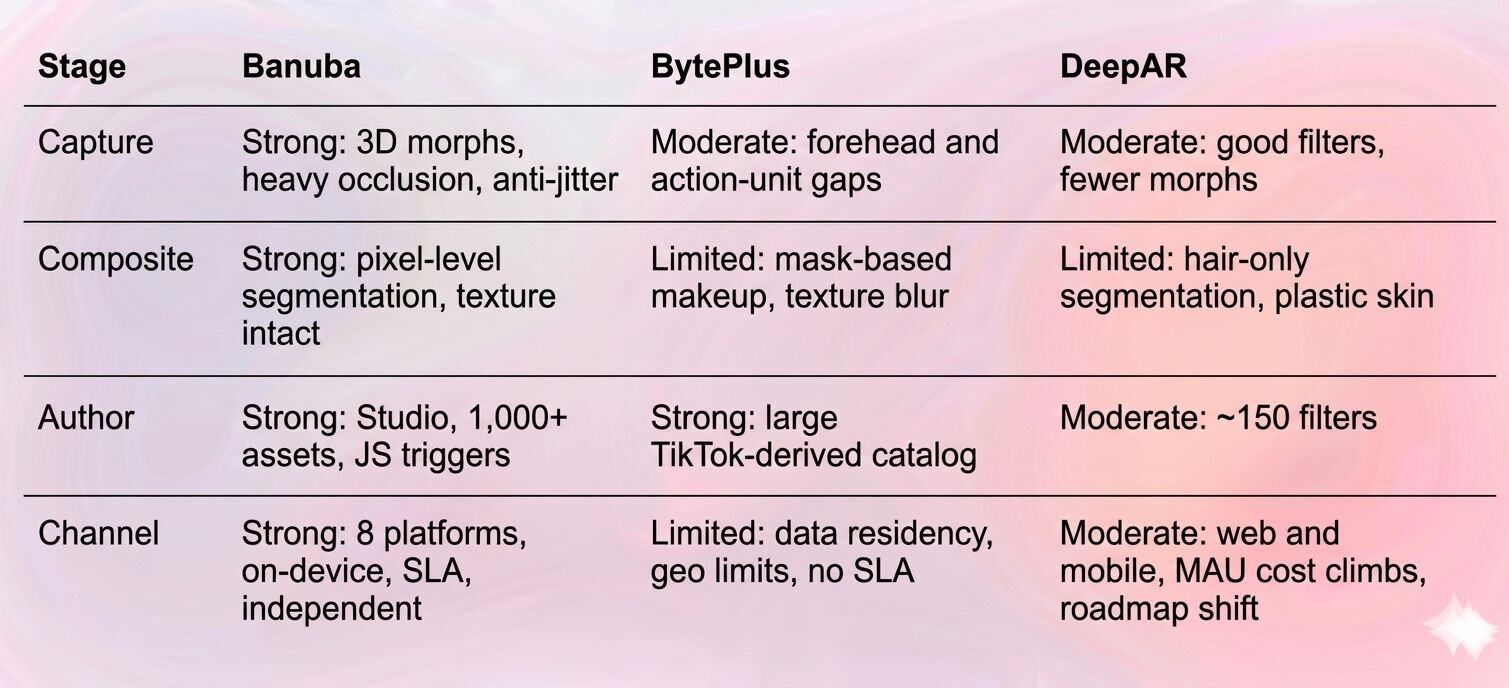
Most comparisons score features in a flat list. That hides where an SDK actually wins or loses. Every face filter runs through four stages before it reaches a user, so we scored each vendor against that route. We call it the Mask Pipeline.
- Capture. How accurately the engine locks onto the face: angles, distance, occlusion, multiple faces, and jitter.
- Composite. How convincingly the mask sits on that face: segmentation depth, lighting, materials, and skin handling.
- Author. How you build and customize filters: studio tooling, ready-made assets, and scripting.
- Channel. How the filter ships: platform coverage, licensing terms, deployment model, and where user data goes.
A weak link at any stage breaks the experience, no matter how strong the others look. The scorecard near the end rates all three vendors across these four stages.
Banuba Face AR SDK
Overview. Banuba is an independent computer vision company founded in 2016, with its own R&D center focused on Face AR. Its face mask SDK ships face tracking, 3D masks, beautification, makeup, hair color, background effects, and scriptable triggers in a single engine.
Capture. Banuba does not rely on flat 2D landmark sets. Its face tracking software builds a 3D morph model, representing the face as a small set of characteristics tied to expression, anthropometry, and head position. That keeps the math light enough for low-end phones while staying accurate. The tracker handles multiple faces at once, works at up to 7 meters from the camera, holds detection across angles from minus 90 to plus 90 degrees, and stays locked with up to 70% facial occlusion. A patented anti-jitter mechanism runs the vision algorithms several times per frame to filter noise, so masks sit still instead of shimmering. The Face Detection SDK even reads a face partly hidden by a medical mask, in low light.
Composite. This is where depth shows. Banuba segments the face at the pixel level, isolating individual features rather than treating the whole head as one surface. The rendering engine supports physically based rendering, image-based lighting, HDR, morphing, physics, video textures, multisample anti-aliasing, and LUT post-processing, with a face mesh of up to 3,308 vertices. Beautification keeps skin texture intact instead of blurring it, which matters for close-up video and product shots.
Banuba's face masks example
Author. Filters are built in Banuba Studio, and teams can license from a catalog of more than 1,000 ready AR filters to cut build time. JavaScript scripting drives interactive triggers like mouth-open, smile, and eyebrow raise, which is how you make face-controlled games and reactive lenses.
Channel. The SDK runs on iOS, Android, Web (HTML5), Windows, macOS, Unity, Flutter, and React Native, with officially maintained plugins on pub.dev and npm. Device coverage reaches 97% of iPhones and 80% of Android phones, from iOS 13 and Android 8.0 up. Everything runs on-device and offline, so no face data leaves the phone, which keeps GDPR handling simple. Pricing comes in two shapes: a flat annual license with unlimited usage and fixed cost, or a usage-based model keyed to monthly active users. Support runs on an SLA with monthly SDK updates and a dedicated account manager. Documentation includes agent skills and code samples on GitHub for every platform.
Real-world use. Video calling app VROOM added Banuba backgrounds and face touch-up and saw 30% monthly active user growth and 54% more registered users. Live chat app Bermuda runs about 15 million Banuba feature launches a month across 20 million installs. sMedio shipped AR features in its app preinstalled on more than 500,000 devices.
Ideal for. Production social, creator, dating, beauty, and conferencing apps that need cross-platform reach, on-device privacy, and natural-looking results.
Who should skip it. Hobby projects that need a free tier and only one basic filter will find the entry cost higher than a metered competitor.

BytePlus Effects
Overview. BytePlus is the enterprise arm of ByteDance, founded in 2012, and its Effects SDK draws on the same effect technology behind TikTok. The pull is the catalog: a very large set of ready effects familiar to short-video users.
Capture. Tracking is competent but uneven. In testing, it showed forehead tracking errors, limited action-unit detection around eye blinks and mouth movement, and visible jitter on small expressions. Hand tracking was imprecise and lost the target often.
Composite. Makeup ships as 3D mask presets rather than individual products, so there is no per-SKU control over foundation, lipstick finish, or liner. Beautification blurs skin texture and tends to look unnatural on close inspection. Background separation struggled, frequently cutting off hands and body, or missing parts of the scene.
Author. The effect library is the headline strength, larger than most rivals, thanks to the TikTok lineage, which helps teams ship trend-driven filters fast.
Channel. Effects covers iOS, Android, Unity, and Web with limited support. The bigger issue for many buyers is data and compliance: processing is partly on-device and partly through backend servers in China, GDPR status is unclear, and the wider ByteDance toolset carries geographic restrictions affecting government staff in several countries. Support runs without an SLA, with responses reported in days.
Ideal for. Teams already building on ByteDance infrastructure, targeting Asian markets, and prioritizing effect volume over data-residency control.
Who should skip it. Regulated industries, EU privacy-sensitive products, government-adjacent apps, and anyone needing precise per-product makeup.
Banuba's face tracking and detection in action
DeepAR
Overview. DeepAR is a London-based AR specialist founded in 2016. In April 2025, Zalando acquired the company to build out its 3D and virtual try-on roadmap. DeepAR stays independent under Zalando, but its direction now tracks a fashion e-commerce strategy rather than the open filter market.
Capture. DeepAR handles face filters, masks, and accessory tracking out of the box and supports up to four simultaneous faces. It offers 11 face morphs, fewer than Banuba's, which limits the range of structural face effects.
Composite. Segmentation is shallow. DeepAR ships hair segmentation but does not isolate lips, eyebrows, or skin individually on Android, which caps makeup precision. Skin smoothing softens texture rather than preserving it, producing the plastic look that fails on close-up shots. The makeup module, with around 10 products, is a paid add-on rather than a core capability.
Author. The bundled filter library sits at roughly 150 effects, well below the catalogs offered by Banuba or BytePlus, though it covers common social use cases.
Channel. DeepAR runs on Web, iOS, and Android, with desktop limited to macOS and no native React Native or Flutter. Processing is on-device. Pricing is metered by monthly active users: free up to 10 MAU, then a low entry tier from about $25 a month, scaling by usage band to custom enterprise terms above 100,000 MAU. That low floor is friendly to prototypes, but the cost rises with success, so a viral app pays a growth penalty. SDK updates land quarterly, slower than monthly competitors, and support runs without an SLA.
Ideal for. Indie developers, prototypes, social gaming, and web-first AR marketing campaigns on a small budget.
Who should skip it. Production apps that need deep segmentation, fast support, predictable cost at scale, or native cross-platform plugins.

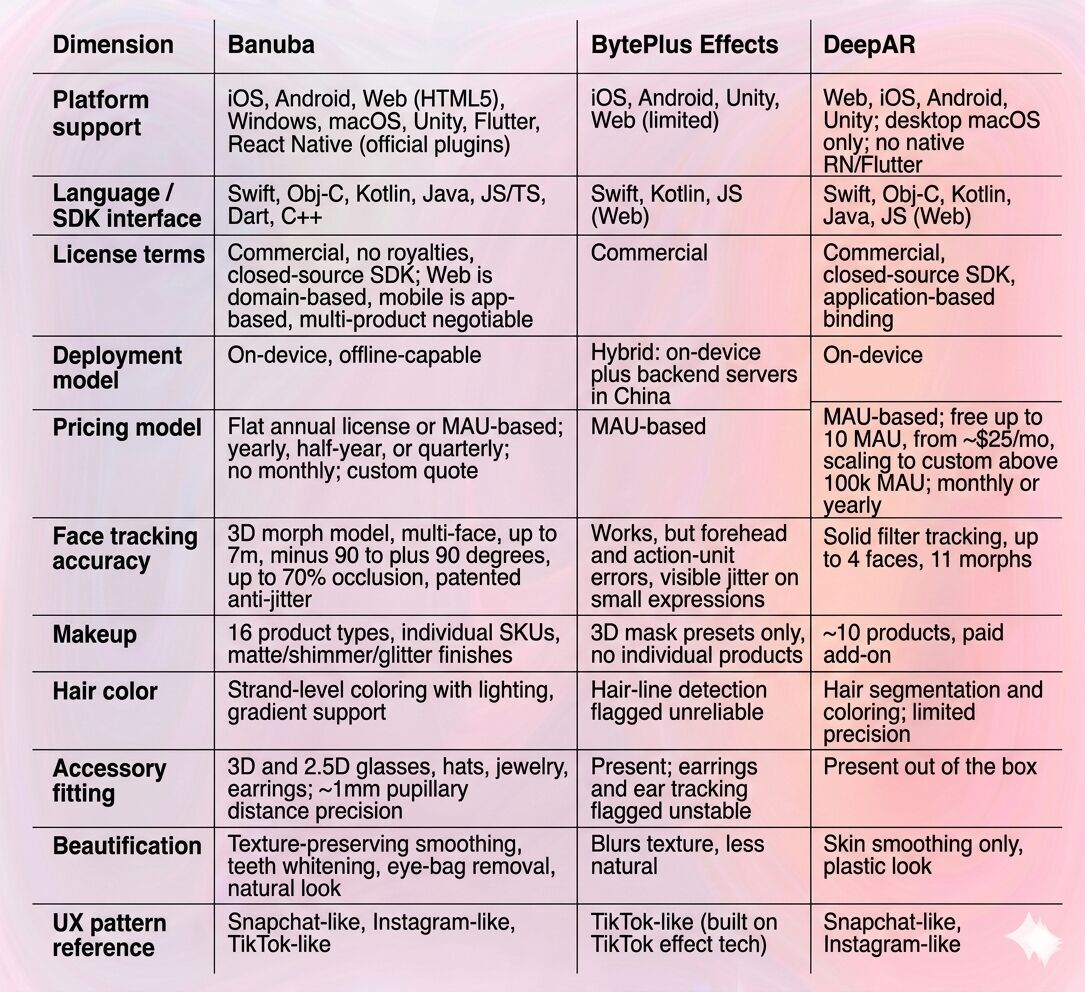
Best Face Mask SDKs Comparison Table
Which face mask SDK should you choose
Best for production apps at scale. Banuba. Broad platform coverage, on-device privacy, texture-accurate rendering, and an SLA make it the safe choice when masks are core to the product and cost needs to stay predictable as you grow.
Best for prototypes and tight budgets. DeepAR. The free tier and low entry price get a proof of concept running quickly, and web-first AR campaigns fit its strengths. Plan for rising cost and the Zalando roadmap shift before you commit to production.
Best for ByteDance-aligned teams in Asian markets. BytePlus. The effect catalog is hard to match, and if your stack already lives in that ecosystem and data residency is not a blocker, it delivers volume.
Weigh four factors against each other: platform reach, data residency and compliance, segmentation depth, and how your bill behaves when usage spikes. Teams in regulated sectors or the EU should put deployment model and data handling at the top of that list.
References
Banuba. (n.d.). Face Filters SDK. Retrieved June 4, 2026, from https://www.banuba.com/facear-sdk/face-filters
Banuba. (n.d.). Face Detection SDK. Retrieved June 4, 2026, from https://www.banuba.com/ai-face-detection-sdk
Banuba. (n.d.). Face Tracking Software. Retrieved June 4, 2026, from https://www.banuba.com/technology/face-tracking-software
Grand View Research. (2025). Augmented reality market size, share & trends analysis report. Retrieved June 4, 2026, from https://www.grandviewresearch.com/press-release/global-augmented-reality-market
Grand View Research. (2025). Augmented reality in e-commerce market report. Retrieved June 4, 2026, from https://www.grandviewresearch.com/industry-analysis/augmented-reality-e-commerce-market-report
Retail Gazette. (2025, April 8). Zalando acquires augmented reality specialist DeepAR. https://www.retailgazette.co.uk/blog/2025/04/zalando-acquires-deepar/
Snap Inc. (n.d.). Camera Kit. Snap AR. Retrieved June 4, 2026, from https://ar.snap.com/camera-kit
-
It is a software development kit that adds real-time face tracking, 3D masks, AR lenses, and beauty filters to an app. It bundles the computer vision, rendering, and authoring tools so developers skip building a face-tracking pipeline from scratch.
-
Look at tracking accuracy under real conditions (angles, low light, occlusion), segmentation depth for clean compositing, platform and cross-framework coverage, where data is processed, update cadence and support terms, and how pricing scales with active users.
-
Two models dominate. A flat annual license gives unlimited usage at a fixed cost, which favors apps expecting scale. A usage-based model tied to monthly active users starts cheaper but grows with your user count, which favors early-stage or seasonal apps. Some vendors offer both.
-
An SDK with wide platform support, on-device processing, deep segmentation, an SLA, and predictable pricing scales most cleanly. Among the three here, Banuba fits that profile.
