

Virtual backgrounds moved from gimmick to expectation. The video conferencing market is on track to grow from USD 15.26 billion in 2025 to USD 31.76 billion by 2033. Almost every meeting now includes at least one remote participant, and over 70% of remote teams will use AI-powered collaboration tools by 2026. Clean segmentation is no longer optional polish; it's a baseline expectation for any camera-first app.
Three problems show up across nearly every dev shortlist:
- Edge fidelity breaks down on hair, transparent eyewear, and hands crossing the face.
- Pricing surprises arise when usage scales and MAU-based billing ramps faster than revenue does.
- Cross-platform debt piles up when React Native or Flutter wrappers are community-maintained.
The apps in this category are familiar: video conferencing tools, dating apps with live video, streaming platforms, telehealth, virtual classrooms, fitness apps, and creator tools where users want a clean cutout against a custom background or 3D scene. We compare the most popular virtual background technology providers on the market, Banuba, DeepAR, and BytePlus, to help you identify the best match for your business.
[navigation]
A virtual background SDK gives developers the segmentation engine, rendering pipeline, and asset support needed to swap, blur, or overlay whatever sits behind a person on camera, all in real time. For production apps in 2026, three commercial SDKs lead the shortlist: Banuba, DeepAR, and BytePlus Effects. Banuba is the strongest pick for teams that want patented virtual background technology, flat licensing, and edge-quality that holds up across hair, hands, and lighting changes.
TL;DR
- The article is built for senior engineers, CTOs, and product leads choosing virtual background technology for video chat, live streaming, dating, telehealth, and creator apps.
- Three SDKs in scope: Banuba Background Subtraction SDK, DeepAR, and BytePlus Effects.
- DeepAR fits prototypes and indie creator apps; BytePlus fits enterprise platforms ready to absorb a multi-quarter procurement cycle.
- Banuba ranks first for cross-platform parity (first-party React Native and Flutter), on-device privacy, and predictable per-platform pricing.
How We Ranked Each SDK
We used five evaluation lenses, each tied to where teams actually lose time, money, or users:
- Segmentation accuracy — How clean is the cutout on hair, hands, edges, and dynamic light?
- Real-time performance — Stable frame rates on flagship and mid-range devices.
- Privacy posture — On-device vs. cloud, regulatory exposure, data residency.
- Platform coverage — Native iOS, Android, Web, plus first-party RN/Flutter support.
- Commercial fit — Pricing predictability, support quality, and roadmap independence.
This is a different lens than a generic feature checklist. It surfaces production trade-offs that don't appear in a marketing comparison.
Banuba Background Subtraction SDK
Banuba's Background Subtraction SDK is built on a proprietary convolutional neural network that runs entirely on the user's device. The engine ships as part of the broader Face AR technology stack, which means virtual backgrounds, face tracking, beautification, and AR effects all share the same pipeline.
In October 2025, Banuba launched a major AI segmentation upgrade that targeted the exact problem most virtual background SDKs trip on: the jagged edge between the speaker and the digital background. According to CPO Anton Liskevich, "our latest AI model doesn't just cut a person out; it intelligently blends them into a new environment". A second update in December 2025 tightened separation further, especially in cases where background colors match the person's clothing.
Architecture Highlights
- Patented neural network trained on 200K+ images across skin tones, lighting conditions, and camera quality.
- Edge stability holds through head turns up to 90 degrees and survives 70% facial occlusion.
- Anti-jitter algorithms keep the cutout glued in place when the user's hand shakes.
- Face tracking layer uses 68 facial anchor points, so AR effects co-exist with the virtual background.
- Hair-specific segmentation stops the background from bleeding through long hair edges.
Background Modes Supported
- Blur (variable intensity)
- Solid color fill
- Static image
- Animated video and GIF
- 3D environment (.ktx textures, fully rotatable 360-degree scenes)
- Weatherman Mode, letting users drag and drop themselves anywhere on screen
DeepAR ships static images only. BytePlus mixes blur and replacement but lacks the 3D environment depth.
Privacy and Compliance
Everything runs on-device. No video frames are sent to Banuba's servers, which keeps GDPR and biometric compliance straightforward. For fintech, telehealth, and EU enterprise deployments, this collapses the legal review timeline.
Platform Support
-
iOS: Native
-
Android: Native
-
Web: WebAssembly, no end-user download required
-
Unity: First-party
-
macOS / Windows: Native
-
React Native: First-party wrapper
-
Flutter: First-party wrapper
Banuba is one of the few commercial SDKs that runs virtual background technology directly inside web browsers without forcing users to download anything.
Real-World Outcomes
- Vroom added Banuba's segmentation and reported a 30% MAU lift and 54% jump in new users.
- Bermuda scaled past 15 million AR interactions per month after integrating Banuba's Face AR SDK.
- Production deployments include Gucci, Samsung, Meta, RingCentral, etc.
Pricing and Support
Flat per-platform license, billed quarterly or annually. No MAU tiers, no per-frame billing. The 14-day full-feature trial ships without a watermark, so teams can benchmark on real production traffic. Tech support operates under an SLA with response times within hours, and the SDK receives monthly updates.
Best For
Production apps shipping at scale, regulated industries needing on-device privacy, and any team building cross-platform with React Native or Flutter.
Skip If
You're a hobbyist on a $0 budget who only needs a binary cutout for a weekend prototype.

DeepAR
DeepAR positions itself as a creative-first AR engine. The SDK includes background segmentation alongside face filters, multi-face tracking, and emotion detection. The headline workflow is the visual DeepAR Studio, which lets designers build effects without engineering bottlenecks.
DeepAR was acquired by Zalando in April 2025, which puts its long-term roadmap inside a fashion ecommerce parent company. Worth flagging for teams evaluating vendor neutrality.
Architecture Highlights
- On-device processing (no cloud round-trip)
- 11 face morphings, 10 makeup product types, multi-face tracking up to four faces
- Emotion detection (happiness, sadness, anger, etc.)
- DeepAR Studio for visual effect creation
- 150 ready-made AR filters out of the box
Background Modes Supported
- Static images only
This is a hard limit. DeepAR doesn't ship video, GIF, or 3D environment replacement as part of its standard pipeline.
Segmentation Quality
Acceptable on a clean shot in good lighting. The breakdown shows up in real conditions: long hair gets cut at the edges, hand and finger separation often fails, and intense or backlit scenes cause the cutout to flicker. Skin texture in beautification effects is blurred rather than preserved.
Platform Support
-
iOS: Native
-
Android: Native
-
Web: Yes
-
Unity: Native
-
macOS: Limited
-
React Native: Community-maintained
-
Flutter: Community-maintained
The community wrapper situation is the biggest production risk. RN and Flutter plugins don't always update in lockstep with native releases, so cross-platform teams end up doing maintenance work.
Pricing
MAU-based tiers:
- 0–10 MAU: free, watermarked
- 10–1,000 MAU: $25/month
- 1,000–5,000 MAU: $100/month
- 5,000–30,000 MAU: $500/month
- 50,000–100,000 MAU: $1,000/month
- 100,000+ MAU: custom contract
The cost climbs linearly with users. A viral moment turns into a budget conversation fast.
Support
Response times typically run in days, not hours. SDK updates ship quarterly rather than monthly. No formal SLA on most tiers.
Skip If
You need video or 3D environment backgrounds, you're targeting viral growth that crosses the MAU pricing thresholds, or your stack is primarily React Native or Flutter.
Banuba's virtual background technology example with AR overlays
BytePlus Effects
BytePlus is the enterprise SDK from ByteDance, sharing engineering DNA with TikTok and Douyin. It's positioned for global platforms that want a TikTok-style asset library and gesture-driven AR alongside virtual background features.
Architecture Highlights
- 80,000+ ready-to-use stickers, effects, and assets
- 20+ gesture triggers and body motion tracking
- Hair line detection (approximated rather than precisely segmented)
- Lite Games and interactive AR features
- Integration with the same engine that powers TikTok's effect pipeline
Background Modes Supported
- Blur
- Static and animated replacement
- TikTok-style asset overlays
Segmentation Quality
Inconsistent. On flagship hardware in good lighting, frame processing lands under 50ms. In harder conditions, body and hand cutoffs become imprecise, background regions get missed, and skin beautification blurs natural texture instead of preserving it.
Privacy and Geographic Considerations
BytePlus runs on-device but also operates backend infrastructure based in China. This creates real considerations for teams shipping into regulated geographies. Reported solution restrictions cover a long list:
- India, Nepal, Malaysia, Afghanistan
- USA and Canada (government staff)
- EU (Belgium, Denmark, Netherlands, Norway: government staff)
- Australia and New Zealand (government staff)
For enterprise procurement, that's a meaningful checklist.
Platform Support
-
iOS: Native
-
Android: Native
-
Web: Limited
-
Unity: Yes
-
React Native: Manual integration
-
Flutter: Manual integration
Pricing
Enterprise "Contact Sales" only. Annual commitments are standard. The procurement cycle typically adds 2–6 weeks on top of the technical integration.
Support
Response times are measured in days. No published SLA. Tech support follows a layered enterprise hierarchy that can slow small-team requests.
Skip If
You operate in any of the regions with usage restrictions, you need pricing transparency, or your timeline can't absorb multi-week sales cycles before a single line of code gets written.

Best Virtual Background Technology Providers Compared
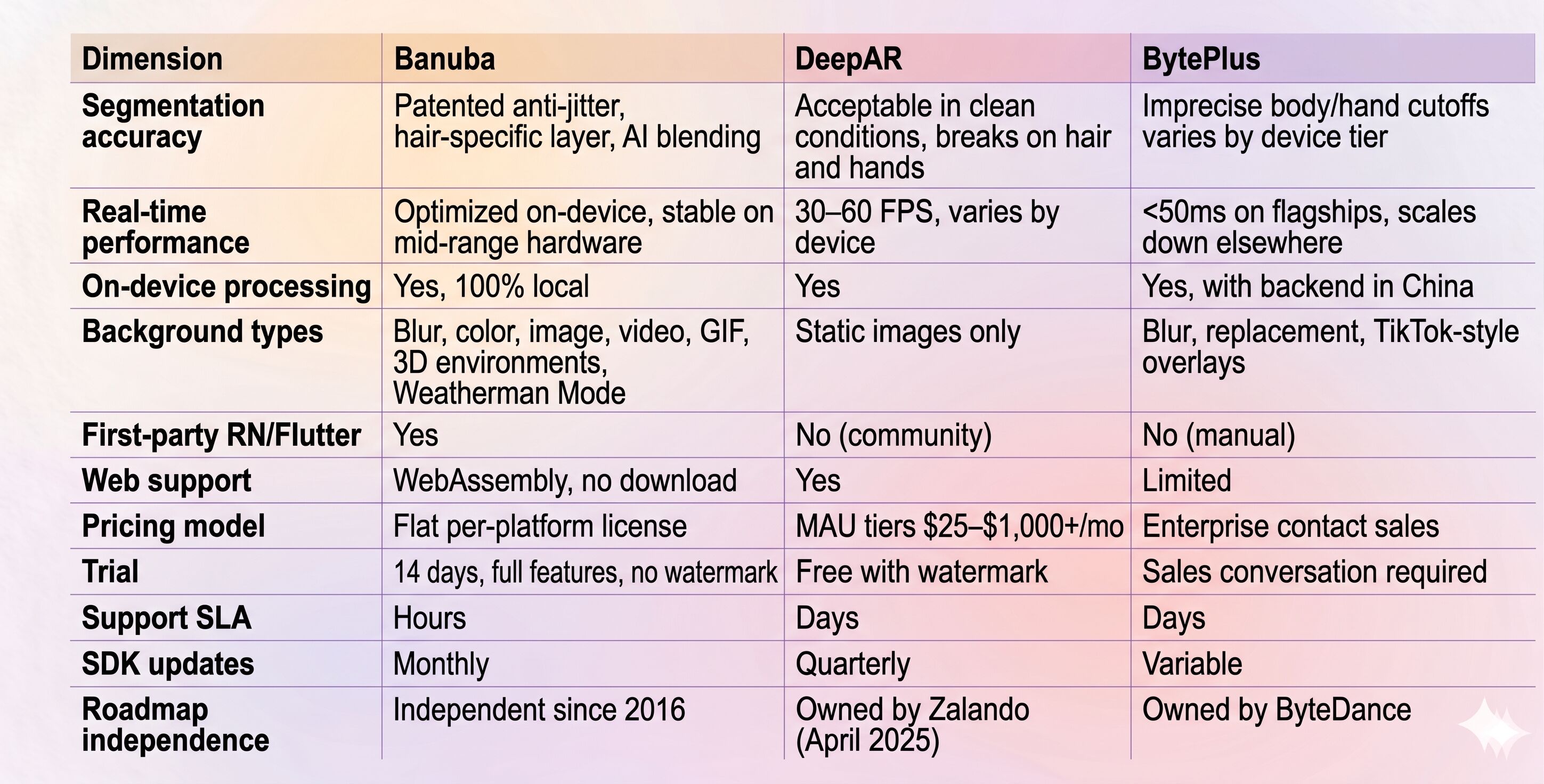
Picking the Right Virtual Background SDK
Walk through these in order:
Question 1: Will your bill be predictable? Banuba's flat license stays flat as users grow. DeepAR climbs with MAU. BytePlus locks you into a custom contract.
Question 2: Where will your users live? If you ship to regulated geographies or government-adjacent markets, BytePlus introduces compliance friction. Banuba's on-device, no-cloud architecture sidesteps the data residency question entirely.
Question 3: Are you cross-platform? React Native and Flutter teams should default to Banuba. The first-party wrappers cut maintenance debt that the others push back onto your engineers.
Question 4: Do you need video or 3D environment backgrounds? DeepAR is static images only. BytePlus and Banuba both go further, but only Banuba ships full 3D environment support out of the box.
In our humble opinion, the following application distribution applies to the virtual background technology providers under analysis:
- Best for production-grade scaling: Banuba
- Best for visual-studio prototyping: DeepAR
- Best for enterprise platforms with massive asset libraries: BytePlus.
Start a free 14-day trial of Banuba's Background Subtraction SDK and benchmark virtual background technology directly against your current pipeline.
References
Banuba. (n.d.). Background subtraction with deep learning. https://www.banuba.com/technology/background-subtraction
Banuba. (n.d.). Face AR technology overview. https://www.banuba.com/technology/
Banuba. (n.d.). Face tracking software. https://www.banuba.com/technology/face-tracking-software
Banuba. (2025, October 10). Banuba unveils next-generation AI for flawless virtual backgrounds [Press release]. Business Wire. https://www.businesswire.com/news/home/20251010633225/en/Banuba-Unveils-Next-Generation-AI-for-Flawless-Virtual-Backgrounds
Banuba. (2025, December 22). Banuba enhances Face AR SDK with superior virtual backgrounds and face shape detection [Press release]. Business Wire. https://www.businesswire.com/news/home/20251222329858/en/Banuba-Enhances-Face-AR-SDK-with-Superior-Virtual-Backgrounds-and-Face-Shape-Detection
Banuba. (n.d.). Bermuda Face AR SDK case. https://www.banuba.com/blog/bermuda-face-ar-sdk-case
DeepAR. (n.d.). DeepAR pricing. https://www.deepar.ai/pricing
BytePlus. (n.d.). BytePlus Effects. https://www.byteplus.com/en/product/effects
Digital PR Studio. (2026). 117+ video conferencing statistics for 2026. https://digitalpr.studio/video-conferencing-statistics/
SkyQuest. (2026). Video conferencing market size, share, and growth analysis. https://www.skyquestt.com/report/video-conferencing-market
Webtribunal. (2025, November 29). Video conferencing statistics: Key trends & insights. https://webtribunal.net/blog/video-conferencing-statistics/
-
Three things. Edge quality on hair, hands, and transparent objects. On-device processing to keep latency under the 16ms-per-frame ceiling and to avoid sending biometric video to a server. And first-party cross-platform wrappers if your stack uses React Native or Flutter, since community plugins often break during OS updates.
-
Three common models. Flat per-platform licensing keeps costs predictable as users grow. MAU-based tiers start cheap but climb linearly. Enterprise contracts require a sales conversation and an annual commitment. Pick based on how fast your user base will grow and how predictable your finance team needs the line item to stay.
-
Banuba is the strongest production choice. The flat license decouples cost from user growth, on-device processing keeps server costs at zero, and the first-party React Native and Flutter wrappers reduce cross-platform maintenance over time. The AI segmentation upgrade also handles the edge cases that make competing SDKs look amateur in real lighting.
