

The photo booth category has moved past photo strips. In 2025, the global photo booth market was valued at USD 584.7 million, and it is expected to reach USD 639.1 million in 2026, growing at a 9.3% CAGR. AI-driven personalization, automated lighting correction, and virtual makeup overlays have raised the per-event revenue ceiling, with corporate brand activations now generating USD 1,500 to 5,000 per event.
The shift is happening on the AR side too. Augmented Reality products show a 94% higher purchase conversion rate compared to non-AR products, and over 70% of photo booth users share their images online, turning each activation into organic marketing content for events and brands.
That mix of growth, shareability, and conversion lift explains why AR photo booth software now sits at the center of brand activations, retail pop-ups, mall installations, theme parks, and large-scale weddings. The trade-offs between platforms, however, are real. Some tools are full AR engines you build into your own hardware. Others are closed apps tied to a single device. Picking the wrong one can lock a team into a dead-end stack.
This article compares three of the most discussed options and explains where each one fits.
[navigation]
AR photo booth software lets brands, agencies, and event teams capture interactive, share-ready photos using face filters, virtual backgrounds, beautification, and gesture-driven effects. Three tools dominate the conversation in 2026: Banuba's AR Photo Booth Software, Simple Booth HALO, and Sparkbooth. Banuba is the strongest pick when the goal is real-time AR, multi-face tracking, and custom effects across iOS, Android, web, and kiosk devices.
TL;DR
- This guide reviews three AR photo booth software options used at weddings, retail activations, pop-ups, and brand events.
- Solutions are compared on AR depth, platform reach, customization, integration effort, and pricing logic.
- Banuba is the right choice when you need 3D AR, gesture triggers, multi-face tracking, and white-label deployment on any hardware.
- Simple Booth HALO suits iPad-only event setups that lean on AI portraits, glam, and lead capture.
- Sparkbooth fits small DIY events with webcam or DSLR, but ships without AR or AI personalization.
How we evaluated each tool
Each platform was scored on six criteria that matter for production-grade AR photo booth deployments:
- AR depth. Real-time 3D effects, multi-face tracking, gesture triggers, and beautification.
- Platform reach. iOS, Android, web, desktop, kiosk, Unity, React Native, Flutter, Vision Pro.
- Customization and white-labeling. Branded UI, custom effects, custom development.
- Integration model. SDK or closed app, documentation quality, sample apps.
- Output formats. Stills, GIFs, boomerangs, video, virtual backgrounds, prints.
- Pricing logic. Subscription, one-time license, enterprise SDK licensing, scalability.
Sources include vendor documentation, public pricing pages, app store listings, developer portals, and product pages. Where vendor claims overlap with marketing language, we weighted independent reviews higher.

Banuba: AR Photo Booth Software
Best for: brand activations, retail kiosks, mirror booths, malls, pop-ups, agencies, and any team that wants real AR rather than 2D filters.
Overview
Banuba's AR Photo Booth Software is built on the company's Face AR SDK and patented neural-network face tracking. It offers custom AR filters, real-time experiences reacting to user touches and mimics, support for all major platforms, and works with all cameras, with fast install and easy run. The product targets developers, agencies, and brands building photo booth experiences inside their own hardware or software, rather than renting a closed app.
Key strengths
Real 3D AR, not flat filters. Banuba offers over 1000 ready-use effects, including detailed 3D masks that respond to head tilt, partial or full face coverage, glow-up beautification (skin smoothing, teeth whitening, wrinkle removal, skin tone correction), virtual backgrounds (still images, GIFs, and 3D environments), multi-face tracking for more than 16 people in one photo (limited only by the hardware), single- and multi-touch interactions, a touchless mode, and programmable triggers and AR games driven by facial expressions like smiling or winking.
Cross-platform SDK reach. Face AR SDK runs on iOS, Android, Web, Unity, Flutter, React Native, desktop, and Apple Vision Pro. That breadth lets one team ship the same AR experience to a phone app, a kiosk, a mirror booth, and a web activation without rebuilding each one.
White-label, custom effects, and brand fit. Banuba offers unique patented technology, an internal R&D department with PhD-level staff, 10+ years on the Augmented Reality market, trust from brands like Gucci and Samsung, custom effect development services, and over 1000 possible effects including 3D masks, virtual backgrounds, and face touch-up. Branded UI, custom 3D masks, custom games are all available.
Production-grade engineering. Banuba's AR Photo Booth Software ships with LLM-friendly documentation, dedicated Flutter and React Native plugins, and platform-specific code samples on GitHub. Integration time is measured in days for a basic build, not weeks.
Limitations
- Pricing is enterprise SDK license, not a flat subscription. Small teams running a single laptop booth at one wedding will find Banuba overpowered for their needs.
- AR content design benefits from a creative team, in-house or via Banuba's effect development service. Teams without any visual asset workflow will lean on Banuba's asset store or Banuba's design team.
Ideal use cases
- Retail mirror booths and mall activations
- Branded kiosks for product launches and pop-up stores
- Experiential marketing for agencies running multi-city tours
- Consumer apps with photo booth modes (Bermuda's 15M Banuba feature launches per month across 20M installs)
- Web-based booths for hybrid and virtual events
Who should not choose it
A solo wedding photographer renting equipment for one event a month does not need an SDK. Banuba is built for teams that ship the booth as a product, run repeat campaigns, or fold AR into a larger app.
Simple Booth HALO
Best for: event professionals running iPad-based booths who want clean AI portraits, glam filters, and built-in lead capture.
Overview
Simple Booth HALO is an iPad photo booth app paired with optional HALO ring-light hardware. It runs on Simple Booth's photo booth software platform, gives event pros and businesses creative control, built-in marketing tools, and intuitive workflows for setup and management. It captures custom layouts, still photos, classic strips, GIFs, looping Rebound clips, and videos, and captures first-party data with an 87% opt-in rate.
Key strengths
- AI background replacement without a green screen and AI-generated portrait styles. Guests can edit photos with glam, background replacement (AI or green screen), filters, props, stickers, and AI effects, then build their own with AI-generated prompts or use guest inputs to create personalized AI portraits.
- Glam filter, background blur, and a face-detection prop system that auto-positions glasses or hats on guests' faces.
- DSLR camera support in newer plan tiers, plus a built-in layout designer and online dashboard.
- Strong distribution flow: QR code, SMS, email, AirDrop, WhatsApp delivery to guests.
Limitations
- iPad-only. No native Android, web, or kiosk support outside the iPad and HALO hardware ecosystem.
- Effects are 2D AI overlays and stickers. There is no real-time 3D face tracking, no head-tilt 3D masks, no gesture-driven AR games, and no multi-face AR effects in the Banuba sense.
- AI effects require a stable internet connection. Banuba's AR runs entirely on-device.
- Not a developer SDK. Custom effects are built inside Simple Booth's tools, not as code in your own app.
- Pricing is subscription per-license, with add-on licenses charged separately for multi-device deployments.
Who should not choose it
Teams building branded mirror booths or web-based AR activations that need to scale across iOS, Android, and kiosk hardware. Simple Booth is a single-device app, not a cross-platform AR engine.
Banuba's AR Photo Booth Software face masks example
Sparkbooth
Best for: small events, hobbyist setups, and party hosts who want a low-cost desktop photo booth without complex configuration.
Overview
Sparkbooth is a Windows and macOS photo booth app that runs on any computer with a webcam, with optional Canon and Nikon DSLR support. The free 30-day trial watermarks photos. Pricing is one-time licensing, which keeps it attractive for seasonal or one-off events.
Key strengths
- One-time license fee instead of recurring subscription.
- Clean, straightforward UI for non-technical users.
- Standard photo booth feature set: GIFs, boomerangs, photo editing, green screen support, mirror booth mode, print layout customization, email and SMS delivery, QR code photo pickup.
- Multilingual interface.
Limitations
- No built-in AR effects and no AI-driven personalization. The "AR" in "AR photo booth software" is not what Sparkbooth offers; it is a classic photo booth app.
- Desktop-only. No iPad, no native mobile app, no web, no kiosk SDK.
- Limited customization for brand activations. No custom 3D effects, no gesture triggers, no multi-face tracking.
- Older interface with fewer modern conveniences than HALO.
Who should not choose it
Anyone who needs real AR. Anyone running a multi-location campaign. Anyone deploying on iPads, kiosks, or the web.

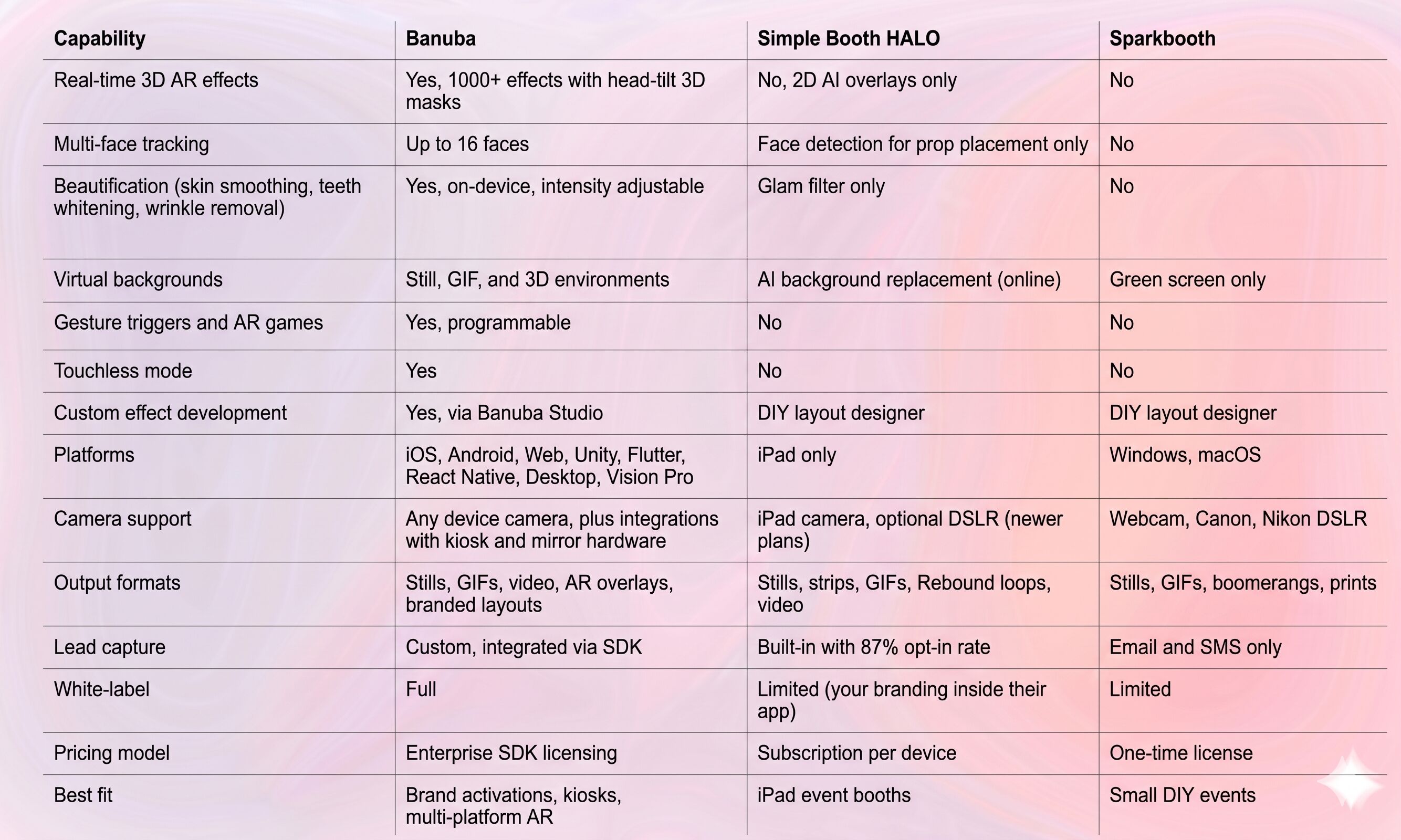
Best AR Photo Booth Software Solutions Compared
Decision guide on choosing AR photo booth software
Pick Banuba when:
- You are building or operating a branded AR photo booth across multiple devices, kiosks, or mirror installations
- You need real 3D AR, multi-face tracking, gesture-driven games, or touchless interactions
- You want to ship the same experience on web, iOS, Android, and Vision Pro
- You need a custom effect or full white-label deployment for a brand
- Your team has, or works with, developers who can integrate an SDK
Pick Simple Booth HALO when:
- You run iPad-based event booths and want a polished, ready-to-use app
- AI portraits, glam, background replacement, and lead capture are your priorities
- 2D filters, props, and stickers are good enough; you do not need 3D AR
- You are fine with a closed ecosystem and a per-device subscription
Pick Sparkbooth when:
- You run occasional small events from a Windows or Mac laptop
- Budget is the deciding factor and one-time licensing matters
- You do not need AR, AI effects, or modern UI polish
- A straightforward photo capture and print workflow is all that's required
Final word
In 2026, AR photo booth software splits into two camps: AR engines that ship as SDKs (Banuba), and closed photo booth apps with light AI add-ons (Simple Booth HALO, Sparkbooth). For brands, agencies, and product teams, the SDK route is the one that holds up across multi-platform deployments, custom hardware, and branded campaigns. For solo event pros running a single iPad or a laptop booth, the closed apps remain practical.
Banuba is the best fit when the brief includes real AR, real customization, and real platform reach. Test it as your AR photo booth software for free for 14 days.
References
Banuba. (2026). AR Photo Booth Software: Create fun & memorable events. https://www.banuba.com/solutions/ar-photo-booth
Banuba. (2026). Face AR SDK: Face filters. https://www.banuba.com/facear-sdk/face-filters
Banuba. (2026). Banuba technology. https://www.banuba.com/technology/
Banuba. (2026). Face AR SDK documentation. https://docs.banuba.com/far-sdk
Bayelsa Watch. (2026, April). Extended reality statistics by market size and user demographics (2026). https://bayelsawatch.com/extended-reality-statistics/
Future Market Insights. (2026, February). Photo booth market outlook 2026–2036: Global industry to surpass USD 1,555.1 million at 9.3% CAGR. https://www.futuremarketinsights.com/reports/photo-booth-market
Kande Photo Booths. (2026, February). Photo booth industry statistics 2026. https://www.kandephotobooths.com/blog/photo-booth-industry-statistics/
Simple Booth. (2026). Simple Booth HALO: Best iPad photo booth & selfie stand. https://www.simplebooth.com/products/halo
Sparkbooth. (2026). Photo booth software for Windows and Mac. https://sparkbooth.com/
-
The shortlist comes down to AR depth, platform reach, customization, and licensing. AR depth means real-time 3D face tracking, multi-face support, beautification, and gesture triggers, not just 2D stickers. Platform reach matters when the same experience needs to run on a phone, a kiosk, and the web. Customization matters when a brand activation needs its own UI, its own 3D effects, and its own logic. Licensing model matters because subscription apps and SDK licenses scale very differently as a campaign grows.
-
Three patterns dominate: mobile apps often use per-device subscriptions, desktop software typically uses one-time machine-based licenses, and AR SDKs rely on enterprise pricing based on platforms, features, customization, and contract terms. SDK licensing is more complex upfront but often more cost-effective at scale.
-
For production apps, multi-platform deployments, and large brand activations, an SDK-based approach wins because it removes the ceiling on customization and ownership. Banuba is the most common choice when teams need 3D AR, multi-face tracking, white-label deployment, and reach across iOS, Android, web, Unity, and Vision Pro.
