

[navigation]
TL;DR:
- We compared Banuba AR SDK and DeepAR SDK across Platform, Language and SDK surface, License, Deployment, and Pricing, plus AR feature depth, using Banuba's internal competitor battlecard and product documentation as the data source.
- Banuba AR SDK covers iOS, Android, Web, Windows, macOS, Unity, Flutter, and React Native. DeepAR covers iOS, Android, Web, and macOS, with no Unity support and no Windows desktop support.
- Banuba Face AR SDK reconstructs a 3D face mesh with up to 3,308 vertices through direct 3D reconstruction. DeepAR converts 2D landmarks into a 3D model, which introduces drift under extreme angles, mixed lighting, and partial occlusion.
- Banuba Face AR SDK tolerates up to 70% facial occlusion, tracks across a -90° to +90° head-angle range, and detects faces up to 7 meters from the camera.
- Segmentation is the widest gap: Banuba segments every major face part independently, while DeepAR's battlecard lists hair segmentation only.
- DeepAR has documented advantages in two try-on categories: footwear try-on, which Banuba does not offer, and hand-wearable try-on, which Banuba lists as limited.
- DeepAR publishes MAU-based pricing tiers, starting free at up to 10 MAU and reaching $1,000/month at 50,000 to 100,000 MAU. Banuba prices on a subscription that factors in MAU count, platforms, and the feature set, billed yearly, half-yearly, or quarterly.
- Support and release cadence differ materially: Banuba ships monthly SDK updates with SLA-backed support and a dedicated account manager; DeepAR ships quarterly with no SLA and documented response delays.
Choosing an AR SDK: What Actually Decides the Outcome
Most AR SDK shortlists collapse into a feature checklist, and feature checklists hide the two things that break projects later: how much of the AR stack you have to assemble yourself, and what the license does to your roadmap. Banuba's AR SDK is positioned as a single engine across face, hand, background, and try-on workloads, which matters when the second and third feature request arrives after launch.
We scored both products against five universal constraint dimensions plus three category-specific ones, defined before looking at either vendor:
Platform. Which operating systems, browsers, engines, and cross-platform frameworks get first-party support, including desktop and Unity.
Language and SDK surface. How the SDK is distributed and consumed: native packages, package managers, and framework wrappers.
License. What the license is bound to (domain, application, company), how long it runs, and whether it can be reused across products.
Deployment. Where processing happens, what the integration path looks like, and how long a working integration takes.
Pricing. The billing model, the payment cycles offered, and how the bill behaves as usage grows.
Category-specific: tracking and segmentation depth. How the face model is constructed, how it behaves under stress, and which regions can be isolated independently.
Category-specific: AR feature breadth. Beauty, makeup, try-on categories, hand tracking, avatars, and rendering capabilities.
Category-specific: vendor operations. Update cadence, support model, customization, and ownership.

Banuba AR SDK
Banuba's AR SDK is a commercial, on-device computer vision engine covering face tracking, segmentation, beauty and makeup effects, virtual backgrounds, hand tracking, avatars, and virtual try-on. The company was founded in 2016 and remains independent.
Platform. iOS, Android, Web, Windows, macOS, and Unity, with officially maintained Flutter and React Native wrappers. Mobile requires iOS 13+ and Android 8.0 (API level 26+) with Camera 2 API and OpenGL ES 3.0, which covers 97% of Apple smartphones and 80% of Android devices in the field. Desktop requires OpenGL 4.3+ (4.1+ on macOS), Windows 8.1+, macOS 10.13+, or Ubuntu 18.04+. Web requires WebGL 2.0+.
Language and SDK surface. Distributed through CocoaPods, Maven, and NPM, with sample projects published for iOS and Android. The Face AR SDK documentation includes LLM-ready docs for AI-assisted development workflows.
License. Domain-based for Web and application-based for apps, with application binding negotiable. License duration is one year. A single license does not extend across multiple products.
Deployment. All computation runs on-device, with no cloud round-trip, and the product is GDPR compliant. Integration to a working state takes up to one week. Setup services with a set-up fee are available.
Pricing. Banuba offers two pricing models: a flat annual license fee with unlimited usage and predictable costs, or an active user-based model with lower upfront spending but costs that rise as the user base grows. Yearly, half-yearly, and quarterly billing are offered; monthly billing is not. Discounts and special offers apply. A 14-day free trial is available with no card required.
Tracking and segmentation depth. The engine tracks 37 facial morphs rather than hundreds of static points, maintains 68 facial anchor points, and reconstructs a 3D face mesh with up to 3,308 vertices. Because the 3D geometry is built directly instead of being converted from 2D landmarks, tracking holds across the full -90° to +90° head-angle range, tolerates up to 70% facial occlusion, and detects faces up to 7 meters from the camera. Face tracking and related technologies are patented in the USA and worldwide. Every major face part is segmented independently: hair, skin, eyes, eyebrows, and lips, alongside background.
Banuba face tracking in action
AR feature breadth. 28 face morphing options with skin texture preserved during smoothing, acne removal, and eye-bag removal. 16 makeup product types with skin-tone-aware application, plus eyebrow shape detection and nail detection. Background separation handles hair and hand edges and works under intense, side, back, and low light, with static images, video, GIFs, and 360-degree backgrounds supported. Hand tracking covers palm and finger tracking, ring try-on, and gesture recognition. An Avatars SDK with action units and blink detection is included, as are age, gender, skin tone, and heart rate detection, and biometric match. The rendering engine supports KTX format, specular antialiasing, per-component color correction, and advanced metallic textures. The asset library holds 1,000+ AR effects with GLTF import.
Vendor operations. Monthly SDK updates, SLA-backed technical support with responses usually within several working hours, and a dedicated account manager. The SDK can be adapted and customized for a client, and white-labelling is supported. Documented deployments span streaming (Tango.me), video conferencing (RingCentral, Kakao, Vidyo), dating and social (Match Group, Chatroulette), cosmetics and beauty (Gucci, Oriflame, Schwarzkopf, Henkel, Fujitsu), creator and UGC apps (Gettr, Parler), kiosks (Me.Group), healthcare (Crisalix), and fintech liveness (Capital.com).
Production evidence. b.stage, the SaaS fandom platform built by bemyfriends, uses Banuba face touch-up, filters, and 3D masks in its live streaming and video chat. Two years after launch, it surpassed 1 million monthly active users from 224 countries. The team cited natural-looking touch-up that preserves skin texture, the breadth of the ready-made mask library, and support responsiveness as the reasons for selecting Banuba.
Limitations. Footwear try-on is not offered. Hand-wearable try-on is listed as limited. A single license cannot be reused across multiple products. Monthly billing is not available, which can be a constraint for teams that cannot commit to a quarterly minimum.
DeepAR SDK
DeepAR is an on-device AR SDK from I Love Ice Cream Ltd., also founded in 2016, focused on face effects, masks, and filters, with a visual effect editor (DeepAR Studio) and a separate commerce platform (ShopAR).
Platform. iOS, Android, Web, and macOS. Desktop support is limited to macOS. Unity is not supported. Cross-platform mobile framework wrappers are not first-party.
Language and SDK surface. SDK integrated into mobile, web, and desktop applications. Documentation is English-localized and of good quality, and the vendor publishes integration guides for Amazon IVS and Azure Communication Services.
License. Application-based binding, one-year duration. A single license does not extend across multiple products. A free license is available for testing and development.
Deployment. Processing runs on-device, and the product is GDPR compliant. Integration to a working state takes up to one week. Setup services with a set-up fee are not provided.
Pricing. Published MAU-based tiers: free up to 10 MAU, $25/month or $250/year up to 1,000 MAU, $100/month or $1,000/year up to 5,000 MAU, $500/month or $5,000/year up to 30,000 MAU, and $1,000/month or $10,000/year up to 100,000 MAU. Above 100,000 MAU, pricing is contact sales. Yearly and monthly payments are both available, and discounts apply. DeepAR Studio is free to use. DeepAR Beauty is in beta and free for testing, with a waitlist for the API. ShopAR is priced separately and is not MAU-based.
Tracking and segmentation depth. Machine learning models identify face position and expressions from the camera feed and render 2D and 3D graphics over each frame, converting 2D landmarks into a 3D model. Face tracking is not patented. Segmentation is limited to hair; eyes, lips, eyebrows, and skin are not available as independent targets. Standard and multiple face tracking, background replacement, and background blur are supported on iOS, macOS, Android, and Web. Emotion detection is available on iOS, macOS, and Android but not on Web. Hair segmentation is iOS only. Body tracking is in closed beta.
AR feature breadth. 11 face morphing options and presets; skin texture is blurred during beautification, and acne removal and eye-bag removal are not available. 10 makeup product types, with the battlecard recording narrower application accuracy and no skin-tone-aware application. No eyebrow segmentation and no nail detection technology. Background separation is documented as low quality, with background fragments, long hair, and hands and fingers frequently mis-separated, and only static image backgrounds are supported. No support for different lighting conditions. No Avatars SDK, no hand or finger tracking, and no gesture recognition. No age, gender, skin tone, or heart rate detection, and no biometric match. The rendering engine does not support KTX format, specular antialiasing, per-component colour correction, or advanced metallic textures. The effects library holds roughly 150 filters, with no GLTF support. Virtual makeup is available through the separate DeepAR Beauty API rather than the base SDK, and VTO tracking for glasses, footwear, and watches is a ShopAR feature rather than a base SDK feature.
Try-on categories where DeepAR is ahead. Footwear try-on is supported by DeepAR and not offered by Banuba. Hand-wearable try-on is supported by DeepAR while Banuba lists it as limited. Sunglasses, headwear, hair color, and nail try-on are supported by both.
Vendor operations. Quarterly SDK updates. No 24/7 or SLA-backed technical support, with multiple reported response delays and typical response times measured in days. No dedicated account manager. The SDK cannot be adapted or customized for a client, though white-labelling is supported. Documented clients include Ralph Lauren, Kiko, and Zalando.
Limitations. Hair-only segmentation, low-quality background separation, static-image-only backgrounds, no Unity, no Windows desktop, quarterly release cadence, and no SLA.

Banuba AR SDK vs DeepAR SDK: Comparison Table
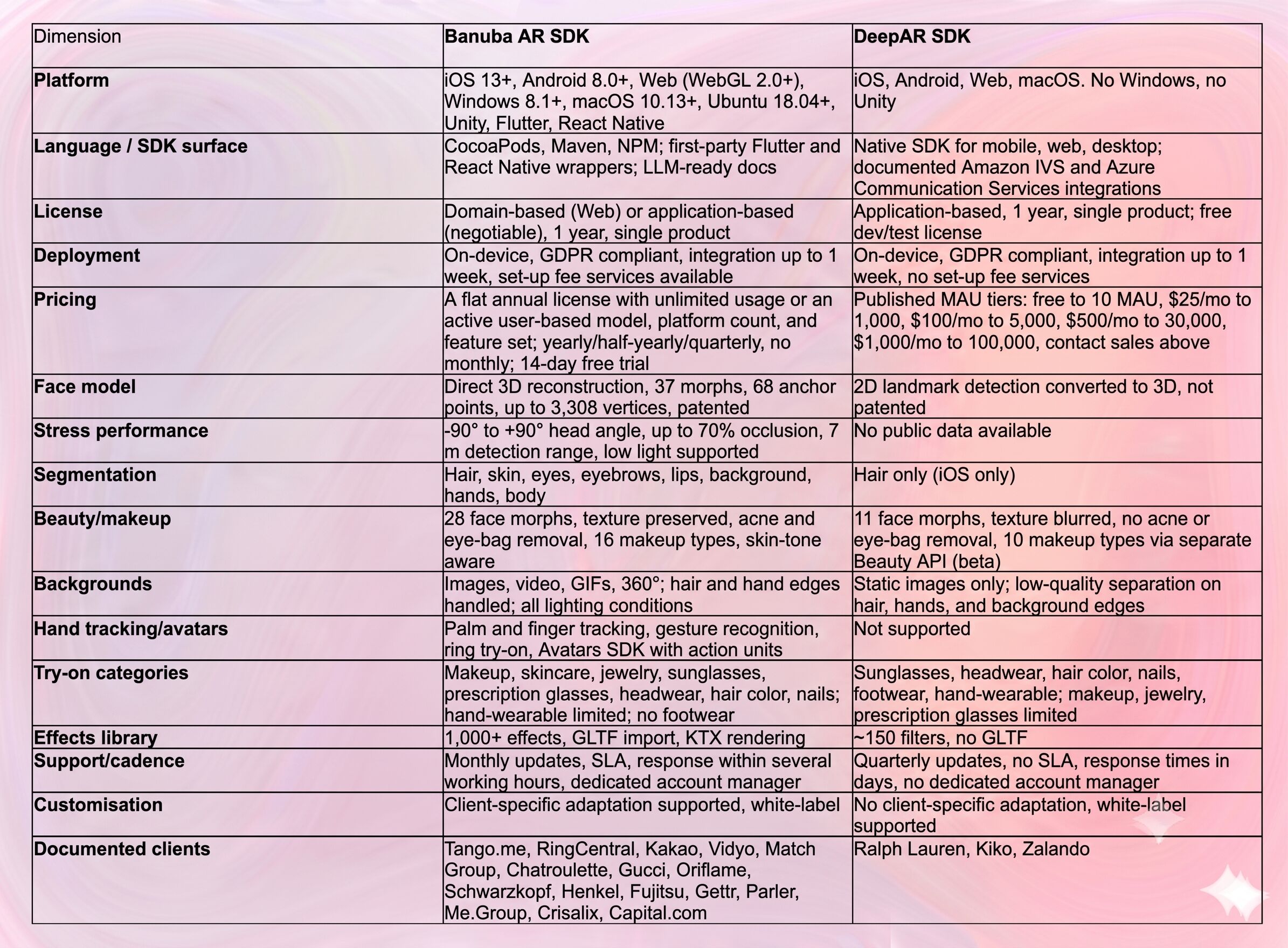
Which One Should You Pick?
Overall: Banuba AR SDK. Across the five constraint dimensions, the two products are closest on deployment (both on-device, both GDPR compliant, both roughly a week to integrate) and furthest apart on platform reach and feature depth. Windows desktop and Unity support, independent segmentation of every face part, hand tracking, avatars, and a 1,000+ effect library with GLTF import cover a wider set of roadmap directions from one integration. Monthly releases with SLA-backed support and a dedicated account manager reduce the operational risk of building a product feature on someone else's SDK.
Scenario winners:
- Short-lived web AR campaign or prototype at low user counts: DeepAR. The free tier up to 10 MAU and the $25/month tier up to 1,000 MAU remove the upfront barrier, and DeepAR Studio produces simple face effects quickly. If the project is a browser experience running for a few weeks with no segmentation or desktop requirement, this is the faster route to something live.
- Footwear try-on: DeepAR. Banuba does not offer footwear try-on. If sneaker or shoe try-on is a requirement, DeepAR is the only one of the two that covers it.
- Hand-wearable try-on: DeepAR, with caveats. DeepAR supports hand-wearable try-on outright while Banuba lists it as limited. Banuba does, however, cover ring try-on specifically, backed by palm and finger tracking.
- Beauty, cosmetics, or skincare products: Banuba. Hair-only segmentation is a hard boundary for anything that needs lipstick, eyebrow, or skin work as separate targets. Face-part segmentation, skin-tone-aware makeup, and texture-preserving beautification are the deciding factors here.
- Video conferencing, kiosks, and desktop deployments: Banuba. Windows desktop support and background separation that survives long hair, hands, and difficult lighting are requirements in these environments, and both are gaps on the DeepAR side.
- Unity-based apps and games: Banuba. DeepAR does not support Unity.
- Teams that need the SDK modified for their pipeline: Banuba. Client-specific adaptation is supported by Banuba and is not offered by DeepAR.
- Predictable enterprise procurement: split decision. DeepAR publishes its price list, which makes early budgeting straightforward. Banuba requires a quote but offers longer billing cycles, discounts, set-up services, and SLA-backed support. Which one is simpler depends on whether the constraint is budget transparency or contractual guarantees.
For a narrower read on how the two engines behave in one specific workload, our team has also published a production-focused breakdown of face mask rendering across both SDKs, which goes deeper into rendering behavior than a general comparison can.

References / Further Reading
- Banuba. (n.d.). Augmented Reality SDK. https://www.banuba.com/augmented-reality-sdk
- Banuba. (n.d.). Face AR SDK Documentation. https://docs.banuba.com/far-sdk
- Banuba. (2024). 1 Million MAUs in 2 Years for a SaaS Fandom Platform. https://www.banuba.com/blog/1-million-maus-in-2-years-for-a-saas-fandom-platform
- DeepAR. (n.d.). Documentation. https://docs.deepar.ai/
- DeepAR. (n.d.). Pricing. https://docs.deepar.ai/deepar-sdk/pricing/
-
How each one builds the face model. Banuba constructs 3D geometry directly from the camera feed, tracking 37 morphs and 68 anchor points to reconstruct a mesh with up to 3,308 vertices, while DeepAR detects 2D landmarks and converts them to 3D. Direct reconstruction is what allows Banuba's face tracking SDK to hold tracking at extreme head angles, under partial occlusion, and in low light.
-
No. Both Banuba and DeepAR run entirely on-device with no cloud round-trip, and both are GDPR compliant. On-device processing is one of the most repeated requirements from teams evaluating Banuba Face AR SDK, and the Face AR SDK documentation covers the local processing pipeline and the integration path for each platform.
-
Banuba covers iOS, Android, Web, Windows, macOS, Unity, Flutter, and React Native. DeepAR covers iOS, Android, Web, and macOS only, with no Unity and no Windows support. Banuba's augmented reality SDK page lists the exact OS versions, OpenGL, and WebGL requirements for each target.
-
DeepAR publishes MAU-based tiers running from free at up to 10 MAU to $1,000/month at 50,000 to 100,000 MAU, with contact-sales pricing above that. Banuba prices on a subscription that factors in MAU count, the number of platforms, and the feature set, billed yearly, half-yearly, or quarterly. The Banuba Face AR SDK pricing guide breaks down what moves the number.
-
Yes. Banuba Face AR SDK offers a 14-day free trial with no card required and full documentation access, and publishes runnable sample projects on GitHub. DeepAR offers a free license for testing and development, and a free tier up to 10 MAU for production use.
-
Banuba, on the segmentation evidence. Beauty features need eyes, lips, eyebrows, and skin as separate targets, and DeepAR's segmentation is limited to hair. Banuba's makeup AR try-on covers 16 makeup product types with skin-tone-aware application, plus eyebrow shape detection and nail detection.
-
Yes. DeepAR supports footwear try-on, which Banuba does not offer, and hand-wearable try-on, which Banuba lists as limited. Banuba covers ring try-on specifically through the palm and finger tracking in its AR ring try-on product, so the gap is narrower for jewelry than for footwear.
