

The augmented reality market reached about USD 120 billion in 2025 and is forecast to hit roughly USD 1.05 trillion by 2033, a 29.7% CAGR. Face AR drives a big slice of that, since beauty filters, virtual try-on, and live-stream effects all start with one thing: knowing exactly where a face is, frame by frame. Get that wrong, and every layer above it looks cheap.
Here is the part that teams underestimate. Most face SDKs look identical on a feature page. The gap shows up in the field when a user turns 60 degrees in a dim room on a three-year-old phone. That last point matters more than it sounds, because Android runs close to 72% of the world's mobile devices, and that base spans thousands of chipsets from flagship to budget. Strong Android face tracking is what separates a filter that delights from one that jitters and drops.
These SDKs power social camera apps, beauty and makeup try-on, AR live streaming, video conferencing effects, dating apps, and avatar tools. The two we compare here, Banuba and BytePlus, both target that space but take different routes to get there.
[navigation]
A face-tracking SDK gives your app a real-time engine that detects a face on camera, maps its geometry and expressions, and feeds that data to filters, beauty effects, or try-on overlays. Banuba is the stronger pick for teams that want on-device tracking that stays accurate on cheap phones, at hard angles, and in bad light, with predictable licensing. BytePlus fits teams that mainly want a huge prebuilt effects catalog and already accept quote-based enterprise terms.
TL;DR
- This guide is for engineers, product managers, and technical founders choosing a face tracking SDK for camera, beauty, or try-on apps.
- It compares Banuba Face Tracking SDK against BytePlus Effects on architecture, device reach, accuracy under stress, platforms, and pricing.
- Banuba wins on on-device privacy, low-end Android performance, opportunity to create custom effects, a library of AR filters, and a flat license that does not scale with your user count.
- BytePlus wins on raw catalog size, since it ships tens of thousands of ready-made effects built on TikTok-grade technology.
- Pick Banuba when tracking quality and cost predictability matter most; pick BytePlus when you want a large effects library and can work with custom enterprise pricing.
How we evaluated them
We read both vendors' technical documentation, sample repositories, and pricing material, then scored them on the criteria that actually drive a build decision:
- Tracking architecture: how the face model is built, and what it does at angles, in low light, and under occlusion.
- Device reach: minimum OS versions and behavior on low-end Android hardware.
- Platform and cross-platform coverage: native plus React Native, Flutter, Unity, and Web.
- Feature depth: beautification, makeup, accessory fitting, and effect creation.
- Deployment and privacy: on-device versus cloud, and where data sits.
- Pricing and licensing: model, predictability, and vendor terms.
We also ran each through a field-conditions check, described next, because that is where the two products separate.
The five conditions where face tracking breaks
This is our original lens for the comparison. A face tracker is only as good as its worst moment, so we score against the five situations that cause most production complaints:
- Steep angles. The head turns past 45 degrees, and the mesh has to hold.
- Low light. Evening selfies, dim bars, badly lit rooms.
- Occlusion. A hand, a mug, hair, or glasses cover part of the face.
- Cheap hardware. A budget Android phone with a weak GPU.
- More than one face. Group shots that need every face tracked at once.
We refer back to these five throughout the product sections and again in the scorecard below.
Banuba Face Tracking SDK
Banuba builds a face tracking system around a patented technology of a 3D math model rather than a flat list of dots. Instead of leaning on a sparse landmark set, it tracks roughly 36 head positions expressed as morphs, then reconstructs a dense 3D mesh of up to 3,308 vertices. Where a landmark-level reference is needed, the engine maps 68 facial points. The morph approach keeps the math light, which is the reason the tracker runs several times per frame.
Key strengths
- Holds tracking at angles from -90 to +90 degrees and through up to 70% facial occlusion, with detection out to seven meters.
- A patented anti-jitter mechanism runs the algorithms multiple times each frame to separate the real face from visual noise, so the mesh stays smooth.
- Tuned for mobile first. Banuba states support from iOS 13.0 and Android 8.0 (API 26+), covering about 97% of iOS devices and 80% of Android ones, which is what makes its Android face tracking usable on budget hardware, not just flagships.
- Runs fully on-device and offline, so face data never leaves the phone. That keeps it GDPR-friendly by design.
- First-party plugins for Flutter and React Native, plus native iOS, Android, Unity, Windows, and Web builds, with public GitHub samples and LLM-ready docs.
- Beautification preserves real skin texture instead of blurring it flat, and face segmentation isolates features at the pixel level for accurate makeup and try-on placement.
- Offers a filter library with 1000+ AR effects and Banuba Studio, where customers can create their own filters.
Banuba's face tracking in action
Limitations
- It is a commercial SDK, so there is no free open-source tier for hobby projects. However, a 14-day trial is available for a test drive.
- The prebuilt public effects catalog is smaller than what a TikTok-scale vendor ships, though Banuba's Asset Store and Studio let teams build their own.
Ideal use cases
Beauty and makeup try-on, AR live streaming, video conferencing effects, social camera apps, and avatar experiences, especially when users sit on both mid-range and budget Android phones, and the latest releases.
Who should skip it
Teams that want a free, fully open-source tracker and are willing to own all optimization and edge-case work themselves.

BytePlus Effects
BytePlus is ByteDance's enterprise technology brand, and BytePlus Effects draws on the same engine family behind Douyin and CapCut. It pairs 3D facial tracking and expression blendshapes with a very large effects and makeup catalog, covering lipstick, blusher, contour, pupil coloring, hair dye, brows, and detailed face-shape adjustment.
Key strengths
- A deep Creative Store of ready-made stickers and effects, which shortens the path to a populated filter menu.
- Mature beautification and face-shaping controls with many adjustable parameters per feature.
- Cross-platform reach across iOS, Android, and Web, with on-device processing under an offline license mode.
- Heritage from one of the largest short-video ecosystems in the world, so the effect tooling is well-exercised.
Banuba's makeup virtual try-on example
Limitations
- Pricing is not published. Access runs through a free trial and a sales conversation, which makes early budgeting harder.
- The exact tracked-landmark count and published support SLA are not documented publicly. Requires fact-checking.
- ByteDance is headquartered in China, a factor some regulated buyers weigh during vendor and data-residency review.
Ideal use cases
Camera and live-streaming apps that want a large prebuilt effect library out of the box and have an enterprise procurement process ready.
Who should skip it
Teams that need transparent pricing up front, a documented SLA, or a vendor outside the ByteDance ecosystem for compliance reasons.

Banuba Face Tracking vs BytePlus: Ultimate Comparison
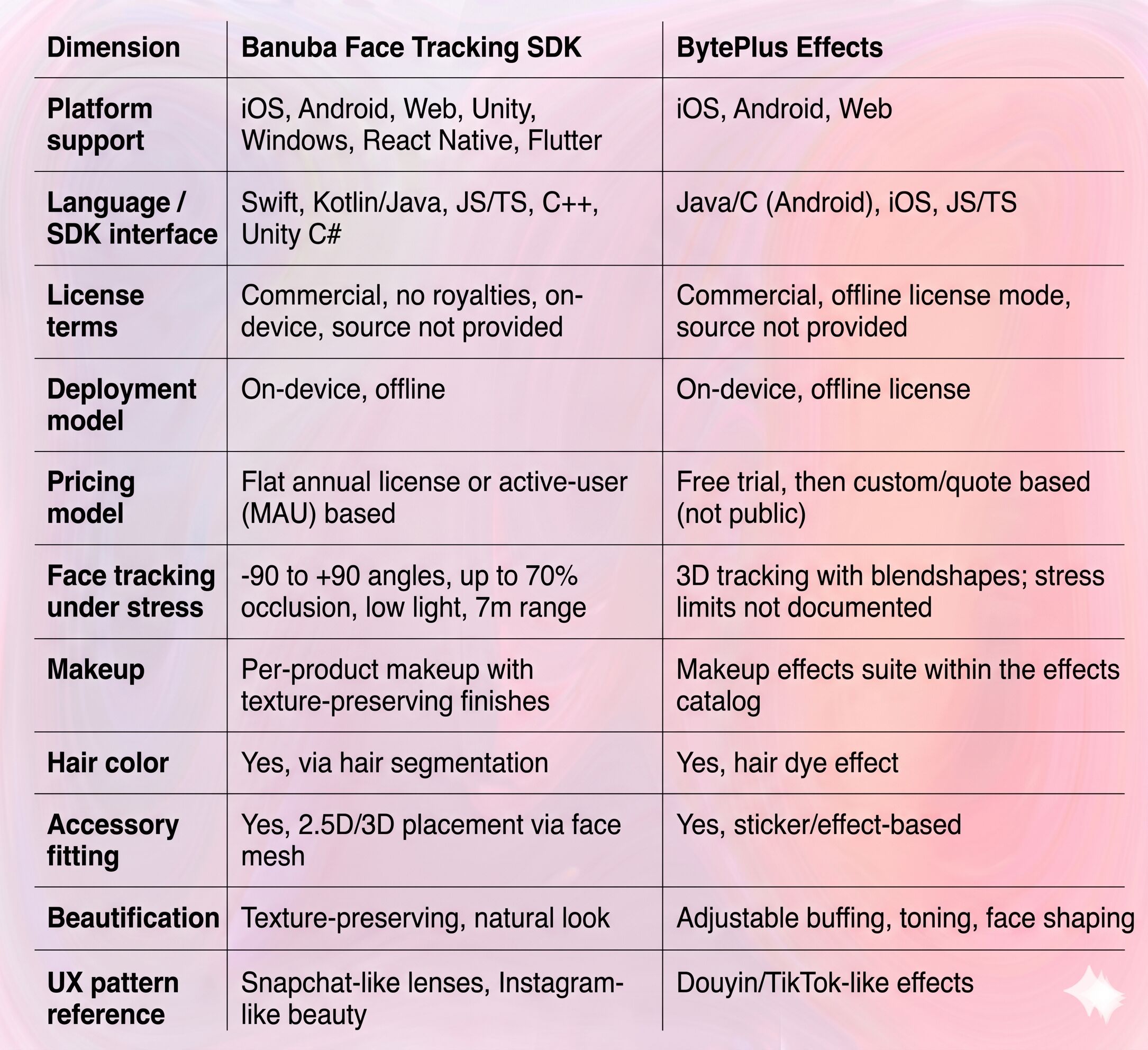
The pattern is consistent. Banuba publishes hard numbers for the stress conditions and builds its whole pitch around low-end reach. BytePlus leads on catalog breadth and ecosystem heritage, while its stress limits stay undocumented.
Which one should you choose?
Pick Banuba if tracking quality and cost control sit at the top of your list. It is the better fit when your users span budget Android phones, when you need on-device privacy, and when you want a flat license that does not grow with success. Banuba runs two models: a flat annual license with unlimited usage and predictable cost, or an active-user model that starts lower and scales with your base.
Pick BytePlus if your main need is a very large prebuilt effects library and you are comfortable with custom enterprise pricing and a vendor inside the ByteDance ecosystem.
Weigh four things before you commit: your user base's device mix, your stack (native versus React Native or Flutter), your compliance posture, and how predictable you need costs to be at scale. For most beauty, try-on, and creator apps with a broad Android footprint, Banuba's face tracking software is the safer production bet. Besides, you can start your no-commitment trial and see how Banuba’s face tracking matches your business needs.
References
Banuba. (2026). Face tracking software. https://www.banuba.com/technology/face-tracking-software
Banuba. (n.d.). Face AR SDK pricing. Retrieved June 3, 2026, from https://www.banuba.com/banuba-pricing-face-ar-sdk
BytePlus. (n.d.). Effects. Retrieved June 3, 2026, from https://www.byteplus.com/en/product/effects
BytePlus. (n.d.). Product overview: BytePlus Effects. Retrieved June 3, 2026, from https://docs.byteplus.com/effects/docs/product-overview
Grand View Research. (2025). Augmented reality market size, share & trends analysis report. https://www.grandviewresearch.com/industry-analysis/augmented-reality-market
StatCounter. (2025). Mobile operating system market share worldwide. Retrieved June 3, 2026, from https://gs.statcounter.com/os-market-share/mobile/worldwide
-
Look past the feature list and test behavior under stress: steep head angles, low light, partial occlusion, and low-end Android hardware. Then confirm on-device versus cloud processing, native and cross-platform coverage, and whether pricing is transparent. An SDK that only shines on a flagship in good light will disappoint a real user base.
-
Two models dominate. A flat annual license gives unlimited usage at a fixed, predictable cost. An active-user model bills by monthly active users, which starts cheaper and rises as you grow. Some vendors, including BytePlus, do not publish pricing and route everything through sales, so budget early.
-
If your growth lands on a wide range of Android devices, Banuba is built for that case, with Android face tracking tuned for budget chipsets and a flat license that keeps cost steady as users climb.
