

Buying wigs online has always been a leap of faith. Customers worry about fit, volume, hairline placement, color accuracy, and how a style will actually look on them, not on a model. This friction is the primary reason why wig retail has historically seen high return rates and lower conversion compared to other beauty categories. It’s hard to commit to a $500+ investment based on a static photo of a model who looks nothing like you.
That’s where virtual wig try-on for e-commerce changes the game. By combining augmented reality and AI, brands can let shoppers try on wigs virtually online, building confidence before checkout and reducing costly returns.
In this guide, we compare the best virtual wig try-on SDKs in 2026. This is not a list of consumer apps but a practical comparison for brands, developers, and product teams evaluating wig try-on SDKs for e-commerce use.
Quick Comparison: Top Virtual Wig Try-On SDKs
Below is a high-level look at leading virtual wig try-on SDK providers, ranked by overall suitability for e-commerce and enterprise use:
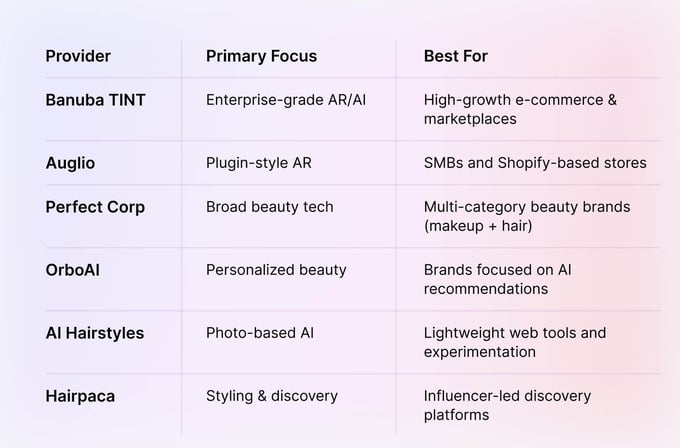
- Banuba TINT Virtual Wig Try-On: Best-in-class, enterprise-ready SDK focused entirely on high-fidelity AR/AI wig and hair try-on for e-commerce, marketplaces, and custom solutions.
- Auglio: A solid AR try-on platform with strengths in static and assisted shopping experiences.
- Perfect Corp (MakeupAR / AI Hairstyles): A comprehensive beauty-tech platform offering broader AI makeup and hair solutions, suitable for omnichannel beauty brands.
- OrboAI: A tool that specializes in AI beauty tech with a focus on hairstyle personalization.
- AI Hairstyles: A lightweight, photo-based option for quick virtual hairstyle experimentation.
- Hairpaca: A solution that focuses on personalization and wig recommendations.
Each one approaches AI wig try-on differently. Some emphasize realism, while others focus on personalization or fast deployment.
Virtual Wig Try-On SDKs at a Glance
What Is a Virtual Wig Try-On SDK?
A virtual wig try-on SDK is a modular software package designed for easy integration into web, mobile, or custom environments. It allows developers to deliver in-app try-on functionality without relying on external platforms or third-party workflows.
At a high level, augmented reality wig try-on works like this:
- Head & Face Detection: Identifying the user’s facial boundaries and head shape.
- Segmentation: Distinguishing between the user’s natural hair, skin, and the background (essential for "tucking" the natural hair under the virtual wig).
- 3D Rendering: Overlaying a digital 3D model of the wig that moves naturally with the user's head.
The business value is clear: by bringing the "fitting room" experience online, these SDKs dramatically reduce purchase uncertainty, boost buyer confidence, lower return rates, and drive higher conversion rates for e-commerce businesses. It’s not just about fun but about serious commercial impact.
Key Features to Look for in a Wig Try-On SDK
Choosing the right virtual wig try-on SDK for e-commerce can directly impact conversions, engagement, and returns. Since feature sets vary widely, prioritize these core elements:
- Realism and visual accuracy are non-negotiable. A virtual wig should appear natural, align perfectly with the user’s face, and closely match the real product. Prioritize SDKs with advanced rendering, lighting estimation, and hair physics that realistically capture movement and texture.
- Catalog flexibility directly affects scalability. The right SDK should confidently support a wide range of wig lengths, styles, colors, and curl patterns. High-quality texture rendering, whether for synthetic wigs, human hair, or lace-front designs, ensures every product looks true to life.
- Scalability is a core technical requirement. Evaluate whether the SDK can manage large SKU volumes with consistent performance, streamlined asset management, and minimal manual intervention when expanding the catalog.
- Integration depth is a key architectural choice. SDKs enable granular control over UI, logic, and branding, whereas plugins trade flexibility for convenience. For complex or enterprise environments, SDKs are usually the more future-proof option.
- Cross-device performance is a core benchmark. No matter the device someone is using, the try-on needs to feel smooth. A shopper on a flagship laptop and someone on a mid-range phone should both get a fast, responsive experience. That only happens when the SDK is well optimized and doesn’t push the device too hard or drain the battery.
Best Virtual Wig Try-On SDKs (A Deeper Look)
-
Banuba TINT Virtual Wig Try-On SDK
“When we built TINT, we weren't looking to create another 'fun' social media filter; we set out to solve the precision gap in hair e-commerce..” - Alex, Senior Product Manager at Banuba
When it comes to enterprise-grade virtual wig try-on for e-commerce, the Banuba TINT Virtual Wig Try-On SDK stands out as the most advanced and enterprise-ready solution on the market. Designed as an SDK-first, backend-driven platform, it gives brands full control over how virtual wig try-on software is implemented and scaled.
Banuba combines years of AR and AI expertise with high-performance face and head tracking, delivering realistic wig rendering that holds up across devices and lighting conditions. The solution is built specifically for commercial use, not demos or experiments.
Key strengths include strong realism, stable performance, and the ability to handle large wig catalogs without sacrificing speed. This makes it a natural fit for serious e-commerce operations.
PERFECT FOR: Online wig and hair retailers, from major e-commerce stores and marketplaces to DTC brands. It’s equally suited for teams developing custom beauty-tech solutions that require a lifelike, trustworthy try-on tool.
PROS: It looks real, runs fast on any device, and can handle huge catalogs with ease. The SDK lets you customize every detail, and the robust AR, AI, and backend support keep everything running smoothly.
You can learn more about how to integrate these capabilities by visiting Banuba's dedicated virtual wig try-on page.

-
Auglio
Auglio is widely known for its "Magic Mirror" plugin, which is a favorite for eyewear and jewelry. Their wig try-on software is the premier choice for brands that prioritize a fast, "out-of-the-box" setup over deep technical customization. While it may not offer the low-level backend control of a pure SDK like Banuba, it excels in ease of use for Shopify, WooCommerce, and Magento users.
PERFECT FOR: Smaller boutiques looking for an assisted shopping experience without heavy development.
PROS: Quick integration for standard e-commerce platforms. Plus, it includes Social Shopping (shareable try-ons) and Head Measurement tools to ensure the physical wig cap fits as well as the virtual one.
-
Perfect Corp
Perfect Corp is a well-established name in the beauty tech industry, known for its comprehensive suite of AI and AR solutions.Their AI Hairstyle and Wig tool is part of a massive ecosystem of beauty tools. It is incredibly feature-rich, often including hair color changing and skin analysis in the same package. While Perfect Corp offers strong AI capabilities for hair and makeup, its solution is broader than just wigs. This means it may not be as hyper-specialized in wig realism and scalability as a dedicated wig try-on.
PERFECT FOR: Brands looking to deliver a unified beauty try-on experience that includes makeup, hair color, and basic hairstyle previews across different platforms.
PROS: This is a platform that understands beauty. It’s designed for omnichannel use and adapts easily to different brand needs and customer touchpoints.
-
OrboAI
OrboAI focuses on AI beauty technology, emphasizing hairstyle and personalization strengths. Their solutions leverage artificial intelligence to help users visualize different hairstyles and potentially wig options. OrboAI's approach leans into personalization, offering tools that can suggest styles based on user preferences or facial analysis. While competent in AI-driven beauty transformations, its scope for virtual wig try-on remains somewhat narrower than the highly specialized, enterprise-scale solutions, particularly concerning the advanced rendering and diverse catalog handling crucial for large e-commerce wig retailers.
PERFECT FOR: Brands that want a more personal, concierge-style experience.
PROS: The AI does a good job by offering recommendations that surely make sense for the user instead of repeating the generic suggestions.
-
AI Hairstyles
AI Hairstyles is a lightweight, photo-based solution that allows users to experiment with different looks quickly. It’s easy to use and suitable for early-stage testing or content-driven experiences. For enterprise needs, such as real-time AR, large catalogs, or deep integration, it may feel limited. AI Hairstyles generally lack the real-time AR capabilities, high fidelity, and scalability required for enterprise-level e-commerce operations. They are more suitable for basic "what if" scenarios rather than providing a crucial, confidence-boosting step in a complex purchase journey.
PERFECT FOR: Marketing campaigns, social media lead magnets, and lightweight web tools where "fun" takes priority over "utility."
PROS: Very easy to implement. Works well for static photo uploads. Usually requires a simple API call or iframe.
-
Hairpaca
Hairpaca positions itself with a strong emphasis on personalization and recommendations within the hair try-on domain. Its core strength lies in helping users discover styles that might suit them, often through AI-driven suggestions rather than purely focusing on hyper-realistic AR rendering of specific product SKUs. While valuable for guiding customer choices and enhancing discovery, Hairpaca's approach prioritizes recommendations over the deep AR realism and precise product representation that is critical for reducing returns and increasing conversions for direct wig sales.
PERFECT FOR: Platforms that rely on community-driven style recommendations.
PROS: Great for trend-focused discovery. Great for converting "window shoppers" who aren't sure which style to pick. Highly accessible for brands that want an intelligent recommendation layer without a massive technical overhaul.
How to Choose the Right Virtual Wig Try-On SDK
Picking the right virtual wig try-on SDK for e-commerce depends on business goals as much as technology. Consider these decision points:
- Business Size and Scale: Before choosing a solution, it helps to be honest about scale. A niche boutique and a marketplace with thousands of SKUs face very different challenges, and larger businesses need technology with the backend strength to grow with them.
- Technical Resources and Integration Capability: Ask yourself: do you have developers who can handle a full SDK, or do you need something ready to go? SDKs let you customize everything, but they take more technical resources.
- Need for Customization and Branding: How closely should the try-on match your brand? Some SDKs let you fully customize the look and flow, while others follow a set template.
- ROI Expectations and Performance Metrics: What are your goals for implementing virtual try-on? Increased conversions? Reduced returns? You'll want an SDK that can deliver measurable improvements and maintain high performance to positively impact these metrics.
For most serious e-commerce businesses looking to maximize realism, scalability, and conversion rates, a dedicated, high-performance SDK like Banuba TINT will offer the most comprehensive and ROI-driven solution.
Use Cases for Virtual Wig Try-On
The applications for virtual wig try-on technology extend across various segments of the hair and beauty industry, transforming how customers discover and purchase hair products online.
- Wig & Hair E-commerce Stores: Customers enjoy trying before buying. When shoppers can try on wigs virtually on your product pages, they feel more confident in their choices. DTC brands and wig stores see the benefits too: more satisfied customers, better conversions, and fewer returns.
- Marketplaces: Big online marketplaces that feature multiple wig and hair brands can offer virtual try-on as a unified experience. It not only helps customers feel confident trying different styles but also gives all vendors a boost by showcasing their products in a modern, interactive way.
- Custom Beauty-Tech Platforms: If you’re developing a new beauty platform, these SDKs can be the building blocks for something really special. From virtual styling and color changes to personalized wig recommendations, they let you offer an interactive, one-of-a-kind experience.
Conclusion
The world of online wig shopping is changing fast. Virtual wig try-on is no longer a “nice-to-have” but a core tool for brands competing in the digital space. The SDK you pick will determine the realism of the experience, how smoothly your catalog grows, and the returns you see on your investment.
Giving customers the ability to try wigs virtually right on your site removes friction, boosts confidence, and drives more sales with fewer returns. Banuba TINT Virtual Wig Try-On SDK is one of the best tools out there, combining realistic visuals, enterprise-level scalability, and flexible integration that serious e-commerce brands will appreciate.
Ready to transform your online wig store? Explore the advanced capabilities of Banuba Virtual Wig Try-On and Camera SDK to elevate your customers’ shopping experience here and now.
Reference List
Aulas, C., & Harytonau, A. (2025, November 19). What is AR? Complete Guide to Augmented Reality Technology. https://www.banuba.com/blog/what-is-augmented-reality
Aulas, C., & Harytonau, A. (2026, January 9). Top 5 Augmented Reality solutions companies leading in 2025. https://www.banuba.com/blog/augmented-reality-technology-solution-companies
Charlton, A. (2022, February 24). All the Things That Drain Your EV Battery. WIRED. https://www.wired.com/story/ev-battery-drain-tips/
Chedraoui, K. (2026, January 8). I saw the future of AI-Powered beauty, and it told me I’m old. CNET. https://www.cnet.com/tech/services-and-software/i-saw-the-future-of-ai-powered-beauty-and-it-told-me-im-old/
Direct to Consumer: How the DTC model works in 2026. (2025, September 26). Shopify. https://www.shopify.com/blog/what-is-direct-to-consumer
Krasko, A. (2025, December 16). How virtual Hairstyle Try-On is revolutionizing ecommerce experiences. https://www.banuba.com/blog/how-virtual-hairstyle-try-on-is-revolutionizing-ecommerce-experiences
Musto, P. (2025, March 3). Why testing before launching is the new standard for marketers and creators. Forbes. https://www.forbes.com/councils/forbescommunicationscouncil/2025/02/25/why-testing-before-launching-is-the-new-standard-for-marketers-and-creators/
Soós, P., Krafčík, M., & Balawejder, L. (2022, April 6). The secret sauce of world’s leading virtual Try-On tool (VTO). News | Auglio.com. https://auglio.com/en/news/article/21-the-secret-sauce-of-worlds-leading-virtual-try-on-tool-vto
TED. (2024, October 4). The power of Personalization in the age of AI | Mark Abraham | TED [Video]. YouTube. https://www.youtube.com/watch?v=vNCVrtwrAWg
tint_landing_MAKEUP_300x400. (2025a, December 20). [Video]. https://www.banuba.com/solutions/e-commerce/virtual-try-on
Try before you buy: How it works with examples (2025). (2025, May 8). Shopify. https://www.shopify.com/retail/try-before-you-buy-programs